Showing posts with label Canada Fights Human Trafficking. Show all posts

Tuesday, December 27, 2011

Mickey Goodman: Actress Julia Ormond Speaks Out Against Human Slavery

http://www.huffingtonpost.com/Mickey-goodman/actress-julia-ormond-speaks_b_1128100.html

12/26/11 06:21 PM ET

Mickey Goodman


On an unseasonably blustery day in Atlanta, actress Julia Ormond's dark hair is pulled back in a jagged ponytail and she's clutching a loose sweater around her slender frame. She leans forward in her chair at Porsche headquarters and talks about her speech the night before to a group of women associated with Womenetics. Though her appearance is completely un-Hollywood, there's something decidedly magnetic about the beautiful actress who dazzled audiences inLegends of the Fall, The Curious Case of Benjamin Button and many more.

Once dubbed "the new Vivian Leigh," she portrays the famous actress in her current film, My Week with Marilyn. It is based on Colin Clark's memoirs, The Prince, The Showgirl and Me about Marilyn Monroe, Laurence Olivier and his real-life wife, Vivien Leigh.

But instead of dishing Hollywood gossip or talking about the new film, her topic was deadly serious -- human trafficking -- and the organization she founded, the Alliance to Stop Slavery and End Trafficking (ASSET) which is on a mission to find solutions. Thanks to Porsche's partnership withWomenetics, Ormond was brought to Atlanta to talk to women executives at the top rung of their corporate ladders, all associated with the organization founded by Elisabeth Marchant to empower women and their companies.
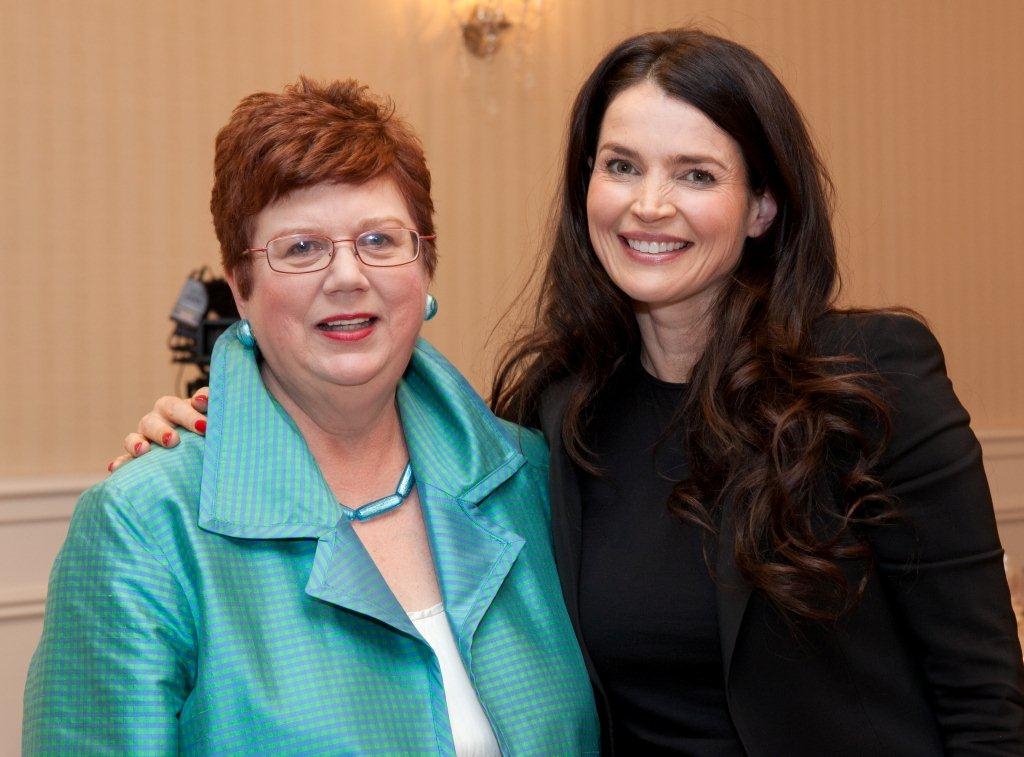
2011-12-04-JuliaOrmond.JPG

L to R: Elisabeth Marchant, founder of Womentics with actress Julia Ormond.
Photo by Paula Gould

"Do you want to know where human slavery is the worst?" Ormond asks. "It's in my own kitchen. The tomatoes on my counter were likely picked by people living in slave camps in Florida where 90 percent of the tomatoes are harvested. They end up in restaurant chains, grocery stores and our own tables."

According to Ormond, nearly all of the fresh foods we eat, the clothes we wear and the athletic gear we use are likely produced by slaves somewhere along the supply chain. "Without our knowledge, it's a problem that has received little, if any, scrutiny," she says. "If we don't deal with it now, the problem will only get bigger."

The statistics are appalling. The International Labour Organization (ILO) estimates that there are 12 million victims of forced labor worldwide of which 2.5 are trafficking victims. Half of those are underage. "But for every person forced into the sex trade, nine are forced to work in agriculture and manufacturing," Ormond says. It's common to use children in mines and fields, a number estimated at 200 million worldwide by the International Labor Organization (ILO). Corporations benefit by being able to offer lower prices. Reform has been far too slow, and consumers are largely left in the dark.

Until now.

Thanks to the efforts of ASSET and other nonprofits, there's been a breakthrough. On January 1, 2012, California will become the first state to enact a bill requiring companies with revenues of more than $100 million to publicly report on their websites voluntary efforts to monitor their direct supply chains to eliminate exploitation.

Named the California Transparency in Supply Chains Act of 2010 (SB 657), it affects 3,200 different brands doing business in the state. By visiting company websites, consumers can use their buying power to convince corporations that human slavery is bad for business.

But why would a Hollywood actress who continues to land plum roles get involved?

"While working in Eastern Europe, the issue of human trafficking kept popping up," says Ormond, a long-time activist. She couldn't get the problem out of her mind and decided to talk with survivors. "Hearing their stories was like walking through a tunnel of horror. I also talked with experts who were struggling to find systemic solutions -- not just something reactive like setting up shelters and refugee centers."

Out of those conversations came ASSET and an effort to bring all the stakeholders together -- government, law enforcement, non-governmental organizations, corporations and consumers. Since those associated with Womenetics are in positions to think about best practices in their own companies and strive to eliminate the use of forced workers, they are the perfect audience to effect change.

Although stopping slavery, whether sexual, agricultural, manufacturing or mining is definitely part of their DNA and one of the main reasons Porsche signed on as a major sponsor of Womenetics, their main focus is empowering women. "Companies that have women at the top get better results," says Marchant, whose decision to become a virtual organization was to focus on women around the globe.

The reasons can be counted in dollars and cents. In 2009, women became the majority gender in the workforce, topping 51 percent. Many are the sole breadwinner. They make 90 percent of the buying decisions in the household, control $12 trillion of the $18.4 trillion total global spending, generate $1.3 trillion in revenue, own 8.1 million businesses that employ 7.7 million people, and control 51.3 percent of private wealth (www.womenetics.com).

Because Atlanta is home to Porsche's North American headquarters and the geographic center for human trafficking in the United States, the company wanted to reach out to women like those associated with Womenetics who could take action. By bringing Julia Ormond to the city, they hope to raise awareness of this issue on a local and national level.


Enhanced by Zemanta

Saturday, October 1, 2011

“Innocence Lost” Sex Trafficking Task Force Rescues 3 Girls in SeaTac : SeaTac Blog

Source: SeaTac Blogby Greg Wright

SeaTac Police Captain Annette Louie confirmed this morning that SeaTac Sgt. Rich McMartin and his team participated in the joint police raid over the weekend that rescued three 15-year-old girls working as prostitutes in SeaTac. As is often the case with underage sex workers, the three had been coerced into the trade by unscrupulous adults–an offense that puts convicts in a Federal penitentiary for at least 15 years, Louie points out.

The FBI’s Innocence Lost Task Force, which is “aimed at addressing the growing problem of domestic sex trafficking of children in the United States,” acted as the main coordinator of weekend stings in the greater Seattle area, including specific locations in Shoreline and SeaTac, according to Louie. Local law enforcement agencies cooperate with FBI agents to execute raids planned by Innocence Lost. In the weekend operation in Seatac, officers from the Tukwila and Seattle police departments were also involved. On the SeaTac side, Louie said the department’s Street Crimes Unit–which includes McMartin and three detectives–”helped to coordinate the whole weekend.”

Louie is grateful for the help the Federal agency brings to the table in combatting sex trafficking–which is not only a national problem, but a global one. “The FBI is integral in that,” the Captain points out–a valuable “regional asset” for a small municipality with limited resources and budgets. According to Task Force site, over the last seven years, joint operations

have worked successfully to rescue more than 1,200 children. Investigations have successfully led to the conviction of over 600 pimps, madams, and their associates who exploit children through prostitution. These convictions have resulted in lengthy sentences, including multiple 25-year-to-life sentences and the seizure of real property, vehicles, and monetary assets.

Captain Louie also touts other local resources devoted to stemming both the tide and effects of sex trafficking.

The Genesis Project–which “exists to offer hope for a new life to young women and girls involved in Domestic Minor Sex-Trafficking (DMST) in the South King County area”–is one of those, and has been working with girls since 2009 to provide them with alternatives to jail time. In the past, prostitutes as young as 11 years old might be arrested and sent directly to juvenile detention centers. With facilities like the Genesis Project’s 24-hour drop-in center, girls rescued from the sex trade, have a process that treats them like victims rather than criminals. (The girls rescued over the weekend were returned to their parents.) As described by the Genesis Project website:

Phase 1: Rescue – Once rescued, victims will be able to utilize the 24 hour drop-in center to access hot meals, showers, laundry facilities, and a place to rest in a safe, stable environment. They will receive counseling and encouragement as well as access to any and all resources that are available through our other non-profit partners.

Phase 2: Renew and Restore – Referral to transitional housing that is already established. As funding is received we will build our own housing which will be long term and outside the normal areas of prostitution to offer normal living conditions in a loving environment.

Phase 3: Education and Release – After a victim has been enrolled in the long term housing we will offer them the option of taking classes from our educational faclility. This facility will offer them the ability to get their GED as well as other Job and life skill training. They will be able to choose something that they are passionate about and upon completion we will assist them in job placement. Once released, they will receive support from the Genesis Project for as long as they wish.

Another resource is Soroptimist, an international volunteer organization “raising awareness about the devastating and complex crime of sex trafficking, which largely affects women and girl children.” The Federal Way chapter is hosting a forum on human trafficking tonight in the Federal Way City Council chambers at 7 PM (33325 8th Ave. South). District 30 State Senator Tracey Eide, Chris Johnson (policy director for state attorney general Rob McKenna), Sr. Donna Freed of Sisters United Against Human Trafficking, Federal Way deputy police chief Andy Hwang, and Robin Schildmeyer of the Genesis Project are expected to participate.

Sex trafficking has been in the local and national headlines of late due to the controversy over online classified ad site Backpage.com’s “adult services” listings–which fail to screen out ads for underage girls and boys. As reported today on Publicola,

Backpage is in the midst of a game of legal chicken with Seattle Mayor Mike McGinn and a group of 51 attorneys general—led by Washington’s Republican AG Rob McKenna—who have all demanded Backpage shut down their escort ad section, or institute much stricter guidelines on the site to protect children from being exploited by pimps and johns.

Backpage responded to McKenna in a letter last week, declining to make any major changes to the site, and saying the company is already doing its “best to provide a sage and legal environment for its customers and to be a responsible corporate citizen.”

Village Voice, which publishes Backpage, has since early summer been editorializing against CNN, McGinn, McKenna, and other public officials for criticizing what Backpage sees as its right to free speech. As reported today by MyNorthwest.com‘s Dan Mitchinson, McGinn was feisty yesterday in the wake of the weekend’s operations:

“In light of Backpage.com’s response to the 51 attorneys general, I’d like to update you on our efforts to rescue children from being sexually exploited on Backpage.com,” said Mayor Mike McGinn. “On Thursday September 22, while Backpage.com was drafting its lengthy rationalization of their practices, our High Risk Victims Unit participated in a task force operation in SeaTac. We recovered three female children who were being advertised for sex on Backpage.com.”

McGinn says protecting exploited children is a top priority for the Seattle Police Department, but continues, “we can never get ahead of this crime while a company like Backpage.com profits from the sexual exploitation of children and uses their newsrooms to minimize the extent of the issue.”

Related articles
Enhanced by Zemanta

Thursday, June 2, 2011

She’s 10 and Now May Be Sold to a Brothel - NYTimes.com

KOLKATA, India

Damon Winter/The New York Times

Nicholas D. Kristof

M. is an ebullient girl, age 10, who ranks near the top of her fourth-grade class and dreams of being a doctor. Yet she, like all of India, is at a turning point, and it looks as if her family may instead sell her to a brothel.

Her mother is a prostitute here in Kolkata, the city better known to the world as Calcutta. Ruchira Gupta, who runs an organization called Apne Aap that fights human trafficking, estimates that 90 percent of the daughters of Indian prostitutes end up in the sex trade as well. And M. has the extra burden that she belongs to a subcaste whose girls are often expected to become prostitutes.

M. seemed poised to escape this fate with the help of one of my heroes, Urmi Basu, a social worker who in 2000 started the New Light shelter program for prostitutes and their children.

M., with her winning personality and keen mind, began to bloom with the help of New Light. Both her parents are illiterate, but she learned English and earned excellent grades in an English-language school for middle-class children outside the red-light district. I’m concealing her identity to protect her from gibes from schoolmates.

Unfortunately, brains and personality aren’t always enough, and India is the center of the 21st-century slave trade. This country almost certainly has the largest number of human-trafficking victims in the world today.

If M. is sold to a brothel, she will have no defense against H.I.V. and other sexually transmitted diseases. Decisions about using a condom are made by the customer or the brothel owner, not by the girl. In one brothel I slipped into to conduct some interviews, there was not a single condom available.

The police make more effort to help girls like M. than they did a few years ago, and in a column a week ago I described a police raid on a brothel and the rescue of girls inside ages 5, 10 and 15. Yet the police force’s progress is uneven, with one prostitute explaining why brothels hide young girls from police: “Because when the police come through, they confiscate the very young girls, and then the brothel owners have to pay a bribe to get the girls back from the police.”

Now at age 10, M. is running out of time. Her parents have pulled her out of her school in Kolkata and are sending her back to their native village hundreds of miles to the west.

“Our family situation is such that we have to take her back,” said her mother. She is vague about the reasons, except to say that the girl’s grandfather insists upon it. M. has a scholarship through New Light to study free in Kolkata, so the cost of M.’s education is not a factor.

This leaves Basu and me with an extremely bad feeling, fearing that once she is back in the village and away from her protectors at the New Light shelter, her grandfather could sell her to a trafficker for transfer to a red-light district anywhere in India.

When we ask M. what she thinks, she looks down and says in a small voice that she worries as well. But she says she will never give up: “I will not stop my studies,” she told me firmly.

Then again, she is unlikely to be consulted. And traffickers offer families hundreds of dollars for a pretty girl.

I’m here in Kolkata with America Ferrera, the actress from “Ugly Betty,” to film a television documentary. Ferrera fell in love with M., and M. with Ferrera; they spent much of their time giggling together.

“When I look at her, I see all the 10-year-old girls I’ve ever known,” Ferrera said. “She’s bubbly, silly, and optimistic. It would be heartbreaking to lose such a beautiful spirit to a life of violence and prostitution.”

Ferrera, Basu and I jammed into M.’s one-room shack to beg her parents to let her stay in school in Kolkata. “I’m pleading with you,” Basu said. “Let your daughter have this opportunity!”

We got nowhere. Her parents have bought M. a train ticket back to the village in a week’s time.

I don’t know how this will end up. Ferrera said she will be writing letters to M. in hopes that this may make her family nervous about a sale. And Basu is counseling M. on what to do if she is sold to a trafficker. We just don’t know what else to do.

What I do know is that it is surreal that these scenes are unfolding in the 21st century. The peak of the trans-Atlantic slave trade was the 1780s, when just under 80,000 slaves a year were transported from Africa to the New World.

These days, Unicef estimates that 1.8 million children a year enter the commercial sex trade. Multiply M. by 1.8 million, and you understand the need for a new abolitionist movement.

Source: NYTimes.com
Enhanced by Zemanta

Monday, February 14, 2011

Black Iris (Feat. Bethany Cosentino) – “When Will I Love” Video - Stereogum

MTV EXIT is a campaign to raise awareness & increase prevention of human trafficking in Europe and Asia. Since its launch in 2004, MTV EXIT has created various programs and activities that informed and empowered millions of young people both from source and destination countries about the issue and take actions within their communities.

Music collective Black Iris joined forced with MTV EXIT and Best Coast’s Bethany Cosentino to do “When Will I Love.” The song is about human trafficking, especially the human trafficking of young women, who are forced into prostitution or slavery away from their homes and families. MTV EXIT is MTV Europe’s anti-human-trafficking foundation. Check out the short song and awareness-raising video below:

MTV EXIT full version: "When Will I Feel Love" - Black Iris featuring Bethany Cosentino of Best Coast from MTV EXIT on Vimeo.


Wednesday, December 29, 2010

YouTube - Abolitionist - Aaron Cohen - Human Trafficking in The United States and Around The World


Human trafficking is a problem, not just in southeastern Asia or Cambodia, but also right here in the good ole' United States of America. The US is both a destination and a source location for human trafficking victims. Join Aaron Cohen as he investigates the global problem of human trafficking and modern day slavery. See the mass reunion of slaves in Sudan and children returned to their families in Haiti.

YouTube - Abolitionist - Aaron Cohen - Human Trafficking in The United States and Around The World
Enhanced by Zemanta

Friday, July 23, 2010

YouTube - DNA Welcome Message

DNAFoundation | June 22, 2010

Demi and Ashton hope to help abolish modern day slavery, punish perpetrators and free the many innocent and exploited victims. We hope you'll get involved and join us in the fight. If you'd like to make a donation to the DNA Foundation, please visit our Causes page: http://www.causes.com/causes/481816

You can also follow us on Facebook: http://facebook.com/dnafoundation Twitter: http://twitter.com/dnafoundation and at http://demiandashton.org


YouTube - DNA Welcome Message
Enhanced by Zemanta

Monday, June 28, 2010

Help Wanted: Hiring, Human Trafficking, and Modern Day Slavery in the Global Economy

Check out this report, Help Wanted: Hiring, Human Trafficking, and Modern Day Slavery in the Global Economy, prepared by Verite. The executive summary is reproduced below.

http://www.verite.org/wellmade/_pdfs/Help_Wanted_2010.pdf

Executive Summary

"Workers are at heightened vulnerability to modern-day slavery when they have been brought to work away from their homes. This vulnerability is generated or exacerbated by the involvement
of labor brokers. Labor brokers act as the middlemen, facilitating a connection between potential workers and their eventual employers.

The system of labor brokerage is widespread, opaque, sometimes corrupt, and largely lacking
in accountability. In some cases brokerages are substantial, well-organized companies. In others they are informal in their structure and outreach. In all cases their presence in the recruitment and hiring “supply chain” increases the vulnerability of migrant workers to various
forms of forced labor once on-the-job. The debt that is often necessary for migrant workers to undertake in order to pay recruitment fees, when combined with the deception that is visited upon them by brokers about job types and salaries, can lead to a situation of debt-bondage – which, according to Anti-Slavery International, is “probably the least known form of slavery today, and yet it is the most widely used method of enslaving people.”1

When a migrant worker finds herself in a foreign country, with formidable recruitment debt and possibly even ancestral family land hanging in the balance, on a work visa that ties her to one employer and a job that doesn’t remotely resemble the salary and conditions that were promised
to her by her labor broker, she has fallen into what Verité calls a HIRING TRAP. There are few global workplace problems in more urgent need of attention.

This report begins by offering key findings from recent Verité research on the intersection of brokers, migrant workers and slavery. This research was performed in a variety of sectors and locales across the globe, including: the migration of adults from India to the Gulf Cooperation
Council (GCC) States of the Middle East for work in construction, infrastructure and the service sector; the migration of children and juveniles from the Indian interior to domestic
apparel production hubs; the migration of adults from Guatemala, Mexico and Thailand to work in U.S. agriculture; and the migration of adults from the Philippines, Indonesia and Nepal to the Information Technology sector in Malaysia and Taiwan.

This report then presents the factors that, in Verité’s view, constitute the major red flags for vulnerability of migrant workers to broker-induced forced labor. These red flags were present individually or in various combinations across all the sectors and locales of Verité’s research. A set of concrete activities and engagements to promote the fair hiring of migrant workers is offered at the close of the report."

Enhanced by Zemanta

Tuesday, January 5, 2010

Group fights human trafficking - Brantford Expositor - Ontario, CA

A human trafficking awareness poster from the ...Image via Wikipedia

Posted By MICHELLE RUBY
Updated 2 hours ago

Naomi Baker of Brantford founded the organization Canada Fights Human Trafficking in the past year. < BRIAN THOMPSON The Expositor >


A city woman is dedicating herself to fighting human trafficking -- a devastating crime she says Canada is just beginning to tackle.

Naomi Baker was working with an American-based anti-trafficking group when she discovered how serious the problem was in her home country. Devastated by the knowledge, she established Canada Fights Human Trafficking about a year ago.

"The country is just coming to grips with the problem," said Baker.

According to an Organized Crime Impact Study commissioned by the Solicitor General of Canada, the impact of trafficking on Canada is estimated at between $120 million and $400 million a year and accounts for between 8,000 and 16,000 people illegally arriving annually in Canada.

Human trafficking is defined as the recruitment, transportation, harbouring or delivery of people for the purpose of slavery, sexual exportation and forced labour.

About 2.5 million people worldwide, mostly women and children, are believed to victims of human trafficking.

Baker said that, in Canada, a girl can be sold for $15,000 and earn her owner more than $40,000 a year. Although China, Romania, the Philippines and Moldova are the top four worst offenders in international human trafficking to Canada, many cases involve Canadian women and girls who are exploited in the sex trade.

"There is nowhere for these girls to go," said Baker. "They are victimized on every level - mentally, physically, sexually, emotionally, spiritually."

The not-for-profit Canada Fights Human Trafficking is an umbrella organization that brings together volunteers, philanthropists and nongovernmental organizations from across the country. The network can provide victims with basic needs: safe housing, clothing and medical assistance.

Baker, who launched the organization at the Sanderson Centre, says she has about 20 local volunteers working with countless others situated across the country.

"There is a huge need for our services," said Baker, who estimates she devotes more than 70 hours a week to work for group.

Advertisement

The woman who was the first documented human trafficking victim in Canada has become the group's education director and travels across Canada sharing her story and creating awareness about the flesh trade.

Although human trafficking officially became a crime in Canada in 2004, the first charge wasn't laid until May 2008. A 25-year-old former Toronto man, who made more than $400,000 selling two teenage girls for sex, received a five-year prison sentence.

"We are one of the only nations without a minimum sentence, even Thailand has one," said Baker.

Canada Fights Human Trafficking is a strong supporter of a private member's bill, introduced by Winnipeg MP Joy Smith, which calls for a minimum sentence of five years for those who traffic minors.

"Human trafficking occurs today throughout Canada," Smith says on her website. "Not only are women and young girls trafficked into Canada from abroad, but Canadian women and girls are also trafficked throughout our provinces and cities. Young aboriginal girls are especially vulnerable and are trafficked from their reserves to cities in Canada and the U.S."

Baker, who owns and has been operating Therapeutic Massage Counsel on Fairview Drive for the past 10 years, is seeking to get charitable status for her organization, a designation that would make it easier to raise funds.

"We have been fighting for a charitable number. They tell us we're too political, but we haven't dedicated any resources to political issues. Every time they deny us status, it puts more women at risk and our organization further in debt."

Without stable funding, Canada Fights Human Trafficking has, on several occasions, had to "issue a plea" for money in order to transport victims across the country, said Baker. The group is always looking for local volunteers.

"Kind people (have offered support). It's those people who are the heroes."

- - -

Want to know more?

For more information on Canada Fights Human Trafficking, go to canadafightshumantrafficking.com.

Donations can be made online or at 203-222 Fairview Dr., N3R 2W9.
Article ID# 2246343

Group fights human trafficking - Brantford Expositor - Ontario, CA


Reblog this post [with Zemanta]