Unprecedented Court of Women hears testimonies from the trafficked and sexually exploited
Nusa Dua, Bali (Indonesia), August 7
The jury deliberating on a most unusual trial - the first
South East Asia Court of Women on
HIV and
Human Trafficking in South East Asia - here have urged the governments, UN agencies, civil society organizations and others to urgently to address the vulnerabilities of women to trafficking and HIV.
However, these responses should be rights and gender-responsive and should not "re-victimise" the women who have been trafficked, they said. What is required are joint-efforts based on
human rights principles rather than inappropriate
law enforcement.
"The vulnerabilities of women to trafficking and HIV are rooted in the disproportionate human insecurity, poverty, illiteracy and disempowerment that they face in their daily lives," the Jury said in a statement issued at the end of the Court. In several countries, women who are trafficked are chased by the same law that is meant to protect them: they are treated as "illegal migrants" and "criminals" and are often denied their rights and choices.
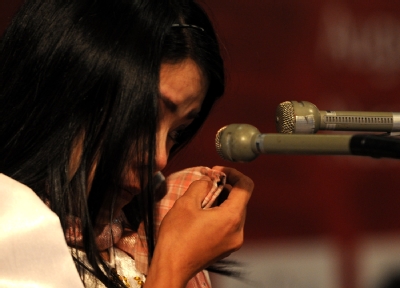
The jury of six eminent legal and human rights experts heard real-life testimonies in the Women's Court, including harrowing stories of trafficking, violence and exploitation. The Court provided a forum for women across SE Asia to share their personal survival stories and to create further awareness about trafficking, sexual exploitation, bonded labour, and HIV in the region.
Alongside the powerful and poignant testimonies of women who suffered at the hands of traffickers, "expert witnesses" presented data and powerful analyses to highlight the intense violation of dignity and rights of thousands of other women from South East Asia. The Court brought together leaders, politicians, activists and communities who are working to make a difference to empower women and reduce their vulnerability to trafficking and HIV in the South East Asia region.
The event was organised by the UN Development Programme (
UNDP),
Asian Women's Human Rights Council (AWHRC), and Yakeba, a Balinese NGO , with financial support from the Japanese Government and in partnership with UNODC and others.
Opening the court, Ms. Meutia Hatta, Minister for Women's Empowerment of Indonesia, said: "of the total number of people trafficked globally, one-third is from South East Asia and gender inequality and unequal power relations are the main fuelling factors for this phenomenon." In view of the seriousness of the issue, the Government of Indonesia enacted the anti-trafficking law in 2008. The spread of HIV in the region is increasingly impacting women 2-3 times more at risk of contracting HIV than men in the same age group.
In her key note address, Dr. Nafis Sadik, UN Secretary General's
Special Envoy on
HIV/AIDS in Asia and the Pacific region, said that trafficking was matter of legislation alone, though laws were essential. They should be drafted with due respect for human rights and there must be even-handed enforcement. "Too often, we find double or triple standards at work." She added: "the sex workers are endowed with the same rights as other human beings; and that coercion in all its forms, including trafficking, has no part to play".
The testimonies heard by the Court included:
* Wanta, a young Cambodian woman selling sugar care juice on the streets of Phnom Penh couldn't resist the lure of an overseas job that promised her a decent salary. Smuggled out of her country through the Cambodia-Thai border, she ended up in Malaysia as a bonded sex worker. After months in several brothels and a jail, she is now back in Phnom Penh, thanks to the intervention of an NGO. But with a battered past and HIV, life is a daunting struggle for her.
* Nitha from Indonesia took a job in the Middle East as a domestic worker, but faced extreme hardship and escaped, ending up in a detention centre in Jakarta. Unable to make both the ends meet, she tried for another job in another country. This time, the working conditions were worse. "They forced me to work without a break and withheld my pay frequently. I fell unconscious often. I was raped several times."
Speaking on the occasion, Mr. El Mostafa Benlamlih, UN Resident Coordinator for Indonesia and UNDP Resident Representative, said: "there are no borders between human trafficking, violence and
HIV/AIDS as there are no borders between nation states. When human insecurity and poverty thrive; migration, human trafficking, violence against women and HIV breed on each other." "Behind the voices of the testifiers at the Court, there is suffering of human beings, men, women and children; misunderstood, victimized, exploited, raped, infected, imprisoned, blamed and thrown at the margins of society."
"The timing of the Court is significant in that the current economic crisis has narrowed the opportunities for formal migration, making women in particular vulnerable to various forms of exploitation including trafficking. What is needed is collective and inclusive responses, given the diversity of views that exist on the issue," said Mr. Jeff O'Malley, Director, HIV/AIDS Practice, UNDP, New York said. The Court has brought together these critical views and has made an affirmative move towards joint efforts against trafficking and HIV that build on human rights principles and empowerment strategies, rather than inappropriately using only law enforcement, he added.
"In addressing the dual challenges of human trafficking and HIV, we need to ensure that the voices of women who are most affected are heard. The Regional Court of Women in attempting to bring such unheard voices to the public domain is laudable," said Christian Kroll, Global Coordinator of HIV/AIDS, UNODC.
"We need to urgently shift the deeply embedded norms, attitudes and behaviours that socially sanction unspeakable forms of violence against women. Rampant human rights violations, gender inequality, severe deprivation and unsafe migration; which create a fertile environment for trafficking of women are the same factors that increase their vulnerability to HIV, Ms. Caitlin Wiesen, Regional HIV Practice Leader, Asia Pacific, UNDP, said.
Ms. Corinne Kumar, International Coordinator, Courts of Women, said: "in its experience of a new imaginary, the Courts of Women are finding different ways of speaking truth to power; but also speaking truth to the powerless, seeking the conscience of the world, creating other reference points than that of the rule of law, returning ethics to politics."
The eminent jury included Hon. Mieke Komar Kantaatmadja (Supreme Court Justice, Indonesia), Prof. Vitit Muntarbhorn (Prof. of Law and Former UN Special Rapporteur of the Commission on Human Rights on the sale of children, child prostitution and child pornography, Thailand), Marina Mahathir (Steering Committee Member, Asia Pacific Leadership Forum on HIV/AIDS and Development, Malaysia), Annette Sykes (Lawyer, New Zealand), Sylvia Marcos (Director, Center for Psycho-ethnological Research, Mexico), and Esperanza I. Cabral (Secretary, Department of Social Welfare and Development, Philippines).
http://www.unodc.org/unodc/en/human-trafficking/court-of-women.html




![Reblog this post [with Zemanta]](http://img.zemanta.com/reblog_e.png?x-id=34186fe0-0582-4c9c-80c6-bb33f20cd33a)
![Reblog this post [with Zemanta]](http://img.zemanta.com/reblog_e.png?x-id=4b1080d3-a82a-48c4-b2ce-73e2ed58af89)
