
Showing posts with label Jiangsu. Show all posts

Friday, February 11, 2011

Chinese parents turn to microblogging in hunt for missing children | World news | The Guardian

Call for internet users to post pictures of street children results in huge response – and abducted boy being reunited with his father
  • guardian.co.uk,
  • Article history
  • Kidnapped boy called Yang Weixin found begging on street
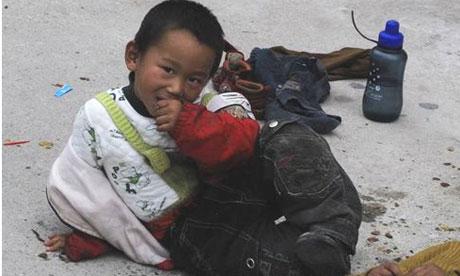
    A kidnapped boy called Yang Weixin found begging on a street. Chinese authorities recorded 5,900 trafficked children last year. Photograph: Sina.com It began with a letter from a desperate mother. It has become a campaign embraced by tens of thousands of internet users – which appears to have resulted in at least one happy ending. A Chinese activist's attempt to track down a missing child via microblogs has highlighted the problem of trafficking in the country and helped attempts to reunite thousands of lost children with their parents. Yu Jianrong urged internet users to take pictures of street children and upload them on to Sina – the Chinese equivalent of Twitter – after a mother asked for help in finding her son. The resulting movement has demonstrated the power of social media on the mainland, even in spite of the extensive censorship of services such as Sina. China has 80 million microblog users in addition to a relatively small number who bypass censorship to access Twitter, which is blocked by the authorities. Yu's campaign gathered pace over the Chinese new year, traditionally a time for family reunions, and within days has garnered more than 100,000 followers who uploaded more than 1,800 images. Chinese authorities recorded 5,900 trafficked children last year. Previous reports suggest most are boys under five, often sold to rural families who want a son but in other cases forced to work as beggars. Parents have previously used the internet to post images of their missing children on sites such as Baby Come Home, hoping that someone might spot them. But it took the initiative by Yu, a professor at the Chinese Academy of Social Sciences, to create a wave of interest both online and in China's mainstream media. Amid the publicity, a student browsing pictures of missing children spotted one he was sure he recognised: Peng Gaofeng's six-year-old son, Wenle, snatched from a street in Shenzhen, Guangdong province, three years ago. Peng and his wife had plastered their business with posters of Wenle and offered a 100,000 yuan reward – a huge sum for Chinese workers – to anyone who could help find him. Having had his hopes dashed repeatedly, Peng was stunned to receive an emailed photograph of a little boy in Jiangsu province and realise it was indeed his son. Police helped him to track down Wenle, who told an officer: "That man who is crying is my dad." Peng told China Daily: "It's a miracle, a miracle that could not be true without the help of netizens. I've opened 13 blogs on the internet and pasted my son's photo everywhere online. Now, the efforts have paid off." He said he believed Wenle was abducted by the late husband of the woman with whom he had been living as an adopted son. Parents have often complained of police inefficiency and indifference when their children have gone missing. But the authorities have stepped up efforts in the last two years and Chen Shiqu, head of the country's anti-trafficking unit, used his own microblog to urge people to support Yu's campaign. Last September, Xinhua reported that Chinese police had freed 10,621 women and 5,896 children since a crackdown began in April 2009. The public security ministry said it had also improved measures to reunite families, building a DNA database that has so far matched 813 children and their parents. In many cases, children are snatched as infants or toddlers, meaning they are too young to remember their parents and may be less recognisable. One mother faced disappointment this week after wrongly identifying a child beggar as her missing son. He had been photographed with a man in Zhuhai, but DNA tests showed the two were father and son, said police. Parents lucky enough to find their children still have to deal with the long-term consequences. Wenle appears to have grown attached to his kidnappers and be reluctant to leave. His father said his son was healthy and doing well at school, but added: "My only concern is that he will not want to come home. This change will probably be more traumatic for him at this age than his kidnapping when he was three."
Source: guardian.uk.com


Chinese parents turn to microblogging in hunt for missing children | World news | The Guardian
Enhanced by Zemanta

Thursday, July 22, 2010

AFP: Japan's trainee programme 'human trafficking': lawyer
The crest for the Japanese GovernmentImage via Wikipedia

TOKYO — A Japanese human rights lawyer Thursday labelled a government-backed foreign trainee programme as a "form of human trafficking", saying dozens had died from apparent overwork.

Japan has invited tens of thousands of foreigners for industrial training programmes as low-wage apprentices, mostly from China, Indonesia and the Philippines, since the 1990s, officially so they can learn new skills.

"There is a huge difference between the purpose of this system and the reality," said Lila Abiko of the Lawyers' Network for Trainees in Japan.

"The purpose they say is the international contribution through transferring technologies through the person from a developing country. But actually this system functions to receive cheap unskilled labourers and exploit them."

The Japanese government, which allows little immigration of unskilled workers, started the trainees' programme in 1993, after the world's second-largest economy dived into a serious downturn.

Amid rising concern over abuses, the lawyer said that a record 35 workers from Asia had died in Japan in the year to March 2009 alone.

The Japan International Training Cooperation Organization (JITCO), which oversees the programmes, had said last year that of these 16 had died of heart and brain ailments, five in workplace accidents and one had committed suicide.

A JITCO spokesman was not immediately available for comment.

The following year, 27 deaths were reported, including nine from heart and brain ailments and three suicides, Abiko said.

This month a Japanese labour office for the first time recognised that a Chinese intern employed under the programme had become the victim of what in Japan is called "karoshi" or "death through overwork."

Jiang Xiao Dong, 31, from Jiangsu province died after a heart attack in June 2008 after working more than 100 hours overtime the month before at a metal processing firm northeast of Tokyo.

Abiko, who represents Jiang's family, said one of his time cards showed he had worked 350 hours in November 2007 alone.

She said many of the interns had paid high deposits in their home countries, often equivalent to several years' income, to unauthorised local brokers who helped them register for the programme and travel to Japan.

"I think this is one form of human trafficking, especially when they are seized by the throat because of the deposit," she said.

One Chinese trainee, Li Quing Zhi, 34, said he came in 2007 to learn Japanese cooking but instead did manual work at a manufacturing workshop at minimum wage, working 150 hours of unpaid overtime a month.

After repeated complaints he was fired in March, leaving him stranded.

"I cannot go back to China without getting the payment that I deserve," said the man, who said his wife and two children are waiting for him.

Jorge Bustamante, UN special rapporteur on the human rights of migrants, issued a warning in April about the trainee programmes.

The Justice Ministry was not available for comment when contacted late Thursday by AFP.


AFP: Japan's trainee programme 'human trafficking': lawyer
Enhanced by Zemanta