Showing posts with label Sex Trafficking: Inside the Business of Modern Slavery. Show all posts

Tuesday, December 14, 2010

Slavery, the bottom line - The Boston Globe

f we want to stop slavery, argues Siddharth Kara, we need to treat it as a business

By Katie Bacon December 12, 2010

While it’s tempting to think of slavery as existing only in history books, the modern slave trade is booming. More than 27 million people are enslaved around the world, doing work for no pay as prostitutes, farm laborers, factory workers, or domestic servants, according to the advocacy group Free the Slaves. In fact, advocates believe the pace of enslavement has increased during the past two decades as the price of slaves has decreased — pushed along by globalization, higher poverty levels, and crumbling national borders.

Author Siddharth Kara Author Siddharth Kara

A decade ago, Siddharth Kara, a former investment banker with a law degree and an MBA, had an insight: Slavery was primarily a business, and no one had done a comprehensive, strategic analysis of how that business worked. So he set out to understand the inner workings of the business models for three broad categories of slavery: human trafficking, forced labor, and bonded labor. He has visited 20 countries and interviewed more than a thousand current or former slaves, finding them in tea fields in Bangladesh, carpet factories in India, sex clubs in Moldova, and massage parlors in the United States.

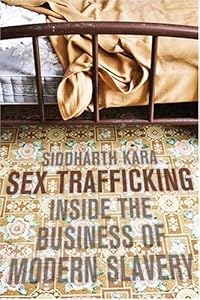
He’s writing a series of three books on the subject; the first, “Sex Trafficking: Inside the Business of Modern Slavery,” came out last year. Modern sex trafficking, Kara concluded, is one of the most profitable businesses there is: He calculates its average profit margin at 70 percent. (By way of comparison, a top-performing company like Google has a profit margin of under 30 percent.) Traditionally, sex trafficking has been treated as a human-rights issue, and fought by addressing the poverty and gender inequality that make people vulnerable to being enslaved in the first place. But Kara believes that an economic approach is the most efficient way to undermine the industry.

Kara will soon bring his approach to the Kennedy School, where he’s helping to build a think tank on slavery and human trafficking, and where he spoke earlier this month at a film forum on human rights and sex trafficking. This interview was condensed from two separate conversations with Ideas.

IDEAS: Why is sex trafficking best fought as a business?

KARA: Contemporary forms of slavery...all function on a simple economic premise: maximize profit by minimizing or eliminating the cost of labor.

IDEAS: So what’s the business model?

KARA: The business model contains three essential steps: acquisition, movement, and exploitation. Sex trafficking is probably the most profitable form of slavery the world has ever seen, in that you can acquire or transport someone for a few hundred dollars, maybe a couple thousand dollars, and generate tens of thousands, if not hundreds of thousands....That’s the essential functioning and logic of the business model: low cost and risk to transport the slave, and immense profitability on the exploitation side.

IDEAS: What is the difference between this and typical prostitution?

KARA: Some people will argue that the difference is very slim. But in general you could construe sex trafficking as the profit-maximizing version of prostitution.

IDEAS: If it’s an international trade, what are the trade routes?

KARA: I’ve tracked down...routes from Central and Eastern Europe into Western Europe but via North Africa, and...throughout South Asia into India and vice versa. Literally you can’t find anyplace that isn’t connected to another in terms of contemporary human trafficking. And they’re increasingly sophisticated: multiple stops in multiple countries, as these organized crime groups further evolve the modes and means through which they can move and exploit human beings.

IDEAS: How do you go about disrupting the business?

KARA: The minute [you] pull someone out of a sex slave condition, [you’ve] cut off all future cash flows. In terms of a sex slave it’s 10, 15, 20, transactions a day, a week, a month, year after year. You’ve got to pull people out, care for them...and then prosecute and convict effectively. That means several things: fast track courts, judicial review, and an economic penalty regime that makes it uneconomic to be in this business. If you start to alter the landscape, then the perception by the offender is: This business doesn’t pay. Right now the perception is: Huge profit, almost no risk, I’m there. This is about money: It’s not cruelty for the sake of cruelty. I’ve met traffickers. Some of them are just mundane opportunists.

IDEAS: What about the customer side? How do you reduce demand?

KARA: Depending on which country you’re in, it takes 1.5 to 2 hours of work at that country’s per capita income to purchase 1 hour of sex from a sex slave. So you ask yourself, How many males will trade in 1.5 hours of salary to purchase sex? A huge number. If we were to revert back to where prices were a decade ago, by putting more cost and risk into the system...you [would] see a massive decrease in demand, because you’ve priced out of the market those low-wage consumers — like day laborers, taxi drivers, and tuk tuk drivers — who are now in the market.

IDEAS: Have you seen this kind of business-focused approach work against other crimes?

KARA: There’s no easy analogue to this crime. On the side of the offender, human sex trafficking is a very economically driven crime, but it’s also the aggregate of some of our most barbaric criminal offenses: rape, torture, abduction, battery, assault, administering noxious substances, homicide. The fact that the penalties for the crime of sex trafficking are largely less than the penalties against some of these individual components is mystifying. At many levels we still haven’t grasped how this crime works, as an offense against a human being and as a business. And this is why the design of our responses has been severely lacking.

IDEAS: Should we shift resources away from more traditional ways of fighting the trade, such as alleviating poverty or fighting gender discrimination?

KARA: I don’t think so. I’ve run the numbers and my plan would probably cost about $400 million a year, and I think we should probably do this for at least 10 years. This is leveraging what’s already in place and what’s already being done. The resources are out there. It’s just a matter of priority.

IDEAS: What will it take to bring that kind of focus on the problem?

KARA: What the field needs is what other human-rights fields have:...highly trained economists, legal scholars, sociologists and anthropologists, experts in gender, child rights, et cetera, deploying their minds in a dedicated way to this issue. I think that’s starting to happen.

Katie Bacon, a journalist and editor based in the Boston area, has written for The New York Times, TheAtlantic.com, and other publications. 

Source: The Boston Globe

Slavery, the bottom line - The Boston Globe

Enhanced by Zemanta

Friday, August 6, 2010

TED Blog | Fellows Friday with Siddharth Kara


  • 06 August 2010

    Siddharth Kara fights bonded labor, forced labor, and human trafficking with what he says are the most effective weapons against them: rigorous scientific research and analysis. Read his interview below to learn why dispassionate study may be the antidote to this inherently emotional issue, and why Siddharth is optimistic about the direction of the anti-slavery movement. Click here to follow his updates on CNN.com as he travels South Asia investigating labor exploitation.

    Tell us about your research.
    I’ve been researching modern slavery of all kinds for about ten years. I’ve now covered six continents and 18 countries, and I’m writing a series of three books on the subject. I’m putting forth what I think is the first real, strategic, comprehensive, global analysis of the phenomenon. This means not just anecdotes and a superficial or sensationalistic look at slavery, but really trying to dig in to understanding how this is all working in the global economic context, in the global legal context, and what are the various business models of labor exploitation? Are there weak or vulnerable points in those models that may be susceptible to the right kind of tactical policy or legal intervention?

    There are three categories of slavery I’ve broadly identified: bonded labor, forced labor, and human trafficking. I’m covering these three subjects somewhat in the three books. The first book [Sex Trafficking: Inside the Business of Modern Slavery] actually focused on a subset of human trafficking, which is forced prostitution. That came out last year. My next book will focus very much on the bonded labor category. And the third book will kind of cover the rest.


    What approach do you take when writing your books?
    All three books tend to be based on analysis and reliable data and research. You see, slavery and labor exploitation are inherently sensational to begin with. When you hear stories of men, women, and children being coerced against their will to perform some labor or service, certainly the most extreme cases of that kind of exploitation are already sensational. They’re already shocking to us. And unfortunately, in the ten years that I’ve been doing this research, there’s really been a limited amount of progress in both knowledge and efficacy to fight the phenomenon.


    This is primarily a result of the focus on the sensational. People, whether knowingly or unknowingly, leverage that quality of the issue for their own good — be it fundraising for their NGO, selling books and stories, making movies. Whatever taps a human nerve can also be very marketable.

    You see a lot of data and information being thrown around — numbers and statistics. But if you ask those people, “Where did that come from?” they can almost never explain it to you. And efforts to galvanize a grassroots global movement of every day citizens to combat the issue have tended to fragment and falter because after that initial wave of agitation and worry learning about slavery creates, without a comprehensive and specific plan driven by good analysis, people lose their interest.

    So what I’m trying to do is very much shift the paradigm to focus specifically on starting with the analysis and then saying “What does this tell us? What recommendations can we make that are based on analysis?” It’s fortuitous for me that my background is in economics and law because I think these are the two most important disciplines when it comes to understanding labor and labor exploitation.

    Slavery has always been an economic crime. Of course it’s an abhorrent human rights violation. But it’s fundamentally an economic crime: it seeks to maximize profit by minimizing or eliminating the cost of labor. That’s been the formula for millennia. It hasn’t changed from 2,000 – 3,000 years ago or more to today. Now, the modes and means and sophistication and complexity and profitability of that formula have certainly changed. But the formula has remained the same.

    You mentioned trying to find and target vulnerabilities in the business models of slavery. Can you talk about what those might be?

    Well, it depends very much on which form of slavery you’re talking about, because the business model of various forms of labor exploitation are very different. So, let’s look at the example of sex trafficking. The key thesis that emerged from my analysis is that the enormity and pervasiveness of the global sex trafficking industry and its rapid growth across the last 20 years is driven by its ability to generate immense profit at almost no real risk.

    The business opportunity that is presented to the criminal is the following: you can generate tens if not hundreds of thousands of dollars per slave, per year, through the exploitation of a trafficked sex slave. The average price it will cost you to purchase or acquire and transport that slave is around $2,000. That’s the immense profit side of that key thesis I articulate.

    Then there’s the no real risk side of the thesis. What are the penalties? Slavery is not legal anywhere in the world. But, depending on where you are in the world, the penalty ranges from little to none. There are many countries in which there’s no economic penalty stipulated in the law, or only a very small one. There are countries where there’s a very large economic penalty, but these crimes are almost never prosecuted and convicted. So the real penalty is still basically zip.  There are always provisions for incarceration, but if — and these are big “if’s” — if you get prosecuted, and if you get convicted, jail times are relatively short.

    Well, criminals, like the rest of us, are what an economist would call “rational economic agents.” And this is a very compelling economic opportunity. So as long as that reality prevails, individuals — rational economic agents — who lack any moral sensibility will flock to the opportunity of exploiting an individual as a slave in forced prostitution, in this case.

    So, now we know how the business works. What’s the actual business model? Well, people are acquired from a certain area through various means — deceit, fraud, coercion and whatnot. They are moved a distance near or far, and then coerced and forced — through violence, threat of violence, torture, starvation, humiliation, and rape — to engage in commercial sexual activity. That’s where the money center is.

    Are there vulnerable points in this business model that I very briefly described? Can we intervene at the point of acquisition, movement, or exploitation?

    Well, it’s too inexpensive to move people, it’s too easy, they’re almost always using legitimate documents now, so it’s very difficult to identify them, and if you try to cut off one route, well, they’re very practiced at redirecting somewhere else. Borders between countries tend to be porous and unguardable. Movement, I argue, is not the vulnerable section.

    What about acquisition? Well, there are 2.5 billion people in poverty, there are 30 million people who are displaced due to war or environmental disaster, there are hundreds of millions of people living in economies that are corroding or societies that are unsafe, corrupt, lawless, etc. Can we solve all those problems and intervene at acquisition? All those problems should be solved, but I don’t think we’re going to solve those in the near future. But this is where NGOs tend to focus. This is what makes obvious sense to anyone. All right, let’s solve poverty. Let’s deal with gender bias. Let’s deal with refugee status and all that, because that’s the low-hanging fruit intellectually.

    It’s much harder to analyze the business model of what I’ll get to next, which is the exploitation side. I argue yes, we need to deal with the acquisition, the supply-side forces, but this isn’t going to happen in the near term. Let’s be realists. We’re not going to solve poverty and bias against women tomorrow. Or even 10 years from now. Or even 50 years from now. What does that leave us with? It leaves us with the point of exploitation. Where the actual business is happening. And fortunately, there are vulnerabilities here.

    You’ve got brothels, hotels, parlors, street corners, apartments, clubs — these are the typical venues where individuals are exploited in commercial sex. Consumers come to these places in broad daylight — if I can
    track them down, anyone can — and make the purchases multiple times a day — globally, millions of times a day.

    There are vulnerabilities here that can be exploited, in that it’s occurring in relative daylight. It happens millions of times a day. The locations in which it happens are relatively fixed, and you can’t go too far underground because consumers aren’t going to follow you there. And other reasons why this is the vulnerable point, where if you intervene intelligently and carefully, you can not only liberate the slave, which means you also cut off all future cash flows, but you can gather the requisite evidence and information required to successfully prosecute and convict, which elevates the real risk.

    So there you are attacking profits and elevating risk, which is inverting that compelling formula we talked about. So this is the argument I make, based on understanding how it works, of what should be done, to more effectively respond.

    Now, other forms of slavery will be different: debt bondage in the brick kiln industry, forced labor in child soldiers, etc. Different business models, different economics, and different vulnerable points. Looking at each of them will yield the right response.

    You’ve proposed a think tank on labor exploitation. Why is creating a think tank for this issue important?

    Because each type of slavery requires a different answer, and because it’s a complex phenomenon that resides at the center of a whole host of issues relating to human rights, to global economics, to law, etc., I’ve argued and suggested that the best way to continue advancing knowledge and effective research and ultimately response to the phenomenon is to create a multidisciplinary think tank of individuals — economists, lawyers, sociologists, law enforcement, human rights, NGOs, etc. — who can bring their respective areas of expertise to this phenomenon to analyze it, and then to create a fully comprehensive suite of research and recommendations on how to respond effectively to each type of slavery in each region around the world.

    My suggestion was taken quite seriously by folks at Harvard and the Kennedy School of Government, and we’re setting the think tank up presently. The idea is to set up a multidisciplinary, world-class, Harvard-caliber research program on this issue.

    How has TED Fellowship impacted you and your cause?

    The TED Conference has helped in that for a couple of conferences in a row, they’ve had someone who’s talked about this issue or known about this issue. If I could offer a subtle critique of the TED Conference, I’d say that they’ve probably focused a bit on the sensational, but that’s important in terms of raising awareness, and that’s what TED talks can do.

    But at TED you also have a very invested and captive audience of very intelligent people. Really successful, intelligent people, who I think would certainly appreciate and benefit from more strategic or rigorous analysis and suggestions of what to do.

    I had conversations offline with a lot of people at TEDIndia who said, “Boy, we really wish we would have heard from you, because that’s real analysis. That’s a real argument. I know what to do now.” Long before me, though, Ruchira Gupta up in Delhi, who won the Clinton Global Citizen award last year for her work with slave trafficking in India, should be a TED speaker. She’s a remarkable, remarkable woman — brilliant and passionate and intelligent and analytical.

    Some of my other Fellows, people who had done very innovative things, created new products, responded to a problem in a new and innovative way. That’s exactly what TED is brilliant at. But they haven’t quite got it right with the human rights side, at least with slavery so far.

    How did you get involved with this issue?

    I worked at a refugee camp in Yugoslavia as an undergrad. The conditions in the camp were miserable.  I lost 18 pounds and heard countless tales of heartbreaking atrocities, some of which involved Serb soldiers who raided Bosnian villages, executed the men, rounded up the women and female children, and trafficked them to brothels across the region. It took me a few years to process these experiences. I was an investment banker in New York at Merrill Lynch, and then I set that work aside because I had this idea that, “Gosh, this is terrible, all these things are happening but I see very little real, good analysis” — and this was back in 2000, so you can only imagine back then there was really not much going on — “Maybe there’s a way for me to apply my background in a form that would be more useful to someone besides me and myself and my paycheck at Merrill Lynch.”

    So I started the campaign of self-funded research around the world. Very tentatively at first just trying to understand what’s going on, and the more I learned, the more people I met at NGOs of which there are obviously many extraordinary ones and people doing tremendous work, and they proved invaluable to me: their knowledge and access to the areas where I just couldn’t have gone otherwise.  The more I learned, the more I realized, “You know, I might be on to something here.”

    As I did more and more research and started to speak about what my kind of approach was, it caught the interest of people and politicians and lawmakers and whatnot. I was asked to testify in front of Congress in 2005, so five years after I started. Then I got the offer from Columbia Press for the three books, was asked to sit on a few boards, and really started picking things up in terms of my research and writing. Still of course doing other work on the side because this isn’t my career, but it’s something I’m passionate about.

    Besides speaking with police, lawyers, and judges, and confronting traffickers and slave owners, you’ve also interviewed more than 500 slaves. How do you go about doing this?

    I’ve never pretended to be interested in buying a slave. In terms of researching sex trafficking I’ve gone into venues and certainly pretended to the proprietor to be interested in a certain type of purchase, but then once speaking to someone, I said, “Look, this is who I am, I’m a researcher, I’d be interested to speak to you, but if you don’t feel comfortable that’s fine, I’ll turn around and walk out.” And nine times out of 10 that’s how it happens. One time out of 10 I have a short conversation, and sometimes a slightly longer one. Most of the long interviews are of course in shelters. And again that’s where NGOs are so invaluable to the kind of work that I and other researchers like Kevin Bales do. You can’t get the kind of information that is needed without those NGOs. But what I’ve really then focused on is understanding the business model and the economics. Because I think that’s where the answer is.


    Siddharth Kara interviewing bonded laborers in northern India

    But with other types of slavery it’s very different. When you’re researching child labor at carpet looms you’re going into clandestine looms and trying to get information as quickly as you can before the slave owner gets back. You know, people get killed. People have been killed. People I know have been killed doing that kind of work. Or severely injured.

    This is such a difficult issue to be immersed in all the time. How do you deal with coming face to face with these horrors?

    In the beginning when I started my research, Kevin Bales of Free the Slaves was a real mentor to me, and he’s certainly encountered a lot of slavery in his time as well. And he’s the first one who pointed out after some of my research trips, he said, “You know, you may be suffering from PTSD. I certainly did after some of my research.”

    I find that working helps. Like, sitting down and running my numbers. Or writing. Editing, running some numbers in a spreadsheet. Kind of diving into that minutia helps, believe it or not. Using that other side of your brain that doesn’t store all these dark memories and encounters. Other things, simple stuff like going to the movies, I really enjoy SCUBA, so I do that now and then, all the time I can get with my wife. That’s always rejuvenating.

    Are there reasons to be optimistic about this issue?

    I hope I didn’t sound too critical a note on the current state of the movement and the people involved in it. I do get a little frustrated at times at what appears to be, to me, the focus on sensationalism and careerism and kind of self-perpetuation. But in general there are certainly several exceedingly dedicated, wonderful people who have taught me a lot.

    In terms of my own impressions of where this movement is going, it can be sometimes intimidating and a little overwhelming to face these powerful forces of human cruelty, and it’s easy to understand how people who work on this every day get very passionate and angry. And they need that to fuel the work they do and to fight back against these powerful forces.

    But I am optimistic that a growing population of informed and dedicated and intelligent activists and thinkers at higher and higher scholarly levels can catalyze a social movement that will make a major dent in this issue. I do sincerely see that starting to happen and have reason for an intense amount of optimism as a result.

    TED Blog | Fellows Friday with Siddharth Kara


    Enhanced by Zemanta

    Wednesday, July 7, 2010


    Dear Colleagues,
    I am passing along an email from Meredith Howard, of Columbia University concerning the release of the paperback edition of Siddharth Kara's book Sex Trafficking: Inside the Business of Modern Slavery.

    ==========================================


    Columbia University Press is pleased to announce the publication of the paperback edition of Siddharth Kara's acclaimed book Sex Trafficking: Inside the Business of Modern Slavery.

    "An eloquent, campaigning book that addresses an evil that belittles our humanity."
    -Jonathan Birchall, Financial Times

    "Sex trafficking is more of a problem than most people realize. Read this well-written book and find out."
    - Kirk Douglas

    Across eighteen countries and six continents, Siddharth Kara has witnessed firsthand the sale of human beings into slavery, interviewed more than five hundred slaves of all kinds, and confronted some of those who trafficked and exploited them. In this book he draws on his background in finance and law to provide the first ever business and economic analysis of contemporary slavery worldwide, focusing on its most profitable and barbaric form, sex trafficking. Kara describes the local factors and global economic forces that gave rise to various forms of modern-day slavery worldwide and, for the first time, quantifies their size, growth, and profitability. He also recommends specific legal, tactical, and policy measures that would target the most vulnerable sectors of various slavery industries and help abolish slavery once and for all.

    Siddharth Kara is the first Fellow on Human Trafficking with the Kennedy School of Government at Harvard University.

    To read the text or find out more about this work go to:
    http://www.cup.columbia.edu/book/978-0-231-13960-1/sex-trafficking

    To watch a video interview with the author see:
    http://www.youtube.com/watch?v=QOGf5ml39kA&feature=player_embedded

    The author is available:
    -to write something for your site
    -for interviews

    Feel free to link to the URLs above from your site. If you would like a review copy of the book, please hit reply or e-mail mh2306@columbia.edu your mailing address.

    With best wishes,
    Meredith Howard


    Meredith Howard
    Publicity Director
    Columbia University Press
    phone: 212-459-0600, ext 7126
    fax: 212-459-3677
    e-mail: mh2306@columbia.edu
    61 West 62nd St.
    New York, NY 10023

    Enhanced by Zemanta

    Sunday, June 13, 2010

    Anti-Slavery Experts and Advocates to Provide Reaction and Commentary on 2010 Trafficking in Persons Report; First-Time U.S. Ranking; Situation in Haiti

    On Monday, June 14, the U.S. government will release its annual assessment of the phenomenon of human trafficking around the world. In a call with media immediately following the report’s release, leading experts and advocates engaged in the movement to stop human trafficking and modern-day slavery will provide expert reaction and informed response to the report’s content and conclusions.
    Washington, DC (PRWEB) June 11, 2010 -- On Monday, June 14, the U.S. government will release its annual assessment of the phenomenon of human trafficking around the world. In a call with media immediately following the report’s release, leading experts and advocates engaged in the movement to stop human trafficking and modern-day slavery will provide expert reaction and informed response to the report’s content and conclusions.

    Anticipated highlights from the 2010 U.S. State Department Trafficking in Persons Report include the first-ever self-assessment of trafficking in the United States. The report will also include an assessment of the problem of human trafficking in post-earthquake Haiti, as well as additional insight into emerging global human trafficking trends.

    Human trafficking is one of the most profitable criminal industries in the world, among the illicit trade of drugs weapons. There are an estimated 27 million slaves in the world today—more than at any time in history.

    This event is hosted by the Alliance to End Slavery & Trafficking (ATEST), a coalition of leading U.S.-based anti-slavery and trafficking organizations. ATEST is a project of Humanity United, a California-based philanthropic organization that seeks to build peace and advance human freedom.

    TIME: 1:00 p.m. EDT, Monday, June 14, 2010
    SPEAKERS:
    Dr. Kevin Bales, Founder, Free the Slaves
    Siddharth Kara, Author, Sex Trafficking: Inside the Business of Modern Slavery
    Justin Dillon, Director and Producer, CALL + RESPONSE
    Additional experts will be on the call and available for comment, including Kay Buck, Coalition Against Slavery and Trafficking; Brad Myles, Polaris Project; and others.
    The call will be moderated by David Abramowitz, Director of Policy and Government Relations, Humanity United.
    DIAL-IN: 866.551.3680 (U.S.) | +1.212.401.6760 (Int’l) | Passcode: 4754529#

    Materials and expert contact information are available upon RSVP. Transcripts and a recording of the call will be available on Tuesday, June 15. The briefing is for professional, working media only, please. RSVP is requested by Monday, June 14 -- please send to Julia Thornton at Julia(at)humanityunited(dot)org or Vanessa Parra at VParra(at)humanityunited(dot)org.
    # # #

    Anti-Slavery Experts and Advocates to Provide Reaction and Commentary on 2010 Trafficking in Persons Report; First-Time U.S. Ranking; Situation in Haiti
    Enhanced by Zemanta

    Monday, April 5, 2010

    CampusProgress.org | Modern Abolition

    An organization called the Not for Sale Campaign is using students and citizens to end slavery and human trafficking in our lifetime.

    By Rebecca Foerg-Spittel
    April 5, 2010

    A young Nepalese girl with a flier explaining how to avoid human traffickers. Poverty-stricken women in Nepal are frequently sold into slavery. (Flickr/The Emancipation Network)

    An Egyptian girl had been trafficked to Orange County, where she lived in a house from about 10 to 12 years old. There she slept on a dog bed in the garage, did household chores, and suffered as sex slave for the family’s husband. Her story is one of many that inspire American activist Christina Hebets, international operations manager and head of the student movement at the Not for Sale Campaign (NFSC), a campaign that works to raise awareness about human trafficking and end modern-day slavery. “One day, the neighbor saw this girl mopping the floor of the kitchen and wondered, why isn’t this girl ever in school?” she says.

    This girl eventually got out of the situation, but she is only one of 27 million people enslaved across the globe. These are huge numbers, and although on the TV news it can seem like a faraway problem belonging to places like Nepal and Thailand, it’s not. It exists right now in the United States, in just as many small suburban towns as big cities, and involving women and men from all over the globe—most notably Asian countries like Cambodia, South East Asian countries like India and Pakistan, and Eastern European countries like Albania. They’ve sewn your clothes, harvested the cocoa that became your chocolate bar, huddled in the corner of the local massage parlor, or they’re hidden in your neighbors’ houses as domestic servants.

    According to Siddharth Kara’s 2008 book, Sex Trafficking: Inside the Business of Modern Slavery, 1.2 million people are trafficked for sexual exploitation, 1.5 million are trafficked for other labor, and 18.1 million have not been trafficked, but are enslaved. Annual profits from slave labor are actually highest in North America, averaging about $57, 975. The second highest is in the Middle East.

    Groups like the NFSC, founded by former University of San Francisco professor David Batstone, and a handful of his former USF students, are using a mix of activism, advocacy, and outreach to end this reality. NFSC’s ultimate goal is to “end slavery within our lifetime.” It’s an organization that reaches out to as many demographic groups as possible—church organizations, advocacy groups, government, and students. They operate a youth arm, the Student Abolitionist Movement.

    “It’s really easy to turn the other cheek…if there’s [only] a couple people saying, you know, ‘there’s slaves in your chocolate,’” Hebets says, but NFSC is working to make the problem increasingly visible, focusing especially on the consumer role this year. Hebets and NFSC hope that consumer consciousness about the issue will catch on. “It’s kind of like the whole green movement,” she says, “…even a few years ago, people were like, ‘oh, crazy environmental activists,’ but now it’s like the cool thing to be green, to buy eco-friendly materials.” NFSC’s idea is to encourage consumers to demand goods made without the benefit of human trafficking or slave labor just like many demand green products. It takes comparatively little effort to become a better-informed consumer and make better choices, and nothing speaks to big corporations like demand.

    NFSC’s latest work on American consumption has been advocating a bill introduced by Sen. Max Baucus (D-Mont.) and Sen. Chuck Grassley (R-Iowa), the Customs Facilitation and Trade Enforcement Reauthorization Act. Two sections of the bill deal with “goods made with forced or indentured labor or by benefit of human trafficking.” But the bill hasn’t moved at all in recent months. These rules essentially already existed, but the new versions in the reauthorization allow for the regulations to actually be enforced, by closing an egregious loophole in previous versions of the law.

    No matter what information regulators have on cases of human trafficking, they have no authority to prosecute companies under current law. The new bill lays out direct consequences for violating the law, to be enforced by a newly created Office of Labor Enforcement. The OLE will be part of the U.S. Immigration and Customs Enforcement Agency of the Department of Homeland Security. They hope that if this bill is passed that this will put enough pressure on American companies to start a definitive movement away from the use of exploitative business practices.

    Though the idea is simple, it can be a tough sell in Washington because lobbyists from companies who don’t want to spend the money or time on changing their practices are pushing against the bill. Companies such as Wal-Mart, Kraft, Mars, and General Electric have been lobbying against the bill. However, after speaking with, leaving messages for, and emailing with their representatives, Campus Progress never got from those companies a statement of their position on the bill.

    In early March, the Washington, D.C., branch of NFSC’s “Global Advocacy Days,” trained a group of students at George Washington University on how to be advocates on the Senate’s bill. (Advocacy days also took place in Ottawa on March 24-25.) NFSC depends on students around the country to report instances of human trafficking on slaverymap.org, to start their own NFSC organizations at their respective schools, or to be Ambassadors, raising money on a monthly basis for international NFSC projects that they choose. They hold academies across the country to teach students how to do their own investigation and advocacy work. Students are even state directors—Jamee Herbert is a Connecticut state director and a senior at the College of Holy Cross.

    This reliance on students is no accident. Hebets was once part of Batstone’s year-long class, which took its social justice focus as human trafficking and modern day slavery. It was there that she began her work as an activist. Hebets says that human trafficking “just fell in my lap.”

    NFSC works to make human trafficking fall in the lap of students across the country. Hebets says, “Students are able to mobilize and they have resources behind them whether that be funding from the university or a requirement for a class, or the sheer fact that they want to be engaged, and we’re kind of a new generation of advocates and conscious consumers.”

    Students are discovering their own ways to make a difference. At the Advocacy Days, one student from Clemson University was beginning his own jeans company and wants to make it fair trade and slavery-free. Another student from Gainesville State College in Florida came to Advocacy Days because she tutors girls who have been able to get out of sex trafficking. Others were involved in ministries or school clubs, and there was a whole contingent from a school of social work. Hebets sees this as part of a greater pattern of young people. She says, “We care about global issues, we care about moral issues, not necessarily for the religious reasons or because we’re liberals, it’s just a common mentality that is emerging, and that’s fortunate for this movement.”

    Advocates like those at NFSC are working for one particular reason—the 9, 10, and 11 year olds who are trafficked and enslaved, the vulnerable of the third world open to exploitation, like the Egyptian girl in Orange County. Whatever advances they make, the 27 million people affected by trafficking still exist as a powerful reason for students and citizens to be aware, get involved, and end slavery within our lifetime.

    Rebecca Foerg-Spittel is an editorial intern at Campus Progress.


    CampusProgress.org | Modern Abolition
    Reblog this post [with Zemanta]