Showing posts with label Sheryl WuDunn. Show all posts

Thursday, October 4, 2012

Sex selection in states spurring women trafficking, says activist | Firstpost

http://www.firstpost.com/living/sex-selection-in-states-spurring-women-trafficking-says-activist-473155.html

Source: Firstpost

Sept. 29, 2012
by Viji Sundaram
Republished from New America Media
Urmi Basu, founder and trustee of the Kolkata-based New Light shelter program for prostitutes and their children recently met New America Media editor, Viji Sundaram. The trip comes ahead of the US broadcast of the documentary, Half the Sky: Turning Oppression into Opportunity for Women Worldwide, which features the work of the activist.
The heart-wrenching film takes the readers to several countries in Africa, Southeast Asia and India where young girls are victims of unspeakable violence, but where women’s rights activists are providing them opportunities to get back on their feet when they leave their oppressors. The four-hour film was inspired by the widely acclaimed book of the same name by New York Times columnist Nicholas Kristof and his wife, Sheryl WuDunn.
When and why did you start New Light, and could you describe the work you are doing?
Basu: I started New Light in 2000, a few years after I had an opportunity to visit a red light area in Mumbai while I was a graduate student at the Tata Institute of Social Sciences. That visit, as well as seeing the [1988] film, Salaam Bombay, made a lasting impression on me, especially when I realized that no concerted effort was being made to bring civic services to families living in the red light areas.
You say the widespread preference for boy children over girls has contributed to the problem of India’s child trafficking. What’s the connection there?
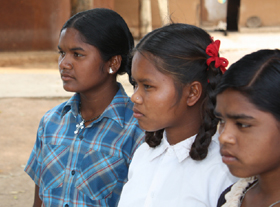
Basu: The gender ratio in parts of Punjab, Haryana, Rajasthan and Bihar has resulted in a shortage of girls in those states. In some places, for every seven boys there are only three girls. Traffickers see this as a business opportunity. They are bringing girls from Bangladesh and Nepal to those states.
Courtesy: New America Media
Are these traffickers from outside places?
Basu: It’s a total misconception to think that traffickers come from outside places. Most of them are from the villages from which the girls are trafficked. They entice parents with promises of jobs and a better life for their children. Parents, who are living in utter poverty, hand over their children, believing they will send money back home. For a month or two, the trafficker sends the parents some money. Then the trafficker goes back to the village and tells the parents that their child left him without his knowledge.
The New Light shelter is based in the heart of Kolkata’s red light district. The shelter houses children of prostitutes. But how do you persuade a prostitute to give up her child? 
Basu: Most of the girls in the shelter are former school dropouts. What does a mother do? Most times the mothers are grateful we have taken their children in.
We take the sons of prostitutes in as well because about 54 percent of the children who are sexually abused in India are boys. They too need to be given opportunities. And besides, when they are with us, we can teach them that girls need to be respected.
In a 2011 report, the US State Department ranked India as a “tier-2 country” in terms of sex trafficking, by which it means that the government is not doing enough to eliminate the problem, although it is taking steps to curb it. What is your take on this? Do you think that in the last couple of decades things have improved for women?
Basu: Women in India are far better off today than they were 20 years ago. They are better educated, entering the workforce in larger numbers and empowering themselves.
The PBS documentary features trafficked and abused girls in East and West Africa and several Southeast Asian countries, as well. How does the problem there compare to what it is in India?
Basu: India is far ahead of Southeast Asian countries when it comes to prosecuting cases of trafficking because of the laws the government has passed.
Also, after Hillary Clinton visited Kolkata earlier this year and met with a number of NGOs who are working in the field of human trafficking, she made it clear that she was committed to doing everything she could to end (what she calls “modern day slavery.”) That sends out a signal to us that we need to pay attention to the way girls are treated. She said she was our (the NGOs) greatest cheerleader.
Bollywood actor Aamir Khan has used his celebrity to make a television show that shine a light on some of India’s social ills, including child sexual abuse. Has that helped your cause?
Basu: If there’s one human being we should take our hats off to, it is Aamir Khan. He is someone I have a lot of respect for. If he ran for political office tomorrow, I’d vote for him.
How did New Light come on the radar of the documentary makers?
Basu: I’ve known Nicholas Kristof for some seven or eight years now. He has visited our shelter and seen what we are doing – in fact, he has mentioned us in his book, Half the Sky. He must have seen we were not a fly-by-night operation.
It must be really expensive to run all the shelters and feed and educate so many children. Do you think that after people see the documentary, donations to New Light will spike?
Basu: We have been getting donations all these years from people in different countries, some of whom have not even visited us. Our operating budget is about $250,000 a year, about 80 percent of which comes from foreign donors. If the documentary brings in more donations, we will welcome that.

Enhanced by Zemanta

Monday, January 17, 2011

AnnaLynne McCord: End Slavery Now

AnnaLynne McCord

AnnaLynne McCord

Posted: January 14, 2011 12:35 PM
Over the 2010 holiday season I had the incredible opportunity of returning to my home away from home, Cambodia. My older sister Angel and one of my best friends Melissa joined me on this trip in order to see a world many people are unaware even exists. We brought school supplies, donated computers and Christmas gifts to shelters run by my beautiful "sister," my friend, Somaly Mam. Somaly founded the grassroots organization, AFESIP, which is now supported by the Somaly Mam Foundation, to rescue, rehabilitate and reintegrate survivors of human trafficking.

A true heroine of our time, Somaly was sold into slavery at age 12 and forced to work in a brothel, where she was brutally tortured and raped on a daily basis. Heroically, however, Somaly managed to escape her captors, vowing to never forget those left behind. She has dedicated her life to saving other victims and empowering those lucky enough to survive the atrocious plight of human trafficking. To date, Somaly has rescued over 6,000 girls from modern-day slavery.

During my trip back to Cambodia we returned to the first shelter of Somaly's that I ever visited, Kampong Cham, as well as two other shelters she runs in two of Cambodia's biggest cities, the capital Phnom Penh and Siem Reap. On the trek to Kampong Cham there is an abandoned facility which was formerly a brothel. Multicolored condoms litter the floor in this skeleton of a building which once imprisoned innocent young girls being used for sex. In the basement the remnants of a true cage are apparent with metal posts decorated with rusted chains representing the punishment which would be inflicted should a girl refuse to service a client.

Upon arriving to the shelter, I was greeted by many familiar faces and Angel and Melissa were overwhelmingly uplifted by the dozens of vibrant young girls, all of whom now have the opportunity to study English, learn computer skills, and take practical job skill training.

It can take anywhere from three to five years for survivors of sex trafficking to reclaim their lives. The Somaly Mam Foundation is there every step of the way, supporting programs which rescue victims, offer psychological counseling and provide funds for education and vocational training to prepare survivors for reintegration into society.

Each of Somaly's girls bears her metaphoric mark. The love emanating from their very cells pours into my heart and soul, changing me eternally in ways I cannot express with words. Their illuminating beauty lights the room and the world around them, allowing no darkness anywhere to reside. Their laughter rings like happy Christmas bells to all who may be so lucky to hear it. "I love you in my heart!" they told me over and again with loving affection shining in their eyes.

I first met these beautiful beings on a glorious March day after an insanely bumpy hour and half long drive through the rural Cambodian countryside. The journey to Kampong Cham was only the beginning of my introduction to beauty so pure, so raw and yet not untouched.

As survivors of one of our world's most atrocious human rights violations, these young, would-be indentured slaves have seen a life to which we in our sheltered lives could never be privy. And thankfully so, as the stories I've come to learn would cause even the most callous of my peers to become ill with emotion.

Thank God for writers such as New York Times columnist Nicholas Kristof and Sheryl WuDunn, authors of my favorite book to date, Half the Sky. Their depiction of our world's continued conflict over equality for women worldwide is as honest as one can hope to find. With informative statistics, clarified myths, and calls to action laced into every chapter, one cannot finish this book without at least a slight understanding of the true importance of the fight to have women be free of oppression and allowed access to education without discrimination.

The idea behind Nicholas and Sheryl's book is, simply stated, empower and educate a girl if you hope to see change in a community and/or abroad. Even simpler still, as the book's title states, "women hold up half the sky." All women can realize their potential for greatness and all great men have already realized their need for a strong woman. I do not say this from a feminist standpoint. I do not say this thinking in any way, shape or form that women are at all superior to men. I say this because it has been proven and because he who hath an ear to hear, let him hear.

Beauty is in the eye of the beholder, and for millennia the female species has been viewed as a thing of beauty. Beauty that is revered, beauty that is lusted after, beauty that is appreciated, beauty that is preyed upon. The last of which not one of Somaly's resilient Cambodian girls hasn't fallen victim to. Whether by pimp or sex-tourist, local deviant or more heinous still, a father, brother, uncle, cousin, grandfather, Somaly's girls have survived the worst of what our world has to offer. And yet, something which may come as a surprise to you -- it most certainly did to me -- these beauties are the happiest young women and children I've ever met.

Forced into a life of shame and degradation, these "damaged" humans are so far above the piteous box in which most Westerners would think to put them. In fact, I would go as far as to say they are not the damaged ones at all. If anyone is to be pitied it is we of the Western world, as we gripe and complain about simplicities such as not having "enough bars in enough places," or in L.A. where I live, "the horrible traffic on the 405." I am most certainly guilty of this. Yes, it is we who have a lot to learn from these incredible individuals who can survive well beyond what would seem to be humanly possible and after, finally in their state of freedom, smile and dance with zest for life.

Human trafficking is perpetrated in every country and has been deemed the fastest growing form of organized crime in the world. UNICEF estimates that 1.2 million children are trafficked every year. The Somaly Mam Foundation works internationally to end these atrocities through direct services for victims, advocacy and outreach.

Melissa, Angel and I are privileged to have experienced resilient love in its purest form: hugs, kisses and nonstop affection given by young heroes following in the footsteps of their hero and "mother" Somaly. I gained a new perspective on what is really important in life -- a gift from Somaly and her "girls."

January is National Human Trafficking Awareness Month in the United States. Please consider what you can do (Facebook, Twitter, etc.) to raise awareness of the greatest human rights violation of our time, modern-day slavery. Visit www.somaly.org to learn more about this global crisis and how you can help raise funds to support programs for survivors. Every action, whether small or great, is a step towards ending this atrocious sin on humanity.

Source: The Huffington Post
AnnaLynne McCord: End Slavery Now
Enhanced by Zemanta

Thursday, September 30, 2010

Tabby Biddle: Nicholas Kristof Helping End Girl and Women Slavery

Tabby Biddle

Tabby Biddle

Posted: September 28, 2010 01:11 PM

2010-09-17-sexslaves_India.jpgHalfway around the world, millions of women and girls are enslaved. Girls are kidnapped as young as seven and eight years old, and then sold into brothels. Young women are forced into prostitution by trickery and coercion. Why should this matter to you? And what can you do about this?
For some Westerners living far away from these women, they have assumed that prostitution is something that women turn to opportunistically as a way out of economic desperation. This is hardly the truth.

Take Meena Hasina, for example. Meena is an Indian Muslim who was kidnapped from her village near the Nepalese border when she was eight or nine years old. She was then sold to a low-caste tribe that controls the local sex trade, and taken to a rural house where the owner kept prepubescent girls until they were mature enough to attract customers.

When Meena was 12, she was taken to the brothel. When customers were brought to her, Meena fought them off. The brothel owners did not like this. "They beat me mercilessly, with a belt, with sticks, with iron rods," she reported. They even threatened to kill her. But with each customer, she kept resisting. "Finally they drugged me," she says. Then one of the brothel owners raped her. She gave in and stopped fighting customers.

Unfortunately, Meena's story is all too common for young women around the world.

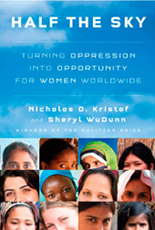
2010-09-17-HalftheSky.jpgI first learned about Meena from Nicholas Kristof and Sheryl WuDunn, in their bestselling book, "Half the Sky: Turning Oppression Into Opportunity for Women Worldwide." According to the research of Kristof and WuDunn, they estimate that there are three million women and girls (and a very small number of boys) worldwide who are enslaved in the sex trade.

For the 12 years Meena was in the brothel, she says that she was beaten on average five days a week. It is common in brothels for girls to be consistently beaten until they smile for potential customers. This can send a confusing message to the rest of the world in terms of what is really going through the minds and hearts of these young women. A passing foreigner might see a girl smiling and laughing and assume she is doing this work voluntarily. This is hardly the case!

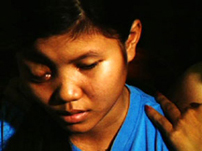
2010-09-17-LongPross.jpgOne young woman, Long Pross, was 13 when she was kidnapped and sold to a brothel in Cambodia. When she rebelled, the brothel owner punished her by gauging her eye with a metal rod. The peculiar thing is that the owner was female.

It turns out that women brothel owners are quite common. Why is this? Why are women willing to enslave, humiliate, and torture each other -- and sell each other to men?

One female brothel owner in India, quoted by Kristof and WuDunn, made it clear: "If my own daughters can be prostituted, then you can be, too."

I hear this and think about what a vicious cycle of self-hatred there is going on for women around the world. Women beat young girls, just as they had been beaten. The acceptance of rape, abuse, subjugation, and murder of girls continues this horrific cycle.

There are those who are unwilling to acknowledge the disgrace and dishonoring of this enslavement, and argue that girls and women get a decent income from prostitution. The fact is, according to research by Kristof and WuDunn, women and girls are often not paid. Add to this, in some brothels, girls are never let out and are forced to live without shoes or clothes for fear that they will run away. It is truly slave labor, performed under the threat of execution.

So what are the solutions?

Going to the police is not one of them. It turns out that police officers are no help because they are often "serviced" at the brothels for free. There have been too many stories of young women escaping to the police station, only to be laughed at and then beaten and raped by the people who are supposed to protect her. According to Kristof and WuDunn, in most places around the world where sex slavery is high (such as in India, China, and Pakistan), police officers, government officials, and even religious leaders avert their eyes from forced prostitution.

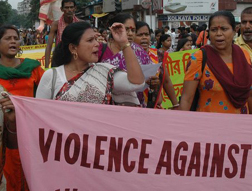
2010-09-17-stop_violence_against_women.jpgI feel that as women of the Western world, it is our responsibility to speak up for our sisters around the world. I believe we can do something about this. There are already many organizations that fight sexual slavery, such as Equality Now, Shared Hope International, and Vital Voices, but in my opinion, there need to be more. I think emancipating women and girls from sexual abuse and slavery needs to be a top priority of our government. With our voices, we can call attention to the atrocities to get our government to make gender-based violence a diplomatic priority. We need to put pressure on these countries to crack down on sexual slavery, and put brothels out of business. We need to hold governments accountable to pass laws and enforce them.

Along with the crackdown on brothels, we need put pressure on governments and support organizations that offer social services for the women and girls who have been enslaved. They need education, job training, and drug rehabilitation. Because being raped and being a sex worker is so stigmatized in all of these cultures where it is prevalent, there is no place for these young women to go, and no way for them to earn money. It is imperative that we find ways to grow institutions and organizations that support these women. One successful example is Apne Aap Women Worldwide, an organization that fights sex slavery in India, and has started a boarding school for girls, partly with donations from American supporters.

2010-09-17-GregMortenson_girlsschool.jpg
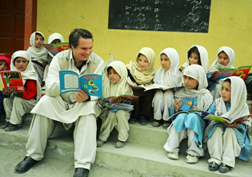
A key element to keeping girls from being trafficked is providing schools for them and making education possible. Greg Mortenson's schools in Afghanistan and Pakistan are a great example of this. Greg is the Executive Director of the Central Asia Institute and the author of the New York Times bestsellers "Three Cups of Tea" and "Stones Into School." He has successfully established 145 schools in remote regions of Afghanistan and Pakistan, which have provided education to 64,000 students, with an emphasis on girls' education. These girls are now working, making money, and seen as leaders, rather than seen as worthless.

Until we get this disrespect and dishonoring of women and girls straightened out, we are going to have a long way to go to create world peace. I believe it is this abuse of the feminine that holds us back. Without taking responsibility for abusing the Divine Feminine, we are killing ourselves internally and externally. Look at what's happening to Mother Earth, for example. She is being raped just as the women and girls are around the world. We keep taking from her, expecting her always to give back, but soon she will not. Her anger and hatred will be so strong, that we will destroy ourselves.

If we continue to allow the torture and subjugation of girls, we will be continually creating circumstances for hatred and war. Instead, we need to use our energy to create a global movement to emancipate women and girls from sexual slavery. This movement gains momentum each time someone joins in.

Here are 3 steps, recommended by Kristof and WuDunn, that you can take in the next ten minutes:


  1. Go to www.kiva.org and open an account. Kiva connects you to the women who need you. You can lend a woman money to start her own business, creating economic independence for her.

  2. Sponsor a girl or woman through Plan International, Women for Women International, or World Vision. By sponsoring a girl or woman, you can lift them out of poverty and make a HUGE difference in their lives and the lives of other girls and women.

  3. Join the CARE Action Network. As Kristoff and WuDunn explain: This will assist you in speaking out, educating policy makers, and underscoring that the public wants actions against poverty and injustice.

  4. These are first steps. The next step I would recommend is to read "Half the Sky" and hear the stories from women and girls about what's really going on, then blog or write about it like I am doing now. The more that we tell each other about what's going on in the world, the more it creates opportunity for us to create change in the world.

    Tabby Biddle, M.S. Ed., is a writer/editor dedicated to the empowerment of women and girls. Her work has been featured by The Los Angeles Times, USA Today, NPR, and other popular media. She lives in Santa Monica, CA with her husband.

    Follow Tabby Biddle on Twitter: www.twitter.com/tabbybiddle

Tabby Biddle: Nicholas Kristof Helping End Girl and Women Slavery
Enhanced by Zemanta

Tuesday, December 1, 2009

Ending Modern Day Slavery - Oprah.com

This is a photograph of the painting "The...Image via Wikipedia

At the peak of the transatlantic slave trade, 80,000 slaves were transported from Africa to the new world. Now, New York Times human rights columnist Nicholas Kristof reports that more than 10 times as many women and girls are being forced into brothels or other forms of slavery.

In their new book, Half the Sky, Nicholas and his wife, Sheryl WuDunn, investigate the causes and the very achievable solutions to putting an end to this form of modern-day slavery. "If you begin to think of your own child not in middle school, but being locked up in a brothel, then it suddenly becomes pretty real," he says.

Children like Long Pross, kidnapped from her Cambodian village at age 13, are forced into a terrifying world of prostitution. She had not yet had sex or her first period. "The fear was overwhelming," she says. "In a room they tied your hands, and outside there was a guard. If you resisted, they electrocuted you. Sometimes they electrocuted me twice a day if I argued too much."

As a virgin, Pross was a profitable commodity. Nicholas reports that virgins bring in hundreds of dollars for brothel owners. Virgins are also in high demand by men with AIDS who believe having sex with a virgin will cure them. By the time she escaped, her virginity had been sold four times. "They stitched me up three times," she says.

Enslaved girls are also forbidden to request condoms, leaving them vulnerable to STDs, AIDS and pregnancy. Pross says she became pregnant twice. "The second time they waited until I was four months pregnant before they gave me the abortion," she says.

Pross says when she asked for a few days of rest, her eye was gouged out with a piece of metal. When her eye became infected, the brothel considered her too mutilated to be worth anything and left her on the streets. An organization called Somaly Mam Foundation, founded by a former sex slave, stepped in to help Pross reclaim her life. Pross also received an operation to repair her eye. It was not successful, but there is hope for another surgery. "Pross is just such an incredibly courageous, inspiring woman," Nicholas says.

In 2004, Nicholas was so moved by the plight of two teenage prostitutes that he purchased their freedom. After paying the brothel owners $353, Nicholas returned the young girls to their Cambodian villages.

Later, Nicholas returned to Cambodia to find, one of the women married and expecting a baby. The other woman, however, had developed a drug addiction and returned to the brothel just days after she was freed. "It just broke my heart when she went back, but the brothel gave her meth. It was a way of controlling her," Nicholas says. "The underworld these women inhabit is complex and layered. Rescuing them involves so much more than just opening a door."

Still, there are signs that things are changing. "We tend to think that this is an absolutely hopeless problem, but I've watched Cambodia over the years. Because there has been pressure—the police demand more in bribes—some of the brothel owners go from dealing in girls to dealing groceries or stealing motorcycles or selling pirated videotapes," Nicholas says. "We can make them change the kind of business they do."

In centuries past, slavery was abolished thanks to the efforts of everyday people starting grassroots movements. Nicholas says it's time to start another. "People want to help if they think they can make a difference," Nicholas says. "They get involved, and they just find it incredibly fulfilling and enriching for themselves. The truth is trying to help other people has a mixed record, but invariably you end up helping yourself."

Find out how you can help girls like Pross from your living room. Visit our For All Women Registry and take action today.

http://www.oprah.com/article/oprahshow/pastshows/pkgregistry/20090901-tows-long-pross-sex-slavery

Reblog this post [with Zemanta]