Showing posts with label Amsterdam. Show all posts

Tuesday, October 4, 2011

Todd Reisz: From Dubai to Amsterdam, There Is No Divide

Source: Huffington Post

Todd Reisz

10/4/11 11:38 AM ET
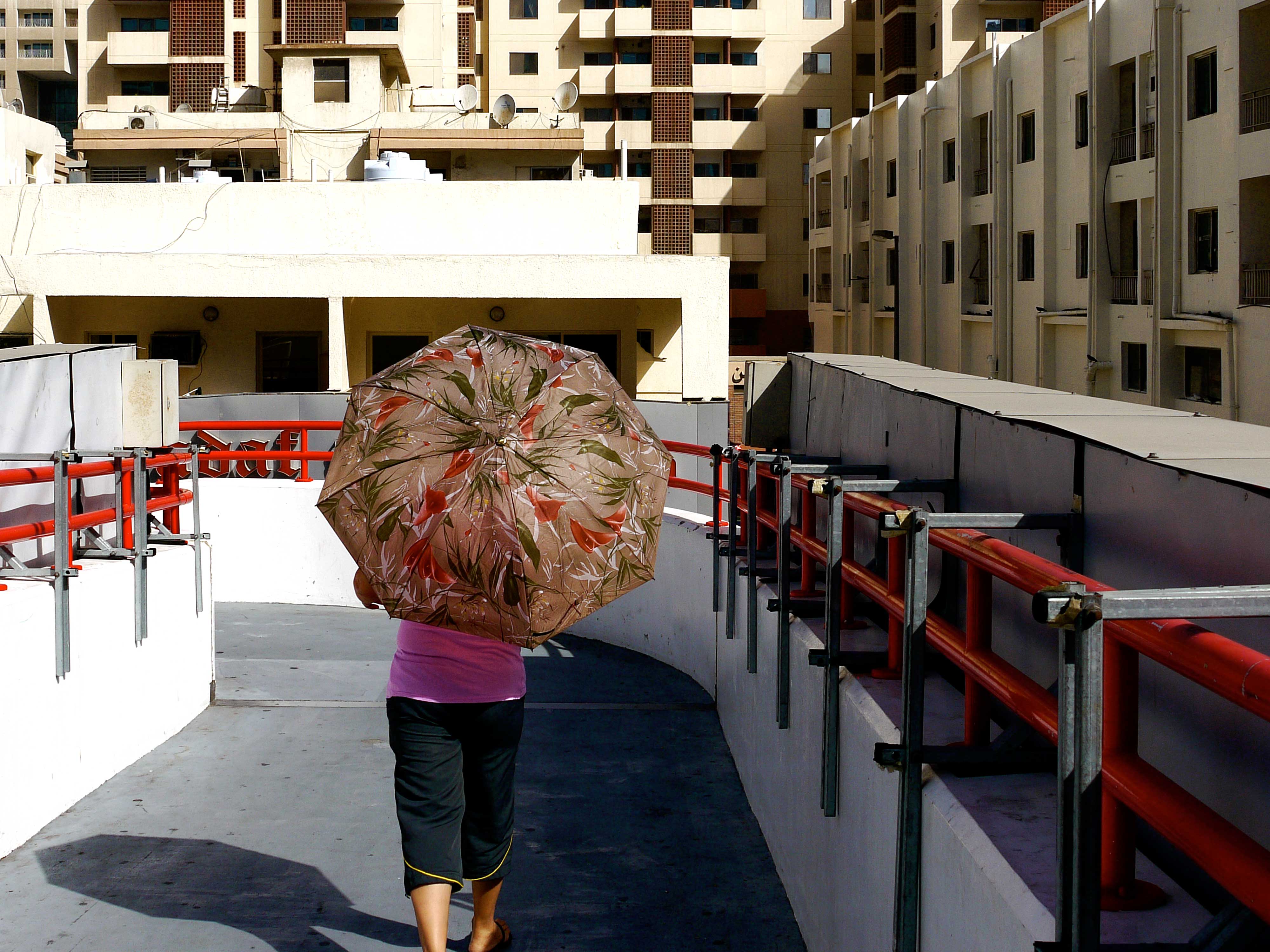
2011-10-03-P1190840_CROP_WEB.jpg
Woman crosses Maktoum Road in Deira, Dubai. Photo: Todd Reisz


Leaving my house earlier than normal this morning, I found the nearby shopping street eerily quiet. Amsterdam's center wakes up late because it's more about entertainment than general commerce. Opposite Rembrandt's house were three Latin American men occupying sidewalk benches usually claimed by tourists. Each had an overpacked duffle bag and work boots. The men were apparently waiting for a pick-up, and, to my eye, they might have been people whose daily wages are deemed illegal. Or maybe theirs were legal. In either case the question was playing out in the light of day, but a light that most people of central Amsterdam sleep through.

Discussions about the globalization of labor often distinguish between a here and a there. When it is about home, the conversation is framed as 'labor issues', and when it is about somewhere far away, it more quickly employs disquieting terms like 'human trafficking.'

Around another corner from my house is Amsterdam's red light district. Municipal leaders want to clean the neighborhood up. It can get rowdy there: soft (and hard) drugs easily bought; sex even more easily bought; and then the rowdiness and messiness that traveling mischievousness can provide. Change, the politicians say, is needed: fewer prostitution windows, less hash smoke, more boutiques. In addition, they assert, there is a graver, moral issue at hand, namely that there is a good deal of human trafficking going on in the district. The thought of such a thing happening in Amsterdam is powerful enough to silence even the staunchest critics of gentrification. Whenever the term is used, however, details remain vague. Listeners are left to fill in with their own imagination. That's easy to do.

To mention human trafficking conjures up graphic images of abuse, suffering, torture and other marks of evil. But while the accusations remain obscure along Amsterdam's canals, there are those who do not hesitate to incriminate, with a glaring certainty, goings-on in a city like Dubai. These are the kinds of contradictions and disconnects that crossed my mind reading Pardis Mahdavi's recent book Gridlock, which takes on the issues of migrant labor and human trafficking in Dubai.

Mahdavi, at times, seems like another academic interloper in Dubai, but she has written a thoughtful book about the city at a moment when several other American university professors have issued their own. She makes a few wince-causing mistakes (like getting Dubai's weekend wrong and confusing Sheikh Rashid al Maktoum with Sheikh Zayed bin Sultan Al Nahyan), but these can be put aside for what she achieves.

One historical matter that Mahdavi doesn't consider is the fact that Dubai's growth was defined by migrant populations before anyone talked about a 'globalized economy.' The city's mid-20th-Century modernization is largely a result of its migrant population, from the builders of its first bridge to the investors who bankrolled that bridge. Most of those people never expected to stay long in Dubai, and many did not. Dubai was one of the first cities to show us that assumptions about citizenship, about belonging, about home were to be turned on their heads.

Mahdavi does not dwell on questioning this increasingly accepted global condition, but she rightly calls on us to be aware of oversimplifying what is happening. Like many before her, she acknowledges and presents explicit examples of where things go wrong. Some of her portrayals of people she interviewed are harrowing, but what seems to anchor her descriptions in reality is her balanced understanding of the situation and, daresay, appreciation for what Dubai has afforded many migrants. She is not presenting people whose dreams have been shattered, but people who have made difficult, yet calculated, decisions to improve their situations:

Discussions about trafficking also reveal a xenophobic dimension; namely, that women from the Third World make the 'irrational' choice to migrate and are duped or tricked into sex work. In my experience, the migrant women I met in Dubai were neither stupid nor duped. Instead, they had made a difficult but rational choice to leave family and loved ones behind in search of wage-earning possibilities, adventure, or stability.

News accounts from places around the world have offered us images of humans living, and dying, traveling in packed containers or under duress. The accounts on their own are heart-wrenching, but in a way they also provide us a deplorable comfort. We are able to separate ourselves from the story. We can develop parallel worlds: a here and a there. Plenty of correspondents are willing to report to us from places where we don't dare to tread: an underground, a dark side, a secret.* But what is more terrifying is that it is all within our reach. In Amsterdam and in Dubai. There is no divide. It is unfurling on my shopping street; it is the person beside me on my next flight.

As an anthropologist, Mahdavi relies on her urban fieldwork -- interviews with over a hundred men and women. Whether via an anthropologist, a Human Rights Watch report or a global-trotting journalist, Dubai's condition has been told many times through the voices that some interests might prefer we didn't hear. But Mahdavi's interviews are convincing. She follows up with her subjects; often even after they have left Dubai. One of her findings is not surprising: that every story is different. It might seem cliché to claim this, but it reveals there is not just one problem and certainly not a blanket solution.

Mahdavi clarifies 'where the heart is' for many expatriates in Dubai. A common criticism, especially from American observers, is directed toward the inaccessibility of citizenship for foreign workers.** Mahdavi's interviews expose this as a minor issue. Almost all of her interviewees have a plan to leave Dubai eventually; they are putting their money aside to help loved ones abroad and then to go home without debt; it is true as much for a British worker as for a Bangladeshi. The book's findings provide nuance for gauging why Dubai functions as it does. That nuance can also generate a more likely means to improving people's lives than tolerating the heavy-footed judgments usually projected toward Dubai.

Any new policies or oversight will inevitably have to simplify things, reduce people to numbers. But that doesn't reduce the danger in thinking that way. Men and women taking on work, whether as domestic workers, construction laborers, or turning toward 'informal' markets, are making decisions with their direct personal interests in mind. That being said, Mahdavi visits a Kerala neighborhood in Dubai; she finds a community that could provide the support to get people through tough situations. My own experience in Kerala, historically a significant source of skilled and unskilled labor in the Gulf, is that there was once a strong support network for workers in Dubai: family and friends. Family members made sure a job was legitimate; recommended fair employers; helped each other out. Mahdavi's findings are looking for solutions that would replace this vanishing support system. She tells us that regulation could help, but such efforts in the Philippines and Ethiopia have mixed results. The answers won't be easy, but thinking more like Mahdavi, in Dubai and Amsterdam, might just get us closer.

* For a striking account of trickery, read Sarah Stillman's New Yorker article about two Fijian women tricked into working for the U.S. military in Iraq.

** Several writers have bungled the fact that Dubai does not grant citizenship, but the UAE does. The question is not whether you become a Dubai citizen, but an Emirati citizen. This is important in measuring the relationship people have with a city versus a nation.


Enhanced by Zemanta

Thursday, November 11, 2010

YouTube - Dutch human trafficking in the spotlight

AlJazeeraEnglish | November 11, 2010

More than 1,000 security officials from across the world are meeting in Doha, Qatar, for the 79th Interpol general assembly.

One issue on the agenda for the world's largest police organisation is human trafficking, which has become a multi-million dollar industry.

People are being traded around the world for prostitution and menial labour among other things.

Al Jazeera's Stefanie Dekker reports on one victim's story from Amsterdam.


Enhanced by Zemanta

Sunday, May 16, 2010

Deliberating de Wallen: notes from the red light district — THE NORTH STAR

By Andrea Austin

The red light district has become an iconic symbol of the commercialized sex industry. Pimps and human traffickers often use these districts to their advantage, looking to make a profit from the many johns/buyers who frequently visit in search of spending a few dollars on a child or woman. This happens everywhere. The United States. Thailand. India. The Netherlands.

Last week I had the opportunity to visit one of the largest and most infamous red light districts: de Wallen in Amsterdam.

I steeled myself against the images I would encounter – the scantily clad women posing in the windows or the black curtains drawn to shield onlookers from what was happening inside. To my surprise, what stood out to me was not what was happening behind the glass, but rather the scene in the street.

Firstly, it is a well-known fact that the red light district is a major tourist destination alongside other attractions such as the Van Gogh museum, Dam Square, and the Anne Frank House. It was surreal observing the hordes of tourists milling about touting cameras and pointing at maps, taking photos in front of ads for sex clubs or buying souvenirs from the sex shops. It was normalized, or worse encouraged, voyeurism at its best.

Secondly, there were large groups of men – clearly potential johns – crawling the streets and eyeing the women. The effect was something of a mall; the men were literally window shopping. It was a stunning manifestation of the commodification of sex, of women’s bodies as products. There were women of every age, shape, and ethnicity available for the choosing.

The impression that the commercial sex industry is legal and regulated in the Netherlands has created an expectation from tourists and buyers alike that visiting, and possibly participating, in the red light district is a necessary part of the experience. As a result, the secondary market of women and children who are trafficked exists, hidden by and integrated in the legalized system. In the past, Dutch politicians have even laid claim that more than 10,000 women are involved in the sex industry, but of these women only 2,000 or so are employed legally. The rest are caught up in the illegal market that is “rife with sex slavery.”

Lastly, and the most striking for me, were the people who were walking through the red light district without giving it a second thought. The red light district was a normal part of the scenery, to be accepted, ignored, or unnoticed. How have we (the global “we”) reached a point where the buying and selling of women’s bodies has become, to some, a normal part of everyday life?

It was a wonder to observe the wide-eyed tourists, potential johns, and complacent passersby – and, scattered among them for all to see, the women in windows. I felt a renewed commitment to fight human trafficking as I walked away from the scene, leaving the dull glow of the red lights behind me.

Deliberating de Wallen: notes from the red light district — THE NORTH STAR


Reblog this post [with Zemanta]

Friday, February 5, 2010

BBC News - Stag parties 'fuel sex trafficking'

Thursday, 14 January 2010
Stag parties 'fuel sex trafficking'

BBC reporter poses as a brothel owner to meet sex trafficker

By Simon Boazman
BBC News

Prague, Amsterdam, Riga, Krakow, they have all become popular destinations for the British stag party industry. But some of the estimated £500m spent each year is also finding its way to criminal gangs trafficking women for the sex trade.

Strip club in Amsterdam
Visiting a prostitute has become part of many stag weekends

The British stag party has changed in the past 10 years. The drink down the pub with dad or your mates is gone. It has been replaced with three or four nights in a foreign city, far from prying eyes and geared to meet the stag party's every desire.

And that is often much more than a visit to a strip club. For a large number of stags, visiting a prostitute has also become part of the ultimate lads' weekend.

Prague has 70 brothels and numerous strip clubs. It is not hard to find some of the half a million stag visitors, many British, that the Prague tourist board say visit every year. I found them at every sex establishment I went to.

There was a strip party bus, lap-dancing, and even a brothel that offers free sex provided you agree to be filmed. And many of the British stag groups had at least some, if not all, members buying sexual services.

A local charity worker was in no doubt that British stag parties coming to Prague had increased local demand for sexual services.

"If a British stag sleeps with women in a brothel or sleeps with her on the streets it could be a women brought… because of the sex industry, to be trafficked there from any part of the world."

Criminal gangs

The Czech Republic has long been a transit point for the trafficking of women in and out, and I wanted to find out how easy it would be to buy trafficked women for the sex trade.

Through contacts in the criminal underworld, we managed to arrange an undercover meeting with a trafficker. Posing as a London brothel owner, I arranged to meet him at a motorway service station.

As I secretly filmed our meeting, it became clear how straightforward the deal would be.

"I have two girls here for you now. That I can give to you. They have papers, they can travel you know, no criminal record, anything," he told me.

In the world of international sex trafficking, the leasing of girls has become common and it is big business.

"One girl makes me 90,000 krona (3,500 euros, £3,119) a month - around 50,000 euros (£44,561) a year. You give me 3,500 euros per month and I will come and visit you every month in England and collect the money every month."

The meeting lasted 20 minutes, and I could have bought two women.

Back alley

In the Latvian capital Riga, brothels are illegal, so the sex industry is more discreet with back-street brothels and street workers.

One British man told me about a "back alley basement place" his group had visited.

Like almost all the Brits I met, he did not want to tell me his name or be identified, admitting they were doing things they would not dream of doing at home.

But he said they had been shown a group of girls and he thought they were probably trafficked.

Housing estate in Lunik 9
Sex traffickers look to areas stricken with poverty to exploit victims

"They stood against the wall with a lack of soul, a dead look on their faces, which suggested that they weren't necessarily there out of their own free will.

"My initial feeling was they had just been brought out of the cupboard and they've just been released from the shackles and marched out to then have an hour with someone."

He told me half the group had seen enough at that point and left. The other half stayed.

Poverty and desperation

Far from the bright lights of the stag cities is Lunik 9, a decrepit crumbling estate in the Slovakian city of Kosice.

The centre wells of the tower blocks are six metres (20ft) deep with rubbish, the windows of the apartments have long since vanished and sewage runs down the walls and through the streets.

It really has to be seen and smelt to be believed, and it is here, amid this poverty and desperation, that sex traffickers look for and then exploit their victims.

Yana was tricked into work as a prostitute

Yana was only 17 when she left Slovakia with a man she thought was her boyfriend, to start a new life in Amsterdam.

When she arrived, she found she would not be leading the life that she dreamed of.

Unknown to her, her boyfriend had sold her to brothel owners.

"He led me to a space where there were a couple of men who were saying that I was beautiful, that I was sexy and they were basically saying that she is here for us, this is what we want her to do… They tore apart my clothes and they raped me."

Yana provides a tragic and deeply emotional testimony of being raped daily and pushed to the brink of suicide.

It is a story that every stag should hear.

Yana finally escaped after a year trapped in Amsterdam.

Using prostitutes

Tibor, another sex trafficker from Slovakia but working in the Czech Republic, agreed to be interviewed about his operation.


Tibor
It is just a regular job where you go to work and you go home at the end of the day
Tibor, sex trafficker

It was not his openness that stunned me but his cold, detached attitude.

I asked if he viewed the trafficked girls as his employees.

"More like things that I own," he said.

He said he felt no guilt about making money from people who were trapped. "It's just a regular job where you go to work and you go home at the end of the day."

Amsterdam

It is estimated that more than 3 million British people go on stag and hen parties each year, with more than 70% of them going overseas.

Amsterdam is the most popular British stag party venue. The local sex industry largely depends on foreign women from poorer countries.

There were nearly 500 women rescued last year according to Dutch police.

"Each year we have more cases," I was told by a policeman who runs an undercover team that infiltrates trafficking gangs.

The industry is worth "millions of euros", he said. "The recruiters are getting money, the transporters are getting money, the exploiters are getting that money."

"Only the girls will get nothing," he adds.


I disagree with it, but... you can't do anything about it. You're just here to have fun, and do things you won't get away with back home."
British stag weekender

In an attempt to make the area easier to police, the local authorities are forcibly buying up nearly half of the 482 brothels in the red light district and closing them down.

But it is not difficult to find a British stag weekender, a bright young man who had admitted to using a prostitute.

I told him that many prostitutes in Amsterdam had been trafficked.

"I don't agree with that, I think it's awful," he said, but admitted it probably would not stop him using a prostitute again that night.

"I disagree with it, but at the end of the day it's just what happens, like. You can't do anything about it. You're just here to have fun, and do things you won't get away with back home."

Simon Boazman reports in Stag Weekends: The Dirty Secrets on BBC Three on Thursday 14 January at 2100GMT or afterwards via the BBC iPlayer .


BBC News - Stag parties 'fuel sex trafficking'


Reblog this post [with Zemanta]