Showing posts with label Dubai. Show all posts

Tuesday, April 8, 2014

High Culture and Hard Labor - NYTimes.com

High Culture and Hard Labor - NYTimes.com


"On Saadiyat, and throughout the gleaming cityscapes of Abu Dhabi and
Dubai, the construction work force is almost entirely made up of Indian,
Pakistani, Bangladeshi Sri Lankan and Nepalese migrant laborers. Bound
to an employer by the kafala sponsorship system, they arrive heavily
indebted from recruitment and transit fees, only to find that their gulf
dream has been a mirage. Typically, in the United Arab Emirates, the
sponsoring employer takes their passports, houses the workers in
substandard labor camps, pays much less than they were promised and
enforces a punishing regimen under the desert sun."


Read Andrew Ross' article here:


http://www.nytimes.com/2014/03/29/opinion/high-culture-and-hard-labor.html?_r=0
Enhanced by Zemanta

Tuesday, October 4, 2011

Todd Reisz: From Dubai to Amsterdam, There Is No Divide

Source: Huffington Post

Todd Reisz

10/4/11 11:38 AM ET

2011-10-03-P1190840_CROP_WEB.jpg
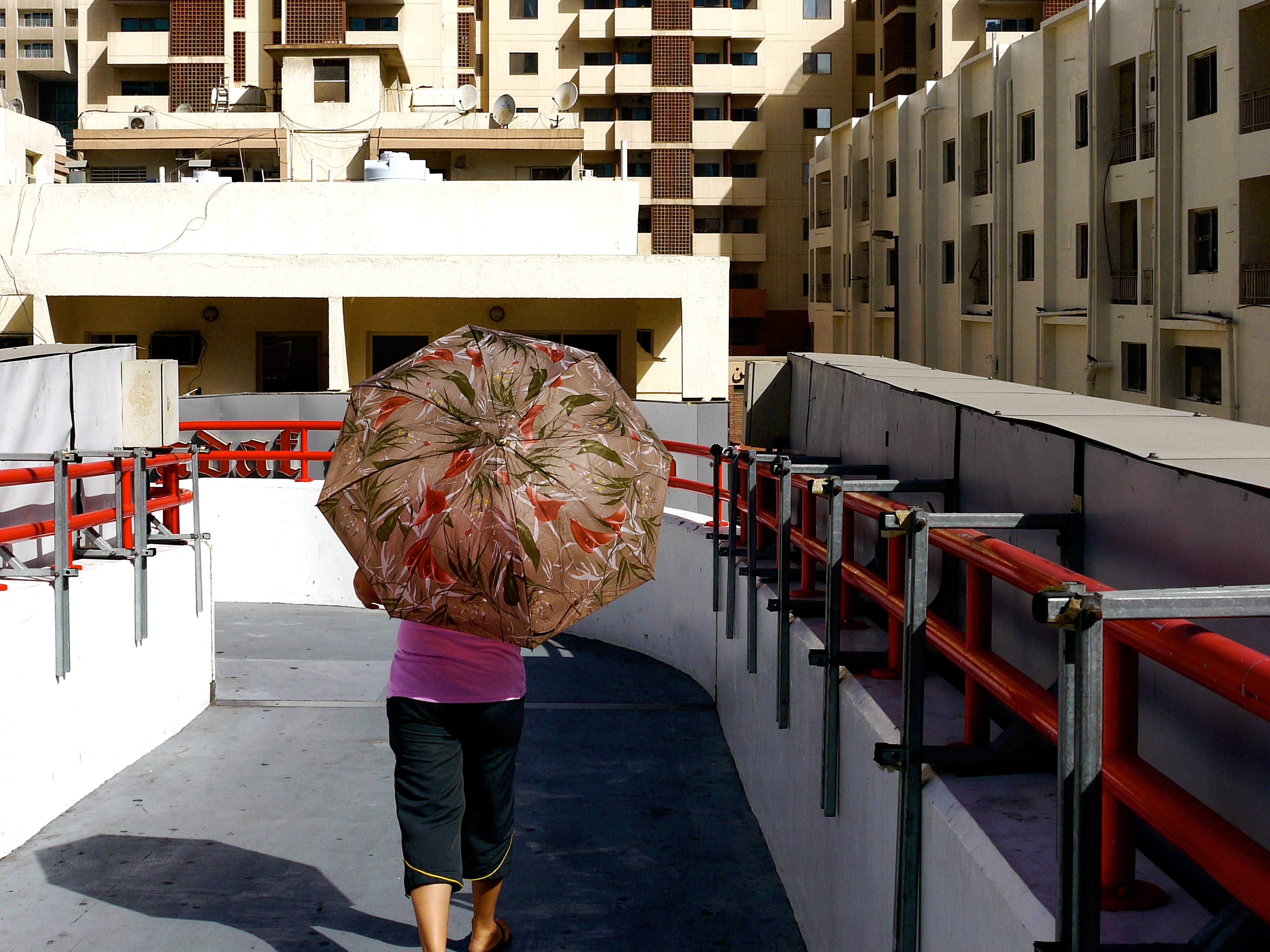
Woman crosses Maktoum Road in Deira, Dubai. Photo: Todd Reisz


Leaving my house earlier than normal this morning, I found the nearby shopping street eerily quiet. Amsterdam's center wakes up late because it's more about entertainment than general commerce. Opposite Rembrandt's house were three Latin American men occupying sidewalk benches usually claimed by tourists. Each had an overpacked duffle bag and work boots. The men were apparently waiting for a pick-up, and, to my eye, they might have been people whose daily wages are deemed illegal. Or maybe theirs were legal. In either case the question was playing out in the light of day, but a light that most people of central Amsterdam sleep through.

Discussions about the globalization of labor often distinguish between a here and a there. When it is about home, the conversation is framed as 'labor issues', and when it is about somewhere far away, it more quickly employs disquieting terms like 'human trafficking.'

Around another corner from my house is Amsterdam's red light district. Municipal leaders want to clean the neighborhood up. It can get rowdy there: soft (and hard) drugs easily bought; sex even more easily bought; and then the rowdiness and messiness that traveling mischievousness can provide. Change, the politicians say, is needed: fewer prostitution windows, less hash smoke, more boutiques. In addition, they assert, there is a graver, moral issue at hand, namely that there is a good deal of human trafficking going on in the district. The thought of such a thing happening in Amsterdam is powerful enough to silence even the staunchest critics of gentrification. Whenever the term is used, however, details remain vague. Listeners are left to fill in with their own imagination. That's easy to do.

To mention human trafficking conjures up graphic images of abuse, suffering, torture and other marks of evil. But while the accusations remain obscure along Amsterdam's canals, there are those who do not hesitate to incriminate, with a glaring certainty, goings-on in a city like Dubai. These are the kinds of contradictions and disconnects that crossed my mind reading Pardis Mahdavi's recent book Gridlock, which takes on the issues of migrant labor and human trafficking in Dubai.

Mahdavi, at times, seems like another academic interloper in Dubai, but she has written a thoughtful book about the city at a moment when several other American university professors have issued their own. She makes a few wince-causing mistakes (like getting Dubai's weekend wrong and confusing Sheikh Rashid al Maktoum with Sheikh Zayed bin Sultan Al Nahyan), but these can be put aside for what she achieves.

One historical matter that Mahdavi doesn't consider is the fact that Dubai's growth was defined by migrant populations before anyone talked about a 'globalized economy.' The city's mid-20th-Century modernization is largely a result of its migrant population, from the builders of its first bridge to the investors who bankrolled that bridge. Most of those people never expected to stay long in Dubai, and many did not. Dubai was one of the first cities to show us that assumptions about citizenship, about belonging, about home were to be turned on their heads.

Mahdavi does not dwell on questioning this increasingly accepted global condition, but she rightly calls on us to be aware of oversimplifying what is happening. Like many before her, she acknowledges and presents explicit examples of where things go wrong. Some of her portrayals of people she interviewed are harrowing, but what seems to anchor her descriptions in reality is her balanced understanding of the situation and, daresay, appreciation for what Dubai has afforded many migrants. She is not presenting people whose dreams have been shattered, but people who have made difficult, yet calculated, decisions to improve their situations:

Discussions about trafficking also reveal a xenophobic dimension; namely, that women from the Third World make the 'irrational' choice to migrate and are duped or tricked into sex work. In my experience, the migrant women I met in Dubai were neither stupid nor duped. Instead, they had made a difficult but rational choice to leave family and loved ones behind in search of wage-earning possibilities, adventure, or stability.

News accounts from places around the world have offered us images of humans living, and dying, traveling in packed containers or under duress. The accounts on their own are heart-wrenching, but in a way they also provide us a deplorable comfort. We are able to separate ourselves from the story. We can develop parallel worlds: a here and a there. Plenty of correspondents are willing to report to us from places where we don't dare to tread: an underground, a dark side, a secret.* But what is more terrifying is that it is all within our reach. In Amsterdam and in Dubai. There is no divide. It is unfurling on my shopping street; it is the person beside me on my next flight.

As an anthropologist, Mahdavi relies on her urban fieldwork -- interviews with over a hundred men and women. Whether via an anthropologist, a Human Rights Watch report or a global-trotting journalist, Dubai's condition has been told many times through the voices that some interests might prefer we didn't hear. But Mahdavi's interviews are convincing. She follows up with her subjects; often even after they have left Dubai. One of her findings is not surprising: that every story is different. It might seem cliché to claim this, but it reveals there is not just one problem and certainly not a blanket solution.

Mahdavi clarifies 'where the heart is' for many expatriates in Dubai. A common criticism, especially from American observers, is directed toward the inaccessibility of citizenship for foreign workers.** Mahdavi's interviews expose this as a minor issue. Almost all of her interviewees have a plan to leave Dubai eventually; they are putting their money aside to help loved ones abroad and then to go home without debt; it is true as much for a British worker as for a Bangladeshi. The book's findings provide nuance for gauging why Dubai functions as it does. That nuance can also generate a more likely means to improving people's lives than tolerating the heavy-footed judgments usually projected toward Dubai.

Any new policies or oversight will inevitably have to simplify things, reduce people to numbers. But that doesn't reduce the danger in thinking that way. Men and women taking on work, whether as domestic workers, construction laborers, or turning toward 'informal' markets, are making decisions with their direct personal interests in mind. That being said, Mahdavi visits a Kerala neighborhood in Dubai; she finds a community that could provide the support to get people through tough situations. My own experience in Kerala, historically a significant source of skilled and unskilled labor in the Gulf, is that there was once a strong support network for workers in Dubai: family and friends. Family members made sure a job was legitimate; recommended fair employers; helped each other out. Mahdavi's findings are looking for solutions that would replace this vanishing support system. She tells us that regulation could help, but such efforts in the Philippines and Ethiopia have mixed results. The answers won't be easy, but thinking more like Mahdavi, in Dubai and Amsterdam, might just get us closer.

* For a striking account of trickery, read Sarah Stillman's New Yorker article about two Fijian women tricked into working for the U.S. military in Iraq.

** Several writers have bungled the fact that Dubai does not grant citizenship, but the UAE does. The question is not whether you become a Dubai citizen, but an Emirati citizen. This is important in measuring the relationship people have with a city versus a nation.


Enhanced by Zemanta

Sunday, July 3, 2011

The U.S. Military’s “Third-Country Nationals” : The New Yorker

For foreign workers on U.S. bases in Iraq and Afghanistan, war can be hell.

by June 6, 2011

More than seventy thousand

More than seventy thousand “third-country nationals” work for the American military in war zones; many report being held in conditions resembling indentured servitude by subcontractors who operate outside the law. Photographs by Peter Van Agtmael.

It was lunchtime in Suva, Fiji, a slow day at the end of the tourist season in September of 2007, when four men appeared in the doorway of the Rever Beauty Salon, where Vinnie Tuivaga worked as a hair stylist. The men wore polished shoes and bright Hawaiian shirts, and they told Vinnie about a job that sounded, she recalls, like “the fruits of my submission to the Lord all these years.” How would she like to make five times her current salary at a luxury hotel in Dubai, a place known as the City of Gold? How would she like to have wealthy Arab customers, women who paid ridiculous fees for trendy cut-and-color jobs?

“I’ll talk it over with my husband,” she replied, coolly, but her pulse was racing. Vinnie, who was forty-five, had never worked abroad, but she often dreamed of it while hearing missionaries’ lectures at her local church. Nearly six feet tall and two hundred and thirty pounds, Vinnie moved with an arthritic gait. But she took care with her appearance. She wore shiny slacks, with a gold pageboy cap on her perfectly coiffed frosted black hair, and carried a bright-red faux-leather purse, stuffed with silver eyeshadow. She could see herself working in one of the great cosmopolitan capitals. The offer seemed like her big break, the chance to send her teen-age daughter to hospitality college and to pay her youngest son’s fees for secondary school.

Later that week, at a salon around the corner, Lydia Qeraniu, thirty-two, heard a similar offer. A quick-witted woman with a coquettish smile and a figure that prompted Fijian men to call out “uro, uro!”—slang for “yummy”—Lydia was thrilled by the prospect of a career in Dubai. So were many other women in beauty shops and beachside hotels across Fiji. A Korean Air flight to Dubai would be leaving from Nadi International Airport in a few days. The women just had to deliver their résumés, hand over their passports, submit to medical tests, and pay a commission of five hundred dollars to a local recruitment firm called Meridian Services Agency.

Soon, more than fifty women were lined up outside Meridian’s office to compete for positions that would pay as much as thirty-eight hundred dollars a month—more than ten times Fiji’s annual per-capita income. Ten women were chosen, Vinnie and Lydia among them. Vinnie lifted her arms in the air and sang her favorite gospel song: “We’re gonna make it, we’re gonna make it. With Jesus on our side, things will work out fine.” Lydia raced home to tell her husband and explain things to her five-year-old son. “Mommy’s going to be O.K.,” she recalls telling him. “Dubai, it’s a rich country. Only good things can happen.”

On the morning of October 10, 2007, the beauticians boarded their flight to the Emirates. They carried duffelbags full of cosmetics, family photographs, Bibles, floral sarongs, and chambas, traditional silky Fijian tops worn with patterned skirts. More than half of the women left husbands and children behind. In the rush to depart, none of them examined the fine print on their travel documents: their visas to the Emirates weren’t employment permits but thirty-day travel passes that forbade all work, “paid or unpaid”; their occupations were listed as “Sales Coördinator.” And Dubai was just a stopping-off point. They were bound for U.S. military bases in Iraq.

Lydia and Vinnie were unwitting recruits for the Pentagon’s invisible army: more than seventy thousand cooks, cleaners, construction workers, fast-food clerks, electricians, and beauticians from the world’s poorest countries who service U.S. military logistics contracts in Iraq and Afghanistan. Filipinos launder soldiers’ uniforms, Kenyans truck frozen steaks and inflatable tents, Bosnians repair electrical grids, and Indians provide iced mocha lattes. The Army and Air Force Exchange Service (AAFES) is behind most of the commercial “tastes of home” that can be found on major U.S. bases, which include jewelry stores, souvenir shops filled with carved camels and Taliban chess sets, beauty salons where soldiers can receive massages and pedicures, and fast-food courts featuring Taco Bell, Subway, Pizza Hut, and Cinnabon. (AAFES’s motto: “We go where you go.”)

The expansion of private-security contractors in Iraq and Afghanistan is well known. But armed security personnel account for only about sixteen per cent of the over-all contracting force. The vast majority—more than sixty per cent of the total in Iraq—aren’t hired guns but hired hands. These workers, primarily from South Asia and Africa, often live in barbed-wire compounds on U.S. bases, eat at meagre chow halls, and host dance parties featuring Nepalese romance ballads and Ugandan church songs. A large number are employed by fly-by-night subcontractors who are financed by the American taxpayer but who often operate outside the law.

The wars’ foreign workers are known, in military parlance, as “third-country nationals,” or T.C.N.s. Many of them recount having been robbed of wages, injured without compensation, subjected to sexual assault, and held in conditions resembling indentured servitude by their subcontractor bosses. Previously unreleased contractor memos, hundreds of interviews, and government documents I obtained during a yearlong investigation confirm many of these claims and reveal other grounds for concern. Widespread mistreatment even led to a series of food riots in Pentagon subcontractor camps, some involving more than a thousand workers.

Amid the slow withdrawal of U.S. forces from Iraq and Afghanistan, T.C.N.s have become an integral part of the Obama Administration’s long-term strategy, as a way of replacing American boots on the ground. But top U.S. military officials are seeing the drawbacks to this outsourcing bonanza. Some argue, as retired General Stanley McChrystal did before his ouster from Afghanistan, last summer, that the unregulated rise of the Pentagon’s Third World logistics army is undermining American military objectives. Others worry that mistreatment of foreign workers has become, as the former U.S. Representative Christopher Shays, who co-chairs the bipartisan Commission on Wartime Contracting, describes it, “a human-rights abuse that cannot be tolerated.”

PHOTOGRAPHS: MAGNUM
Source: www.newyorker.com
Enhanced by Zemanta

Monday, April 11, 2011

gulfnews : Hotline to fight human trafficking in Dubai

Dubai Police to announce telephone number for human trafficking victims seeking assistance

  • By Dina Aboul Hosn, Staff Reporter
  • Published: 00:00 April 12, 2011

Stepping up
  • Image Credit: Megan Hirons Mahon/Gulf News
  • From left: Dr Saeed Mohammad Al Ghafli, Adel Al Rashid, Adel Majid and Dubai Police Chief Lieutenant General Dahi Khalfan Tamim at the Media and Human Trafficking forum in Dubai.

Dubai: Victims of human trafficking in Dubai will soon have a dedicated phone number to seek assistance and report any threats that they may face, Lieutenant General Dahi Khalfan Tamim, Dubai Police Chief, announced on Monday at a conference that seeks to find solutions to the problem.

On the first day of the conference titled ‘Media and Human Trafficking' jointly organised by Dubai Police and the Dubai Foundation for Women and Children, experts said human trafficking was a crime thriving across borders with the situation expected to get worse in the coming years.

The collective effort of security bodies and the media was critical in combating the evil, experts addressing the forum said.

"The media must tackle this issue in a balanced way and refrain from exaggeration to avoid creating panic in the UAE, since these crimes happen in all societies," said Dr Anwar Gargash, Minister of State for Foreign Affairs and Chairman of the National Committee to Combat Human Trafficking.

"One of the most important achievements of the committee has been weeding out wrong information about human trafficking in the UAE, such as the baseless accusation that there are around 1,000 victims of human trafficking in the country, as alleged by some international reports," he added.

Lt Gen Dahi said the new dedicated phone number to report crimes of human trafficking would soon be announced in Dubai. "Since the Dubai Foundation for Women and Children was established, we have had the intention of setting up a hotline, but this was postponed in the hope that we would have a unified number all over the UAE. Unfortunately, I don't see this number anywhere, so we are going ahead with dedicating a line for callers in Dubai, which will happen very soon."

Source: gulfnews
Enhanced by Zemanta

Monday, February 28, 2011

Pardis Mahdavi: When 'Help' is the Problem: Questioning 'Human Trafficking' Policies in the Gulf


Pardis Mahdavi

Pardis Mahdavi

Posted: February 15, 2011 12:53 PM

Meskerem was living in an abandoned construction site, working odd jobs with very little pay when I met her on the streets of Dubai in 2008. Her story exemplifies the experiences of the numerous migrant men and women who make up the majority of Dubai's work force. Meskerem's father had passed away and left her family in high debt in Ethiopia's capital, Addis Ababa. She decided to migrate in search of employment as a domestic worker in the Gulf, but was told by her Ministry of Labor that she could not migrate without having to undergo many months of training and would have to pay for her passage and a visa. A short time later, however, her mother met a man, an illegal recruiter, who said he could facilitate travel to Dubai at no cost and find high-income-generating work for Meskerem. Though she was weary of such an irregular means of migration, Meskerem said, "I knew it was risky, but I had no choice. I had to make money, and this was the only way to get it fast." Meskerem was placed in the home of a family who abused her regularly. When she tried to contact her recruiter, she found out that she had migrated on a tourist visa that had expired and was working illegally. Her recruiter told her he could not help her until she repaid her debt to him. Stuck in a bad situation, abused by her employers, with nowhere to turn, Meskerem is a clear case of the force, fraud and coercion that are at the core of the definition of human trafficking. However, because she is outside the sex industry, and was not kidnapped, she may not fall into popular imaginings of "trafficked."

Current policies and conversations about human trafficking are having a detrimental effect on those they are designed to help. This is because there is a sharp disconnect between stereotypes and images of the typical "trafficked victim" and the reality of forced labor and migration globally. The result: a series of policies that actually operate to the detriment of migrant workers in the Middle East and worldwide.

The United Nations document on trafficking is perhaps the most comprehensive in its definition of the term. However, note the title of the document: the United Nations Protocol to Prevent, Suppress, and Punish Trafficking in Persons, Especially Women and Children (emphasis mine). Furthermore, note that this protocol is operated through the United Nations Office on Drugs and Crime (a curious place for a human rights document). Though the definition of trafficking in this document is broad enough to encapsulate all those who have experienced any form of force, fraud or coercion in migration, the focus is narrowed to hyperscrutiny on women and children in the sex industry.

Moving from the UN to other high-impact policies and their domino effects, it is useful to look at United States legislation on trafficking as these laws have set global standards and have had international reverberations. In the year 2000, Bill Clinton signed into effect the Trafficking Victims Protection Act (TVPA), which was revised and reauthorized under George W. Bush. This act, and its international component, the Trafficking in Persons Report (TIP), focuses the issue further on women in the sex industry. The TIP, especially, is not only biased by gender, but many have noted that it exhibits U.S. foreign policy biases as well. A global scorecard intended to rank all countries according to perceived compliance with U.S. anti-trafficking standards, the TIP has generated much international controversy. The opaque nature of its compilation has been highlighted, as well as the fact that country rankings align more closely with who the U.S. ranks as friend and who the U.S. ranks as foe than actual trafficking problems.

Until recently, the TIP casts the UAE as a major site of sex trafficking, but does not equally address abuses due to labor violations (which in fact constitute the majority of rights violations given the weakness of labor laws in the UAE). In so doing, the TIP Report silences the many narratives that challenge this narrow conception of human trafficking in the UAE. There are both sex workers who choose to migrate to Dubai in search of better economic opportunities, and there are many men in the construction or service industries (such as taxi drivers, or hotel employees) who suffer serious violations of their rights and are very possibly "tricked" (i.e. trafficked) into their current employment situations. Furthermore, neither of these scenarios accounts for what may be the most prevalent situation facing women in Dubai's service industry, in which they may seek out employment of their own volition, but upon arrival, or during the course of their stay, face instances of unexpected abuse or entrapment, with no avenues to turn to for recourse. Policies on trafficking that focus hyperscrutiny on sex work eclipse the instances of forced labor experienced by migrant workers outside the sex industry in Dubai. Addressing human trafficking according to U.S. anti-trafficking standards requires an increase in the numbers of arrests and raids of women in the sex industry. Far from helping these women, raids and arrests feel more abusive to many sex workers in Dubai, who noted that the bulk of their abuse comes from untrained law enforcement officials during raid and "rescue" efforts.

While it is tempting to argue that the term trafficking should be discarded altogether from discourse and policy, such an eventuality is highly unlikely given the force with which it has taken hold in the last decade. A more productive pursuit would be to reconceptualize human trafficking as one particular form of abusive practices found along a continuum of diverse experiences. We must disengage from the notion that trafficking is rooted in a rising global demand for commercial sex, and confront the problem as yet another component of a massive response to severe global economic inequalities.

Source: The Huffington Post
Pardis Mahdavi: When 'Help' is the Problem: Questioning 'Human Trafficking' Policies in the Gulf
Enhanced by Zemanta

Monday, January 24, 2011

gulfnews : Lewd massage parlours warned

  • By Bassam Za'za', Senior Reporter
  • Published: 00:00 January 25, 2011
  • Gulf News

Body massage
  • Image for illustrative purpose only.
  • Image Credit: Supplied

Dubai: Prosecutors have sent out a strong warning to parlours who hire massage therapists to offer sexual services as this will be categorised as a human trafficking crime.

An Asian woman, S.A., and her son [who remains at-large] have been referred to the Dubai Court of First Instance where they will be prosecuted for sexually exploiting three Asian girls and forcing them to offer sexual services to men in massage parlours, said Dubai Attorney General Essam Eisa Al Humaidan yesterday.

Radio 2: Nasreen Abdulla reports on the warning issued to massage parlors offering sexual services

Listen!

* Audio supplied by Radio 2

"This is the first case of its kind and in which Dubai Public Prosecution [DPP] has referred suspects accused of human trafficking — based on exploitation by compulsory sexual services," said Al Humaidan in a media statement on Monday.

"Chief Prosecutor Ali Humaid Bin Khatem, Head of Naturalisation and Residency Prosecution, and Senior Prosecutors Ahmad Murad Ahmad led the investigations which revealed that the victims were exploited and were forced to work in the massage parlour, owned by S.A. in collaboration with another female suspect," he added. "The victims weren't paid their salaries. We have asked the court for a stringent implementation of the anti-human trafficking law."

Coercion

Sources close to the case told Gulf News that the suspects are Chinese.

According to the bill of charges, the three Asian girls were obliged to offer sexual services under coercion and under the threat of being detained. Chief Prosecutor Bin Khatem, assistant head of DPP's special committee that investigates human trafficking cases revealed that the incident happened in a massage parlour in Rifaa Area.

One of the allegedly victimised massage therapists, T.S., reported to Al Rifaa Police Station that she was forced to offer sexual services for men.

Preliminary investigations showed that T.S. was flown to Dubai to work as a massage therapist in the parlour. A month later she was taken to the roof top of a flat where she was coerced to offer indecent services to a man.

When she refused to comply, according to prosecution records, S.A. said if she didn't comply she would be forced to pay for her residency and visa fees.

Source: GULFNEWS
gulfnews : Lewd massage parlours warned
Enhanced by Zemanta

Tuesday, October 26, 2010

Dubai to set up special human trafficking court - Emirates24|7

Move aims to speed up process of such cases and help victims in returning to their homeland

Dubai will establish a specialised court for human trafficking cases by the end of the year. (SUPPLIED)


Dubai will establish a specialised court to deal with human trafficking cases by the end of the year, according to Judge Ahmed Ibrahim Saif.

“The new court is being extended from the Criminal Court and the move aims to speed up the process of such cases and to help the victims,” the judge told Emarat Al Youm newspaper.

“The Dubai public prosecution has referred 15 cases of human trafficking to the courts since the beginning of this year,” he said.

The judge said: “All the cases referred to the court will concern sexual exploitation and not other forms of trafficking such as forced labour, which means the exploitation of others without pay, or slavery or practices similar to slavery, servitude or the removal of organs.”

“The main reason for setting up the court is to protect the interests of the victims and to mitigate the damage
inflicted upon them due to such crimes.”

The court will give priority to the victims by hearing their testimonies in the first session of the trial and assist them in returning to their homeland, said the judge.

He explained that the Criminal Courts in Dubai include criminal court, misdemeanors court, traffic court, immigration court, and juveniles and family court, in addition to the new court that will be set up soon to focus on cases of human trafficking.

Judge Saif said: “Issues related to human trafficking have their own peculiarity where the government takes care of the victims until the case is adjudicated, which is expensive.

“The legal proceedings also differ from other cases and are ruled by the UAE law on combating crimes of trafficking in human beings - No 51 of 2006 - in addition to international agreements signed with other countries.”

Dubai to set up special human trafficking court - Emirates24|7

Source:  emirates247.com
Enhanced by Zemanta

Tuesday, July 27, 2010

Federal News Radio 1500 AM: Human trafficking alleged in Iraq contracting

July 27, 2010 - 1:30pm

Mike Thibault, co-chair, Commission on Wartime Contracting in Iraq and Afghanistan
Click below to hear the interview
Download mp3


By Suzanne Kubota
Senior Internet Editor
FederalNewsRadio.com

Federal News Radio has told you about nearly $9 billion dollars being unaccounted for in Iraq reconstruction funds. Yesterday, the Commission on Wartime Contracting in Iraq and Afghanistan was told about up to $21 billion dollars in questioned and unsupported costs in Iraq contracts.

Commission co-chair Mike Thibault told Federal News Radio about another, equally disturbing, allegation: that subcontractors are using human trafficking to fill the jobs.

At least a third of the 200,000 contracted employees in Iraq and Afghanistan work for subcontractors, and many of them are allegedly slaves.

"We're talking about individuals that were hired from foreign countries in order to come into Iraq but were told they were going to be working in places like Dubai and Kuwait. And when they showed up, they were flown into Iraq," said Thibault.

Then, said Thibault, the subs "take your passport. They threaten you that the money that they advanced to you, you won't be able to pay back and you'll be in arrears and then they send you to Iraq. In an area you didn't sign up for. Something's wrong."

Since they work for subcontractors, the government has no direct oversight into who they are and what they do.

"This is something that should not occur. It shouldn't occur ever," declared Thibault.

How the subcontractors fill slots of people who can do basic jobs like food service and logistical support is in question, said Thibault. "It's worthy of a hearing by itself!"

Who should be responsible and "where it flows up through the Executive Branch, I would just be speculating with you, but a week from now I won't be speculating with you because we're going to drill down into it."

Thibaul said another focus of the Commission yesterday was on a Defense Contract Audit Agency review of prime contractors' billing and cost records.

"Pat Fitzgerald (Director of DCAA) indicated he's now up to $21 billion dollars in questioned and unsupported costs where he's taken exceptions out of some $97 billion dollars in contract awards. That is just unprecedented in terms of percentage."

Both issues, said Thibault, are a result of oversight, or a lack of it. The government is supposed to have oversight of the prime contractors, who in turn are supposed to have oversight of the subs.

Thibault said he'd like to see a change in the law so the government can have more oversight and access to subs. Contractors, of course, are pushing back, but between the costs and human rights issues being raised, current oversight clearly isn't getting the job done.

Or, as Thibault put it, "this is a major miss."

Federal News Radio 1500 AM: Human trafficking alleged in Iraq contracting


Enhanced by Zemanta

Tuesday, July 6, 2010

Global Efforts Can Reduce Human Trafficking in the Persian Gulf ..

Barbara Degorge, "Modern Day Slavery in the United Arab Emirates," The European Legacy, vol. 11, October 2006, pp. 657-665. Copyright 2006 Taylor & Francis Group, LLC. Reproduced by permission of Taylor & Francis, Ltd., http//:www.tandf.co.uk/journals and the author.

Barbara Degorge is a professor at the American University in Dubai, United Arab Emirates.

It is a simple and accepted truth that slavery exists in the twenty-first century. More and more, people are becoming aware that this practice persists, as much or more so than it did 100 years ago. Contemporary slavery is not a phenomenon of modernity, rather it is a timeless institution that has continued to evolve. Today more than 27 million people are enslaved worldwide, ranging from the African continent, Europe, North and South America to the Middle East. Moreover, the type of slavery and the conditions under which it exists have changed due to increased globalization and modernization.

In the last few years the case of Sudan has brought slavery to public attention with the news about the civil war between the North and South revealing a bustling market in human trafficking. However, other regions where slavery is practiced receive little or no attention. One of these regions is the Arabian Gulf which has altogether escaped world attention. This lack of attention is mainly explained by the rapid modernization and development of the Gulf States, where modern skyscrapers and advanced technology hide grimmer realities. This paper examines the different forms of slavery practiced daily in one of the Gulf States the United Arab Emirates [UAE]….

In the Middle East and especially in the Gulf States there is today an active slave trade. Three types of slavery are practiced: exploitation of children, chattel slavery, and "migrant worker" slavery, people who arrive of their own free will with the intention of bettering their lot. These migrants, however, do not always know what they are getting into or how to deal with the situations they fall prey to. This tripartite classification of slavery is close to the UN definition of serfdom; however, the latter term is misleading as the slave is not tied to the land; it applies insofar as both cases entail the slave’s total lack of mobility.

Exploitation of children is probably the most shocking form of slavery the world has witnessed in recent times. It is practiced not only in the United Arab Emirates but in India and many Asian countries. The UAE exploits children mainly as camel jockeys. Children as young as three-year-olds are used to ride camels because of their small size and weight. They are tied to the camel’s back so that they won’t fall off, which enables the camel to race without the encumbrance of an adult person. As in most countries, slavery in the UAE was outlawed (in 2003): it is illegal for a child under 15 years or weighing less than 45 kilos [99 lbs] to be a camel jockey. However, the oil rich countries of the Gulf region find it more profitable to continue this centuries-old practice of buying children from the Indian subcontinentIndia, Bangladesh, Pakistanas well as from Sudan.

Many are kidnapped; many are sold into slavery because their families are too poor to support them. It is estimated that as many as 5,000 children, from two years and upwards, have been kidnapped or bought to be used as camel jockeys. Being a camel jockey is a seven-day-a-week job, all year roundeven in times of extreme heat, which most people in the Gulf States would strive to avoid. The children are maltreated: they are woken up in the middle of the night to clean camel dung with their bare hands; they are beaten if they do not perform well enough and many are injured, killed or maimed during the camel races; they receive no schooling; have no idea about their family origins and are regularly beaten to keep them in line. Some are sexually molested by the trainers, as Peter Conradi reports. When children grow too old or physically big to be camel jockeys, they are lucky if they find employment in one of the camel stables or else are simply left to fend for themselves. This is an extremely dangerous situation for youngsters as throughout the Middle East it is illegal not to hold legal residency status, thus making them subject to fines or incarceration.

In 2004, a Pakistani human rights attorney, Ansar Burney, finally succeeded in bringing the problem of child slavery to public attention in the UAE. After spending two weeks filming this form of slavery in action, Burney convinced Sheikh Mohammed bin Rashid al Nahyan of Abu Dhabi to see the film. The film exposed the bare facts of the trade and all who viewed it were horrified. In March 2005, the Emirati Sheikhs pledged that they were going to put a stop to the practice, which had become a cause of embarrassment for the wealthy Gulf States. They set up "refugee" homes for the boys while an attempt was made to find their families. However, many were too young when they became slaves even to remember who they were or where they came from, which is why so many of them are still in the UAE. Although the practice was outlawed again in 2005, this does not mean that it no longer exists. Human rights groups such as Anti-Slavery International are concerned that it will not really be banned given that a similar law was initiated in 2002. This form of human trafficking, the only way to classify this practice, thus continues throughout the Gulf States.

Another form of human trafficking that is prevalent in the Gulf States, specifically in the UAE, Saudi Arabia, Kuwait, and Qatar, is the forcing of women and children into the sex trade. Saul Hudson points out that the United States has criticized these four Arab countries as the worst offenders in the human sex trade, but the offenders have done virtually nothing to stop the practice of women being used as sex slaves.

Many of the women who enter into this type of slavery do so without knowing what they are getting into. They come to the Gulf States with the idea of starting a new life and finding a job in order to help their families in their home country. They leave their homes, come to the UAE, Kuwait, or another Gulf country, arriving in the home of an Arab family to work as maids or child carers. One such woman, Kamala Rai, arrived in Saudi Arabia in the hope of opening a shop. Instead, her sponsor locked her up, beat her and raped her. The journals she wrote, later found in her suitcase when she finally returned to her native Nepal, illustrate the horrors she experienced during her three-and-a-half-month stay in the Gulf. Others are kept in prostitution homes where they are forced to serve any customer at any time of the day or night.

In 2005 the US State Department cited the case of a young Uzbekistani orphan girl who was sold into slavery in the UAE. She was kept as a prostitute until deemed "unusable." At this point, as Hudson reports, the UAE immigration service stepped in and declared her an illegal immigrant, for which offence she was sentenced to two years in prison.

As one walks down the streets of Dubai, the most liberal of the Emirates, or goes into one of its many hotels, one sees many prostitutes from Eastern Europe. But Dubai is not the only Emirate where prostitution is visible; it is seen in all the Emirates as well as the neighboring Gulf States. Many of these women, from Southeast Asia or Eastern Europe, whether sold as prostitutes or arriving with the expectation of finding respectable employment, find themselves trapped. They are unable to free themselves because, overwhelmed by shame they fear to tell anyone back home what has befallen them.

The two forms of slavery discussed above are practiced not only in the Gulf but worldwide. The sex trade thrives in New York and Paris. The camel jockey, although unique to the Gulf, is only one form of child slave labor, which exists in other forms throughout the world.

The third type of slavery in the Gulf region is that of migrant workers. A migrant worker is someone who has come from another place to perform a job on a temporary basis. About 75% of the population of the UAE can be classified as migrant workers, though most would prefer to be defined as "expatriates." They are certainly expatriates but they are all also migrant workers. They may be divided into two groups: those who have well paid jobs and those who work for next to nothing. But can this be defined as slavery, for, after all, it is directly tied to earning wages? It also raises the question asked earlier: what is it that makes a person free? There is no set definition of wage slavery, only differing views….

In the Gulf States there is an inordinate number of foreign workers dispersed throughout the region. In the UAE, 90% of the workforce is not Emirati. Out of a population of approximately 2.8 million, it is estimated that 1.5 million people come from the Indian subcontinent with the balance of foreigners from western countries and southeast Asia. This is an astronomical figure, in light of the fact that the UAE government has adopted a policy of Emiratization. Not included in it are the illegal immigrants: in 2003 the UAE government issued an amnesty and over 200,000 illegal workers came forward. Whether impoverished or not, all of these people were subject to some form of wage slavery, though they may not be aware of it.

The obvious form of wage slavery includes those holding menial jobs such as factory workers, construction workers, and housecleaners. These are people who come to the UAE and work for what in their home countries would be considered a lot of money. However, their wages, if compared to other wages earned within the UAE, are pitifully low. Some earn only the equivalent of $200 per month which is insufficient to meet the cost of living in the UAE, while sending a portion back to their families.
Slavery today is voluntary: willingly but perhaps unknowingly people give up their freedoms.
The factory and construction workers typically live in labor camps which are hurriedly constructed and poor in quality. Several of them are crowded into one room, with a small air-conditioning unit in the ceiling. They are transported daily to and from work in buses that are not air-conditioned, even in summer. Often they are not paid on time, which has led to a few cases of rioting and setting fire to the camps.

It is not unusual to see women dressed in abayas with shaylas walking a few steps behind an Arab family, pushing a baby carriage or holding an Arab child in their arms. These women, usually Philipino, Indonesian, or Malaysian, work as housekeepers in Arab or expatriate families, and hold next to no rights at all. Locked in the homes where they work, they rarely receive any wages. These women, some of whom are as young as six-year-old girls, are often beaten by their mistresses and sexually abused by their masters….

It can be argued that these cases are not classic examples of slavery. However, the processes of globalization and modernization require us to re-define slavery: The very nuances and modality of enslaving people have undergone change. Slaves today are no longer captured in war or sold. Although the former can still be found, slavery now refers to the situation of people who out of economic necessity enter into work relationships that either limit their freedom of choice or their mobility. Except for the child who becomes a camel jockey, slavery today is voluntary: willingly but perhaps unknowingly people give up their freedoms.
Because globalization has contributed to the continuation of slavery, albeit in new forms, slavery will not be eradicated without globalization.
Those who choose to put themselves in the position of being human traffic for prostitution do so for the most part with the knowledge of what they are doing. They may not realize the conditions they are entering but the prospect of a better life lures them. Unfortunately, this fantasy soon disappears. Similarly, the majority of those who enter into a slave wage contract have no idea of the consequences. The vast majority, whether underprivileged or enjoying apparent privileges, willingly accept the situation in which their freedom is controlled or limited. It is this psychological aspect of the wage slave that turns them into slaves. It is inconceivable that intelligent humans fall prey to the subtle machinations of employers who infuse fears into their minds of losing their livelihood or the chance to return home. These tactics of fear contribute to the ongoing practice of wage slavery.

The question is whether modern day slavery should be condoned or stopped. It is clearly possible to monitor and eradicate the practice of buying children as camel jockeys. In fact, many of the wealthy sheikhs who own the race camels have stopped using children in public. This does not mean that the practice has completely stopped; it may have diminished, but in many instances it has simply been swept under the rug.
But the other two forms of slavery in the UAE will prove more difficult to abolish. The young women who enter into prostitution are not aware of the price they are going to pay or the freedoms they are going to give up. Can this form of slavery be curtailed? Probably it can, but only with improved education and economic conditions for those who involve themselves in such employment. The growing interest of the media and international human rights organizations has brought slavery into the limelight. As more people become aware of what slavery looks like, the practice may perhaps dwindle and fade away as a means to making fast money.

It is the practice of wage slavery that will be most difficult to eradicate, if at all. This voluntary form of slavery is partly created by the global economic conditions. Although the total ramifications of the situation are not always obvious, this condition will prevail so long as people believe they are better off entering into this arrangement for a determined period of time. They endure the fears instilled into them and the mental and at times physical anguish they are subjected to because these are perceived as a means to an end. But among the many who endure there are those who cannot pull themselves out of their situation as they become so indoctrinated with fear of the loss of freedom and mobility. They do not see any other way; they do not perceive themselves as slaves.

In conclusion, slavery in the UAE and other Gulf States can be stopped, but this demands the recognition that slavery persists and the moral courage to change the laws of the land. Ironically, because globalization has contributed to the continuation of slavery, albeit in new forms, slavery will not be eradicated without globalization, for it is only the economically wealthy countries that can do most to combat it: without international pressure it is doubtful that these practices will ever be abolished.

FURTHER READINGS


Books

  • Beate Andrees and Patrick Belser, eds. Forced Labor: Coercion and Exploitation in the Private Economy. Boulder, CO: Lynne Rienner, 2009.
  • Claudia Aradau Rethinking Trafficking in Women: Politics Out of Security. New York: Palgrave Macmillan, 2008.
  • Alexis A. Aronowitz Human Trafficking, Human Misery: The Global Trade in Human Beings. Westport, CT: Praeger, 2009.
  • Kevin Bales and Ron Soodalter The Slave Next Door: Human Trafficking and Slavery in America Today. Berkeley and Los Angeles: University of California Press, 2009.
  • Kevin Bales and Zoe Trodd, eds. To Plead Our Own Cause: Personal Stories by Today’s Slaves. Ithaca, NY: Cornell University Press, 2008.
  • David Batstone Not for Sale: The Return of The Global Slave Tradeand How We Can Fight It. New York: HarperSanFrancisco, 2007.
  • Karen Beeks and Delila Amir, eds. Trafficking and the Global Sex Industry. Lanham, MD: Lexington Books, 2006.
  • Sally Cameron and Edward Newman, eds. Trafficking in Humans: Social, Cultural and Political Dimensions. New York: United Nations University Press, 2008.
  • Steve Chalke Stop the Traffik: People Shouldn’t Be Bought and Sold. Oxford: Lion, 2009.
  • Susan Dewey Hollow Bodies: Institutional Responses to Sex Trafficking in Armenia, Bosnia, and India. Sterling, VA: Kumarian Press, 2008.
  • Dessi Dimitrova, ed. Marshaling Every Resource: State and Local Responses to Human Trafficking. Princeton, NJ: Policy Research Institute for the Region, 2007.
  • Theresa L. Flores The Sacred Bath: An American Teen’s Story of Modern Day Slavery. Lincoln, NE: iUniverse, 2007.
  • Anna Jonsson, ed. Human Trafficking and Human Security. New York: Routledge, 2009.
  • Maggy Lee, ed. Human Trafficking. Portland, OR: Willan, 2007.
  • Kimberly A. McCabe The Trafficking of Persons: National and International Responses. New York: Peter Lang, 2008.
  • Sarah Elizabeth Mendelson Barracks and Brothels: Peacekeepers and Human Trafficking in the Balkans. Washington, DC: Center for Strategic and International Studies, 2005.
  • Tom Obokata Trafficking of Human Beings from a Human Rights Perspective: Towards a Holistic Approach. Boston: Martinus Nijhoff, 2006.
  • Andrea Parrot and Nina Cummings Sexual Enslavement of Girls and Women Worldwide. Westport, CT: Praeger, 2008.
  • Ernesto U. Savona and Sonia Stef, eds. Measuring Human Trafficking: Complexities and Pitfalls. New York: Springer, 2007.
  • Silvia Scarpa Trafficking in Human Beings: Modern Slavery. Oxford: Oxford University Press, 2008.
  • Clare Ribando Seelke and Alison Siskin Trafficking in People. New York: Novinka Books, 2008.
  • Kara Siddharth Sex Trafficking: Inside the Business of Modern Slavery. New York: Columbia University Press, 2009.
  • E. Benjamin Skinner A Crime So Monstrous: Face-to-Face with Modern-Day Slavery. New York: Free Press, 2008.
  • Kimberley L. Thachuk, ed. Transnational Threats: Smuggling and Trafficking in Arms, Drugs, and Human Life. Westport, CT: Praeger Security International, 2007.
  • Louisa Waugh Selling Olga: Stories of Human Trafficking and Resistance. London: Weidenfeld and Nicolson, 2006.
  • Jeremy M. Wilson Human Trafficking in Ohio: Markets, Responses, and Considerations. Santa Monica, CA: Rand, 2007.
  • Sheldon X. Zhang Smuggling and Trafficking in Human Beings: All Roads Lead to America. Westport, CT: Praeger, 2007.
Periodicals

  • Joey Ager "Freedom Songs," Sojourners Magazine, March 2009.
  • America "Human Trafficking Victims Need More Help," December 3, 2007.
  • Bridget Anderson and Rutvica Andrijasevic "Sex, Slaves and Citizens: The Politics of Anti-Trafficking," Soundings, Winter 2008.
  • S.M. Berg "Pornography, Prostitution and Sex Trafficking: How Do You Tell the Difference?" Off Our Backs, July 2007.
  • Kevin Clarke "Hidden in Plain Sight," U.S. Catholic, January 2009.
  • Liz Craft "Making a Difference," Times Educational Supplement, October 24, 2008.
  • Michael Cory Davis "Human Trafficking," Hispanic, September 2007.
  • Shannon Devine "Poverty Fuels Trafficking to Japan," Herizons, Winter 2007.
  • Julie L. Drolet "Trafficking and the Global Sex Industry," International Social Work, March 2009.
  • Economist "Drawing Lines in a Dark Place," August 16, 2008.
  • Melissa Farley "The New Abolitionists," Ms., Spring 2008.
  • William Finnegan "The Countertraffickers," New Yorker, March 5, 2008.
  • Barbara Glickstein "The Tragedy of Human Trafficking," American Journal of Nursing, November 2008.
  • Viv Groskop "Not for Sale," New Statesman, June 2, 2008.
  • Jeff Israely "Where the Sun Shines Brightly," Time, July 14, 2008.
  • Andrew Jacobs "Rural China’s Hunger for Sons Fuels Traffic in Abducted Boys," New York Times, April 5, 2009.
  • Dawn Herzog Jewell "Child Sex Tours," Christianity Today, January 2007.
  • Nicholas D. Kristof "If This Isn’t Slavery, What Is?" New York Times, January 4, 2009.
  • Mark P. Lagon "Trafficking and Human Dignity," Policy Review, December 2008-January 2009.
  • T.K. Logan, Robert Walker, and Gretchen Hunt "Understanding Human Trafficking in the United States," Trauma, Violence and Abuse, January 2009.
  • Susan Mohammad "Prostitutes Are Okay, but Not Pimps," Maclean’s, December 8, 2008.
  • Brendan O’Neill "The Myth of Trafficking," New Statesman, March 31, 2008.
  • Caroline Preston "From the Shadows," Chronicle of Philanthropy, December 11, 2008.
  • E. Benjamin Skinner "People for Sale," Utne Reader, July-August 2008.
  • Emma Thompson "Slavery in Our Times," Newsweek, March 17, 2008.
  • Jonathan Tran "Sold into Slavery," Christian Century, November 27, 2007.
  • Christine Van Dusen "Peonage in New Orleans," Progressive, August 2008.
  • Celia Williamson and Michael Prior "Domestic Minor Sex Trafficking: A Network of Underground Players in the Midwest," Journal of Child & Adolescent Trauma, vol. 2, no. 1, 2009.
Tags: dubai united arab emirates, types of slavery, taylor francis, modern day slavery, lack of attention

Global Efforts Can Reduce Human Trafficking in the Persian Gulf .


Enhanced by Zemanta

Tuesday, May 18, 2010

Expose the evils of human trafficking - The National Newspaper

Skyline of Abu Dhabi at the Abu Dhabi Corniche.Image via Wikipedia

Last Updated: May 10. 2010 8:49PM UAE / May 10. 2010 4:49PM GMT

They were found huddled in rooms, terrified and beaten. Bruises the size of fists marred their bodies, and few said anything as the police discovered them, having been terrified into silence.

Robbed of their passports, the 13 trafficked Moroccan women found in Abu Dhabi last year were fated to a life of modern slavery.

Their ordeal came to a close only after one of the women managed to escape and alert the police. Her boldness led to the arrest and prosecution of the largest trafficking ring ever caught in the Emirates.

The number of human trafficking cases brought to the courts is on the rise. And as Dr Anwar Gargash, the chairman of the National Committee to Combat Human Trafficking, emphasised: “In all countries where there are human trafficking cases, the number of cases that reach the court is a drop in the sea of the overall cases that are going on.”

This is sobering news for a country that is fast becoming one of the region’s largest transport hubs. The growing number of people travelling here for employment or transit means that the task of regulating illegal activities is also growing more complex.

Reforms are keeping pace with the rise in trafficking, however.

Infrastructure and legislation are nascent but growing. There are shelters in Dubai and Abu Dhabi; both have hotlines staffed by women 24 hours a day, seven days a week. Legislation that was introduced in 2006 to specifically address trafficking is being revised and updated to include better provisions for victims.

Under UAE legislation, 43 cases were tried in court last year. But the anecdotal evidence of women – and men – forced into jobs unwillingly suggests that many cases do not reach the courts.

And it should be remembered that abuse extends beyond sexual exploitation. Forced labour in any form, whether toiling without wages on a construction site or forced prostitution confined to a room, is abhorrent.

It demands the highest vigilance on the part of authorities if the country is to continue on the path of becoming a modern, progressive country. The opportunity for people to find a better life should not be betrayed by a false promise.

Expose the evils of human trafficking - The National Newspaper


Reblog this post [with Zemanta]

Monday, April 26, 2010

Dubai Police intensify battle against human trafficking

This is a photo of a souk in Deira, Dubai, Uni...Image via Wikipedia

Centre was set up early last year by the Dubai Police to monitor human trafficking

By Siham Al Najami, Staff Reporter
Published: 00:00 April 26, 2010
Gulf News

Maj Gen Khamis Mattar Al Mazeina (left) and Col Dr Mohammad Abdullah Al Murr

* Maj Gen Khamis Mattar Al Mazeina (left) and Col Dr Mohammad Abdullah Al Murr.
* Image Credit: Supplied

Dubai: Human trafficking cases in Dubai increased 28 per cent in 2009 over the previous year, with 33 victims forced into prostitution and a case of an infant offered for sale.

Dubai Police Deputy Chief Major-General Khamis Mattar Al Mazeina said the increase was due to the significant effort police made to combat human trafficking, in collaboration with the Ministry of Interior and international organisations.

Figure dropped

In 2006, human trafficking cases were only seven and shot up to 23 in 2007. The figure dropped in 2008 to 18 cases but rose again in 2009 to 23 cases.

Dubai Police said around 88 per cent of the victims were women. Of the 33 victims, 12 per cent were younger than 18, 53 per cent were 19 to 25 and 34 per cent were older than 26. An additional case of attempting to sell a baby was detected in 2009.

There were "absolutely no other cases of human trafficking such as selling of organs and enslavement," Maj Gen Al Mazeina said.

The majority of victims, around 58 per cent, had come from developing countries with low living standards and had only basic elementary education, he said.

Awareness was the key to fighting human trafficking, he said.

In 2009, 76 suspects were involved in 23 cases. Of those, 21 were committed by more than one suspect; 79 per cent were committed by men and 21 per cent by women.

In 2008 there were 69 suspects involved in 18 cases of human trafficking.

Trafficking monitored

Of those, 14 cases were committed by more than one suspect; 55 per cent by women and 45 per cent by men.

A centre was set up early last year by the Dubai Police to monitor human trafficking, tackle the sex trade and respond to labour violations.

The General Department of Legal and Disciplinary Control Director-General Colonel Dr Mohammad Abdullah Al Murr said the centre implemented field studies and training, and acted globally to combat traffickers and provide necessary services for victims.

Maj Gen Al Mazeina said, "Our centre is the first of its kind established among Arab countries to tackle and combat human trafficking".

"This part of combating crimes requires teams and units specialised in combating human trafficking due to the sophistication and complications of these crimes such as being able to differentiate the nature of the crime from prostitution and providing support to the victim and able to arrest the entire network involved in these crimes," he said.

Identification

It was difficult for prosecutors to identify human trafficking, which could resemble prostitution.

He also called for investigation into how victims could enter the country on residence visas sponsored by UAE nationals.

Maj Gen Al Mazeina said the centre, with the Dubai Foundation for Women and Children, in 2009 offered 36 victims of human trafficking psychological and legal support.

Numbers

In 2006, human trafficking cases were only 7 and shot up to 23 cases in 2007. The figure dropped in 2008 to reach 18 cases and went up again in 2009 to 23 cases.


gulfnews : Dubai Police intensify battle against human trafficking

Reblog this post [with Zemanta]

Friday, March 5, 2010

The 'virtual slaves' of the Gulf states | Nesrine Malik | guardian.co.uk

The recession has worsened the plight of Asian workers in UAE and elsewhere. Their rights are only slowly being addressed

o Nesrine Malik
o guardian.co.uk, Monday 16 November 2009 10.34 GMT

The exploitation of migrant workers in the Gulf states has been worrying human rights groups for some time but now the recession is making their predicament even worse.

Usually employed in a semi-formal manner with large companies, Asian workers in United Arab Emirates fall within a vacuum of employment law and social welfare and hence become the first casualties of a recession. Usually indebted to their agents or "sponsors", ie those who have purchased visas on their behalf, and bereft of passports or identification documents confiscated by their employers, they now inhabit a "grey economy".

Dubai, with its recent construction boom, has been the focal point for media coverage of abused migrant workers. The problem occurs worldwide but it is undoubtedly more highly concentrated in the Gulf. Because of snobbish attitudes regarding the types of work that locals will take on, an entire underclass of migrant workers has been imported to clean, drive, chauffeur, build and serve.

This even prompted an official policy of "Saudisation" in Saudi Arabia (where the slogan was "Be Saudi, Hire a Saudi") in order to counter unemployment among Saudi citizens. Like those in Dubai, migrant workers have their passports confiscated and replaced with an iqama or residence permit. If there is an erosion of goodwill between employee and employer then identification documents are kept hostage.

Even as a white collar worker in Saudi Arabia, I found that merely leaving the country on holiday required an exit visa, which was only issued once the authorities had established that there were no outstanding debts, traffic violations (which was ironic, for as a woman I was not allowed to drive), warrants, etc. Mark Lagon on the US state department blog commented: "This system, which is seen throughout the Gulf, is compounded in Saudi Arabia by the disproportionate power given to employers of housemaids, construction workers, and agricultural labourers in the form of exit permits."

Even in the good times, this is fertile ground for abuse. When an economy is buoyant, migrant workers supply cheap labour, which naturally gets cheaper as recession bites and re-employment options dwindle. However, this classic pattern is further exacerbated by the fact that these workers are subject to the additional restrains of debts to their employers or agents and their inability to leave the country and relocate.

While abuse of cheap labour is not confined to the Middle East, the entrenched anti-immigration, anti-naturalisation policy in Arab states means these workers will never be afforded the rights of citizens irrespective of how long they have spent in the country. As freedom of movement is denied, a situation has developed where workers are forced to remain and take itinerant cash-in-hand jobs, undercutting other workers by eschewing basic provisions such as healthcare in a grim race to the bottom. In addition, owing to the draconian terms of sponsorship law, where one's visa is linked to one's job, workers cannot easily seek alternative work legally and thus fall into illegal, informal, sporadic employment.

Ellene Sana, executive director of the Philippines Centre for Migrant Advocacy, agrees that the human rights of these workers stand to be compromised because of the economic downturn.

"Migrant workers will be desperate for work and will accept anything just to keep their jobs. When you're desperate, you lose your sense of dignity. You'll settle for anything that you can get," she said. These conditions reached such exploitative levels that construction workers rioted in Dubai for the first time since the downturn, halting traffic as thousands protested against low wages.

There have been some advances in employment law in the region brought on partly by international pressure. The UAE now gives workers six months rather than one month to seek alternative employment before visas are cancelled and Bahrain has done away with its sponsorship law which, as the labour minister acknowledged, did "not differ much from slavery". But while cheap labour underwrote the rapid infrastructural and economic development of some Gulf states, in times of slowdown the bureaucratic and legislative backwardness (not devoid of elements racial discrimination) of the region exposes how little has been achieved.

The 'virtual slaves' of the Gulf states | Nesrine Malik | Comment is free | guardian.co.uk


Reblog this post [with Zemanta]