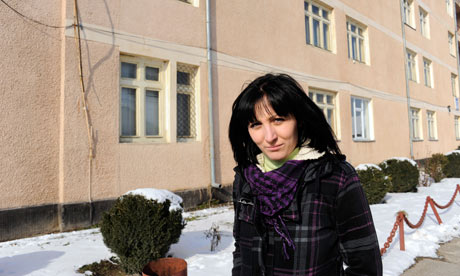
Marinela Badea, 20, was forced to work in Britain as a prostitute by people traffickers who kidnapped her and held her prisoner. Photograph: The Observer/Petrut Calinescu When police turned up at the Shangri-La, it was quiet. Marinela Badea was catching up on sleep and was awoken by the commotion. Minutes later, on a grey Manchester morning, she and half a dozen other women were handcuffed and marched out of the red-brick massage parlour in Openshaw in the east of the city.
Marinela, 17, was terrified. Trafficked from Romania, she had been coerced into prostitution by a pimp who beat her with numbing regularity. Now there was something new to fear. "I didn't even know where I was going," she says now. "I couldn't trust anyone, I had no idea of the law. I was so scared."
The sex crimes unit of Greater Manchester police arrested her for prostitution-related offences, but at least Marinela was safe behind bars. Her first day in custody was the first since her arrival in England six months earlier that she had not been forced to have sex. She had been raped by different men 50 times a week on average, often violent, drunken strangers. And if she was released from prison, Marinela was convinced she would be murdered by the gang who trafficked her.
Eventually police would discover that Marinela was an innocent victim of Bogdan Nejloveanu, 51, and his son Marius, 23, a Romanian trafficking team who last month received the longest sentence for trafficking in UK history. Her extraordinary story, revealed here for the first time, offers a troubling insight into Britain's vast "off-street" prostitution trade. It also raises questions about the apparent indifference of the authorities to tackling trafficking and protecting vulnerable women imported into Britain as sex slaves.
Victims are notoriously reluctant to describe their experience because of the shame, fear and stress. It is even rarer for such women to agree to be identified. Motivated by a courageous desire to expose this sordid, violent world, Marinela has revealed the full horror of her ordeal in an account that should reopen the debate about how Britain deals with its sex industry.
As far as her friends and family were concerned, Marinela vanished. One moment she was on the way home from school in the provincial town of Alexandria, two hours drive from Bucharest, then she was gone. Later they learnt that, just after 5pm one afternoon in mid-March 2008, as she was settling down to her homework in the flat she shared with a female friend, there was a knock on the door. Outside stood two men. One, Cornel, had a reputation for prostituting local girls. The other she had never met. He was called Marius Nejloveanu.
They invited her to a barbecue. "I said no because I had homework," said Marinela. "When Cornel heard that he just banged my head on the wardrobe and said, 'Put your coat on.'
"Marius saw my ID card on the table near the TV and took it and my phone. I asked him: 'Why are you taking my passport?' and he just stared at me." From the barbecue, Marinela was taken to a relative of Nejloveanu's, near Alexandria. There, hours after being abducted, she was raped. "I said, 'I want to go home' – so they beat me up. After half an hour they brought his friend in and they forced me to sleep with him. From that day they kept me prisoner. They wouldn't even let me go outside in case somebody saw me."
In the days that followed, friends and family tried to find her, but there were no clues. Her teachers were baffled. She was in the third year of a course on food hygiene and considered a rising star.
The search intensifed but a new identity was being forced on Marinela. She was given a fake passport that transformed her into a 21-year-old adult, then taken to Bucharest and forced on to the 4am coach to England. Nejloveanu promised a job cleaning hotels. Two days later – on 3 April 2008 – Marinela arrived at Birmingham's central bus station.
A woman claiming to be a girlfriend of Nejloveanu took her to a large suburban house in Edgbaston where another two Romanian girls lived. "Then it dawned on me. I was asked: 'Do you know how to put a condom on?' 'What are you talking about?' I said." Marinela refused to accompany the girls to a nearby brothel and as a consequence received her first death threat. Unless she co-operated Nejloveanu would kill her, she was told, when he returned from Romania.
Desperate and hardly eating, Marinela began to waste away. Diminuitive to begin with, her frame became skeletal. She recalls watching her ribcage protrude when exhaling.
Nejloveanu eventually arrived and she took her first ferocious beating for refusing to have sex with men. "He beat me up and forced me to sleep with him – anal sex. It really hurt. He was pulling my hair and hurting my back. Sometimes he would bang my head right on the corner of the door. That really hurt."
Weeks into her ordeal, Marinela relented. Nejloveanu presented her with a lurid set of garish underwear and she was taken to a nearby brothel masquerading as a sauna. She could not speak a word of English. When the first "client" booked her she wanted to say "no" but could not. She wanted to explain her predicament, tell the man that she was trafficked. Instead she cried, hoping that the man would take pity on her. He did not. None of them did.
On her first day she made £300, enough to support her family in Romania for six weeks, but was forced to surrender every penny. "After that I was making £400, £500. After a month I was making £500 a day, but if I wanted a cigarette or bar of chocolate I had to ask."
Daily shifts lasted 12 hours, 10pm to 10am, seven days a week. Sometimes she would be obliged to have sex 12 times with different men. She says it was normal for her trafficked peers to have sex with 10 men a day.
Punters paid £40 a session, of which half went to Nejloveanu and half to the sauna or massage parlour where she was imprisoned. Most of the men were white or Asian, a number were repeat clients, but most were strangers. Some were drunk, a few violent.
"There was one guy and I didn't want to do what he asked me. So he beat me up because he was drunk, pulled my hair and slapped me like this." She pretends to wallop the side of her face so hard her head jerks back and her tongue lolls out. "But they just take the violent men outside. Nothing ever happens to them even if I am really hurt."
She said the trauma of having to undress for often stinking men she detested never went away. "Even if they stink, and have come straight from work, you have to sleep with them – it was so horrible. Can you imagine how I was feeling taking my clothes off, exposing the horrible underwear that Marius had bought? I was supposed to be in high school, not in England sleeping with men and making money for criminals."
Those who ran the saunas were instructed not to let Marinela go outside, often for days at a time. She made one escape bid. That precipitated one of her most brutal beatings by Nejloveanu: "I got punched, a knife in my head, my hair was pulled until it came out."
Marinela soon picked up enough English to decipher the ease with which Britain's covert sex industry operates. Nejloveanu's girlfriend would simply plough through the local papers' classified section and ring up massage parlours and saunas asking if they required girls. "She was ringing to see if they had any 'jobs' there. Are there any jobs available? Jobs meant brothels." Marinela, along with the two other Romanian girls, was transferred around the West Midlands, to places such as Lisa's Sauna in east Birmingham, where "a lot of girls worked," according to Marinela, and which remains open.
As the months passed, two more trafficked Romanian girls arrived in Edgbaston. Both had severe mental problems and one, aged 23, was later found to have a mental age of 10. The pair made little money for their pimps and one was quickly sold off.
Marinela's family assumed their daughter was dead. Her parents imagined that at 17 she was too young to travel abroad. At their smallholding in Silistea, a farming hamlet 70km north of Alexandria, they despaired and discussed giving up their search.
In England, Marinela was being prepared for her next stage of exploitation. In October 2008 she was taken to Manchester, first to the Belle Air massage parlour and then to Shangri-La, where up to 15 girls a day worked. In the brothels she was forced to inhabit, Marinela estimates she met more than 100 Romanians working as prostitutes in Birmingham alone, many of whom she says had been coerced. Her accounts provide a rare glimpse of the scale of off-street prostitution in Britain, which is notoriously problematic to quantify.
Charities say Marinela's experience supports their belief that sex trafficking into the UK is significantly greater than officially recognised. An investigation by senior police officers last year identified almost 5,890 brothels – saunas, massage parlours and venues used illegally for paid sex – in England and Wales.
The investigation, by the Association of Chief Police Officers, found 342 brothels in the West Midlands. Judging by their statistics, Marinela was among 1,535 east European women working in establishments that featured an average of 6.6 beds. In north-west England, 760 businesses were identified, employing 1,242 sex workers from eastern Europe. In the UK, police found evidence that at least 400 women from eastern Europe have been trafficked, suffering a similar ordeal to Marinela's. But campaigners say the true number runs into the thousands.
Women's groups also lament the lack of police action against venues known to be selling sex illegally. Despite identifying huge numbers of brothels and sex trafficked victims, there is little evidence of a concerted police crackdown to close premises.
When David Greenwood, 43, was jailed last year for running the Belle Air and Shangri-La as brothels, the court heard that both had been known to police for years. Shangri-La has since "closed" but closer inspection indictates it has merely reopened under the name Infinity, with an identical telephone number. Its website lists 36 girls, divided into categories from "busty" to "blonde". The shift structure looks familiar: 12 hours per girl, 10pm to 10am. When asked if 30 minutes for £40 included sex, a female receptionist said: "I can't say on the phone because it's against the law, but it does include a massage and full personal service."
Last week, the Observer took Marinela back to the frozen south of Romania, to be reunited with her family in Silistea. When he learned what had happened to his daughter, Marin, her father, had to be stopped from burning down the house nearby Marius Nejloveanu built with his trafficking proceeds. Her mother, Adriana, wept as she held her daughter.
In Alexandria, returning for the first time since she was snatched from its streets, she seemed uncharacteristically nervous. "I don't like it here. Marius's people might want me dead."
She visited the town's police station where three years earlier her mother had reported her missing. In the early hours of a May morning in 2009, its officers raced to the nearby town of Mavrodin to arrest Nejloveanu following a tip-off from Greater Manchester police. The chief commissioner, Florea Stefan, said: "Marinela is lucky to be alive: many girls are beaten very, very badly." He said Nejloveanu exported five girls to the UK but another seven had vanished in Romania.
Trafficked girls are sometimes killed by their pimps. "Everyone knows that," said Marinela. Police in Alexandria are sensitive about trafficking, but senior officer Voicu Sanbu says between 50 and 100 people disappear each year, male and female. Marinela says she knows at least one girl from Silistea forced to work as a prostitute in England.
Thousands of the region's young women work in the pan-European sex trade, the vast majority in Spain. Stefan said: "Prostitution is legal in Spain. Some are forced, some want to work, but many, many go to Spain. It is a big problem."
When Marinela arrived at the police station Stefan was interviewing a trafficking victim from Spain. Nejloveanu's father, Bogdan, was extradited from Spain to face trial in Manchester. Both were convicted 10 days ago of 34 separate offences. Bogdan was jailed for six years and Marius sentenced to 21 years.
The sentences meant closure for Marinela. Now she is helping at the safe house in Sheffield for vulnerable women, where she was cared for after police released her. With remarkable generosity towards a country where she was so horribly abused, she has grown to love Yorkshire and the city she lives in, and plans to make it her home. She has begun training as a hairdresser while helping to raise awareness of trafficking. She calls herself a survivor, not a victim.
"I will be so happy if I can help other girls," she said. Her outlook is positive, her company characterised by mischievious humour. In many ways Marinela's story is about the human spirit's capacity to regenerate. "And I haven't even got a mental health problem, which is phenomenal," she grinned. Her father laughed, raising a glass of home-brewed brandy. Her mother managed a faint smile before wiping away another tear.
SEX TRAFFICKING AND BRITAIN
The most comprehensive inquiry into sex trafficking and off-street prostitution in the UK identified 17,000 migrants working in brothels.
Of these, about half – 9,000 – were from eastern Europe, of which police believe 400 had been trafficked.
The report, completed last year by the Association of Chief Police Officers after an investigation named Operation Acumen, found a further 4,128 women from eastern Europe, which they categorised as "vulnerable". The classification included women whose experience the police concluded fell below the threshold of trafficking but were vulnerable to sexual exploitation in that they spoke little English, were overly reliant on their "controllers" and faced other barriers preventing them from exiting prostitution.
The police investigation detected another 5,000 women from eastern Europe working in brothels who were willing to work as prostitutes and could not be considered trafficked or vulnerable.
Campaigners, however, say the police's definition of "vulnerable" included many victims of trafficking and that their inquiry significantly underestimates the problem. The Poppy Project argues that many women find it difficult to disclose issues such as rape and that the police's methodology, which involved officers entering brothels and asking women if they had been trafficked, was unlikely to glean accurate information.
The definition of trafficking has long been controversial. The most favoured defines it as involving the use of force, fraud, deception or coercion to transport a victim into an exploitative context.
Source: The Observer
 /reportage-01