During Passover, Remember That Sex Trafficking is Bondage - Sisterhood – Forward.com:
Showing posts with label Passover. Show all posts
Showing posts with label Passover. Show all posts
Wednesday, April 27, 2016


Saturday, April 7, 2012
Rabbi Rachel Kahn-Troster: How Many Slaves Produced Your Seder?
Rabbi Rachel Kahn-Troster: How Many Slaves Prodhttp://www.huffingtonpost.com/rabbi-rachel-kahntroster/how-many-slaves-produced-your-seder_b_1401049.html
Source: The Huffington Post
Posted: 04/ 4/2012 7:28 am


This year, I keep getting questions about chocolate.

Source: The Huffington Post
Posted: 04/ 4/2012 7:28 am
This year, I keep getting questions about chocolate.
Passover seems to be the annual peak of Jewish chocolate consumption (perhaps because it makes an easy dessert when many of us find baking without flour difficult), and for the ethical, kosher-keeping consumer, a tension emerges. There is kosher-for-Passover chocolate. There is kosher fair-trade chocolate. But there is no kosher-for-Passover, fair-trade chocolate. Why is this important? There is a well-documented child labor and child slave labor problem in the cocoa fields of the Ivory Coast, and it seems hypocritical to celebrate Passover by eating a product with such a problematic supply chain. The website Fair Trade Judaica has created a petition (with more than 300 signatures so far) demanding ethically produced chocolate for next Passover. And some of my friends are forgoing chocolate this year.
Then there are the tomatoes. Florida, where almost all of our October to May tomatoes are grown, has been called "ground zero" for modern slavery in America because of the high number of human trafficking cases that have been found in the fields. One federal prosecutor even said that one could guarantee that a Florida tomato had been picked by forced labor. Thanks to the amazing work of the Coalition of Immokalee Workers, more than 90 percent of Florida's tomato growers have begun to implement Fair Food Agreements that include a zero tolerance policy for forced labor and human trafficking in the tomato fields, among other basic protections of human rights. But so far, only two grocery stores (Whole Foods and Trader Joe's) have agreed to only buy Florida tomatoes from growers who have signed these agreements. So your grocery store might still be carrying slave-picked tomatoes -- and you would never know.
The list of products produced by forced labor could go on and on. Fish from Asia. Cotton from Uzbekistan. Tea from Uganda. As a consumer, there is just no way to know whether there is forced labor in the supply chains of the products we buy every day. Each autumn, the Department of Labor releases a list of goods produced by child or forced labor (in 2011, 130 goods from 70 countries), but does not provide details of specific brands or companies. Fair Trade certification is often (but not always) a proxy for ethically produced goods, but the number of products available is small and largely made up of luxury goods. For those of us who keep kosher and are used to looking for a heksher (a symbol of kosher supervision in production) on the food we buy, we wish that we could have a "slavery-free" heksher to help us when we shop. No one wants to be enjoying a delicious piece of chocolate or savoring a tomato and wondering if it was the result of slave labor, especially not at a meal dedicated to liberation like the seder.
This lack of transparency is extremely frustrating. We all might think that because we don't employ any slaves, we lack complicity in the human rights atrocity of modern slavery (with estimates of forced labor worldwide ranging from 12 million to 27 million people), but because of the degree of slave-made materials in the supply chains of products we buy every day that just isn't true. Many corporations fail to adequately police their supply chains, relying on the assurances of third party contractors or suppliers.
It is for this reason that the organization Slavery Footprint designed tools to empower consumers to demand products made without slave labor. By creating a visible demand in the market place, consumers can use their power to affect change on a system that enslaves millions.
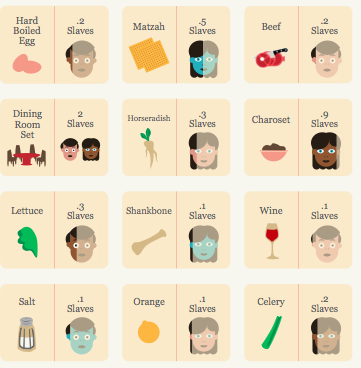

Slavery Footprint's website allows people to visualize how their consumption habits are connected to modern-day slavery. You take an inventory of the goods in your home, and receive a score of how many slaves work to produce your lifestyle, based on what you own. Then, through the online action center and the "Free World" mobile application, you can take practical steps to demand products Made In A Free World by asking companies to check their supply chains for slave labor. Slavery Footprint's call to arms is for the ability for to buy things "Made in A Free World."
My organization, Rabbis for Human Rights-North America, has partnered with Slavery Footprint to produce an activity for Passover based on the larger Slavery Footprint survey. It can bedownloaded from our website for free. Ask your seder guests the question: How many slaves produced the goods on our table? Challenge them to commit to take action.
As the seder begins, we say metaphorically, "This year, we are slaves. Next year, may we be free people." Let us hope that by next Passover, our feasts of liberation will be made without slave labor and that more people will be free.
Tuesday, March 23, 2010
Rabbi Joshua Levine Grater: Slavery, Passover and The World Cup

Rabbi Joshua Levine Grater
This post has been adapted from a piece written on Passover and slavery for Rabbis For Human Rights-North America's annual Passover distribution. You can read that piece at www.rhr-na.org.
It is very sad that we have an expert on modern-day slavery in our world, but E. Benjamin Skinner is that person. He has been writing and studying slavery since 2001 and I begin with a chilling excerpt from a March 23, 2008 op-ed that he wrote in the LA Times:
Let me be clear: By "slaves" I mean, very simply, those who are forced to work, under threat of violence, for no pay beyond subsistence. That is the nice, neat, horrible definition I have used since I began studying the subject in 2001. In the United States today, we tend to use the word "slave" loosely. Merriam-Webster offers as its first definition of the word, "drudgery; toil."
But that's not what slavery is, as Rambho Kumar can attest. Kumar was born into wilting poverty in a village in Bihar, the poorest state in India, the country with more slaves than any other, according to U.N. estimates. In 2001, desperate to keep him and his five brothers from starving, his mother accepted 700 rupees ($15) as an advance from a local trafficker, who promised more money once 9-year-old Rambho started working many miles away in India's carpet belt.
After he received Rambho from the trafficker, the loom owner treated his new acquisition like any other low-value industrial tool. He never allowed Rambho and the other slaves to leave the loom, forcing them to work for 19 hours a day, starting at 4 in the morning. The work itself tore into Rambho's small hands, and when he whimpered in pain, the owner's brother stuck his finger in boiling oil to cauterize the wound -- and then told him to get back to work. When other boys attempted escape or made a mistake in the intricate designs of the rugs, which were destined for Western markets, the owner beat them savagely.
On July 12, 2005, local police, in coordination with activists supported by Free the Slaves, an organization based in Washington, liberated Rambho and nine other emaciated boys.
I've met and talked with slaves and former slaves like Rambho in a dozen countries, including the United Arab Emirates, Romania, India, Sudan and Haiti. The International Labor Organization of the United Nations estimates that in Asia alone, there are about 10 million slaves.
While Passover is mostly associated with the wonderful foods and flow of the Seder, family and friends coming together, finding the Afikomen and not eating chametz, leavened foods, the deepest and most profound issue at the heart of this holiday is slavery, past and present. Over and over again, more than any other matter in the Bible, we are reminded that we were once slaves in the land of Egypt and so we must take care not to treat others as slaves, or allow slavery to exist in our world, for we know what it was like to be those slaves. And yet, for all of the amazing freedoms and liberties that we have gained, especially here in the United States, we will sit down to our sederim this year with the knowledge that over 27 million human beings today, 2010, are slaves. I would imagine that the majority of us would find this horrifying and unbelievable, so the question for our seders this year is: are we are aware and what can we do about it?
Ancient Jewish texts give us one of the more challenging tasks of the seder, dare I say of the whole Passover experience: "In every generation, we are obligated to see ourselves as if we personally went out from Egypt." We read this in the haggadah, the book used to conduct the seder, but do we embody it? I know that I often ask people to think about the things in our lives that we are "enslaved to," such as time, technology, bad habits, fear, etc. For us moderns, this is as close as many of us can come to feeling like a slave. And while this is an important exercise to engage in, perhaps we can take it further this year and spend more time talking about the fact that we live with slaves in our midst. In fact, low-end Justice Department estimates speculate that there are at least 60,000 people in America living as hidden slaves. While we might not be actual slaves ourselves, we live in a world that accepts slavery, if not outright then tacitly, and Rabbi Abraham Joshua Heschel implores us to remember, "In a free society, some are guilty but all are responsible." We should all be talking about this issue of modern day slavery at our seders this year.
How could this have happened? How could we arrive at the 21st century and have more slaves today than ever before in history? Just sixty years after the United Nations Universal Declaration on Human Rights, article 4 proclaimed, "no one shall be held in slavery or servitude; slavery and slave trade shall be prohibited in all their forms," we wake up to find ourselves not living in a world of our dreams and hopes, but rather we find ourselves in a world of our greatest nightmare and fears. Passover is a time to shake ourselves free from the doldrums of habit, passive acceptance of evils and ills that we choose to pretend don't exist, and wake up not only to the rights of being a free people, but to the responsibilities of being free people. Our right to be free cannot manifest itself by enslaving others, but that is sadly what has happened in our world. When we talk about these issues, push ourselves to face the ugliness that exists, we better ourselves and have the chance to better our world. Action begins with awareness.
To that end, I would like to close by returning to the expert, E. Benjamin Skinner, and a more recent article he wrote for Time magazine, highlighting the sex-slave trade that exists in South Africa. In a January 18, 2010 piece, Skinner writes, "While most [slaves] are held in debt bondage in the poorest regions of South Asia, some are trafficked in the midst of thriving development. Such is the case here in Africa's wealthiest country [South Africa], the host of this year's World Cup. While South Africa invests billions to prepare its infrastructure for the half-million visitors expected to attend, tens of thousands of children have become ensnared in sexual slavery, and those who profit from their abuse are also preparing for the tournament.
During a three-week investigation into human-trafficking syndicates operating near two stadiums, I found a lucrative trade in child sex. The children, sold for as little as $45, can earn more than $600 per night for their captors. "I'm really looking forward to doing more business during the World Cup," said a trafficker. We were speaking at his base overlooking Port Elizabeth's new Nelson Mandela Bay Stadium. Already, he had done brisk business among the stadium's construction workers."
As the world has done before, we are going to send millions of people, billions of dollars and invite the world to watch an international sporting event right in the heart of a city and country that is enslaving its children, participating in one of the uglier sides of our global underbelly. "In every generation, we are obligated to see ourselves as if we went forth from Egypt." This year, we owe it to the over 27 million human beings, including millions of children, to truly acknowledge that slavery exists, take responsibility and then take action. I would urge you to have cards at your seder with the name of President Obama's Ambassador-at-Large to Monitor and Combat Trafficking, Luis CdeBaca, and ask them to contact him and express deep concern about the World Cup being held in a country where slavery is so prevalent. (http://www.state.gov/r/pa/ei/biog/124083.htm) Let us not avert our eyes for the sake of entertainment and business; let us see the world with the eyes of God this Passover and speak out against injustice and slavery.
The Haggadah is the ultimate storybook of our people and within it we tell our own stories. We tell the stories of our families, the hopes and fears, dreams and realities; all are welcome at the seder. We stay up late into the night because our stories are so rich, so meaningful, so important to tell. We tell our children the stories so they know where they came from, how they made it to this moment in life, a story that begins with us being freed from Egypt and going forth into a relationship with God and humanity. We all like stories with happy endings, yet that is not always the reality in our world. This Passover, please tell the story of Rambho Kumar, who I began with, as nobody will know about him if we don't tell his story. E Benjamin Skinner cannot be the only one telling these stories. As Jews, we found freedom from slavery and were commanded to work to free others. There is much work to be done. May this Passover inspire us to work harder, speak louder and act bolder.
To read the entire Skinner article: http://tinyurl.com/ykfzer7
To read more about slavery and how you can help, visit www.iAbolish.org
For more texts and resources on slavery in Jewish thought, visit www.rhr-na.org
Follow Rabbi Joshua Levine Grater on Twitter: www.twitter.com/rabbijoshua
Posted: March 23, 2010 12:48 AM
This post has been adapted from a piece written on Passover and slavery for Rabbis For Human Rights-North America's annual Passover distribution. You can read that piece at www.rhr-na.org.
It is very sad that we have an expert on modern-day slavery in our world, but E. Benjamin Skinner is that person. He has been writing and studying slavery since 2001 and I begin with a chilling excerpt from a March 23, 2008 op-ed that he wrote in the LA Times:
Let me be clear: By "slaves" I mean, very simply, those who are forced to work, under threat of violence, for no pay beyond subsistence. That is the nice, neat, horrible definition I have used since I began studying the subject in 2001. In the United States today, we tend to use the word "slave" loosely. Merriam-Webster offers as its first definition of the word, "drudgery; toil."
But that's not what slavery is, as Rambho Kumar can attest. Kumar was born into wilting poverty in a village in Bihar, the poorest state in India, the country with more slaves than any other, according to U.N. estimates. In 2001, desperate to keep him and his five brothers from starving, his mother accepted 700 rupees ($15) as an advance from a local trafficker, who promised more money once 9-year-old Rambho started working many miles away in India's carpet belt.
After he received Rambho from the trafficker, the loom owner treated his new acquisition like any other low-value industrial tool. He never allowed Rambho and the other slaves to leave the loom, forcing them to work for 19 hours a day, starting at 4 in the morning. The work itself tore into Rambho's small hands, and when he whimpered in pain, the owner's brother stuck his finger in boiling oil to cauterize the wound -- and then told him to get back to work. When other boys attempted escape or made a mistake in the intricate designs of the rugs, which were destined for Western markets, the owner beat them savagely.
On July 12, 2005, local police, in coordination with activists supported by Free the Slaves, an organization based in Washington, liberated Rambho and nine other emaciated boys.
I've met and talked with slaves and former slaves like Rambho in a dozen countries, including the United Arab Emirates, Romania, India, Sudan and Haiti. The International Labor Organization of the United Nations estimates that in Asia alone, there are about 10 million slaves.
While Passover is mostly associated with the wonderful foods and flow of the Seder, family and friends coming together, finding the Afikomen and not eating chametz, leavened foods, the deepest and most profound issue at the heart of this holiday is slavery, past and present. Over and over again, more than any other matter in the Bible, we are reminded that we were once slaves in the land of Egypt and so we must take care not to treat others as slaves, or allow slavery to exist in our world, for we know what it was like to be those slaves. And yet, for all of the amazing freedoms and liberties that we have gained, especially here in the United States, we will sit down to our sederim this year with the knowledge that over 27 million human beings today, 2010, are slaves. I would imagine that the majority of us would find this horrifying and unbelievable, so the question for our seders this year is: are we are aware and what can we do about it?
Ancient Jewish texts give us one of the more challenging tasks of the seder, dare I say of the whole Passover experience: "In every generation, we are obligated to see ourselves as if we personally went out from Egypt." We read this in the haggadah, the book used to conduct the seder, but do we embody it? I know that I often ask people to think about the things in our lives that we are "enslaved to," such as time, technology, bad habits, fear, etc. For us moderns, this is as close as many of us can come to feeling like a slave. And while this is an important exercise to engage in, perhaps we can take it further this year and spend more time talking about the fact that we live with slaves in our midst. In fact, low-end Justice Department estimates speculate that there are at least 60,000 people in America living as hidden slaves. While we might not be actual slaves ourselves, we live in a world that accepts slavery, if not outright then tacitly, and Rabbi Abraham Joshua Heschel implores us to remember, "In a free society, some are guilty but all are responsible." We should all be talking about this issue of modern day slavery at our seders this year.
How could this have happened? How could we arrive at the 21st century and have more slaves today than ever before in history? Just sixty years after the United Nations Universal Declaration on Human Rights, article 4 proclaimed, "no one shall be held in slavery or servitude; slavery and slave trade shall be prohibited in all their forms," we wake up to find ourselves not living in a world of our dreams and hopes, but rather we find ourselves in a world of our greatest nightmare and fears. Passover is a time to shake ourselves free from the doldrums of habit, passive acceptance of evils and ills that we choose to pretend don't exist, and wake up not only to the rights of being a free people, but to the responsibilities of being free people. Our right to be free cannot manifest itself by enslaving others, but that is sadly what has happened in our world. When we talk about these issues, push ourselves to face the ugliness that exists, we better ourselves and have the chance to better our world. Action begins with awareness.
To that end, I would like to close by returning to the expert, E. Benjamin Skinner, and a more recent article he wrote for Time magazine, highlighting the sex-slave trade that exists in South Africa. In a January 18, 2010 piece, Skinner writes, "While most [slaves] are held in debt bondage in the poorest regions of South Asia, some are trafficked in the midst of thriving development. Such is the case here in Africa's wealthiest country [South Africa], the host of this year's World Cup. While South Africa invests billions to prepare its infrastructure for the half-million visitors expected to attend, tens of thousands of children have become ensnared in sexual slavery, and those who profit from their abuse are also preparing for the tournament.
During a three-week investigation into human-trafficking syndicates operating near two stadiums, I found a lucrative trade in child sex. The children, sold for as little as $45, can earn more than $600 per night for their captors. "I'm really looking forward to doing more business during the World Cup," said a trafficker. We were speaking at his base overlooking Port Elizabeth's new Nelson Mandela Bay Stadium. Already, he had done brisk business among the stadium's construction workers."
As the world has done before, we are going to send millions of people, billions of dollars and invite the world to watch an international sporting event right in the heart of a city and country that is enslaving its children, participating in one of the uglier sides of our global underbelly. "In every generation, we are obligated to see ourselves as if we went forth from Egypt." This year, we owe it to the over 27 million human beings, including millions of children, to truly acknowledge that slavery exists, take responsibility and then take action. I would urge you to have cards at your seder with the name of President Obama's Ambassador-at-Large to Monitor and Combat Trafficking, Luis CdeBaca, and ask them to contact him and express deep concern about the World Cup being held in a country where slavery is so prevalent. (http://www.state.gov/r/pa/ei/biog/124083.htm) Let us not avert our eyes for the sake of entertainment and business; let us see the world with the eyes of God this Passover and speak out against injustice and slavery.
The Haggadah is the ultimate storybook of our people and within it we tell our own stories. We tell the stories of our families, the hopes and fears, dreams and realities; all are welcome at the seder. We stay up late into the night because our stories are so rich, so meaningful, so important to tell. We tell our children the stories so they know where they came from, how they made it to this moment in life, a story that begins with us being freed from Egypt and going forth into a relationship with God and humanity. We all like stories with happy endings, yet that is not always the reality in our world. This Passover, please tell the story of Rambho Kumar, who I began with, as nobody will know about him if we don't tell his story. E Benjamin Skinner cannot be the only one telling these stories. As Jews, we found freedom from slavery and were commanded to work to free others. There is much work to be done. May this Passover inspire us to work harder, speak louder and act bolder.
To read the entire Skinner article: http://tinyurl.com/ykfzer7
To read more about slavery and how you can help, visit www.iAbolish.org
For more texts and resources on slavery in Jewish thought, visit www.rhr-na.org
Follow Rabbi Joshua Levine Grater on Twitter: www.twitter.com/rabbijoshua

Subscribe to:
Posts (Atom)
