Showing posts with label Rabbis for Human Rights. Show all posts

Saturday, April 7, 2012

Rabbi Rachel Kahn-Troster: How Many Slaves Produced Your Seder?

Rabbi Rachel Kahn-Troster: How Many Slaves Prodhttp://www.huffingtonpost.com/rabbi-rachel-kahntroster/how-many-slaves-produced-your-seder_b_1401049.html

Source: The Huffington Post

Posted: 04/ 4/2012 7:28 am


Rabbi Rachel Kahn-Troster


This year, I keep getting questions about chocolate.
Passover seems to be the annual peak of Jewish chocolate consumption (perhaps because it makes an easy dessert when many of us find baking without flour difficult), and for the ethical, kosher-keeping consumer, a tension emerges. There is kosher-for-Passover chocolate. There is kosher fair-trade chocolate. But there is no kosher-for-Passover, fair-trade chocolate. Why is this important? There is a well-documented child labor and child slave labor problem in the cocoa fields of the Ivory Coast, and it seems hypocritical to celebrate Passover by eating a product with such a problematic supply chain. The website Fair Trade Judaica has created a petition (with more than 300 signatures so far) demanding ethically produced chocolate for next Passover. And some of my friends are forgoing chocolate this year.
Then there are the tomatoes. Florida, where almost all of our October to May tomatoes are grown, has been called "ground zero" for modern slavery in America because of the high number of human trafficking cases that have been found in the fields. One federal prosecutor even said that one could guarantee that a Florida tomato had been picked by forced labor. Thanks to the amazing work of the Coalition of Immokalee Workers, more than 90 percent of Florida's tomato growers have begun to implement Fair Food Agreements that include a zero tolerance policy for forced labor and human trafficking in the tomato fields, among other basic protections of human rights. But so far, only two grocery stores (Whole Foods and Trader Joe's) have agreed to only buy Florida tomatoes from growers who have signed these agreements. So your grocery store might still be carrying slave-picked tomatoes -- and you would never know.
The list of products produced by forced labor could go on and on. Fish from Asia. Cotton from Uzbekistan. Tea from Uganda. As a consumer, there is just no way to know whether there is forced labor in the supply chains of the products we buy every day. Each autumn, the Department of Labor releases a list of goods produced by child or forced labor (in 2011, 130 goods from 70 countries), but does not provide details of specific brands or companies. Fair Trade certification is often (but not always) a proxy for ethically produced goods, but the number of products available is small and largely made up of luxury goods. For those of us who keep kosher and are used to looking for a heksher (a symbol of kosher supervision in production) on the food we buy, we wish that we could have a "slavery-free" heksher to help us when we shop. No one wants to be enjoying a delicious piece of chocolate or savoring a tomato and wondering if it was the result of slave labor, especially not at a meal dedicated to liberation like the seder.
This lack of transparency is extremely frustrating. We all might think that because we don't employ any slaves, we lack complicity in the human rights atrocity of modern slavery (with estimates of forced labor worldwide ranging from 12 million to 27 million people), but because of the degree of slave-made materials in the supply chains of products we buy every day that just isn't true. Many corporations fail to adequately police their supply chains, relying on the assurances of third party contractors or suppliers.
It is for this reason that the organization Slavery Footprint designed tools to empower consumers to demand products made without slave labor. By creating a visible demand in the market place, consumers can use their power to affect change on a system that enslaves millions. 
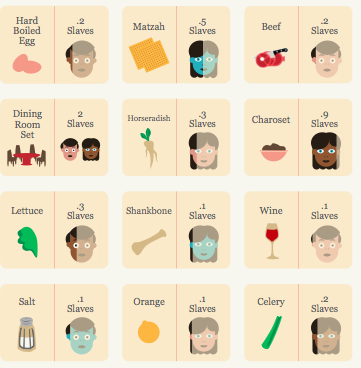
2012-04-03-slaveryatseder.png
Slavery Footprint's website allows people to visualize how their consumption habits are connected to modern-day slavery. You take an inventory of the goods in your home, and receive a score of how many slaves work to produce your lifestyle, based on what you own. Then, through the online action center and the "Free World" mobile application, you can take practical steps to demand products Made In A Free World by asking companies to check their supply chains for slave labor. Slavery Footprint's call to arms is for the ability for to buy things "Made in A Free World."
My organization, Rabbis for Human Rights-North America, has partnered with Slavery Footprint to produce an activity for Passover based on the larger Slavery Footprint survey. It can bedownloaded from our website for free. Ask your seder guests the question: How many slaves produced the goods on our table? Challenge them to commit to take action.
As the seder begins, we say metaphorically, "This year, we are slaves. Next year, may we be free people." Let us hope that by next Passover, our feasts of liberation will be made without slave labor and that more people will be free.
Enhanced by Zemanta

Wednesday, March 28, 2012

The Tomato Finds Its Place On The Seder Plate | The Jewish Week

http://www.thejewishweek.com/special_sections/special_holiday_issues/tomato_finds_its_place_seder_plate

Source: The Jewish Week

Workers’ rights join other social issues symbolized by food items at Passover.

Staff Writer
Tuesday, March 27, 2012

The pre-Passover shopping list of Rabbi Paula Marcus is growing this year.

A pulpit rabbi in California, she will buy the standard items this week: some kosher food, some boxes of matzah, some bottles of wine. And one non-standard item: a tomato.

The tomato is for her seder plate, not for a recipe.

A member of Rabbis for Human Rights, an interdenominational, Israeli-based organization that numbers modern-day slavery among its educational and advocacy issues, Rabbi Marcus will put the tomato in the center of her seder plate — alongside the traditional bitter herbs, charoset, parsley, shank bone and eggs, and an orange, a recent addition in many homes — as a symbol of contemporary slavery.

Moved by the two visits to tomato-growing country in Florida that delegations of RHR rabbis conducted in the last year, meeting with often-underpaid and overworked tomato pickers, and conducting “pray-ins” at supermarkets that had not signed a Fair Food Act that guarantees higher pay and better working conditions, the rabbi decided to put a tomato on her seder table as a reminder of the workers’ plight.

“It’s just obvious to me,” she says.

“We imagine what it was like to be slaves and celebrate our freedom,” she wrote recently in San Francisco’s jweekly newspaper. “But the truth is, there are people in our own country who don’t have to imagine what it is like to be a slave.”

Over the last few years, the issues of actual slavery (estimates of people working today as slaves in the world today range between 12 and 27 million) and workers’ rights (many, like the tomato pickers in Florida, are said to work in near-slavery conditions) have achieved greater visibility in parts of the Jewish community. Especially at Passover, the holiday that commemorates the ancient Hebrews’ freedom from slavery. Individual seder leaders, and organizations like RHR (which produces an “anti-slavery” Haggadah supplement and table cards that contain stories of modern-day slavery), Boston’s Workmen’s Circle branch and Congregation Dorshei Tzedek in West Newton, Mass., have incorporated reminders of farm workers’ rights into their seder readings.

This year the tomato — along with words of accompanying text — becomes the latest symbolic food officially added to some seder tables.

RHR and the Coalition of Immokalee Workers (the central labor representative of agricultural workers “in low-wage jobs” in Florida) this week announced that they are urging Jewish homes to put a tomato on their seder plate.

“The foods on the seder plate are meant to elicit questions that lead to the telling of the story of the Exodus,” according to a statement released by RHR and CIW. “We hope the tomato will lead to questions about the legacy of slavery today and to discussion about the progress being made by the CIW — supported by Jewish communities — to bring about a just- slavery-free workplace.”

During a holiday that fosters both memory and creativity (think of the new tradition of the Miriam’s Cup, which celebrates women’s role in deliverance), the seder plate, whose rituals were established at least a millennium ago, has increasingly become that palette on which Jews express their social, political and theological concerns.

Symbolic items that have found their way onto the seder plate over the years include:

♦ potato peelings or beets, to commemorate Jews who starved during the Holocaust.

♦ a fourth matzah, for Soviet Jews who were not free to practice Judaism.

♦ a roasted potato or a boiled beet, in place of a shank bone, for vegetarians who don’t want meat on their tables. Other people used the potato as a symbol of solidarity with Ethiopian Jews who, because of their earlier near-starvation diets, were unable to eat much substantial food when they first arrived in Israel.

♦ an olive, for peace in the Middle East.

♦ a crust of bread, to express the exclusion of women and homosexuals from parts of the Jewish community. Or an orange, for the same reason.

♦ an artichoke, a symbol for interfaith families.

♦ a plantain, symbolizing oppression in Cuba.

♦ an empty picture frame or an unlit candle, to symbolize China’s suppression of Tibet, including its ban on pictures the Dalai Lama.

♦ Fair Trade chocolate or cocoa beans, a symbol of forced labor.

♦ during the Civil War, a brick. It was an innovation by a Union soldier who was unable, during a battle, to provide charoset.

Last year essayist Paul Greenberg suggested, in The New York Times, an oyster on the seder plate, to remember the first anniversary of the Deepwater Horizon blowout in the Gulf of Mexico.

But modern-day slavery has become the seder-night issue du jour. And the seder, says Rabbi Tsvi Blanchard, a faculty member at Clal – The National Jewish Center for Learning and Leadership, “has become a public forum. It’s a great time to make a statement.”

Seder plate additions “are within the spirit” of the holiday, he says.

These symbols are intended to make a link between the biblical story of the Jews leaving Egypt, and participants’ contemporary narratives. Their lasting power varies.

“Some things are of the moment. Some can have lasting significance,” says Rabbi Michael Strassfeld, spiritual leader of the Society for the Advancement of Judaism synagogue on the Upper West Side and co-author of the take-Judaism-into-your-own-hands series of “Jewish Catalogs” a generation ago.

“Here’s a place where it makes sense,” Rabbi Strassfeld says of the tomato, adding that seder plate innovations are popular because seders take place in people’ homes, where “There is no rabbi to say ‘Don’t do that.’ It’s up to us.”

“The whole idea” of the seder rituals, says Rabbi Steve Gutow, president of the Jewish Council for Public Affairs, is to give the message that “it isn’t something that happened thousands of years ago.” Slavery and oppression didn’t end at the Exodus. The number of people working now as slaves “is increasing — dramatically,” he says.

A tomato on a seder plate “makes total sense,” Rabbi Gutow says. Such additions “help us reflect on the past.”

Every few years seem to bring another symbolic addition to the seder plate. Rabbi Sid Schwartz, a senior fellow at Clal and director of a national interfaith social justice project based at Auburn Theological Seminary here, refers to the trend as a part of Jews’ “continuous revelation,” which “enhances” the Pesach experience. “The creation of ritual,” he says, is “a great affirmation of [Jews] taking Judaism seriously.”

Rabbi Marcus says she will put a tomato on the seder plate of every seder she attends this year, including a model seder during the week before the holiday begins.

Like the other seder readings and rituals, it’s intended to provoke questions, she says; she’s ready to talk about contemporary slavery.

She’ll buy a big tomato, “not a cherry tomato,” at a local grocery that stocks produce from a farm that pays its workers a living wage, says Rabbi Marcus, who has served since 1979 at Temple Beth El in Aptos, Calif., as teacher and cantor and now as spiritual leaders.

Will Rabbis for Human Rights suggest a tomato on the seder plate again next year?

Probably, says Rabbi Rachel Kahn-Troster, Rabbis for Human Rights’ director of North American Programs. Unless the need for the symbolism — i.e., slavery — disappears.

“It will be great,” she says, “if we can take it off.” •

E-mail: steve@jewishweek.org

Related articles

Enhanced by Zemanta