Showing posts with label DNA database. Show all posts

Monday, March 12, 2012

Over 24,000 women, children freed in human-trafficking crackdown - The Irish Times - Mon, Mar 12, 2012

Over 24,000 women, children freed in human-trafficking crackdown - The Irish Times - Mon, Mar 12, 2012

SOURCE: The Irish TimesMonday, March 12, 2012

CLIFFORD COONAN in Beijing

POLICE IN China rescued over 24,000 kidnapped women and children nationwide last year, the country’s public security ministry told the annual parliament, the National People’s Congress, in an ongoing crackdown on human trafficking.

In all, police rescued 8,660 abducted children and 15,458 women in busts of 3,195 human trafficking gangs during 2011, the ministry said.
Girls who are kidnapped are often sold into prostitution and in one high-profile case last year, the police busted a gang that was trafficking women to Angola. In the raid, 19 women were rescued and 16 suspects were apprehended.
Human trafficking is a major problem in China, as the traditional preference for boys over girls, especially in rural areas, and the one-child policy of population control, has seen a rise in the number of boys kidnapped and sold, often to childless couples.
Girls and women also are abducted and used as labourers or as brides for unwed sons, because the one-child policy has seen a massive discrepancy in the birth ratio between the number of boys and girls.
In July last year, 89 children were rescued when police busted two major human-trafficking rings in south China, and the suspects were mostly Vietnamese, smuggling children from Vietnam into China.
The ministry also cited the ministry’s work in helping reunite children with their families, using new technology such as a DNA database for missing children.
The ministry has also opened up a Weibo microblog account to help gather intelligence on missing persons cases.
“The ministry reaffirmed its tough stance on trafficking and vowed sterner crackdowns against such crimes,” Xinhua News Agency said.
The ministry did not give any figures for the total number of women and children abducted last year.
Abductions and human trafficking have become serious public concerns after a string of revelations in past years, including a shocking 2007 scandal in which thousands were forced into slave labour in brickyards and mines across the nation.
The latest big case was on Friday, when police rescued 77 children and arrested 310 suspects after busting four child-trafficking rings, where gangs were buying infants in poor rural areas and selling them to big cities.
More than 7,000 police officers from 14 provinces, including Shandong, Guizhou, Henan, Shanxi, Yunnan and Guangxi, took part in a joint operation.
Enhanced by Zemanta

Wednesday, December 7, 2011

China trafficking crackdown leads to rescue of 178 children | World news | The Guardian

http://www.guardian.co.uk/world/2011/dec/07/china-trafficking-crackdown-rescue-childrendian

Police arrest more than 600 people from two child trafficking networks after six-month investigation involving 5,000 officers

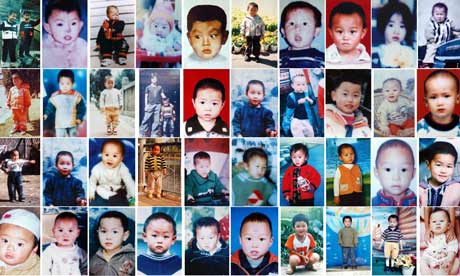
Images of children, mostly boys, who are thought to have been stolen by trafficking gangs in China
A montage of images of children, mostly boys, who are thought to have been stolen by trafficking gangs in China. Photograph: Rex Features

Chinese police have arrested more than 600 people and rescued 178 children in crackdowns on two trafficking networks.

The ministry of public security said on Wednesday that 5,000 officers across 10 provinces had been involved in the six-month investigation.

Authorities recorded 5,900 cases of trafficked children in China last year, although experts believe the true figure is much higher. Many children are recorded simply as missing because their parents cannot prove they were kidnapped.

Boys are particularly at risk and command higher prices as they are often sold to rural families who want an heir. Older girls are bought as brides for sons, while others are forced to work or to beg on the streets, experts say.

The raids appear to have taken place last week, but police in the south-western Sichuan province first discovered one group which had sold 26 children to other parts of the country while dealing with a traffic accident in May. They named the ringleader as Cai Lianchao.

Separately, police in the eastern Fujian province detected an "outsize" gang trading children across provinces in August. They named one member as Chen Xiumei but did not identify the other suspects.

The ministry's statement said the rescued children have been put in the care of female police officers and will be placed in orphanages until their parents can be found.

"Police departments will continue to crack down on child trafficking and ensure that involved children are kept out of the reach of buyers," it added.

The cases demonstrate the sophistication and reach of many of the trafficking operations, with abducted children often traded across the country to make it harder to find them. Police recently reported rescuing infants trafficked across the border from Vietnam as well.

Parents have complained of police inefficiency and indifference. In many cases their search for their missing children has relied primarily on their own efforts and those of others who have been affected.

Microbloggers have also sought to reunite families by sharing pictures of missing children and those seen begging on the streets.

Authorities stepped up efforts to tackle the problem two years ago. The ministry's statement said police had cracked more than 7,000 trafficking rings since April 2009, rescuing more than 18,500 children and 34,500 women.

They have also launched a DNA database to help match children with parents, since many are snatched as babies or toddlers.

Despite their efforts, however, some children have been returned to the families that bought them because it has proved impossible to track down their parents and they have become attached to their new families.

Chen Shiqu of the ministry of public security said the main cause of the crime was demand and that buyers should lose both money and children, but it is not clear whether that policy will be applied to all cases.

Chinese criminal law says that buyers are not held criminally responsible as long as they have not mistreated the children or obstructed the police rescue operation.

Authorities are also considering amending the law on adoptions. At present children cannot be adopted if their parents cannot be traced, and must be left in care homes.

Related articles
Enhanced by Zemanta