June 26, 2013 - 10:49AM


When China gets tough on crime or malfeasance in office, executions or severe prison sentences frequently follow. The precise number of these executions is a state secret and only those put to death for particularly heinous crimes receive special attention from the state media. They are alerted when the government wants to demonstrate its growing intolerance with a specific criminal activity such as corruption, disregard for food safety, soliciting bribes as a state official, or human trafficking.
The highest-ranking offender in recent years was former food and drug regulator Zheng Xiaoyu, who went to his death in 2007 for taking bribes to approve untested medicine at a time when Beijing was trying to show it was serious about improving the safety of Chinese products. The most recent was female gangland prostitution ringleader Wang Ziqi, who was executed this week for forcing hundreds of women into prostitution in Chongqing, southwest China. Aided by her sister, she would lure the women into working in beauty salons, hotels or teahouses, seize their identity cards and then force them into prostitution and confiscate their earnings. One girl, who was paralysed after jumping from the eighth floor of a brothel in a bid to escape in 2003, was forcibly detained until rescued by police six years later.
Such abuse is not a problem that is confined within China's borders. Officials in Beijing directing the fight against human trafficking, say that an increasing number of women from Southeast Asia are being smuggled into China, and sold into marriage or forced to work as prostitutes.
Many of these trafficked women come from poor rural areas of Vietnam, Burma and Laos and are lured by transnational criminal gangs with promises of good jobs or marriage with rich Chinese men who find themselves without wives because of the gender imbalance.
On arrival the victims are often sold to villagers as brides, or forced to become sex workers in underground brothels. State media reports say the women are "purchased" for between 20,000-50,000 yuan (96,000 to 242,000 baht) each. This is modern-day slavery but the profit margins are so immense, the payoffs so huge and the demand so unrelenting it will be a nightmare to stop. No single country has total jurisdiction, and transnational suppression operations are fraught with language and cultural difficulties and the absence of a proper chain of command. Look no further than the Somali pirates in the Gulf of Aden for an example of how hostage-takers become adept at exploiting transnational barriers. China, as the destination country for these gangs, is going to have to prove once again how tough it can be.
Exploitation occurs in our own country, although on a lesser scale than it used to. Nowadays the victims are not always Thai, or even female. And no one should assume the absence of recent high-profile convictions means home-grown traffickers have reformed. Far from it.
They have merely turned their attention elsewhere. With porous borders and a prosperous economy, Thailand is a magnet for migration. Most of it comes from Burma, Laos and Cambodia and young men, many underage, are trafficked into slavery in the fishing industry and condemned to spend months at sea in appalling conditions.
The solution to human trafficking lies in enforcing the law, in better education and in awareness campaigns directed by some very smart and creative people.

Police arrest more than 600 people from two child trafficking networks after six-month investigation involving 5,000 officers
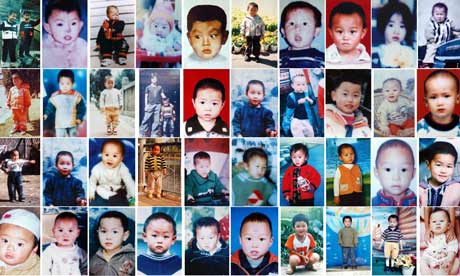
Chinese police have arrested more than 600 people and rescued 178 children in crackdowns on two trafficking networks.
The ministry of public security said on Wednesday that 5,000 officers across 10 provinces had been involved in the six-month investigation.
Authorities recorded 5,900 cases of trafficked children in China last year, although experts believe the true figure is much higher. Many children are recorded simply as missing because their parents cannot prove they were kidnapped.
Boys are particularly at risk and command higher prices as they are often sold to rural families who want an heir. Older girls are bought as brides for sons, while others are forced to work or to beg on the streets, experts say.
The raids appear to have taken place last week, but police in the south-western Sichuan province first discovered one group which had sold 26 children to other parts of the country while dealing with a traffic accident in May. They named the ringleader as Cai Lianchao.
Separately, police in the eastern Fujian province detected an "outsize" gang trading children across provinces in August. They named one member as Chen Xiumei but did not identify the other suspects.
The ministry's statement said the rescued children have been put in the care of female police officers and will be placed in orphanages until their parents can be found.
"Police departments will continue to crack down on child trafficking and ensure that involved children are kept out of the reach of buyers," it added.
The cases demonstrate the sophistication and reach of many of the trafficking operations, with abducted children often traded across the country to make it harder to find them. Police recently reported rescuing infants trafficked across the border from Vietnam as well.
Parents have complained of police inefficiency and indifference. In many cases their search for their missing children has relied primarily on their own efforts and those of others who have been affected.
Microbloggers have also sought to reunite families by sharing pictures of missing children and those seen begging on the streets.
Authorities stepped up efforts to tackle the problem two years ago. The ministry's statement said police had cracked more than 7,000 trafficking rings since April 2009, rescuing more than 18,500 children and 34,500 women.
They have also launched a DNA database to help match children with parents, since many are snatched as babies or toddlers.
Despite their efforts, however, some children have been returned to the families that bought them because it has proved impossible to track down their parents and they have become attached to their new families.
Chen Shiqu of the ministry of public security said the main cause of the crime was demand and that buyers should lose both money and children, but it is not clear whether that policy will be applied to all cases.
Chinese criminal law says that buyers are not held criminally responsible as long as they have not mistreated the children or obstructed the police rescue operation.
Authorities are also considering amending the law on adoptions. At present children cannot be adopted if their parents cannot be traced, and must be left in care homes.

 Image via Wikipedia
| English.news.cn 2010-12-30 21:46:12 |  Feedback   Print  RSS   |
BEIJING, Dec. 30 (Xinhua) -- China's law enforcement agencies have set a deadline for suspects involved in the abduction and trafficking of women and children, as they must surrender within the first three months of 2011 or face severe punishment.
China's Ministry of Public Security said Thursday that it would issue a joint notice with the Ministry of Justice, the Supreme People's Court and the Supreme People's Procuratorate Saturday, ordering human trafficking suspects to surrender by the end of March 2011.
The suspects under the surrender order are those who have committed abductions and trafficking of women and children, the buyers of abducted women and children, and those who prevent the rescue of abducted women and children, according to the notice.
These three groups of suspects will face severe punishments if they do not turn themselves in by the deadline or try to transfer or hide the abducted women and children, said the notice.
On the other hand, those who surrender within the deadline may receive lighter or mitigated punishment and, for those with minor offenses, even exemption from punishment.
Despite police crackdowns, human trafficking of women and children has persisted in the country, where males outnumber females and the concept of preferring boys to girls has long taken hold.
Chinese police have been tough on these crimes. In a crackdown begun in April, Chinese police freed 10,621 women and 5,896 children who had been abducted and sold for profits as of September 2010.
In the campaign, police nationwide apprehended 2,398 human trafficking gangs and documented 13,500 such cases.

 Image via Wikipedia


Desperate families claim trafficking gangs are selling baby boys for up to £4,000
Wednesday, 6 October 2010
 GETTY IMAGES A girl rescued from child traffickers in Guiyang last year
They came from across China to protest under the watchful gaze of the police, brandishing handmade placards with pictures of their missing children. In a sign of growing discontent, the parents' rare demonstration in the centre of Beijing was aimed at pressuring the authorities to do more to investigate the cases of tens of thousands of children snatched and sold every year.
"My wife and I can't sit at home waiting for the police, we keep looking. The longer you wait, the more hopeless you get," said the father of one boy Liu Jingjun, who went missing this year.
Many of China's missing boys are sold to childless couples who turn to criminal gangs to supply the treasured male heir while the girls are trafficked to become prostitutes or brides in rural areas. China's One Child Policy has led to an alarming shift in the gender divide with a major shortage of girls.
Baby boys can sell for as much as £4,000, while girls are sometimes sold for just £300, according to some child welfare groups. Some end up working in brick kilns in the heartland, others as beggars in the booming cities of the east coast. Scandals have occasionally erupted over the sale of abducted children to orphanages for adoption abroad.
The parents protesting in Beijing met through a website called "Baby Come Home" which lists more than 2,000 missing children and led to an informal network of desperate adults. Some were reluctant to give their names in Beijing because of the police presence and many returned home after authorities told them to end the protest.
The authorities responded to the problem in April last year with a high-profile public crackdown on trafficking. Officials say this has led to the break-up of nearly 2,400 criminal gangs and seen nearly 16,000 people detained.
But the US State Department's trafficking report for 2010 said that despite significant efforts, the government did not comply with the "minimum standards" for eliminating trafficking. It said there were continued reports of children being forced into prostitution.
China does not give figures, but an estimate based on reports for a British television documentary suggested that up to 70,000 children were snatched from the streets every year in China.
In a country where the social welfare net is still being constructed, having a child provides security in old age. A preference for males is common in China's rural regions, and families sometimes abort baby girls because they are limited to one or two children by family-planning laws.
But this preference has caused a potentially disastrous gender imbalance in the world's most populous country. In some regions, the male-female ratio can be as high as 130 males for every 100 females, compared to an average ratio of 107-to-100 in industrialised countries.
Daughters become members of their husband's family when they marry and move away, prompting the saying: "Raising a daughter is like watering someone else's fields", whereas boys grow into men who can till the fields and work as migrant labourers in the cities.
The gender gap has created a situation where there are not enough women of marrying-age for China's single men – and organised gangs have moved in to fill the gap.
Police say they have freed more than 10,000 abducted women including 1,100 foreigners, mostly from Vietnam, Cambodia, Laos and Mongolia, since April last year as the widening gender gap fuels bride trafficking and prostitution.
One mother from Datong in Shanxi province lost her daughter Wang Min back in 1997 and has been searching for her ever since. "My daughter was only eight when she disappeared, she'd be 21 now," says her mother, her voice cracking as she spoke. "I went to the police immediately after she disappeared, but since I cannot provide any evidence to the police, they cannot really give any practical help. All I can do is travel to places when I hear of a clue.
"I have another child now, but I still miss Wang Min, I miss her a lot. Maybe I won't even recognise her now if she passed me in the street, but I will never give up hope of finding her," she said.
Li Ni's son disappeared in February 2009 in Xi'an. "A lot of parents have already travelled to nearly all the provinces in China, using all the money in the family," she said.
"I am so desperate to find my son and I will continue to look for him using whatever means necessary, no matter how long it takes, no matter how many hardships I have to endure."
"I believe those who abducted our kids, they are still human beings, they still have feelings just like you or me. I know of one kidnapper who took a kid for a long time, then saw the pain he was causing the parents on the media, so he brought him back because of the pressure from his heart," she said.
"Maybe one day my son will also come back to me in this way, and I will fight for him until that day."


 Image by Getty Images via @daylife
English.news.cn 2010-07-28 09:13:16
BEIJING, July 28 (Xinhuanet) -- Chinese police are speeding up the establishment of a national DNA database to help missing children find their parents as quickly as possible, the Ministry of Public Security (MPS) said on Tuesday.
"The DNA database has helped reunite 730 children with their families," Meng Qingtian, an official with the ministry's anti-trafficking office, told China Daily at an international forum on human trafficking hosted by the All China Women's Federation in Beijing on Tuesday.
The database has already collected 107,000 samples from lost children and 35,000 from the parents of missing children, she said.
The database is composed of blood samples taken by the police from missing children's parents, children suspected of having been abducted or with an unclear history, children in social welfare institutes, homeless children and child beggars, according to the ministry.
Information on the database is shared among the 236 DNA laboratories in the country.
"All homeless children must take blood tests before they can be adopted and this information will be included on the DNA database," Meng said. "Chinese children adopted by foreign families are also required to take the test."
It costs 100 yuan ($14.8) to take a blood sample, while the cost of DNA tests vary. In Beijing, each DNA test costs at least 2,400 yuan, she said.
Police authorities cover the expense, so the service is free for parents and children.
During a nine-month anti-trafficking campaign, which began in April 2009, police rescued a total of 14,717 women and children, according to the ministry's latest data.
They arrested 17,528 suspects, including 19 who had a level A (most wanted) warrant against them.
About 30,000 to 60,000 children are reported missing every year in China, but it is hard to estimate how many are cases of human trafficking, the ministry said.
"The increasing number of trafficking cases in China is due to a large buyer's market and poor awareness of victims," Zhang Jing, a senior official of the All China Women's Federation, said at the forum on Tuesday.
Boys are especially in demand, because many Chinese families in rural areas want to have a son to carry on the family name, partially because the country's land allotment system is biased towards males.
In cities, the "incomplete social security system" places children in the migrant population at higher risk of being kidnapped, Meng said.
Since it is hard for them to enter kindergartens or schools in cities, they are easy prey for traffickers while their parents are busy working to earn money, she added.
Police across the country will treat all cases of missing women and children as crimes, setting up a special investigative team for each incident, in the latest bid to curb human trafficking, the MPS announced earlier this month.
The move, which follows the nine-month campaign against human trafficking, aims to allocate more manpower and resources to cases involving missing women and children.
(Source: China Daily)
| Editor: Bi Mingxin |
|

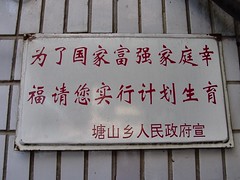 Image by Planet Love via Flickr

