Showing posts with label El Salvador. Show all posts

Sunday, February 6, 2011

Defending the Dignity of Migrant Workers » Blog of Rights: Official Blog of the American Civil Liberties Union

Feb 4th, 2011
Posted by Aron Cobbs,
Human Rights Program at 4:43pm


Tuesday marked the 146th Anniversary of National Freedom Day, the day on which President Abraham Lincoln signed the joint congressional resolution that outlawed slavery and became the 13th Amendment to the U.S. Constitution. In remarks to the president's Interagency Task Force to Monitor and Combat Trafficking in Persons, Secretary of State Hillary Clinton stated that "modern slavery, often hidden and unrecognized, persists today on every continent and, most tragically, right here in the United States, despite being prohibited by both domestic legislation and international law."

On that same day, the ACLU and its co-counsel filed for class certification (PDF) in a case on behalf of over 500 Indian guestworkers. The lawsuit alleges the workers were trafficked into the U.S. and subjected to squalid living conditions, fraudulent payment practices, and threats of serious harm under the control of Signal International, LLC, a company that builds ships and offshore oil drilling rigs.

The lawsuit was first filed in the U.S. District Court for the Eastern District of Louisiana in March 2008. The ACLU is co-counsel with the Southern Poverty Law Center, the Asian American Legal Defense and Education Fund, the Louisiana Justice Institute, and Dewey & LeBoeuf LLP. If class status is granted, it could be the largest human trafficking case in U.S. history.

The complaint alleges that recruiting agents hired by Signal International held the guestworkers' passports and visas, coerced them into paying extraordinary fees for recruitment, immigration processing and travel, and threatened the workers with serious legal and physical harm if they did not work under the Signal-restricted guestworker visa. Between 2004 and 2006, hundreds of Indian men paid as much as $20,000 each for travel, visa, recruitment and other fees under the pretense that it would lead to good jobs and permanent U.S. residency for them and their families.

The complaint also claims that once in the U.S., the workers were housed at Signal's overcrowded, unsanitary and racially segregated labor camps, where as many as 24 men shared a trailer with only two toilets. The lawsuit charges Signal and its agents have violated the Victims of Trafficking and Violence Protection Act (TVPA) and the Racketeer Influenced and Corrupt Organizations (RICO) Act. In addition to Signal's corporate violation of domestic laws and polices, the federal government has failed to protect the rights of migrants under the International Convention on the Protection of Rights of All Migrant Workers and Members of Their Families (ICPRMW), as proven by the lack of government oversight necessary to prevent such a trampling of rights.

Also Tuesday, the FBI, Department of Agriculture and Department of the Interior joined — for the first time — the Interagency Task Force to Monitor and Combat Trafficking in Persons meeting, which suggests that various governmental agencies and departments are now strengthening their efforts to remedy this endemic domestic issue and, hopefully, advance lawsuits against culpable corporations. Fulfillment of the task force's mandate, in addition to greater overall respect for international norms, are opportunities the U.S. must seize to affirm the human rights to which all migrants are entitled.

Learn more about immigrants' and workers' rights: Subscribe to our newsletter, follow us on Twitter, and friend us on Facebook.

Source: aclu.org/blog/human-rights-immigrants-rights
Defending the Dignity of Migrant Workers » Blog of Rights: Official Blog of the American Civil Liberties Union
Enhanced by Zemanta

Wednesday, December 22, 2010

FoxBusiness.com - More Countries Use Child Labor, U.S. Says

By Elizabeth MacDonald
Published December 16, 2010
 
The U.S. Department of Labor just announced it has added six new products from a dozen new countries, 11 in Africa, to the list of countries that use child labor or forced child labor to produce goods for markets around the globe. 

The Labor Department now says a total of 128 goods from 70 countries are made by child or forced child labor, meaning children under the age of 15, in violation of international standards. Many children around the world work in slave or bondage conditions, the department says.

The Labor Department says an estimated 115 million children worldwide are child workers, working in dangerous conditions that are hazardous to their health, says the International Labor Organization.

More than 12 million children and adults “are trapped in forced labor around the world,” the report says. The list of countries fighting child and forced child labor has grown to 170, including the U.S., which has taken an active role.
Forced child labor is still a major problem plaguing the world’s markets.

Children are either forced by governments into labor, or governments ignore companies that forcibly employ them, in Angola, Argentina, Bolivia, Brazil, Burma, China, Colombia, Ethiopia, India, Kazakhstan, Malaysia, Nigeria, North Korea, Pakistan, Russia, Thailand and Uzbekistan, among others.

Under forced labor conditions, children produce jewels and precious metals like diamonds, sapphires, gold and silver; clothes; coal; tobacco; food items like poultry, nuts and sugar; construction materials like bricks; and Christmas decorations, electronic goods, fireworks, footwear and toys; and pornography.

The worst forms of child labor include slavery, forced labor, debt bondage, trafficking, illicit activities like drug dealing, commercial sexual exploitation and armed conflict, as well as hazardous working conditions, such as mining for precious metals or jewels in lakes filled with chemicals and nothing more.

U.S. Labor Secretary Hilda Solis said in a statement: "We consider the eradication of the worst forms of child labor to be a matter of urgency,” adding, “no human being should work under conditions of forced labor or debt bondage or be forced to work under fear of punishment. Shining a light on these problems is a first step toward motivating governments, the private sector and concerned citizens to take action to end these intolerable abuses that have no place in our modern world."

The Labor Department says its Bureau of International Labor Affairs developed the reports based on data collected from U.S. embassies, foreign governments, international and nongovernmental organizations, as well as information gathered from field research projects, academic research and the media.

The newcomers to the list are Angola, Central African Republic, Chad, El Salvador, Ethiopia, Lesotho, Madagascar, Mozambique, Namibia, Rwanda, Zambia and Zimbabwe.

India has the greatest number of child laborers, followed by China. Smaller nations in sub-Saharan Africa have a higher percentage of children, as much as a third of children under 14, who work in diamond mines or other factories instead of going to school. One in every four children in sub-Saharan Africa was engaged in child labor in 2008, the most recent data available.

But the Labor Department says there is some good news. It removed Brazil from the list for child labor used in charcoal production. And it says India and some other countries have moved to stop child labor through anti-poverty programs and compulsory education. Brazil, Thailand, Jordan, Ivory Coast and Ghana also won praise by the department for their efforts in fighting child labor.

In its report, the department also notes that “some countries with relatively large numbers of goods on the list may not have the most serious problems of child labor or forced labor,” adding, “often, these are countries that have adopted a more open approach to acknowledgement of the problems, have better research and have allowed information on these issues to be disseminated.”

The labor department says these countries “include Argentina, Bolivia, Brazil, Colombia, Ecuador, El Salvador, India, Kenya, Mexico, Philippines, Tanzania, Turkey, Uganda and Zambia.” The Labor Department says it has spent more than $740 million in programs to help more than 80 countries combat child labor since 1995.

Iowa Democrat Senator Tom Harkin sponsored a law in the late 1990s that outlawed any company in the U.S. from importing goods made via child labor. In 2005, Congress passed the “Trafficking Victims Protection Reauthorization Act of 2005,” which directs the Labor Department to compile a list of goods produced by child or forced child labor. The first list was produced last year.

http://www.foxbusiness.com/markets/2010/12/16/countries-use-child-labor-says/#ixzz18sSd6f3L


Enhanced by Zemanta

Tuesday, December 21, 2010

A dozen nations added to child, forced labor list

Secretary of Labor Hilda Solis speaks during a news conference at the Department of Labor in Washington regarding the release of three reports on international child labor and forced labor, Wednesday, Dec. 15, 2010.

(12-15) 10:44 PST 
WASHINGTON, (AP) --

The Labor Department is adding a dozen countries to the list of nations that use child labor or forced labor, as officials warn the global economic crisis could cause an upswing in the exploitation of children and other workers.

From coffee grown in El Salvador to sapphires mined in Madagascar, the agency's latest reports released on Wednesday identify 128 goods from 70 countries where child labor, forced labor or both are used in violation of international standards.

"Shining light on these problems is a first step toward motivating governments, the private sector and concerned citizens to take action to end these intolerable abuses that have no place in our modern world," said Labor Secretary Hilda Solis.

New to the list are Angola, Central African Republic, Chad, El Salvador, Ethiopia, Lesotho, Madagascar, Mozambique, Namibia, Rwanda, Zambia and Zimbabwe.

The annual reports are not intended to punish or shame the countries where an estimated 215 million child laborers toil in factories, on farms or as domestic helpers. In fact, the agency says many of the countries that appear on the list are taking steps to address child labor problems. Labor Department officials say making the public aware of the problem helps promote efforts to combat child labor.

While the total number of child laborers fell by about 3 percent from 2004 to 2008, the rate of decline has slowed in recent years.

"I think the very recent picture gives us significant cause for concern," said Sandra Polaski, deputy undersecretary for the Bureau of International Labor Affairs. "That has a lot to do with the economic crisis."

India remains home to the greatest number of child laborers, followed by China. But smaller nations in sub-Saharan Africa have a much higher proportion of children — up to one-third of children under 14 — who go to work instead of school each day.

For the first time, the reports include a set of proposed actions for each government to consider to help reduce the problems detailed.

The agency praises India and some other countries for working to address the problem through anti-poverty programs and compulsory education. Brazil, Thailand, Jordan, Ivory Coast and Ghana also win plaudits for their efforts to combat child labor.

At the same time, the report calls out some of the worst offenders. They include Uzbekistan, where local officials require children to pick cotton, and Myanmar, where forced labor of adults and children helps produce everything from sugar and teak to rubber and rubies.

"They know what the problem is and they know how to fix it, they just need to get serious about doing it," Polaski said.

The problem is complicated in countries like India, Pakistan and Tonga that have no legislation setting a minimum age for work. That makes children more vulnerable to being pulled into hazardous or grueling trades.

Some of the most common products produced by child labor or forced labor include cotton, sugar cane, tobacco, coffee, bricks, gold, diamonds and coal.

Since 1995, the Labor Department has spent more than $740 million in programs to help more than 80 countries combat child labor.

The agency is also working to combat instances of child labor in the United States. Last year, for example, investigators from the agency's Wage and Hour Division found children as young as 6 working on blueberry farms in Michigan. Eight farms were fined about $36,000 for violating federal migrant-housing and child-labor laws.

Solis said inspections this year during the harvest in Michigan, New Jersey and North Carolina have yet to find child labor violations.
Source: sfgate.com
 http://www.sfgate.com/cgi-bin/article.cgi?f=/n/a/2010/12/15/national/w000240S22.DTL#ixzz18midxjs1

Enhanced by Zemanta

Friday, December 17, 2010

A dozen nations added to child, forced labor list - Yahoo! News

Wed Dec 15, 1:44 pm ET

AP 
Tom Harkin 


AP – Secretary of Labor Hilda Solis speaks during a news conference at
the Department of Labor in Washington …


WASHINGTON – The Labor Department is adding a dozen countries to the list of nations that use child labor or forced labor, as officials warn the global economic crisis could cause an upswing in the exploitation of children and other workers.

From coffee grown in El Salvador to sapphires mined in Madagascar, the agency's latest reports released on Wednesday identify 128 goods from 70 countries where child labor, forced labor or both are used in violation of international standards.

"Shining light on these problems is a first step toward motivating governments, the private sector and concerned citizens to take action to end these intolerable abuses that have no place in our modern world," said Labor Secretary Hilda Solis.

New to the list are Angola, Central African Republic, Chad, El Salvador, Ethiopia, Lesotho, Madagascar, Mozambique, Namibia, Rwanda, Zambia and Zimbabwe.

The annual reports are not intended to punish or shame the countries where an estimated 215 million child laborers toil in factories, on farms or as domestic helpers. In fact, the agency says many of the countries that appear on the list are taking steps to address child labor problems. Labor Department officials say making the public aware of the problem helps promote efforts to combat child labor.

While the total number of child laborers fell by about 3 percent from 2004 to 2008, the rate of decline has slowed in recent years.

"I think the very recent picture gives us significant cause for concern," said Sandra Polaski, deputy undersecretary for the Bureau of International Labor Affairs. "That has a lot to do with the economic crisis."

India remains home to the greatest number of child laborers, followed by China. But smaller nations in  
sub-Saharan Africa have a much higher proportion of children — up to one-third of children under 14 — who go to work instead of school each day.

For the first time, the reports include a set of proposed actions for each government to consider to help reduce the problems detailed.

The agency praises India and some other countries for working to address the problem through anti-poverty programs and compulsory education. Brazil, Thailand, Jordan, Ivory Coast and Ghana also win plaudits for their efforts to combat child labor.

At the same time, the report calls out some of the worst offenders. They include Uzbekistan, where local officials require children to pick cotton, and Myanmar, where forced labor of adults and children helps produce everything from sugar and teak to rubber and rubies.

"They know what the problem is and they know how to fix it, they just need to get serious about doing it," Polaski said.

The problem is complicated in countries like India, Pakistan and Tonga that have no legislation setting a minimum age for work. That makes children more vulnerable to being pulled into hazardous or grueling trades.

Some of the most common products produced by child labor or forced labor include cotton, sugar cane, tobacco, coffee, bricks, gold, diamonds and coal.

Since 1995, the Labor Department has spent more than $740 million in programs to help more than 80 countries combat child labor.

The agency is also working to combat instances of child labor in the United States. Last year, for example, investigators from the agency's Wage and Hour Division found children as young as 6 working on blueberry farms in Michigan. Eight farms were fined about $36,000 for violating federal migrant-housing and child-labor laws.

Solis said inspections this year during the harvest in Michigan, New Jersey and North Carolina have yet to find child labor violations.
Source:
A dozen nations added to child, forced labor list - Yahoo! News
Enhanced by Zemanta

Monday, September 27, 2010

IOM - Press Briefing Notes - IOM and Mexico's National Human Rights Commission Sign Cooperation Agreement to Fight Human Trafficking and the Kidnapping of Migrants in Mexico


Posted on Tuesday, 14-09-2010
Mexico - Following last week's signing of a cooperation agreement between IOM and Mexico's National Human Rights Commission (CNDH by its Spanish acronym), a mass information campaign was launched in the northern border city of Ciudad Juarez, Chihuahua.

The agreement between IOM and CNDH and the new information campaign – "No más Trata de Personas", No More Human Trafficking – are focusing on combating human trafficking, the kidnapping of migrants, and other human rights violations against migrants, by raising awareness, defending and promoting the human rights of all migrants, and providing assistance to the most vulnerable.

"This cooperation agreement is vital for the two organizations to join forces to uphold the human rights of migrants, especially those most vulnerable – women, children, and unaccompanied minors," said Thomas Lothar Weiss, IOM Chief of Mission in Mexico.

Also, as part of the agreement, research on human trafficking and the kidnapping of migrants will be carried out, with the aim of compiling the necessary data and information needed to combat these crimes.

According to a 2009 investigation by CNDH, some 10,000 migrants were victims of kidnapping over a period of six months that year, but estimates put that number much higher. Most of the kidnapping victims are migrants from Central America, mainly Honduras and Guatemala. Criminal groups along the route north have adopted kidnapping of migrants as a new way to finance their operations with ransoms going between 500 and 3,000 US dollars. If migrants' families are unable to pay and the victims are unwilling to work with their kidnappers, they are murdered, often in large groups, such as in the recent mass murder of 72 migrants in San Fernando, Tamaulipas, along the Mexican Northern Border.

The information campaign is part of IOM's regional counter trafficking project funded by the US State Department Bureau of Population Refugees and Migration (PRM). Mexico is the fifth country in the region to launch the regional campaign; other countries include Costa Rica, El Salvador, Guatemala and Nicaragua.

Television and radio spots, as well as a radio soap opera, will carry the message to audiences in the northern and southern border cities of Ciudad Juarez, Chihuahua and Tapachula, Chiapas; cities where IOM has sub-offices and carries out anti-trafficking activities.

The states of Chihuahua and Chiapas are places of origin, transit and destination for migrants, many of whom are vulnerable to human trafficking.

According to estimates provided by CNDH, each year more than 20,000 persons fall victim to trafficking in Mexico, mainly in border areas and in tourist destinations.

Since 2005, IOM has provided assistance to 176 victims of trafficking, 80 per cent of whom were found and assisted along Mexico's southern border. The vast majority are from Central America.

For more information, please contact:

Hélène Le Goff
IOM México
Tel: +52 55 55 36 39 22
E-mail: hlegoff@iom.int


Source: IOM

IOM - Press Briefing Notes - IOM and Mexico's National Human Rights Commission Sign Cooperation Agreement to Fight Human Trafficking and the Kidnapping of Migrants in Mexico
Enhanced by Zemanta

Friday, August 27, 2010

Human trafficking second only to drugs in Mexico - CNN.com

FROM CNN
 
By Arthur Brice, CNN
August 27, 2010 -- Updated 1214 GMT (2014 HKT)
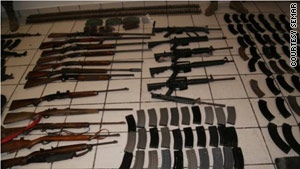
These guns were found at the Mexican ranch in Tamaulipas state, where 72 bodies were discovered.
These guns were found at the Mexican ranch in Tamaulipas state, 
where 72 bodies were discovered.
 
STORY HIGHLIGHTS
  • The road to the United States goes through Mexico for Central Americans
  • The journey is "one of the most dangerous in the world," rights group says
  • Thousands of migrants are abused each years by smugglers and drug cartels
  • Human smuggling may be a $20 billion business in Mexico
(CNN) -- Mario Santos likely never made it to the United States.
The 18-year-old set out 10 years ago from his native El Salvador in search of opportunity and a better way of life. But he had to travel north through Mexico first.

A short while after leaving, he called his parents to tell them he had been beaten and robbed in Mexico, left penniless and without shoes or clothes. It was the last they heard from him.

While it's not certain that Santos is dead, he probably suffered the same fate as 72 migrants from Central and South America whose bodies were found this week in a ranch in northern Mexico, just 90 miles from the U.S. border.

Officials are investigating whether they were the victims of human traffickers or drug cartels that prey on migrants.
It's a fate that officials say befalls thousands of Central and South Americans every year.

"It's brutal," says Peter Hakim, president emeritus of the Inter-American Dialogue, a non-partisan Washington policy institute. "This is very big business. It's very brutal."
 
Video: 72 bodies found in Mexican ranch
 
It is indeed big business. Human trafficking is one of the most lucrative forms of crime worldwide after drug and arms trafficking, the United Nations Office on Drugs and Crime said in April.

In Mexico, it is a $15 billion- to $20 billion-a-year endeavor, second only to drug trafficking, said Samuel Logan, founding director of Southern Pulse, an online information network focused on Latin America.

"And that may be a conservative estimate," Logan said.

That money, which used to go mostly to smugglers, now also flows into the hands of drug cartel members.

The Center for Strategic and International Studies, a bipartisan, nonprofit policy institute based in Washington, noted in an August report that human smuggling and other illegal activities are playing an increasingly important role as narcotraffickers diversify their activities.

"The drug cartels have not confined themselves to selling narcotics," the report said. "They engage in kidnapping for ransom, extortion, human smuggling and other crimes to augment their incomes."

Some cartels have come to rely more in recent years on human smuggling.


"For the Zetas, it's been one of their main revenue streams for years," Logan said about the vicious cartel, which operates mostly in northeastern Mexico.

Cartel involvement has increased the risk for migrants crossing through Mexico to get to the United States, said Mexico's National Commission for Human Rights. An investigation by the commission showed that 9,758 migrants were abducted from September 2008 to February 2009, or about 1,600 per month.

No one knows exactly how many people try to make the passage every year.

The human rights organization Amnesty International estimates it as tens of thousands. More than 90 percent of them are Central Americans, mostly from El Salvador, Guatemala, Honduras and Nicaragua, Amnesty International said in a report this year. And the vast majority of these migrants, the rights group said, are headed for the United States.

"Their journey is one of the most dangerous in the world," Amnesty International said.

"Every year, thousands of migrants are kidnapped, threatened or assaulted by members of criminal gangs," the rights group said. "Extortion and sexual violence are widespread and many migrants go missing or are killed. Few of these abuses are reported and in most cases those responsible are never held to account."

An indication of how many people attempt the trip can be found in statistics compiled by Mexico's National Migration Service, which tracks how many migrants are detained and returned to their countries of origin each year. 

Experts note that these are only the migrants who get caught, and that many -- even most -- are not apprehended.

Nonetheless, the Mexican agency said it detained 64,061 migrants last year, 60,383 of whom were from El Salvador, Guatemala, Honduras and Nicaragua. About 20 percent of them were females and about 8 percent were under the age of 18. Some were under 10.

Officials in El Salvador, where the teen-aged Santos started his trip, estimate that about 10,000 Central American migrants suffered some kind of abuse in 2009.

"The vast majority has been committed by these organized crime gangs, such as the Zetas for example, in the route along the Gulf (of Mexico), which is where they operate most frequently," said Juan Jose Garcia, the Salvadoran vice minister for citizens living abroad.

"But we also have found events in which (Mexican) authorities have participated," Garcia said.

The Salvadoran Foreign Ministry estimates up to 150 citizens leave each day for Mexico. Some analysts put that figure at closer to 300.

For most Central Americans, that journey begins with a human smuggler, commonly called a "pollero." In the United States, the smugglers are better known as "coyotes."

For a set fee, usually ranging from $850 to $5,000 a head, a smuggler will deliver a migrant to the border of the United States or even offer passage across.

Problems often arise when smugglers and migrants approach the border and organized crime organizations get involved.

"This is where things get complicated," said Logan, who is writing a book on the Zetas and is the author of "This is for the Mara Salvatrucha: Inside the MS-13 America's Most Violent Gang."

The drug-trafficking organizations charge the "polleros" a price per person for the right to cross over their territory, a practice called "derecho de piso," or right of passage.

Or they will abduct the migrants and hold them for ransom from their relatives and friends in the United States or family back home.

Often times, the United Nations Office on Drugs and Crime said, migrants who are abducted are subjected to sexual or labor exploitation.

If the migrants are being held for ransom and the money is not paid in time, the situation can get ugly.

"Sometimes the Mexican organized crime group says, 'The hell with it. We're not going to deal with these people,' and they kill them all," Logan said.

That's what may have happened, Logan said, to the 72 people whose bodies were found Tuesday in a ranch building in Tamaulipas state, about 14 miles (22 kilometers) from the town of San Fernando, near the border with Texas.

Or the migrants may have refused to work for the cartel, which is one possibility that has been mentioned in news accounts.

A bloody turf war between the Zetas and the Gulf cartels also may have complicated matters because the smugglers may not have known who to pay or may have paid one group and angered the other.

"In Tamaulipas, it's very hard for a pollero to know who is who," Logan said. "The Zetas and Gulf cartels were once allied and now have split."

At any rate, the involvement of the drug cartels has changed the dynamics of human smuggling in Mexico, said Andrew Selee, director of the Woodrow Wilson Center's Mexico Institute.

Selee remembers living in northern Mexico a few years back and knowing that a father-son duo who lived on his block were "polleros."

"That's gone," Selee said, noting that the costs of having to pay cartels for the right to cross their territory has driven out small-time smugglers.

"They now have to be big enough to handle those costs," Selee said.

Selee and the Inter-American Dialogue's Hakim point out that increased border security and interdiction by the United States also has led to cartel involvement because of the level of sophistication and complexity now often involved in getting someone across the border. The cartels already have the routes and other facilities in place they use for smuggling drugs.

"We're no longer talking about a simple process that involves one or two individuals," Selee said. "This has become much more dangerous."

As always, profit is the motive.

"The smuggling became profitable the more the United States began to build barriers to immigration," Hakim said.

On Thursday, Amnesty International called on the Mexican government to take swift action about the slayings of the 72 people in Tamaulipas.

"Amnesty International issued a report in April highlighting the failure of Mexican federal and state authorities to implement effective measures to prevent and punish thousands of kidnappings, killings and rape of irregular migrants at the hands of criminal gangs, who often operate with the complicity or acquiescence of public officials," the rights group said in a release.

"This case once again demonstrates the extreme dangers faced by migrants and the apparent inability of both federal and state authorities to reduce the attacks that migrants face. The response of the authorities to this case will be a test."

It's too late for the families of the victims.

For the parents of Mario Santos, the Salvadoran who disappeared 10 years ago, much of the anguish lies in not knowing what happened.

"If only he would call me on the telephone and I would know he is alive, even if I never saw him again, that would satisfy me," said his father, Daniel Santos.

For thousands of Central American families, the phone does not ring.

Journalist Merlin Delcid contributed to this report.

Human trafficking second only to drugs in Mexico - CNN.com


Enhanced by Zemanta

Tuesday, November 17, 2009

“Breaking the Chains” of Modern Day Slavery | Catholic Exchange

Catholic Exchange
November 16th, 2009

By Emily Jacobs

Anna was born in La Libertadad, El Salvador. When she was 8 years old, a truck pulled up to her house. Two men got out and approached her father. The men handed him an unspecified amount of money. Her father instructed Anna to get into the back of the truck. The two men drove Anna across the border to Guatemala. They then dropped her off at a local brothel. For two weeks, Anna was savagely raped. After two weeks, the neighbor could no longer stand the little girl’s cries. He called the police and they raided the brothel. The courts placed Anna in the custody of The GOD’S CHILD Project. She was placed with a loving foster family, provided an education, given full medical care, and went through extensive psychological therapy. Not all victims’ stories end like Anna’s. Millions of people are still enslaved today.

On Black Friday groups across the United States will participate in a coordinated effort to raise awareness of modern day slavery and human trafficking. The event is being coordinated by The Institute for Trafficked, Exploited, and Missing Persons and will take place on November 27.

Modern day slavery, or human trafficking, is the use of force, fraud, or coercion to exploit a person for profit. Human trafficking is the fastest growing industry in the world, with revenue totaling between $5 and $9 billion. Because of the hidden nature of trafficking, it is nearly impossible to generate an accurate number of victims; estimates range between 4 and 27 million people throughout the world according to the U.S. Department of State’s Trafficking in Persons Report. The United States is principally a transit and destination country, meaning most victims are brought to the U.S. to serve as domestic or sexual servants. It is estimated that between 14,500 and 17,500 people, primarily women and children, are trafficked into the U.S. annually.

Victims of trafficking and exploitation are coerced through fear tactics, violence, and a lack of knowledge of the resources available to them. They are forced to provide labor, in often dangerous conditions, for little or no money, serve as soldiers and act as sexual servants. Approximately 800,000 people are trafficked across national borders every year. This number does not include the millions trafficked within their own countries. Of transnational victims, approximately 80% are women, and up to 50% are minors.

ITEMP is a program of The GOD’S CHILD Project, the international charity founded by Patrick Atkinson in 1991. The GOD’S CHILD Project has been working in Antigua, Guatemala since 1991 providing education, medical care, and other critical aid to children and families in Antigua and surrounding areas. Since its inception, the project has grown to serve more than 12,000 Guatemalans every year. ITEMP was founded in 2001 to deal primarily with issues of trafficking and exploitation, which are major problems in Guatemala.
“We believe that every person has the right to live their life free from slavery, coercion, and fear. Quite simply, this is why we do what we do” — Patrick Atkinson, Founder of ITEMP.

The goals of ITEMP are reflected by the mission of The GOD’S CHILD Project: to “break the bitter chains of poverty through education and formation.” By educating victims and providing the essential tools to build an independent life, ITEMP helps to disrupt the cycle of poverty and vulnerability to exploitation. ITEMP does this by working with local authorities and taking custody of minors after brothel and forced-labor raids. ITEMP assists adults as well as children after raids by providing shelter, medical care, counseling, and legal aid. ITEMP works with other programs/NGOs, as well as the Guatemalan government, to better aid victims and increase prosecution of offenders.

While assisting victims is crucial, long-term solutions include educating the general public. Community cooperation is essential in the battle against modern slavery, as prevention is a large part of combating trafficking. Awareness on the part of the public creates intolerance of such atrocities being committed to those who cannot, or do not know how to, defend themselves against exploitation.

The day after Thanksgiving, groups will gather in several major U.S. cities to simultaneously give a voice to those without one. People will take a stand together outside of major retailers before opening early Friday morning. Participants will dress in black and bind their hands to demonstrate the chains that still enslave millions of individuals worldwide. The social awareness event aims to educate people about the issues of human trafficking and give people a way to get involved.

“The beauty of this event is that it is something anyone, anywhere can do. Individuals of any age can participate; families can do it, and groups of friends” — Jason Schmitz, group leader in Boston.

Anyone interested in participating can organize groups in their city, or find existing groups in their area by coordinating with ITEMP. A call to action instruction kit can be downloaded at www.itemp.org/breakingthechains.html. Donations will not be accepted during the event. Those who wish to give can visit the website for more information and other ways to get involved.
Emily Jacobs is a long-term volunteer with The GOD’S CHILD Project in Guatemala. She graduated from North Dakota State University in 2007 with a B.A. in English. Originally from Minnesota, she currently lives in Antigua and works in the grant department.

Reblog this post [with Zemanta]

Wednesday, October 14, 2009

GUATEMALA: Only 10 Agents to Fight Human Trafficking Nationwide

A mural in the town of Perquín, El SalvdorImage via Wikipedia

By Danilo Valladares

GUATEMALA CITY, Oct 13 (IPS) - In spite of a new law against human trafficking in effect since March, little has been done in Guatemala to fight the trafficking of children, and child sex tourism has begun to flourish, experts warn.

"The office of the public prosecutor has only 10 agents (to fight human trafficking) throughout the entire country, and they have no telephone and just three or four computers," and "the police do not have the capacity to tackle the problem at a national level," said Sandra Gularte, an official with the ombudsman's office.

Activist Leonel Dubón, director of the Asociación El Refugio de la Niñez, which provides shelter for rescued children, told IPS that "they brought two girls from El Salvador to work in a cafeteria, and the day after the girls got here they were prostituted. Young girls are preferred, because they bring the biggest profits in the sexual exploitation market."

Dubón said trafficking of children occurs mainly in border areas, although he said it also exists in the capital, where underage girls are brought in by means of false job offers.

In this Central American country where corruption is so notorious that a U.N.-sponsored commission was set up to strengthen and purge the country's justice system and help identify and dismantle clandestine armed security groups, the impunity enjoyed by traffickers is so great that their business has diversified.

"We know tourists come to have sex with street kids and that a network of taxi drivers is involved," said Dubón.

After drug and arms dealing, human trafficking is the third largest organised crime industry in the world, according to the United Nations Children's Fund (UNICEF).

At least 15,000 children under 18 are the victims of child sex trafficking networks in Guatemala, estimates Casa Alianza, the Latin American branch of the New York-based Covenant House, which stopped operating in Guatemala in January due to lack of funds.

In the capital alone, Casa Alianza identified more than 2,000 children sexually exploited in bars and massage parlours, most of whom came from Central American countries.

One of the biggest achievements in the fight against such crimes was the new Law against Sexual Violence, Exploitation and Trafficking in Persons, which entered into force in March.

The new law classified crimes related to sexual exploitation, created a Secretariat Against Sexual Violence, Exploitation and Trafficking in Persons, and put in place procedures for the repatriation of trafficking victims who have been taken out of the country.

But "the Secretariat has not been assigned the necessary resources for it to function, there is no training for the judges responsible for applying the law, and there has been no real interest in implementing the necessary actions on the part of state institutions," Dubón complained.

In the meantime, trafficking continues apace in border areas.

"In Malacatán and Tecún Umán (municipalities in the southwestern province of San Marcos, on the border with Mexico), owners of child care centres, and even parents and other relatives, are involved in the trafficking of children," José Maldonado, an official in the ombudsman's office in Coatepeque, in the neighbouring province of Quetzaltenango, told IPS.

The trafficking industry feeds on the vulnerability and desperate economic situation of the Central American migrants who pass through the area in large numbers on their way to the United States, and the sexual exploitation of mainly Guatemalan, Honduran and Salvadoran girls in that area is commonplace, the ombudsman's office reports.

"Because there are so many people involved in this illegal trade that undermines the integrity of girls and boys, it has been impossible to curb it," said Maldonado.

According to the World Bank, in Guatemala, one of the poorest countries in Latin America, around 75 percent of the population lives below the poverty line, defined as an income that is insufficient to purchase a basic basket of goods and services, while nearly 58 percent have incomes below the extreme poverty line, defined as the amount needed to purchase a basic basket of food.

Guatemalan girls, and to a lesser extent boys, are the victims of trafficking in border cities in southeastern Mexico, Guatemalan vice consul Estuardo Figueroa in the city of Tapachula, in the Mexican state of Chiapas, denounced last month.

At a meeting of the human rights department of the Tapachula city government, aimed at finding ways to rescue child victims of trafficking, the Guatemalan diplomat said the children are purchased in border areas of the two countries and subjected to labour or sexual exploitation in Chiapas.

Figueroa described how children can be seen in the streets of Tapachula and Tuxtla Gutiérrez hawking sweets, shining shoes, cleaning windshields or dressed up as clowns.

The ninth annual Trafficking in Persons Report on Guatemala, published by the U.S. State Department in June, put this country on the Tier 2 Watch List "for failing to show increasing efforts to combat human trafficking, particularly in terms of providing adequate assistance to victims and ensuring that trafficking offenders, including corrupt public officials, are appropriately prosecuted, convicted, and sentenced for their crimes."

The State Department trafficking in persons report places nations in one of four categories based on their efforts to curb human trafficking, prosecute those involved and support and assist victims. Countries doing the best job are in Tier 1; Tier 2 includes countries that are demonstrating a commitment to addressing the problem but have not yet met international standards; and the Tier 2 "Watch List" includes countries that show signs of digressing to Tier 3, the lowest level.

In Latin America, Costa Rica, El Salvador, Honduras and Panama were put in Tier 2, while Nicaragua, Argentina, the Dominican Republic and Venezuela are on the Tier 2 Watch List, along with Guatemala, due to the large number of victims of trafficking, despite the efforts made.

The report mentions the "nascent child sex tourism" in certain areas such as Antigua and Guatemala City, and points out that young Guatemalan girls are often subject to forced labour within the country as domestic servants.

In addition, it says, "Guatemalan men, women, and children are trafficked within the country, as well as to Mexico and the United States, for forced labour, particularly in agriculture.

And "In the Mexican border area, Guatemalan children are exploited for forced begging on streets and forced labour in municipal dumps (and) Guatemalan men, women, and children are trafficked for forced agricultural work, particularly on coffee plantations," the State Department report adds.

It recommends that Guatemala "Implement and enforce the new anti-trafficking law; increase efforts to investigate and prosecute trafficking offenses, and convict and punish trafficking offenders, including public officials complicit with trafficking activity."

María Eugenia Villarreal, director of ECPAT International in Guatemala told IPS that the main concerns of her organisation – whose name stands for End Child Prostitution, Child Pornography and the Trafficking of Children – are the protection of children and adolescents and the prosecution of traffickers.

"There are many problems in terms of enforcing the law," she said. "Although the law is new, we should have had many more sentences. We have also observed an enormous weakness in investigations by prosecutors and in the failure of judges to classify crimes as trafficking."

Sandra Gularte, coordinator of trafficking issues in the ombudsman's office, told IPS that Guatemala's law is the most advanced of its kind in Latin America.

This year, the ombudsman's office received 41 complaints of trafficking from January to September, compared to 23 in 2008, which she said does not represent an increase in cases as much as a growing willingness to report trafficking-related crimes and seek assistance.

Nevertheless, she said "there is a greater vulnerability due to the economic crisis, which will prompt more Guatemalans to try to make the journey to other countries and to fall prey to organised crime networks."

Greater information and awareness-raising are essential, she said, because many people are unaware of what trafficking is and thus do not report it, and due to a long history of exploitation of poor, indigenous people in this country.

But in Gularte's view, the essential thing is to continue strengthening the office of the public prosecutor and the police. (END/2009)

http://www.ipsnews.net/news.asp?idnews=48850
Reblog this post [with Zemanta]