NEW DELHI, Dec 4 (TrustLaw) - Inside the crumbling housing estates of Shivaji Enclave, amid the boys playing cricket and housewives chatting from their balconies, winding staircases lead to places where lies a darker side to India's economic boom.
Three months ago, police rescued Theresa Kerketa from one of these tiny two-roomed flats. For four years, she was kept here by a placement agency for domestic maids, in between stints as a virtual slave to Delhi's middle-class homes.
"They sent me many places - I don't even know the names of the areas," said Kerketa, 45, from a village in Chhattisgarh state in central India. "Fifteen days here, one month there. The placement agent kept making excuses and kept me working. She took all my salary."
Often beaten and locked in the homes she was sent to, Kerketa was forced to work long hours and denied contact with her family. She was not informed when her father and husband died. The police eventually found her when a concerned relative went to a local charity, which traced the agency and rescued her together with the police.
Abuse of migrant maids from Africa and Asia in the Middle East and parts of Southeast Asia is commonly reported.
But the story of Kerketa is the story of many maids and nannies in India, where a surging demand for domestic help is fuelling a business that, in large part, thrives on human trafficking by unregulatedplacement agencies.
As long as there are no laws to regulate the placement agencies or even define the rights of India's unofficially estimated 90 million domestic workers, both traffickers and employers may act with impunity, say child and women's rights activists and government officials.
Activists say the offences are on the rise and link it directly to the country's economic boom over the last two decades.
"Demand for maids is increasing because of the rising incomes of families who now have money to pay for people to cook, clean and look after their children," says Bhuwan Ribhu from Bachpan Bachao Andolan (Save the Childhood Movement), the charity that helped rescue Kerketa.
Economic reforms that began in the early 1990s have transformed the lifestyles of many Indian families. Now almost 30 percent of India's 1.2 billion people are middle class and this is expected to surge to 45 percent by 2020.
Yet as people get wealthier, more women go out to work and more and more families live on their own without relatives to help them, the voracious demand for maids has outstripped supply.
BEHIND CLOSED DOORS
There are no reliable figures for how many people are trafficked for domestic servitude. The Indian government says 126,321 trafficked children were rescued from domestic work in 2011/12, a rise of almost 27 percent from the previous year. Activists say if you include women over 18 years, the figure could run into the hundreds of thousands.
The abuse is difficult to detect as it is hidden within average houses and apartments, and under-reported, because victims are often too fearful to go to the police. There were 3,517 incidents relating to human trafficking in India in 2011, says the National Crime Records Bureau, compared to 3,422 the previous year.
Conviction rates for typical offences related to trafficking - bonded labor, sexual exploitation, child labor and illegal confinement - are also low at around 20 percent. Cases can take up to two years to come to trial, by which time victims have returned home and cannot afford to return to come to court. Police investigations can be shoddy due to a lack of training and awareness about the seriousness of the crime.
Under pressure from civil society groups as well as media reports of cases of women and children trafficked not just to be maids, but also for prostitution and industrial labor, authorities have paid more attention in recent years.
In 2011, the government began setting up specialized anti-human trafficking units in police stations throughout the country.
There are now 225 units and another 110 due next year whose job it is to collect intelligence, maintain a database of offenders, investigate reports of missing persons and partner with charities in raids to rescue victims.
Parveen Kumari, director in charge of anti-trafficking at the ministry of home affairs, says so far, around 1,500 victims have been rescued from brick kilns, carpet weaving and embroidery factories, brothels, placement agencies and houses.
"We realize trafficking is a bigger issue now with greater demand for labor in the cities and these teams will help," said Kumari. "The placement agencies are certainly under the radar."
NATIONAL HEADLINES
The media is full of reports of minors and women lured from their villages by promises of a good life as maids in the cities. They are often sent by agencies to work in homes in Delhi, and its satellite towns such as Noida and Gurgaon, where they face a myriad of abuses.
In April, a 13-year-old maid heard crying for help from the balcony of a second floor flat in a residential complex in Delhi's Dwarka area became a national cause célèbre.
The girl, from Jharkhand state, had been locked in for six days while her employers went holidaying in Thailand. She was starving and had bruises all over her body.
The child, who had been sold by a placement agency, is now in a government boarding school as her parents are too poor to look after her. The employers deny maltreatment, and the case is under investigation, said Shakti Vahini, the Delhi-based child rights charity which helped rescue her.
In October, the media reported the plight of a 16-year-old girl from Assam, who was also rescued by police and Shakti Vahini from a house in Delhi's affluent Punjabi Bagh area. She had been kept inside the home for four years by her employer, a doctor. She said he would rape her and then give her emergency contraceptive pills. The doctor has disappeared.
ONE ON EVERY BLOCK
Groups like Save the Children and ActionAid estimate there are 2,300 placement agencies in Delhi alone, and less than one-sixth are legitimate.
"There are so many agencies and we hear so many stories, but we are not like that. We don't keep the maids' salaries and all are over 18," said Purno Chander Das, owner of Das Nurse Bureau, which provides nurses and maids in Delhi's Tughlakabad village.
The Das Nurse Bureau is registered with authorities - unlike many agencies operating from rented rooms or flats in slums or poorer neighborhoods like Shivaji Enclave in west Delhi. It is often to these places that maids are brought until a job is found.
There are no signboards, but neighbors point out the apartments that house the agencies and talk of the comings and goings of girls who stay for one or two days before being taken away.
"There is at least one agency in every block," says Rohit, a man in his twenties, who lives in one of scores of dilapidated government-built apartment blocks in Shivaji Enclave.
With a commission fee of up to 30,000 rupees ($550) and a maids' monthly salary of up to 5,000 rupees ($90), an agency can make more than $1,500 annually for each girl, say anti-trafficking groups.
A ledger recovered after one police raid, shown by the charity Bachpan Bachao Andolan to Thomson Reuters Foundation, had the names, passport pictures and addresses of 111 girls from villages in far-away states like West Bengal, Jharkhand, Assam and Chhattisgarh, most of them minors.
The Delhi state government has written a draft bill to help regulate and monitor placement agencies and has invited civil society groups to provide feedback.
But anti-trafficking groups say what is really needed a country-wide law for these agencies, which are not just mushrooming in cities like Delhi but also Mumbai and other towns and cities.
The legislation would specify minimum wages, proper living and working conditions and a mechanism for financial redress for unpaid salaries. It would also specify that placement agencies keep updated record of all domestic workers which would subject to routine inspection by the labor department.
In the meantime, victims like Theresa Kerketa just want to warn others.
"The agencies and their brokers tell you lies. They trap you in the city where you have no money and know no one," said Kerketa, now staying with a relative in a slum on the outskirts of south Delhi as she awaits compensation.
"I will go back and tell others. It is better to stay in your village, be beaten by your husband and live as a poor person, than come to the city and suffer at the hands of the rich."
(TrustLaw is a global news service covering human rights and governance issues and run by the Thomson Reuters Foundation, the charitable arm of Thomson Reuters)
(Editing by Sonya Hepinstall)


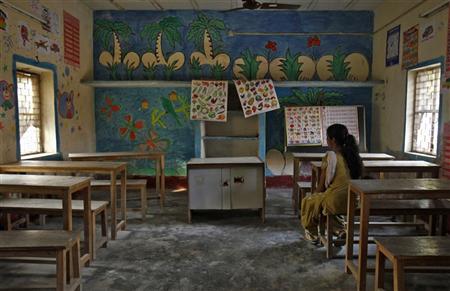



 Balmani - a young girl from the rural part of Jharkhand (a State with a high number of


