"In the depths of India's illegal mica mines, where children as young as five work alongside adults, lurks a dark, hidden secret - the cover-up of child deaths with seven killed in the past two months, a Thomson Reuters Foundation investigation has revealed."
Read MORE
Blood Mica:
Showing posts with label Bihar. Show all posts
Showing posts with label Bihar. Show all posts
Thursday, September 29, 2016


Thursday, August 11, 2011
India's journey of hope: UNODC showcases inspiring initiatives to fight human trafficking
 Balmani - a young girl from the rural part of Jharkhand (a State with a high number of human trafficking victims) who received livelihood training in housekeeping and is now able to support her mother's medical treatment.
Chandni - a 14-year-old girl from Kishanganj, Bihar (another major source State for human trafficking), who narrowly escaped being sold to a 45-year-old stranger for marriage.
Jamila - a caregiver from a boys' shelter in Calicut, Kerala, who has learned to view children under her care as 'individuals needing care and protection' and not as 'problem cases'.
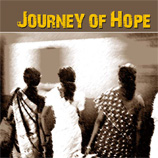
15 July 2011 - These are some of the people one meets while following the 'Journey of Hope', a publication compiled by the UNODC Regional Office for South Asia to showcase initiatives to combat human trafficking in India, where a large number of people fall victim to such trafficking.
In March 2008, UNODC embarked on two projects to combat human trafficking and provide support for victims in India: one was aimed at providing assistance to trafficking survivors in order to secure their legal and human rights; the other was designed to provide quality care and support services to vulnerable children at risk of physical and sexual abuse and comprehensive rehabilitation opportunities to trafficking survivors.
UNODC implemented both projects in collaboration with the Ministry of Women and Child Development, the Government of India, the governments of individual States and non-governmental organizations in the States of Andhra Pradesh, Bihar, Jharkhand, Karnataka, Kerala, Tamil Nadu and Uttar Pradesh, with the support of the United States Agency for International Development (USAID). The experience gained under both projects has now been documented in ' Journey of Hope', an attempt to bring together and visualize stories of hope, endurance and voices from the field.
The 'Journey' begins in the States of Jharkhand and Bihar in northern India, highlighting the factors that make girls and women vulnerable to trafficking. Case studies demonstrate how communities and local organizations are working to prevent human trafficking and rehabilitate survivors through various means, such as livelihood training, education and awareness-raising programmes, village vigilance committees and local advocacy.
In southern India, the 'Journey' takes the reader to Government-run shelters in the States of Tamil Nadu, Kerala and Andhra Pradesh, which provide temporary shelter to women and children who have been rescued from human trafficking and other difficult circumstances. The homes work to restore the confidence, hope and psychological well-being of women and children who have had harrowing experiences at the hands of traffickers.
The publication explains how psychosocial support training programmes have helped shelter staff and caregivers to become more sensitive to the psychosocial needs of the residents and have taught them practical techniques for addressing those needs. UNODC hopes that the inspiring individual stories in the publication will serve to show that is possible to win the fight against human trafficking. Lessons learned from the projects will serve to strengthen initiatives implemented elsewhere to combat human trafficking and provide support to victims.
Under the Protocol to Prevent, Suppress and Punish Trafficking in Persons, especially Women and Children, supplementing the United Nations Convention against Transnational Organization Crime, UNODC is mandated to improve the protection and assistance afforded to survivors of human trafficking. The Protocol is the first legally binding international instrument to define trafficking in persons. UNODC assists countries in implementing effective responses to human trafficking, not only by ensuring that structures are in place to facilitate the prosecution and conviction of traffickers but also by addressing the needs of survivors.
Related information:
Journey of Hope (pdf)
UNODC Regional Office for South Asia
Blue Heart Campaign against Human Trafficking
Source: unodc.org

Saturday, June 4, 2011
Human trafficking a major concern - The Times of India
Pooja Kashyap, TNN
Jun 2, 2011, 04.33pm IST
PATNA: Human trafficking and rehabilitation of the rescued have emerged as major concerns for the state government. Though Bihar is one of the few states to have prepared an action plan named 'Astitva' to deal with the issue, it largely remains unimplemented.
'Astitva', the state plan of action with a vision of "Trafficking-Free Bihar," was approved by the state cabinet in 2008.
Indo-Nepal border that has emerged as one major area prone to trafficking of both women and children, poses an alarming situation. Surprisingly, a large number of aged women are illegally slipped out through this border for the purpose of breast feeding.
Since many of those rescued are physically and mentally challenged, whose rehabilitation poses a major problem, a demand to device a mechanism to ensure their rehabilitation was raised by various NGOs during a daylong workshop organized here at a posh hotel jointly by the department of social welfare and Save The Children, an NGO.
A suggestion to involve the religious groups and spiritual heads in dissemination of relevant information and awareness generation among masses was also mooted at the workshop. Trafficking in the state has mainly been attributed to commercial sexual exploitation of girls and women, said Nikhat Quasim, state consultant, child protection, adding "mistreatment of trafficked women lodged in brothels is common knowledge."
Suman Lal of Prayas Bharati Trust, working for the implementation of Immoral Trafficking Prevention Act, noted that a major shift in approach has now come about with respect to trafficked victims in brothels, who are now treated as victims and not as accused. "This makes them entitled for rehabilitation and not liable for punishment," Lal said.
During the workshop, district programme officers, district welfare officers, assistant director, social security of all these districts were trained along with different stake holders from police, prosecution, NGOs and government departments for effective coordination and smooth implementation of 'Astitva'.
 Human trafficking a major concern - The Times of India
Source: timesofindia.indiatimes.com

Jun 2, 2011, 04.33pm IST
PATNA: Human trafficking and rehabilitation of the rescued have emerged as major concerns for the state government. Though Bihar is one of the few states to have prepared an action plan named 'Astitva' to deal with the issue, it largely remains unimplemented.
'Astitva', the state plan of action with a vision of "Trafficking-Free Bihar," was approved by the state cabinet in 2008.
Indo-Nepal border that has emerged as one major area prone to trafficking of both women and children, poses an alarming situation. Surprisingly, a large number of aged women are illegally slipped out through this border for the purpose of breast feeding.
Since many of those rescued are physically and mentally challenged, whose rehabilitation poses a major problem, a demand to device a mechanism to ensure their rehabilitation was raised by various NGOs during a daylong workshop organized here at a posh hotel jointly by the department of social welfare and Save The Children, an NGO.
A suggestion to involve the religious groups and spiritual heads in dissemination of relevant information and awareness generation among masses was also mooted at the workshop. Trafficking in the state has mainly been attributed to commercial sexual exploitation of girls and women, said Nikhat Quasim, state consultant, child protection, adding "mistreatment of trafficked women lodged in brothels is common knowledge."
Suman Lal of Prayas Bharati Trust, working for the implementation of Immoral Trafficking Prevention Act, noted that a major shift in approach has now come about with respect to trafficked victims in brothels, who are now treated as victims and not as accused. "This makes them entitled for rehabilitation and not liable for punishment," Lal said.
During the workshop, district programme officers, district welfare officers, assistant director, social security of all these districts were trained along with different stake holders from police, prosecution, NGOs and government departments for effective coordination and smooth implementation of 'Astitva'.
Source: timesofindia.indiatimes.com

Subscribe to:
Posts (Atom)
