The Syrian Refugee Crisis: A Greenhouse for Human Trafficking | Human Rights First:
Showing posts with label Lebanon. Show all posts
Showing posts with label Lebanon. Show all posts
Sunday, August 21, 2016


Wednesday, July 11, 2012
Migrant nightmares: Ethiopian domestic workers in the Gulf > Global > Redress Information & Analysis
http://www.redress.cc/global/gpeebles20120703
Source: Redress Information & Analysis
By Graham Peebles
3 July 2012
Graham Peebles charts the horrendous abuse faced by Ethiopian migrant workers in Saudi Arabia, the Gulf states and Lebanon where they are traded by unscrupulous traffickers – “not brokers/agents in any recognizable, legitimate sense of the word, but common criminals engaged in human trafficking and the destruction of lives”.
Employment opportunities in Ethiopia are scarce, particularly for young women with only a basic education who live in rural areas, where 85 per cent of the population reside. Many travel to the towns and cities in search of work, only to discover a barren job scene. The World Bank puts unemployment at 20.5 per cent with a quarter of all 15-24 year olds being out of work. Unable to find anything in Ethiopia, some venture further afield, to the Gulf states of Saudi Arabia, Kuwait and the United Arab Emirates (UAE), as well as Lebanon and even Yemen. Women that head to the Gulf are overwhelmingly single, between 20 and 30 years of age and, according to Ministry of Labour and Special Affairs (MOLSA), 70 per cent are Muslim and almost a quarter cannot read or write.
The International Organization for Migration (IOM), in its 2011 report on Ethiopia, documents a “huge increase in migration in and from Ethiopia, in particular by the youth” –50 per cent of Ethiopia’s 85 million people are under 20 years of age. The numbers of economic migrants travelling to the Arabian peninsula via all routes is increasing, with over 70,000 in 2011 making the hazardous journey to Yemen from where they seek somehow to find a way to other Gulf states. Naive and vulnerable, they go with hope in their hearts in order to support their families and build a decent life for themselves, not realizing the servitude and exploitation that all too often awaits them.
Agents and Gulf numbers
Migrant domestic workers in Gulf countries can expect to earn 100-150 US dollars a month. Compared to the 12 dollars a month maids are paid in Ethiopia, this is a small fortune and is the carrot that lures so many innocent and desperate. There are two “official” channels for women looking to work in the Gulf: the “public” migrant workers, registered with MOLSA, who secure work through personal contacts abroad, and the 110 private employment agencies (PEA) which work directly with employers or agencies in the relevant Gulf country. MOLSA says 30,000 a year are processed through these channels, and estimates that a further 30,000 pass through illegal brokers; these may be individuals or companies, many of which are little more than criminal traffickers.
The PEAs and illegal brokers are overwhelmingly Muslim, commonly import-export traders in commodities who have diversified into trading people. These “brokers” see the women looking for work as simply another commodity to be packaged and sold. They know well the world in which they send the unsuspecting and care not.
The International Labour Organization (ILO) estimates that there is between 53 and 100 million domestic workers worldwide and that, within the Gulf Cooperation Countries (GCC), a staggering 50 per cent of the GCC’s population of 35 million are migrant workers. In the UAE around 150,000 families employ 300,000 domestic workers and, according to the Human Rights Watch (HRW) report “Walls at every turn”, “Kuwait has 660,000 migrant domestic workers”, one for every two Kuwaitis. Extraordinary figures, and still these workers have little or no legal labour protection and are not even considered employees within labour laws in the GCC.
There is, it seems, an unwritten contract between the Gulf dynasties and their citizens. The populace agrees to the regimes’ unquestioned legitimacy in exchange for oil revenues being used to subsidize state welfare systems. Importing migrant workers to undertake the dirty work is part of this bargain. As the academic Bina Fernandez explains, “the state provides a leisured life in exchange for complete political control”. An important ingredient in such self-indulgent lifestyles are domestic workers, a luxurious commodity and status symbol in a world built on image and materiality. Filipina women shine bright at the top of the human bling chain, followed by Indonesians and Sri Lankans, with African/Ethiopian women at the bottom. Human beings reduced to assets, to be used and abused as their owners see fit. Such is the attitude of many Gulf families to the fragile, lonely, isolated women in their charge.
Kafala ownership
At the poisoned heart of the migrant domestic workers employment system throughout the GCC is the Kafala (Arabic for bond or bail) sponsorship. The scheme effectively grants ownership of migrants to the employer, and fuels trafficking and all manner of abuse and exploitation.
As Bina Fernandez explains, the “Workers’ legal presence in the country is tied to the Kafala ... who invariably confiscates their passports in order to control them”. In its report “As if I am not human”, HRW states that the system “creates a profound power imbalance between employers and workers and imposes tight restrictions on migrant workers’ rights.” Domestic workers sleep, eat and work within the home of their employer, who they are completely dependent upon, legally and practically. Living with the family places the women in a highly vulnerable position.
The Kafala denies workers all independent rights, and creates a dangerous imbalance between employer and employee, placing all power with the sponsor. The workers’ freedom of movement is completely restricted by the employer; they can be confined to the house for weeks or months, in many cases women are forced to continue working long past the completion of their contract and are not allowed to return home. This imprisonment contravenes Article 13 of the Universal Declaration of Human Rights (UDHR), which states (1) “Everyone has the right to freedom of movement and residence within the borders of each state. (2) Everyone has the right to leave any country, including his own, and to return to his country.”
Kafala is a major obstacle to the implementation of universal labour Laws and international human rights conventions. It must be dismantled as a matter of urgency and safeguards protecting the rights of migrant workers accepted and implemented throughout the Gulf region.
Traffickers and servitude
Upon arriving in Dubai, Abu Dhabi, Beirut and Kuwait City airports, women are routinely met by a local agent, who is all too often instrumental in their exploitation and trafficking. The women are corralled into a special area of the airport, their passports and mobile phones confiscated, and they are driven to their employers’ home, where commonly they disappear. As the head of women’s rights at HRW, Liesl Gerntholtz, says, “What is particularly striking about domestic workers is their invisibility. Once they come to the country, they disappear into people’s homes.” Isolated and held tightly within their employers’ houses, women are at risk of all manner of abuse. As HRW says in its far-reaching report, “The domestic workers convention: turning new global labour standards into change on the ground”, “domestic workers are typically isolated and shielded from public scrutiny … are at heightened risk of mistreatment, including physical, sexual and psychological abuse; food deprivation and forced confinement.”
Much of the mistreatment that domestic workers are subjected to constitutes trafficking. The United Nations “Protocol to Prevent, Suppress and Punish Trafficking in Persons, especially Women and Children”, signed and ratified by Saudi Arabia, the UAE and Kuwait but pointedly, not Lebanon or indeed Ethiopia, defines trafficking as, among other things, “the recruitment, transportation, transfer, harbouring or receipt of persons, by means of coercion, of abduction, of fraud, of deception, of the abuse of power”. This clearly covers the Kafala sponsorship and the entrapment of workers within employers’ homes.
Another form of imprisonment that comes under the trafficking umbrella is debt bondage. Many Ethiopian women are tied into deeply exploitative and damaging working sentences by debt bondage, or bonded/forced labour. Inflated fees charged by unscrupulous agents for placing workers, or spurious charges levied for changing employers, are often passed onto women workers. According to the HRW report “As if I am not human”, many women “find that deductions of 90 to 100 per cent of their salaries are withheld to cover recruitment and placement fees. Depending on the country, migrant domestic workers may work for three to 10 months without ever receiving a wage.”
This “debt” is used to trap them in servitude. Some report being held “captive” without their passport, their wages withheld for the full two-year term, while others, according to HRW, face “direct or indirect threat from employers or agents of being trafficked into forced prostitution, charged substantial fines if they did not finish their contracts, or being abandoned far from home”. These are not brokers/agents in any recognizable, legitimate sense of the word, but common criminals engaged in human trafficking and the destruction of lives. It is time they were treated as such by the judicial system.
Violence and despair
The catalogue of reported cases of criminal treatment and physical abuse suffered by migrant workers, including murder, rape, beatings burning and verbal insults, is endless. The HRW report, “The domestic workers convention: turning new global labour standards into change on the ground”, documents many cases. One migrant worker, referring to her Saudi employer, said: “She beat me until my whole body burned. She beat me almost every day... She would beat my head against the stove until it was swollen. She threw a knife at me but I dodged it. This behavior began from the first week I arrived.”
Sexual harassment and abuse are commonplace and lead many women to despair. For example, on 27 February 2012 the Arab Times carried a report which said: “Police are looking for a 23-year-old Ethiopian housemaid who ran away from her sponsor’s house … after her sponsor’s three sons raped her.” The same source recounted the case of an Ethiopian housemaid who “died after her Kuwaiti sponsor (allegedly) beat her”.
A 2011 US State Department annual report on trafficking viewed Lebanon, Saudi Arabia and Kuwait as destinations for women and children subject to forced labour, sex trafficking and myriad forms of abuse. In some cases, according to HRW, “physical abuse is so severe it has led to paralysis, blindness and death”.
The case of Alem Dechesa is the most widely publicized example of mistreatment. She supposedly hanged herself (unthinkable for an Orthodox Christian) in a mental health institution in Beirut after being dragged and beaten by the recruitment agent in front of the Ethiopian consulate where she had sought and been denied refuge. According to the Guardian newspaper on 4 April 2012, “Alem’s case has lifted the lid on the plight of migrant workers in Lebanon”. It cited HRW as saying that “one migrant worker dies each week in Lebanon from suicide or other causes”.
Sleepless in the Gulf
For many women there is no sanctity to be found even in sleep, which is often denied workers imprisoned and enslaved within many Gulf households. There, they can be forced to sleep in store-rooms, cupboards and utility rooms where they are acutely vulnerable to sexual abuse. Made to work from early morning until well into the night, with no days off, women have little or no rest and are often fed rotting or poor quality food. According to HRW, “in some cases domestic workers are literally starved”. Such inhumane treatment pushes the most vulnerable to self-harm, causes mental breakdowns and suicide.
Although some attempt to flee their employer and escape the torment, there are many dangers associated with running away. With no passport or money, women on the streets are in a precarious position: if caught by the police they risk being sexually abused, and may be returned to an enraged employer. In Lebanon workers who leave their employer’s house without permission automatically lose their legal status. Those that are not caught seek out other Ethiopian women living on the outside; the runaways live together in small rented rooms, take on freelance domestic work, sell illicit alcohol and resort to prostitution. They live hidden lives and are completely abandoned by the Ethiopian embassy, which is guilty of neglecting all domestic workers and regards freelancers as delinquents who have broken their employment contract. It fails to recognize the exploitation and mistreatment the women have suffered at the hands of abusive sponsors and agents, and their responsibility to protect their citizens in a foreign land.
Although some attempt to flee their employer and escape the torment, there are many dangers associated with running away. With no passport or money, women on the streets are in a precarious position: if caught by the police they risk being sexually abused, and may be returned to an enraged employer. In Lebanon workers who leave their employer’s house without permission automatically lose their legal status. Those that are not caught seek out other Ethiopian women living on the outside; the runaways live together in small rented rooms, take on freelance domestic work, sell illicit alcohol and resort to prostitution. They live hidden lives and are completely abandoned by the Ethiopian embassy, which is guilty of neglecting all domestic workers and regards freelancers as delinquents who have broken their employment contract. It fails to recognize the exploitation and mistreatment the women have suffered at the hands of abusive sponsors and agents, and their responsibility to protect their citizens in a foreign land.
Laws for the unprotected
Victims in a chain of usury and exploitation, migrant domestic workers trapped into slavery by poverty, lack of opportunity and the fear of worse need the protection written into international law to be enforced. In addition to the United Nations “Protocol to Prevent, Suppress and Punish Trafficking in Persons”, which deals with many of the offences currently being committed, the great hope for domestic workers worldwide is the ILO “Domestic Workers Convention 189”.
Passed in June 2011, crucially with all Gulf states voting in favour, Convention 189 is a huge step forward in securing domestic workers’ labour rights. Ratifying states are required to ensure the effective promotion and protection of the human rights of all workers. As the ILO makes clear, “The landmark treaty setting standards for the treatment of domestic workers ... has been widely hailed as a milestone” and “aims at protecting and improving the working and living conditions of domestic workers worldwide”. When implemented and enforced, domestic workers will finally have recourse to law and potentially much abuse and exploitation currently so prevalent would be largely eradicated.
In a positive move Saudi Arabia and the UAE have proposed new laws, which albeit inadequate and full of contradictions, at least recognize domestic workers as human beings entitled to the same rights as other employees. The rule of international law must be applied to and within Gulf states where widespread inhumane treatment of domestic workers takes place and where domestic labour laws must be reformed in line with international standards.
As Ethiopian migrant domestic workers are less expensive and easier to manipulate than other nationals, demand for them within the GCC and neighbouring states will no doubt continue. The Ethiopian government must, as a matter of urgency, begin to offer them assistance, establish female support groups and demand justice where complaints of mistreatment are investigated and substantiated. Within Ethiopia long-term measure in education and the creation of employment opportunities for women are essential. Tighter controls must be applied to recruitment agents and steps taken to root out illegal brokers involved in trafficking to Gulf states, where such horrendous abuse is allowed to take place, destroying the lives of so many vulnerable young women.
Tuesday, December 20, 2011
Lebanon joins the Blue Heart campaign against human trafficking
UNODC.ORG
http://www.unodc.org/unodc/en/frontpage/2011/December/lebanon-joins-the-blue-heart-campaign-against-human-trafficking.html?ref=fs1  20 December 2011 - High-level representatives of the Government of Lebanon led government officials, local non-governmental organizations, media and UNODC staff in the official launch of the Blue Heart Campaign in Beirut last weekend.
"The Government of Lebanon is ready to act to end trafficking in persons in the country," said Prime Minister Mikati in a statement read on his behalf. "We shall utilize all possible resources available to us to help to spread awareness among the public and to ensure justice for victims of trafficking. Through the Ministry of Justice and the Ministry of Interior, my Government will improve on efforts to better equip law enforcement officials, judges and social workers to be sensitive to dealing with human trafficking cases," he added.
Speaking at the launch, Mr. Masood Karimipour, Regional Representative of the UNODC Regional Office for the Middle East and North Africa, said: "We are very pleased to note that Lebanon is the first country in the region to join the Blue Heart campaign. We were also pleased to note that, despite the many challenges faced by the country, Lebanon adopted an anti-trafficking law on 1 September 2011."
Lebanon's new anti-trafficking law was developed in line with the provisions of the Protocol to Prevent, Suppress and Punish Trafficking in Persons, especially Women and Children, supplementing the United Nations Convention against Transnational Organized Crime.
Among other things, the new law establishes human trafficking as an offence punishable by 5 to 10 years' imprisonment. It exempts victims of organized crime from punishment and sets out adequate measures to protect victims and witnesses.
"We are proud of our collaboration in Lebanon with the Ministry of Justice and the Ministry of the Interior. We thank our donors, the Netherlands and Switzerland, for their unwavering support of our efforts to fight human trafficking. I also salute the work on the ground of the Directorate of General Security, as well as NGOs and civil society, who are raising awareness and protecting victims. UNODC fully supports the Government of Lebanon in its efforts against human trafficking and other challenges, including drug control and crime prevention," added Mr. Karimipour.
 Mr. Karimipour announced that under the UNODC Regional Programme on Drug Control, Crime Prevention and Criminal Justice Reform in the Arab States 2011-2015, the Office is initiating a regional effort against human trafficking, in cooperation with Arab countries and the League of Arab States and with the support of Qatar and Norway.
As part of awareness-raising efforts under the Blue Heart campaign in Lebanon, UNODC has supported local NGO Caritas Migrants and law enforcement officials in publishing booklets in local languages for vulnerable groups such as domestic workers. The booklets, to be distributed at airports, provide information about forms of human trafficking and the recently adopted anti-trafficking law.
UNODC has unveiled a national billboard advertising campaign on the Blue Heart Campaign, published advertisements in magazines and on related websites and organized forums on human rights issues and human trafficking in several Lebanese schools. Blue Heart Campaign stands have also been established at some main shopping malls in the city to provide information on the campaign and the law against human trafficking.
The Blue Heart Campaign seeks to encourage involvement and inspire action to help to stop the crime of human trafficking. It allows people to show solidarity with the victims of such trafficking by wearing the Blue Heart, and aims to make the Blue Heart an international symbol against human trafficking.
Related information:
Blue Heart Campaign against Human Trafficking
Related articles

Friday, January 7, 2011
2 cops in hot water for alleged human trafficking
 Image via Wikipedia
01/06/2011 | 02:06 PM
Two policemen assigned to the Aviation Security Group are now in hot water for alleged involvement in human trafficking activities.
Immigration acting Commissioner Ronaldo Ledesma said the two, whom he did not name, are under investigation for possible links to human trafficking syndicates operating at the Ninoy Aquino International Airport (NAIA).
The activities of the group were discovered after Immigration officers intercepted on Monday nine Lebanon-bound Filipino women attempting to leave the Philippines by using fake Immigration departure stamps on their passports.
Ledesma said the two policemen were allegedly responsible for the fake stamps on the passports of prospective overseas Filipino workers (OFWs).
Ledesma said the women, who planned to work as domestic helpers in Beirut, were about to board a Philippine Airlines flight to Singapore when they were stopped.
He said the would-be OFWs planned to take a connecting flight to Lebanon.
Deployment ban
The Philippine government has a long standing deployment ban to the Middle Eastern country.
Ledesma said the passengers were hurriedly walking past the immigration counters when they were spotted and accosted by members of the Bureau of Immigration’s Travel Control Enforcement unit (TCEU).
The women reportedly ignored the queuing policy of the bureau and went straight to the boarding gate, he said.
“They evaded inspection by our immigration officers because it turned out that their passports already had fake immigration departure stamps," Ledesma said.
“It is obvious that the human trafficking syndicates are feeling the pinch of our intensified campaign that they are resorting to all means to bring their victims out of the country," he added.
Offloaded workers
BI-airport operations division chief Maria Antonette Bucasas did not divulge the names of the offloaded workers in deference to their plight as human trafficking victims.
She said the women admitted during questioning that they were hired to work as domestic helpers in Lebanon.
“One of them even presented her Lebanon visa which was concealed inside a chocolate bar wrapper," Bucasas said.
She said the case of the offloaded passengers was referred to the Inter-Agency Council Against Trafficking (IACAT) for further investigation.
The BI and IACAT’s intensified campaign against human trafficking is part of the Aquino administration’s efforts to remove the Philippines from the US State Department’s Tier 2 watch list of countries with severe trafficking situations.
The campaign has resulted in the offloading of thousands of prospective OFWs, most of whom only have tourist visas although they intend to work in their respective countries of destination. - KBK/VS, GMANews.TV
2 cops in hot water for alleged human trafficking - Pinoy Abroad - GMANews.TV - Official Website of GMA News and Public Affairs - Latest Philippine News

Monday, January 3, 2011


Thursday, April 29, 2010
The Associated Press: Rights group: Mideast maids unprotected from abuse
By BARBARA SURK (AP) – 2 hours ago
DUBAI, United Arab Emirates — Reforms undertaken by governments in the Middle East to protect domestic workers from abuse are insufficient to shield women working as house maids from abuse and violence, Human Rights Watch said Thursday.
Millions of mostly Asian women who work in countries like Saudi Arabia, Lebanon and the United Arab Emirates remain at risk of human trafficking, forced labor, confinement and sexual violence, the New York-based group said.
Although several governments have made improvements for migrant domestic workers in the past five years, reform has been slow and incremental, Nisha Varia, the group's senior researcher of women's rights told The Associated Press.
"There has been a big change in the sense that these countries are recognizing there is a problem," Varia said in a phone interview. "But while many governments are introducing reforms, most have yet to implement them."
The 26-page report released Thursday documents progress in extending protections to mostly Asian women working as house maids in Saudi Arabia, Lebanon, Jordan, Bahrain, Kuwait and the Emirates.
Women working in private homes often work 20-hour days, face forced confinement and are sometimes physically and sexually abused, the report said.
Their passports are confiscated upon arrival, leaving employers in full control of their house maids' lives under what is known as a "sponsorship system."
The custom remains the biggest factor contributing to abuse, leaving women trapped in abusive situations since they are not allowed to legally change an employer, HRW said.
The group also urged that it's essential that domestic workers' rights — now governed by immigration law in most Mideast countries — are included in the labor law, assuring them of basic rights such as setting their work hours, regulating the quality of food and housing they get and guaranteeing them a day off a week.
"Governments will have to think creatively how to reach out to women working in private homes," Varia said. "It is a unique working environment."
While Human Rights Watch praised Jordan for including domestic work in the country's labor law, it said that "enforcement remains a big concern."
Most migrant workers in the Middle East — 1,5 million, according to HRW's assessment — are employed in Saudi Arabia. About 200,000 migrants work in Lebanon and 660,000 in Kuwait.
Domestic work in foreign countries is an important source of employment for women in Indonesia, Sri Lanka, the Philippines, Nepal, India, and Ethiopia. Their earnings abroad amount to much of the billions of dollars of remittances sent home each year.
Copyright © 2010 The Associated Press. All rights reserved.
The Associated Press: Rights group: Mideast maids unprotected from abuse
Friday, March 5, 2010
Women worked to death in Lebanon | Dalila Mahdawi | Comment is free | guardian.co.uk
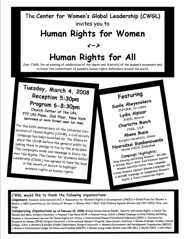 Image by CWGL via Flickr
o Dalila Mahdawi
o guardian.co.uk, Tuesday 10 November 2009 21.00 GMT
They mop floors, take out the rubbish, walk the dog, buy groceries and care for the children, the elderly or disabled. Many a well-to-do and lower middle class Lebanese family relies on migrant domestic workers to take care of their household, but when it comes to providing for these women, not all return the favour.
Migrant domestic workers – women who work as live-in or freelance housekeepers, cooks, and nannies – form a vital presence in Lebanon and elsewhere in the Middle East, where women's increased participation in the workforce has not been accompanied by state-backed social or childcare services.
There are thought to be about 200,000 women, mostly from the Philippines, Ethiopia and Sri Lanka, in Lebanon alone. But although they are becoming an intrinsic part of the country's social fabric, their contribution is often overlooked. While many Lebanese people are careful to ensure their housekeepers are well treated, a significant number abuse them. In extreme cases, migrant domestic workers are killed or kill themselves.
The spate of suicides has become so bad in recent weeks it prompted Lebanese blogger Wissam to launch the grimly named Ethiopian Suicides blog. The website is dedicated to monitoring media reports on the deaths of foreign migrant domestic workers in Lebanon. "I have a dream," Wissam says. "That migrant domestic workers will be treated humanely in Lebanon and will stop trying to commit or commit[ting] suicide."
In the last three weeks alone, Wissam notes, four Ethiopian women have died. Lebanese police say the deaths of Kassaye Atsegenet, 24, Saneet Mariam, 30, Matente Kebede Zeditu, 26, Tezeta Yalmiya, 26 were probably suicides. But as human rights activists here will testify, the truth about what happened to them may never be known because police usually only take into account the employer's testimony. Migrants who survive abuse or suicide attempts are not usually provided with a translator, meaning their version of events often does not get registered with officials.
Sadly, violations against such workers occur throughout the region and in some cases the women end up in slave-like conditions.
Reflecting the concern of sender countries for the wellbeing of their citizens, Ethiopia and the Philippines have placed bans on working in Lebanon and Jordan, but this has not stemmed the flow of illegal migrants smuggled in through third countries. Without the necessary work papers and embassy support, migrant women become even more vulnerable to human rights abuses.
One reason the women are driven to the edge is that, in Lebanon at least, they are not given protection under the country's labour law. Such exclusion means that those who withhold salaries, confiscate passports, confine their employees to the house or otherwise abuse them, can literally get away with murder. The problem is exacerbated by the fact that five months after parliamentary elections, a Lebanese government is only now being formed.
The campaign to grant migrant domestic workers greater rights in the region has been led by Human Rights Watch. This summer, it contacted Lebanese beach resorts and found that 17 out of 27 private facilities practised some form of discrimination against such women by prohibiting them from swimming in the pool or even the Mediterranean sea.
A study conducted by the organisation last year found that more than one migrant domestic worker was dying in Lebanon each week – mostly from suspected suicide or by falling off a balcony while trying to escape abusive employers. The numbers sent ripples throughout the rights community and resulted in far more sustained local media coverage on the issue of domestic migrant workers. Judging by Wissam's recent statistics, however, this does not appear to have persuaded the authorities to take sufficient measures to protect their rights.
The embassies of countries that supply migrant workers have a duty to protect their citizens. They could start by offering amnesty and assistance to all illegal workers, increasing their legal protection capabilities and properly informing women at home of their rights and responsibilities while working abroad. Many countries, such as Nepal or Madagascar, which are sending women to the Middle East in increasing numbers, would do well to increase their diplomatic representation from consular level to embassies.
Many migrant workers come to the Middle East seeking a better life for the families they left behind. The Lebanese themselves have a long history of migration and hardship, and should know first-hand the difficulties of living and working in a foreign country. Just as many Lebanese abroad work hard with the hopes of eventually returning home, the Lebanese should ensure that these women get to go back to their countries – alive and well, not in body bags.
Women worked to death in Lebanon | Dalila Mahdawi | Comment is free | guardian.co.uk

Spate of suicides by foreign maids in Lebanon sheds light on abuse - CNN.com
 Image via Wikipedia
December 2, 2009 12:02 p.m. EST
STORY HIGHLIGHTS
* 10 maids die in seven weeks, all suicides or falls from high buildings
* HRW: abusive work conditions, isolation and lack of recourse are causes
* 200,000 foreign maids work in Lebanon -- one for every four families
* Poor regulation of domestic labor and racism conspire against maids
London, England (CNN) -- A recent spate of suicides by foreign maids in Lebanon is prompting outrage among human rights groups, who say the government is doing too little to protect migrant domestic workers from severe abuse.
Over the past seven weeks at least 10 women have died, either by hanging themselves or by falling from tall buildings. Six of these cases have been reported in local media as suicides and four more have been described as possible work accidents.
An Ethiopian woman working as a cleaner in Lebanon told CNN by phone that she was sad about the recent suicides, and that she had a friend who killed herself several years ago, when she too was working as a live-in maid.
"If the Madame maybe she is very bad, they feel there is no way, no solution," said the woman who asked not to be identified, referring to abuse by the female employer. "Everyone has a different case," though she added.
This is modern day slavery ... these suicides are just the tip of the iceberg
--Wissam, Ethiopiansuicides.blogspot.com
"We are clearly seeing a high rate of suicide. The two leading causes of death for migrants is suicide [and] dying while trying to escape from employers," said Nadim Houry, Senior Researcher for Human Rights Watch (HRW) in Lebanon.
"This pattern [of abuse] is on going," Houry told CNN, citing "bad working conditions, isolation and a feeling of helplessness that comes from lack of recourse," as the sources of desperation that can drive these women to their deaths.
"It is ridiculous ... this is modern day slavery," said Wissam, a Lebanese activist who started a blog after he noticed four Ethiopian women committed suicide within 10 days in October.
"What about the things we don't know? These suicides are just the tip of the iceberg of the mistreatment of these women," he said.
In August 2008 HRW reported that more than one domestic worker was dying each week, either from suicide or failed escapes from abusive employers.
Rampant Abuse
There are more than 200,000 migrant domestic workers in Lebanon -- roughly one per every four families. Overwhelmingly they are women in their 20s and 30s who come alone from the Philippines, Sri Lanka, Ethiopia, Indonesia, Nepal and Madagascar, to earn money to support families back home.
According to HRW, more than one third of foreign domestic workers in Lebanon are denied time off and more than 50 percent work at least 10 hours per day.
A 2001 International Labor Organization survey of Sri Lankan domestics in Lebanon found that 88 percent were given no time-off. Among the 70 respondents, nearly 30 percent said they were not given enough food to eat.
Over the past several years there have been increasing reports of exploitation documented in the media, including testimonies from domestic workers about withholding of wages, verbal or physical abuse and restrictions on free movement. Statistics on abuse are difficult to find though, because employees are often afraid to complain, prevented from doing so, or simply don't know how.
"The isolation is key ... Their passports are confiscated and they are often locked in. They are far from home, and not all of them can contact their families -- some can once per month," Houry told CNN.
One Nepalese maid who spoke to HRW from her hospital bed, after jumping from the third floor of her employer's building to escape, said she had seen snow-capped mountains from the window and thought she could walk across to find her village. She did not understand that Lebanon was thousands of miles away from her home in Nepal. "She just had no idea where she landed," Houry said.
Both charity organizations and foreign embassies in Lebanon say they have their hands full dealing with runaways and incidents of abuse.
In August, the Philippines Embassy reported that 117 women who had escaped from maltreatment were sleeping on the embassy floor. The Catholic relief organization CARITAS also estimated that they have an average of 40 runaway domestics sleeping in their shelter at any one time.
Roots of the Problem
The abuse faced by migrant domestic workers is a common problem throughout the Arab Middle East, both because of generally poor labor regulation and also cultural prejudice.
"The responsibility lies primarily with the state. There are no inspectors who can check on working conditions. The laws need to be modified," Houry said.
"The mistreatment of these women and the absence of any government protection is not just in Lebanon -- it's in all the Arab countries," Wissam said.
Neither the Lebanese Labor Ministry, nor General Security, who regulate migrant workers, could be reached for comment on this article.
Because domestic work is performed in the private sphere, it is not considered formal labor and is not covered by Lebanon's labor laws.
In January, the government issued a uniform contract for all maids, which took the critical step of guaranteeing one day off per week and decent working conditions. Rights activists say that the contracts though are not being enforced.
Both Houry and Wissam also pointed to social norms of prejudice that condone abuse. "There is racism against people of poor background and darker skin," Houry said.
This past summer an HRW investigation found that 17 private beaches, out of a nation-wide total of 27, do not allow Asian or African domestic workers to swim, which they argued reflects latent cultural racism in Lebanon.
"There is a mind set among some that says these women have to work for me, and if they don't do it, I have to beat them," Wissam said. "This misconception dehumanizes these women."
Spate of suicides by foreign maids in Lebanon sheds light on abuse - CNN.com

Wednesday, September 30, 2009
LEBANON: Plight of the trafficked domestic worker

Abbey, not her real name, was presented by the recruitment agent with a three-year contract, which included transport to the Lebanese hospital, and a salary of US$1,000 per month.
On arrival there, however, she was put in a house with another Madagascan domestic worker where she was forced to cook, clean and care for three children and a newborn.
"We didn't sleep day or night; we had to be up whenever the baby cried. We didn't even have time to shower or eat during the day because we were always rocking him so he didn't cry. It was like that for two and a half years," Abbey told IRIN.
From her salary of just $150 a month, Abbey said she had to give her Lebanese employer money to buy food for her: "So basically, we were working for free."
Cases like Abbey's are not uncommon in Lebanon, which is a country of destination for women trafficked from Africa, Sri Lanka and the Philippines for the purpose of domestic labour.
In June, Lebanon was added to the US State Department's human trafficking tier 2 watch list [http://www.state.gov/g/tip/rls/tiprpt/2009/123132.htm] for its failure to protect victims of trafficking or to prosecute those responsible.
Inclusion on the list, which includes neighbouring Syria on tier 3 (the worst category), [http://www.irinnews.org/Report.aspx?ReportId=82686] for a second year could mean Lebanon faces US sanctions on non-humanitarian and trade-related aid and US opposition to loans and credits from the International Monetary Fund and World Bank.
Deception, exploitation
Being deceived about the job she was brought to Lebanon to perform makes Abbey's case one of trafficking under the established UN definition [http://www.unescap.org/esid/Gad/Issues/Trafficking/index.asp] of the "recruitment, transportation, transfer, harbouring or receipt of persons, by means of the threat or use of force".
However, the US State Department's 2009 Trafficking in Persons (TIP) report [http://www.state.gov/g/tip/rls/tiprpt/2009/] makes clear it considers trafficking to include the conditions a worker is kept in, including forced labour and debt bondage. That makes not only Abbey's life after arriving in Lebanon a case of trafficking but means the situation of many of Lebanon's estimated 200,000 migrant domestic workers [http://www.irinnews.org/Report.aspx?ReportId=78865] can also be considered trafficking.
"Women from Sri Lanka, the Philippines, and Ethiopia who travel to Lebanon legally to work as household servants often find themselves in conditions of forced labour through withholding of passports, [http://www.irinnews.org/report.aspx?ReportId=83948] non-payment of wages, restrictions on movement, threats, and physical or sexual assault," said the TIP report.
'
Local rights activists praised the recognition of exploitative labour conditions as trafficking.
"Working on trafficking is very difficult because of the definition set by the UN, but if you simplify it you see that there are three main components: the recruitment; deception or coercion; and then that the purpose of recruitment is exploitative. This is considered trafficking," said Ghada Jabbour, gender and trafficking specialist at Lebanese NGO KAFA.
The TIP report said that exploitation includes the specific crimes of "involuntary servitude, peonage, debt bondage, or slavery".
After escaping from the home she was forced to work in, Abbey has spent the past 10 years working as a freelance domestic worker, facing jail if she is caught by police without the identification papers she was never issued with, and owing $5,000 in fines to the General Security Directorate, a Lebanese intelligence agency, for overstaying her visa.
Little protection
Domestic workers remain outside Lebanon's Labour Law and its protection.
Last year, according to the 2009 TIP report, the Lebanese government reported no criminal prosecutions, convictions, or punishments for trafficking offences, a significant decrease from the 17 prosecutions reported in 2007.
The Lebanese Penal Code does not specifically prohibit forced labour or trafficking, but Article 569's prohibition against the deprivation of an individual's liberty to perform a task could be used to prosecute forced labour. Commercial sexual exploitation, deprivation of freedom and use of false documents are also criminalized in Lebanese law.
The TIP report urges authorities to investigate and prosecute claims by domestic workers who have escaped abusive employers, and implement the new unified contract for domestic workers [http://www.irinnews.org/report.aspx?ReportId=83948] created in March this year, but which rights groups say remains largely unimplemented.
Valuable trade
Activists believe the value of the trade in domestic workers is such that the political will to comply with international regulations against trafficking remains lacking.
"The money that is collected through domestic workers coming to Lebanon is millions of dollars per year. You have the residency fees, the visa and recruitment fees on both sides for the worker and the employer," said KAFA's Jabbour.
"The government takes a lot of money in the process by regulating domestic workers and there are a lot of stakeholders. Politicians are also involved in this issue and it goes underground, which is why it's difficult to get laws to protect these women."
http://www.tayyar.org/Tayyar/News/PoliticalNews/en-US/128988024720725404.htm#

Subscribe to:
Posts (Atom)
