Trafficking Monitor is a blog I created and curate. It offers posts highlighting the multifaceted nature of human trafficking and forced/indentured labour. I draw on a diversity of sources for my posts. You are invited to recommend materials for posting.
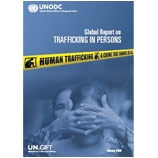
Based on data gathered from 155 countries, it offers the first global assessment of the scope of human trafficking and what is being done to fight it. It includes: an overview of trafficking patterns; legal steps taken in response; and country-specific information on reported cases of trafficking in persons, victims, and prosecutions.
At the launch of the Report in New York, the Executive Director of UNODC, Antonio Maria Costa said that "many governments are still in denial. There is even neglect when it comes to either reporting on, or prosecuting cases of human trafficking". He pointed to the fact that while the number of convictions for human trafficking is increasing, two out of every five countries covered by the UNODC Report had not recorded a single conviction.
According to the Report, the most common form of human trafficking (79%) is sexual exploitation. The victims of sexual exploitation are predominantly women and girls. Surprisingly, in 30% of the countries which provided information on the gender of traffickers, women make up the largest proportion of traffickers. In some parts of the world, women trafficking women is the norm.
The second most common form of human trafficking is forced labour (18%), although this may be a misrepresentation because forced labour is less frequently detected and reported than trafficking for sexual exploitation.
Worldwide, almost 20% of all trafficking victims are children. However, in some parts of Africa and the Mekong region, children are the majority (up to 100% in parts of West Africa).
Although trafficking seems to imply people moving across continents, most exploitation takes place close to home. Data show intra-regional and domestic trafficking are the major forms of trafficking in persons.
The United Nations Protocol against Trafficking in Persons - the foremost international agreement in this area - entered into force in 2003. The Report shows that in the past few years the number of Member States seriously implementing the Protocol has more than doubled (from 54 to 125 out of the 155 States covered). However, there are still many countries that lack the necessary legal instruments or political will.
"This Report increases our understanding of modern slave markets, yet it also exposes our ignorance", said Mr. Costa. "We have a big picture, but it is impressionistic and lacks depth. We fear the problem is getting worse, but we can not prove it for lack of data, and many governments are obstructing", he admitted. The head of UNODC therefore called on governments and social scientists to improve information-gathering and -sharing on human trafficking. "If we do not overcome this knowledge crisis we will be fighting the problem blindfolded", he warned.
In a Panel Discussion on "Exposing Denial and Benign Neglect", Mr. Costa called on governments, the private sector, and the public at large to step up the fight against trafficking in persons. "More must be done to reduce the vulnerability of victims, increase the risks to traffickers, and lower demand for the goods and services of modern-day slaves", he said.
To increase public awareness of human trafficking and rally the world to fight it, Mr. Costa appointed Academy Award-winning actress Mira Sorvino as a Goodwill Ambassador to Combat Human Trafficking. "We know that Mira's commitment to the plight of trafficking victims will move people to take action against modern-day slavery", said the Executive Director of UNODC.
"Beyond Awareness: Putting the Human Back in Human Trafficking". This was the impassioned message by UNODC Goodwill Ambassador for Human Trafficking, Mira Sorvino, speaking at an event to mark the end of National Slavery Month in the US. Check out her full video below, or visit http://j.mp/TIKdVato read her speech.
THOROLD - He stood in The Virgin Room. Filmmaker Christopher Bessette, alone with his camera.
It was 2008 and he was in Cambodia shooting footage for a documentary about an organization that rescues children from the sex trade.
He was visiting a village near Phnom Penh, in a building that was once used as a brothel. The Virgin Room was the place where girls as young as five and six were sold for sex.
It had been turned into a community centre. And the room was empty. Repainted.
Bessette stared out of the second-floor window, watching children play in the street below.
His thoughts drifted to the room's past.
"There was probably, one day, a little girl standing here looking out this same window."
Bessette is a 50-year-old father of three. A husband. A guy who went to E.L. Crossley Secondary School and these days still lives in his childhood house in Thorold. And a guy with a soft spot in his heart for the exploited, for people without a voice.
At that very moment, alone in the Virgin Room, something spoke to him from deep inside.
He heard himself whisper the words: "Oh, God, help me do something. Help me tell her story."
The little girl in his imagination -- and all she represented -- drove Bessette to once again do what he knows best. The result is the $6-million independent film, Trade of Innocents, written and directed by Bessette. Set in present-day Southeast Asia, the story unfolds with a filthy cinderblock room, a bed with soiled sheets and a little girl who waits for the next man to exploit her.
Alex Becker is a human trafficking investigator played by Dermot Mulroney (Young Guns, My Best Friends Wedding). His wife, Claire, (Mira Sorvino) volunteers in an aftercare shelter for rescued girls.
Actor John Billingsley (alien Dr. Doctor Phlox on the television series Star Trek: Enterprise), plays a pedophile with a perverted quest to steal the innocence of "fresh" little girls.
The pimp is played by actor Trieu Tran.
The film, shot in Bankok, Thailand last year, will be screened at Central Community Church in St. Catharines on Friday, Dec. 7 -- only the second time it's been shown in Canada. Afterwards, Bessette will answer questions from the audience.
Bessette wants to make a difference. "I don't know how anyone can see this and not do something about it," he says.
There's one scene in particular where directing crossed into reliving for him. It's based on an experience he had back in Cambodia. He was in a hotel having pizza and drinks. A Wednesday night. He sat at a table near the stage where a band was playing Top 40 American hits.
A Cambodian man walked in with an American-looking man, in his 60s, dressed in a black track suit with white piping down the leg. Walking beside him, a young Cambodian girl.
Soon after sitting at a reserved table near the stage, the Cambodian man leaves. The white man hands the little girl a note, and she takes it to the band. They begin playing Puppy Love.
The man pulls her chair closer to his and strokes the inside of her thigh.
Bessette wants to jump up and rescue her. He is held back. There must be an investigation. Evidence collected. Procedure followed.
"We could save that one girl, but sacrifice 30 other girls," he says.
The man leaves with the girl. Bessette never sees him again.
Except inside his head, over and over again, where that experience becomes the "Puppy Love" bar scene.
He once told the film's producer: "I just wish I could have done more."
"You are. You are now," is the response.
Bessette hopes that people do more than feel disgusted and walk away. He wants them to take action. Take a stand.
"It means nothing if people don't respond and take the story to heart," he says.
And in the words of the Mulroney's character, Alex Becker, responding to a suggestion that his efforts to shut down every brothel are futile:
10/06/2012 There was a time in America, 150 years ago -- on September 22, 1862 to be exact -- when it was chic to have a slave serving your dessert, or at hand to service your every need. While slavery is no longer acceptable in the developed world, legally or socially, the sad truth is that it is still rampant -- hidden in the underbelly of society (all around the world) and woven into the supply chain of some of our goods. Human trafficking is a $32 billion industry with 20.9 million people trafficked annually, according to the International Labor Organization. One-quarter of the world's slave labor are children.
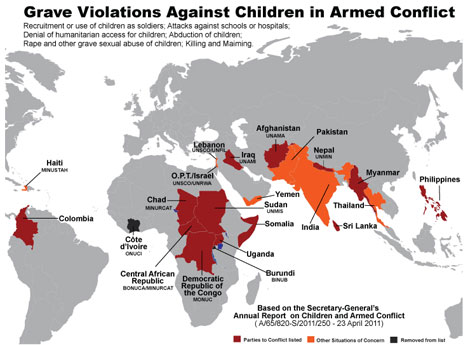
Young boys are forced to become child soldiers in countries that export coffee, diamonds, oil and other materials to the U.S. and the rest of the developed world. As you can see in the map below, the problem is more acute, but not limited to, Africa and the Middle East.
Young girls, even before puberty, are forced into prostitution -- not just in developing countries, but here in the United States as well. Impoverished individuals are promised a better life, and then forced to work 18-hour days in sweat shops -- bound by a debt that they can never pay off.
There is a large effort going on to stop modern slavery, however. Two weeks ago, on September 25, 2012, President Barack Obama marked the 150th anniversary of the Emancipation Proclamation with a new call to action against "modern slavery." In front of a packed house at the Clinton Global Initiative, President Barack Obama advocated for everyone to become involved in the eradication of forced labor and the exploitation of children, saying, "All the business leaders who are here and our global economy companies have a responsibility to make sure that their supply chains, stretching into the far corners of the globe, are free of forced labor... And, every citizen can take action: by learning more; by going to the website that we helped create -- SlaveryFootprint.org; by speaking up and insisting that the clothes we wear, the food we eat, the products we buy are made free of forced labor; by standing up against the degradation and abuse of women."
On October 5, 2012, the film Trade of Innocents, starring Academy Award winner Mira Sorvino and Dermot Mulroney, opened in New York City. Trade of Innocents is a powerful, fictional story that was inspired by real-life incidents. Mira Sorvino, Dermot Mulroney, Trieu Tran and John Billingsley bring the sobering, heartbreaking, firsthand experiences of writer/director Christopher Bessett and producers Bill and Laurie Bolthouse to life in a way that will change your life instantly and forever. At the premiere, when the final credits rolled, people sat unable to move or speak.
Bessett told the shell-shocked crowd how he had personally witnessed a scene from the movie -- when an American businessman openly "dates" a seven-year old village girl in the local speakeasy, and had her request that the band play "Puppy Love" for them. In the movie, the young girl had been kidnapped from her home. Her teenage sister, who had tried to escape prostitution, was sold back to the brothel by a mother who needed her daughter to "provide for the family."
For the audience, it is a movie. For millions of young girls, it is real life. According to the U.S.Department of Justice, age 14 is the average age of entry into pornography and prostitution in the U.S. More than a quarter of a million children are in danger of becoming sexual commodities in the U.S. every year.
Mira Sorvino, who is the U.N. Goodwill Ambassador to Combat Human Trafficking, explains the harsh reality of forced, underage prostitution, which she has witnessed firsthand in care centers around the world, writing:
A little girl, around three and a half feet tall, approached me, holding out papers. Her mouth was open in a smile; her front baby teeth were out, and the new ones had not grown in yet. She handed me her addition and subtraction problems on lined paper. A staffer whispered, "We rescued her four months ago. Her father killed her mother in front of her when she was three, then relatives sold her to a brothel for tourists, where she worked from age four to seven." When the child was asked what things she had been made to do, she did not even know how to describe them. All she could say was, "Incorrectos."
Trade of Innocents shines a light into the corners of a world you know in your heart exists. Suspect circumstances flash before us when we least expect them, and then disappear before we can make sense of what happened. It's easy to be so embroiled in our own life challenges that we forget to look more closely and listen more astutely to the far away cries of victims who are forced into brothels, sweatshops, fields, factories, domestic servitude, war, drugs and even organ selling on a global scale that is reminiscent of some of the worst chapters in human history.
In the midst of a heated presidential election, President Obama took the stage at CGI and, instead of trying to win another vote, he used that moment to fire up our national commitment to the oppressed, saying:
Right now, there's a woman, hunched over a sewing machine, glancing beyond the bars on the window, knowing if just given the chance, she might some day sell her own wares, but she doesn't think anybody is paying attention. Right now, there's a young boy, in a brick factory, covered in dust, hauling his heavy load under a blazing sun, thinking if he could just go to school, he might know a different future, but he doesn't think anybody is paying attention. Right now, there is a girl, somewhere trapped in a brothel, crying herself to sleep again, and maybe daring to imagine that some day, just maybe, she might be treated not like a piece of property, but as a human being. And so our message today, to them, is -- to the millions around the world -- we see you. We hear you. We insist on your dignity. And we share your belief that if just given the chance, you will forge a life equal to your talents and worthy of your dreams.
If you'd like to take part in this call to action, below are a few ways to lend a hand in eradicating modern slavery.
1. Trade of Innocents. Learn where this important movie is playing. Go see it and encourage your thousands of friends on Google+, Twitter and Facebook to see it, too. Limited screenings began in New York City on October 5, 2012.
2. Zero Under 18. Learn more about the United Nations campaign to end the involvement of children in armed conflict.
3. SlaveryFootPrint.org. Take two minutes to learn how many slaves work for your lifestyle, and how you can change that. And share this web link with thousands of your friends, too.
ATEST and the CNNFreedom Project hosted a forum on human trafficking in Washington, D.C. on June 23, 2011. Moderated by CNN anchor Jim Clancy, participants included Mira Sorvino, Congressman Chris Smith, Ambassador Luis CdeBaca, CNN International's chief Tony Maddox, survivor and advocate Rani Hong, human trafficking expert Kevin Bales, and Humanity United's David Abramowitz.
8 March 2011 – The United Nations Office on Drugs and Crime (UNODC) and its Goodwill Ambassador, Academy Award-winning actress Mira Sorvino, today launched a new fund that will support groups working on the frontlines to assist the victims of human trafficking.
The announcement of the Small Grants Facility for victims of human trafficking coincides with International Women’s Day, a symbolic move, according to UNODC, given that two-thirds of the victims of this $32 billion global industry are women and children.
The Facility is part of the UNODC-managed UN Voluntary Trust Fund for Victims of Human Trafficking, which provides humanitarian, legal and financial aid through established channels of assistance, such as governmental, intergovernmental and non-governmental organizations.
The UN estimates that more than 2.4 million people are currently being exploited after being trafficked by unscrupulous human smugglers. The Voluntary Trust Fund, launched last November, is an important element of the UN Global Plan of Action to Combat Trafficking in Persons, adopted by the General Assembly in July 2010.
UNODC Executive Director Yury Fedotov highlighted the critical steps being taken in pushing an increased victim-centred approach to human trafficking as he addressed the launch event in London.
“The launch of this Small Grants Facility is the first concrete step in rolling out the UN General Assembly’s Global Plan to Combat Trafficking in Persons adopted in 2010. As a coordinated and comprehensive approach to end human trafficking in all its forms, the Trust Fund will make a real difference to the lives of those who need it most.”
Ms. Sorvino stressed the need to prioritize responses to victims. “Through my work in various parts of the world I have seen with my own eyes the unspeakable pain trafficking victims go through: from girls stolen from their homes or sold by their own parents into sex work, to men enslaved and made to perform torturous labour, to children whose innocence and safety are ripped from them at the hands of adults whose only concern is their profitability.
“As a victims’ advocate in the fight against human trafficking, I encourage each and every person to work together in tackling this crime: modern day slavery only exists because we tolerate it.”
UNODC estimates that in Europe alone, trafficking is worth an annual $3 billion, with around 140,000 people trapped in a vicious cycle of violence, abuse and degradation across the continent.
“Our fellow human beings are sold like goods – it’s time we renew our stance towards this terrible practice and work to beat this crime,” said Mr. Fedotov.
Français/French
15 December 2010 - Academy Award winning actress, humanitarian and UNODC Goodwill Ambassador Mira Sorvino was today awarded the Global Advocate of the Year Award for her support in highlighting the plight of victims of human trafficking by the United Nations Correspondents Association (UNCA), the UN's press corps in New York.
Presented by the Secretary-General, the Award recognizes Ms. Sorvino's work in raising awareness about this crime which has become one of today's top concerns, affecting the lives of millions across the world.
Speaking at the event ceremony, UNODC Executive Director Yury Fedotov praised Ms. Sorvino's work in fighting this crime which traps over 2.4 million people globally: "Human trafficking is a complex problem, and the challenges remain daunting. But all over the world, momentum is growing to stop this shameful violation of human rights and human dignity. Mira Sorvino has made an enormous contribution to this momentum. Her work onscreen and off has lent a voice to the voiceless."
In addition to her Academy Award for her performance in the film Mighty Aphrodite, Ms. Sorvino received a Golden Globe nomination for her powerful performance in the landmark miniseries Human Trafficking. The show, which focuses on the plight of three girls who are trafficked for sexual purposes, highlights what so many have to endure day after day.
"Both with UNODC and on her own, Mira has met with countless victims of trafficking, and she uses her platform as a global personality to tell their powerful stories. We are grateful for Mira's extraordinary commitment and her invaluable assistance to UNODC in our efforts to fight human trafficking", said Mr. Fedotov.
Ms. Sorvino's involvement in raising awareness around trafficking has been extensive and she has been the face of UNODC's Blue Heart campaign to end human trafficking at the two recent Spain and Mexico launches.
Earlier this year she actively participated in intense consultations with Member States during the negotiations of the newly adopted United Nations Global Plan of Action to Combat Human Trafficking. One of the outcomes of the Global Plan of Action is the formation of the United Nations Voluntary Trust Fund for Victims of Trafficking, giving Governments, the private sector, international organizations, NGOs and individuals the means to partner with each other to directly and meaningfully help trafficking victims.
Ms. Sorvino also attended the recent Luxor International Forum against Human Trafficking, participated with the Secretary-General in the 2010 Global Creative Forum in Los Angeles where she raised awareness of the need to prioritize efforts to fight trafficking, was on the jury of this year's CNN Heroes Awards and has represented UNODC at the Clinton Global Initiative, as well as given testimony to the US Congress on trafficking in persons. She has also been honoured with Amnesty International's Artist of Conscience Award.
This year marks the 15th anniversary of the raid on an El Monte apartment complex where more than 70 Thai nationals were being held against their will and forced to sew garments in sweatshop conditions.
After they were freed in the raid, the victims sued some prominent clothing companies and collected about $4 million in damages.
On Tuesday, some of those women joined public officials in speaking out about human trafficking and how important it is to be vigilant since slave sweatshops are still in business in Southern California.
Rotchana Sussman, one of the El Monte victims, said she was conned into coming to America, but when she arrived she was locked in an apartment complex that had armed guards and barbed wire on the fences. She had been forced to sew garments 18 to 20 hours a day.
"These human beings came for the American dream," Los Angeles City Council Member Tony Cardenas told the news conference called Tuesday. "What they got, was a nightmare."
The news conference was held on the south lawn of L.A. City Hall. Cardenas, who said he has worked on this issue since 2003, wanted people to know this was not just a third world crime: "This crime is occurring in our back yard every single day."
Cardenas cited a new report that estimated Latinos make up 46 percent of the victims, Southeast Asians, 24 percent; and East Asians, 12 percent.
Cardenas said the current state of the economy may be making people more vulnerable to human trafficking crimes.
Los Angeles Police Chief Charlie Beck called it one of the worst crimes because it dehumanizes everybody. He has set up the L.A. Metro Task Force Against Human Trafficking, and he hopes to fight back "through prosecution, education and through partnership we can make a difference."
Task force member Kevin McClure said they've put together billboards, bus bench campaigns to help the public figure out what to look for in case human trafficking is occurring in your neighborhood.
The Task Force works in cooperation with the FBI and U.S. Immigration and Customs Enforcement.
Jose Guzman, the Assistant Special Agent in Charge of ICE, said there's more than one reason to be on the lookout for traffickers.
The same routes and methods these criminal networks use, can be used by terrorists seeking to do us harm," Guzman said.
At the news conference, some of the survivors of El Monte held up colorful quilts they had made themselves as a show of solidarity.
Sussman urged the public to call the police if they suspected people were being held as slaves.
"Please, everyone, don't overlook the situation. Human trafficking existed then and it exists now," Sussman said.