Trafficking Monitor is a blog I created and curate. It offers posts highlighting the multifaceted nature of human trafficking and forced/indentured labour. I draw on a diversity of sources for my posts. You are invited to recommend materials for posting.
Showing posts with label sexual exploitation. Show all posts
Showing posts with label sexual exploitation. Show all posts
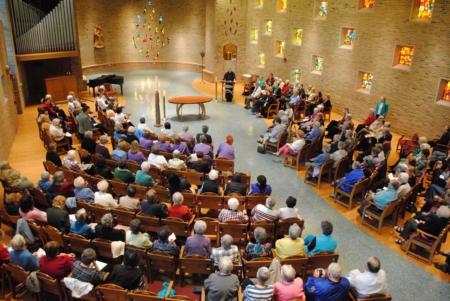
Participants attend an anti-trafficking symposium at the motherhouse of the Sisters of St. Joseph in Brighton May 5. Pilot photo/Courtesy Sisters of St. Joseph of Boston
Posted: 5/11/2012
BRIGHTON -- Over 225 participants gathered for a symposium on consumerism and the many faces of human trafficking in Boston May 5.
This was the fifth such event offered by the Boston Unit of the Leadership Conference of Women Religious (LCWR) Anti-trafficking Coalition since 2008.
Topics ranged from an introduction to human trafficking globally, nationally, and locally; to looking at what one person can do; to the latest topic of how consumer's buying power can become a tool for addressing human trafficking.
The question of what individuals can do to combat human trafficking was addressed right at the beginning of the symposium, as participants watched a brief YouTube video titled: ''Where Am I Wearing?'' by Kelsey Timmerman. As the morning progressed, presenters continued to address the way individuals can become inadvertently complicit in human trafficking by the products they use every day.
Father David Couturier, OFM Cap., past president of Franciscans International, an NGO at the United Nations (2000-2003) and former director of Pastoral Planning for the Archdiocese of Boston, was the first keynote speaker. In addressing the group on consumerism and the supply chains of human trafficking, he asked, "What can we do?"
"We must," he said, "undertake an examination of consciousness when it comes to corporate human trafficking."
Father Couturier then asked some questions to the audience. "Do I care whether the products I buy or use are tainted with human slavery? Are the price, convenience and availability of goods more important to me than the possibility that those goods might be the result of slave labor? How much time and effort am I willing to invest in determining whether a product is the result of trafficked labor? How willing am I to make this problem of human trafficking personal? How willing am I to work with others to eradicate slave labor from my home and dinner table?'
The second keynote presenter was Kate Price of the Jean Baker Miller Training Institute at Wellesley College. Price, being a survivor of childhood sexual exploitation, used her personal experience to inform and educate others. She spoke about buying power and how consumerism and the sexualization of children put all kids at risk.
Toward the end of the symposium, Kathy McCluskey, CSJ, former Executive Director of the U.S. Federation of the Sisters of St. Joseph, summarized the work of the collaborative efforts of the federation to address human trafficking as it exists in hotels throughout our country. Karen McLaughlin, a major architect of the Massachusetts Anti-Trafficking Law passed last November, thanked the coalition for their advocacy and persistence in making this law a reality.
Women religious congregations in the greater Boston area have been offering educational opportunities on the issue of human trafficking since 2008.
Apne Aap's Expanded Global Advocacy to End Sex Trafficking Prioritizes Leadership of Survivors
NEW YORK, Sept. 23 /PRNewswire-USNewswire/ -- In the past year, Ruchira Gupta, President of Apne Aap Women Worldwide and recipient of the 2009 Clinton Global Citizen Award, has made significant strides in the battle to end sex trafficking in India and around the world. Apne Aap has used the increased visibility brought by the Clinton Global Initiative's honor to dramatically expand its programmatic reach on the ground, while spearheading cutting-edge, survivor-led strategies in the global movement to end sex trafficking.
Apne Aap's work is based around organizing the victims and survivors of sex trafficking into "self-help groups" and transforming those groups into small business collectives. In the last year alone, Apne Aap has more than doubled the number of registered self-help groups, growing the number of women and girls whose lives are directly affected from 1,005 one year ago to 2,185 today. Through community centers and publications, Apne Aap's impact now reaches over 10,000 women and girls in India's red light districts.
Perhaps the most significant achievement of Apne Aap over the past year is its profound influence on the perspective of global decision makers in their treatment of the survivors of sex trafficking. The organization has challenged the notion that survivors are passive recipients, convincing the highest level policy makers that survivors are active change agents remarkably capable of informing and shaping national laws and international agendas. In October 2009, Gupta took a panel of survivors to speak at the UN General Assembly in New York alongside Secretary General Ban Ki-moon and High Commissioner for Human Rights, Navi Pillai, and in 2010, she led a group of survivors to speak before the UN Human Rights Council in Geneva. Apne Aap has opened groundbreaking avenues within India for survivors to communicate their ideas to strengthen the anti-trafficking law, the Immoral Traffic Prevention Act, rallying the voices of 3,042 survivors of trafficking to demand the criminalization of the buyers and profiteers of commercial sex while decriminalizing the women in prostitution.
More recently, Apne Aap has embarked on an exciting South-South anti-trafficking partnership with NGOs in South Africa by exporting its model of community organizing and women's self-empowerment to this new arena. Speaking before the South African Parliament this summer, Gupta called on African politicians to put into place stricter mechanisms to prevent trafficking in women and girls.
"The Clinton Global Initiative award was significant for Apne Aap because it opened up new opportunities by amplifying the influence that an NGO from the Global South can have internationally. The increased visibility has helped raise funding, networking opportunities and the ability to engage with new audiences," said Ruchira Gupta. In 2010, Gupta was invited to join CGI Lead, a high-level group within the Clinton Global Initiative whose mission is to "bring together a select group of accomplished young leaders to develop innovative solutions to some of the world's most pressing challenges." Said Gupta, "There is still much that needs to be done in addressing sex trafficking effectively. As India is gearing up to the Commonwealth Games in October, the government has not prioritized the safety of women and girls from commercial sexual exploitation. Thousands of women and girls' lives are in danger and we need to keep global pressure on the Indian government to put in place adequate measures that will protect girls and women."
On Tuesday, September 21st, Gupta moderated a session at the CGI Annual Meeting to explore initiatives that are applying different approaches to the problem of trafficking, including monitoring corporate supply chains, rehabilitating victims through training and income generation, and preventing trafficking through education and micro-land grants. Among the participants were actors Julia Ormond, Ashley Judd, Demi Moore and Ashton Kutcher.
About Apne Aap
Apne Aap fights human trafficking and empowers women to escape sexual slavery. We provide the women and children of India's Red Light Districts with education, health care, legal protection and job skills.
Field Update: 12-year Old Girl Escapes Sex Trafficking and Plays Major Role in Prosecuting Traffickers
This summer, 12-year old Nisha went missing. Nisha comes from a red-light area in a rural community in Bihar, India where caste discrimination pushes many families to accept forced prostitution as their expected means of income generation. The region is rampant with home-based brothels and parents trafficking their own children. On hearing of Nisha's disappearance, Apne Aap quickly stepped in, reporting the situation to the police and finding the traffickers who had taken Nisha with the intent of sexual exploitation. With Apne Aap's help, Nisha was rescued from an area brothel and brought to Apne Aap's Kasturba Gandhi Balika Vidyalaya hostel and school. This marks the first ever occasion when a rescued girl has been brought to a rehabilitation program, rather than a jail or shelter. Nisha is recovering well from the trauma in the safe, stable environment of the school. She recently gathered the courage to testify against her own father for pulling her out of school and is assisting Apne Aap in the prosecution of child traffickers.
The right to education is at the center of Apne Aap's legal campaign to stop the forced prostitution of all girls. During Nisha's rescue, Apne Aap lobbied the Chief Minister of the state of Bihar to take action to prevent parent-traffickers from pulling their children out of schools and safe houses. As a result, the Chief Minister ordered a new School and Hostel facility built for Apne Aap and has committed to extend funding to allow what was previously a 9-month bridge program into a full middle and high school.
Prostitution is commonplace and legal in Tijuana's Zona Norte area. (Photo by Tania Navarro)
Prostitution is commonplace in Tijuana's Zona Norte area. (Photo by Tania Navarro)
It’s a modern form of slavery, the third largest criminal industry in the world after drug and weapons dealing, and the fastest growing.
Human trafficking is a real issue around the world that affects many victims who are engaged in prostitution, pornography or exotic dancing. It also occurs in forms of labor exploitation, such as domestic servitude or restaurant work, sweatshop, factory work or migrant agricultural work.
To prevent and discuss ideas that could help to intervene and eradicate human trafficking and commercial sexual exploitation at this border, the Bilateral Safety Corridor Coalition (BSCC) — an alliance of over 60 government and nonprofit agencies in the U.S. and Latin America — convened a panel with national and foreign experts.
BSCC director Marisa Ugarte said last year the group registered more than 2,000 calls and 349 cases of labor and sexual exploitation in San Diego.
“The number of victims for human trafficking and exploitation is incalculable. Some organizations suggest that at least 350,000 kids are being exploited in the U.S. but there are no real surveys to prove it, because most of the time the victims are invisible to us,” she said.
Click here to find out more!
BSCC is headquartered in National City with a sister office in Tijuana. Ugarte has led the organization since 1997. She knows that the problems are even more dangerous in border cities and the tourist destinations.
Child pornography, sexual and labor exploitation, sex tourism, and panhandling, are some of the issues happening in Baja California and California frontiers, said Ugarte.
In specific areas such as El Cajon Boulevard, National City, and Vista in San Diego County or the Zona Norte in Tijuana, the problems are more notorious. Women, men and children from Mexico, the U.S., and many other nations are being trafficked and exploited at the San Diego-Tijuana border region, she said. Enough proof is the case of Salim Boughader, a Tijuana restaurant owner that was sentenced to 60 years in a Mexican prison in 2008. He was accused of leading a trafficking network and brought more than 200 Lebanese into the U.S., including sympathizers of the terrorist group Hezbollah.
Boughader smuggled people without problems through Mexican airports and some successfully crossed the border between Tijuana and San Diego.
Reverse trafficking
Many American teenagers and young women are victims of human trafficking and exploitation, said Anna Rodriguez, founder and CEO of the Florida Coalition Against Human Trafficking.
Japan, Aruba, Thailand, South America and Europe are some of the destinations where these girls are taken to, she said.
Rodriguez said that at first they are recruited in their hometowns to participate as models or dancers in live shows; once they obtain the job, they travel overseas with legitimate documents and paid by the contractors.
Prostitution is legal in Tijuana'z Zona Norte area but exploitation is common. (Photo by Tania Navarro)
Prostitution is legal in Tijuana'z Zona Norte area but exploitation is common. (Photo by Tania Navarro)
“Then they arrive alone to a foreign country and they are forced to work as prostitutes or lap dancers at strip clubs, with no other choice than stay because most of the time the contractors take away their passports,” she said. “If they want to escape, they need first to pay for their travel expenses and then collect enough to go away.”
American customers
All day and night in Tijuana’s downtown, very close to the border fence, many women and men practice legal prostitution, in the tolerance area called Zona Norte.
“Just one visit to those streets is necessary to find out that many of the people that buy these men and women are Americans,” said Rodriguez.
But in Zona Norte, not everything is legal. There are also children that are forced to have sex with adults, said Ugarte.
“Human trafficking has proliferated in our border and in our cities because dogs don’t smell it, the product is not a drug and the criminals don’t sell it,” she said. “They recycle it and exploit it many times until the girl or boy is no longer attractive for the customers,” she said.
Under the U.S. PROTECT Act of 2003, a law aimed at preventing child abuse, citizens or residents of the United States are subject to 30 years in prison if engaged in sexual activity with boys or girls under 18, even if the offense is made in another country. (PROTECT stands for “Prosecutorial Remedies and Other Tools to end the Exploitation of Children Today”).
“We have a law that punishes Americans that commit these crimes in another country, but we are not seeing more cases of this kind,” Rodriguez said. “Then where are we failing?”
Mexican efforts
There are three types of countries for human trafficking crimes: the countries of origin, transit and destination.
“The seriousness of the problem of trafficking in Mexico is that this is an origin, transit and destination country,” said Fernando Batista of the Mexican Human Rights Commission.
“Certainly this is a problem that has been gradually strengthening in our country, not just in the border states. However, the border is a very active place for the transit of persons who are subjected to this terrible crime,” he said.
Batista said that in Mexico, indigenous people, women, children, and immigrants are potential victims for human trafficking.
While organ trafficking, and sexual and labor exploitation are some of the most frequent crimes in Mexico, most of the time the perpetrators are not punished.
“In the commission, we have promoted the approval of many state laws and public policies implemented to prevent human trafficking, as well as any other action made to enforce the Palermo Protocol,” he said.
The Palermo Protocol, adopted by the United Nations in 2000, offers practical help to states with drafting laws, creating comprehensive national anti-trafficking strategies, and assisting with resources to implement them.
The commission is also looking forward to the federalization of the human trafficking crime in Mexico, as a strategy to bring national attention in this issue.
“We want those who commit this crime in Mexico be brought into our justice institutions, be convicted and that no impunity reign in our country,” he said.
Tania Navarro is SDNN’s Tijuana correspondent.
This entry was posted on Monday, February 8th, 2010 at 11:42 am and is filed under Mexico . You can follow any responses to this entry through the RSS 2.0 feed. You can skip to the end and leave a response. Pinging is currently not allowed.
Attention to human trafficking has focused in recent years on sexual exploitation, but one of every five victims is estimated to endure forced labor in factories or on farms. The Obama administration has recognized that reality and is to be commended for bringing to justice two farm owners who conspired with others to hold 44 men from Thailand in forced labor through debts, threats and restraint.
Brothers Alec and Mike Sou, co-owners of Aloun Farm on the Ewa plain, pleaded guilty Wednesday in federal court to conspiring to commit forced labor. Each faces up to five years in prison for their roles in a labor trafficking operation.
The Justice Department should honor the Thai government's request that it take care of the workers who were victims of the scheme. The workers, most of them married with children, secured loans to pay the recruitment fees, using their homes and subsistence farmlands as collateral.
Slavery became illegal in the United States 145 years ago, but President Barack Obama said in Tokyo two months ago that the industry has become a vast "transnational problem." He urged countries to put a "stop to this scourge of modern-day slavery once and for all."
The Sou brothers were accused of lying on visa applications to import the workers. California businessman Matee Chowsanitphon admitted having brokered the agreement in a trip to Thailand in 2003 and escorted the workers to Hawaii the following year for a price of $5,500 per worker. Once they arrived, the Sous took their passports, put them to work at paltry wages and restricted their contact with others.
"Holding other human beings in servitude against their will is a violation of individual rights that is intolerable in a free society," said Thomas E. Perez, assistant attorney general for civil rights.
In the past fiscal year, his division brought the highest number of labor trafficking cases to court in a single year, according to a Justice news release.
"Labor traffickers prey on vulnerable victims and their dreams of a better life," added U.S. Attorney Florence T. Nakakuni. "Those who conspire to hold workers in forced labor undermine this country's promise of liberty and opportunity. We will continue to hold accountable those who seek to enrich themselves at the expense of the freedom, rights and dignity of others."
Farm workers are especially vulnerable, since they are denied by federal labor law the right to organize and form unions or receive overtime pay, while minimum wage and workplace safety protections are hardly enforced.
The Sou brothers are not likely to be the only employers in Hawaii to have exploited foreign workers. The Justice Department should use the Sous' case as a starting point for an extensive crackdown on employers that enslave their workers in Hawaii.
Attention to human trafficking has focused in recent years on sexual exploitation, but one of every five victims is estimated to endure forced labor in factories or on farms. The Obama administration has recognized that reality and is to be commended for bringing to justice two farm owners who conspired with others to hold 44 men from Thailand in forced labor through debts, threats and restraint.
Click Here For More Info!
Brothers Alec and Mike Sou, co-owners of Aloun Farm on the Ewa plain, pleaded guilty Wednesday in federal court to conspiring to commit forced labor. Each faces up to five years in prison for their roles in a labor trafficking operation.
The Justice Department should honor the Thai government's request that it take care of the workers who were victims of the scheme. The workers, most of them married with children, secured loans to pay the recruitment fees, using their homes and subsistence farmlands as collateral.
Slavery became illegal in the United States 145 years ago, but President Barack Obama said in Tokyo two months ago that the industry has become a vast "transnational problem." He urged countries to put a "stop to this scourge of modern-day slavery once and for all."
The Sou brothers were accused of lying on visa applications to import the workers. California businessman Matee Chowsanitphon admitted having brokered the agreement in a trip to Thailand in 2003 and escorted the workers to Hawaii the following year for a price of $5,500 per worker. Once they arrived, the Sous took their passports, put them to work at paltry wages and restricted their contact with others.
"Holding other human beings in servitude against their will is a violation of individual rights that is intolerable in a free society," said Thomas E. Perez, assistant attorney general for civil rights.
In the past fiscal year, his division brought the highest number of labor trafficking cases to court in a single year, according to a Justice news release.
"Labor traffickers prey on vulnerable victims and their dreams of a better life," added U.S. Attorney Florence T. Nakakuni. "Those who conspire to hold workers in forced labor undermine this country's promise of liberty and opportunity. We will continue to hold accountable those who seek to enrich themselves at the expense of the freedom, rights and dignity of others."
Farm workers are especially vulnerable, since they are denied by federal labor law the right to organize and form unions or receive overtime pay, while minimum wage and workplace safety protections are hardly enforced.
The Sou brothers are not likely to be the only employers in Hawaii to have exploited foreign workers. The Justice Department should use the Sous' case as a starting point for an extensive crackdown on employers that enslave their workers in Hawaii.
Three decades ago, the relatives of an eleven-year-old Native girl in Minnesota forced her to have sex with a man in exchange for alcohol. The story was not front-page news. It was not the subject of a feature-length film with a happy ending. No one intervened. But when she turned eighteen, the police started paying attention. She was arrested and convicted over twenty times for prostitution. Her parents’ addiction became her own, and she entered treatment dozens of times.
At an early age, the girl became one of hundreds, maybe thousands, of Native American children and women forced into prostitution in Minnesota, falling under the radar of social services, the community, and the media.
“If it was a bunch of white, blonde hair, blue-eyed girls, believe me, there would be an end to this,” said Vednita Carter, executive director of Breaking Free, a St. Paul-based nonprofit serving women involved in prostitution.
In September, the Minnesota Indian Women’s Resource Center became the first organization in the state to release a report about the widespread trafficking of Native women. The agency hopes its effort will draw attention and funding to Native victims of sexual exploitation.
Advocates say the report’s findings cast little doubt that the situation has already become a crisis. In a sample of 95 Native women seeking services from the resource center, 40 percent reported being the victims of commercial sexual exploitation.
Sixty percent of the women surveyed entered prostitution or pornography before the age of 18. And about one-fifth had been sexually exploited before their thirteenth birthday. When the girls become adults, the exploitation often continues. They remain in prostitution, but the law often no longer views them as victims, but as criminals.
The 126-page report, called Shattered Hearts, written by esearch scientist Alexandra Pierce, focuses on women who live outside of reservations. The report compiles statistics, identifies flaws in the legal system, draws parallels to the historic exploitation of Native people, and makes dozens of suggestions about how to address the problem. Pierce incorporated the Resource Center’s own studies, interviews with social service workers, and available government data.
“To me, it’s an emotional issue; it’s a financial issue; it’s a justice issue; it’s a human rights issue,” said Suzanne Koepplinger, the Resource Center’s executive director.
Although the legal system treats prostitution and trafficking differently, the report often uses the terms interchangeably, as many advocates believe that prostitution can never be considered fully consensual. The prostituted woman is the true victim of the crime, they argue.
“There’s a general acceptance that prostitution is a lifestyle choice, when it’s actually a federal crime against women,” Koepplinger said.
The report found that Native women have been disproportionally impacted by sexual exploitation. For example, Native American women make up about 25 percent of all women on probation in Hennepin County for prostitution-related offenses, according to data from 2007. But Native women represent only 2.2 percent of the county’s population.
Past treatment of Indian women
Some of the reasons for the staggering numbers are clear. Native Americans have the state’s highest rates of homelessness, poverty, and alcoholism – what many call the legacy of hundreds of years of colonialism. But the report also argues that generational trauma plays a role. White settlers repeatedly raped, tortured, and murdered Native women over hundreds of years, treating their bodies as disposable and worthless.
In one account from the 1860s, a white rancher describes a government attack on the Cheyenne: “I heard one man say that he had cut out a woman’s private parts and had them for exhibition on a stick…I also heard of numerous instances in which men had cut out the private parts of females and stretched them over the saddle-bows and wore them over their hats while riding in the ranks.”
Other more recent practices, including the involuntary sterilization of Native women and the Indian Adoption Project (which removed Native children from their homes), added to the collective trauma, the report says.
“There’s been so much violence and destruction of families because of colonization,” said Nicole Matthews, executive director of the Minnesota Indian Women’s Sexual Assault Coalition.
In Minnesota, advocates say that Native women have been prostituted onto ships in the Duluth harbor for generations, although local law enforcement say that they have not noticed any trafficking since harbor security was ramped up after 9/11.
“Girls have conversations with their mothers about their time, when the mothers were working on the boats,” one advocate said during a round-table discussion conducted as part of the report. “Many of the girls were conceived out of working on the boats.”
These historical experiences leave Native women psychologically vulnerable to exploitation, the report says. Once women enter into prostitution, they are less likely to ask for help, as violence against women may seem normal.
Sexual exploitation in the Native community
Advocates say that many Native communities have also normalized sexual exploitation. Although data is limited, the fact that Native women are often exploited in childhood suggests that Native men play a significant role in their abuse. In many close-knit Native communities, women may have difficulty speaking out.
“It’s a very difficult issue because it’s a very painful issue,” Koepplinger said. “But not talking about it hasn’t helped us.”
An advocate who was interviewed anonymously as part of the report said that when she has tried to talk about sexual violence with members of her Native community, “Some of the elders don’t appreciate that.”
Another participants agreed, saying, “Oh, I know, I know. I was ‘that nasty girl who talks nasty.’”
Criminalization of victims
If the girls don’t find help before they turn eighteen, the legal system takes over, often criminalizes their abuse, and fails to effectively stop sex trafficking, advocates say. But disagreement exists among both advocates and law enforcement about the best intervention methods.
“Police get a hold of them first,” said Linda Miller, executive director of Civil Society, a non-profit that provides legal and other assistance to trafficking victims. “They’ve declared that they’re not going to look beneath the surface.”
But St. Paul Police spokesperson Paul Schnell points to the federally funded Gerald D. Vick Human Trafficking Task Force, a police-led effort to coordinate services for victims of trafficking. The police department trains officers to recognize signs of human trafficking when they approach criminal situations.
However, many women are distrustful of law enforcement, and Schnell acknowledges that police officers frequently arrest women engaged in prostitution.
“In the moment, a case may become a case, “ he said. “But over the course of time and doing that investigation via prosecution or defense counsel, there are different places where there can be interventions to address the trafficking issues.”
Carter, of Breaking Free, said that St. Paul police officers have been increasingly receptive to treating prostitutes as victims. More police officers are bringing women directly to Breaking Free instead of jail, she said.
Nonetheless, arrests continue, and advocates say that a prostitution conviction – or even an arrest – can prevent a woman from ever having a decent job or housing.
“Not many women want to spend the rest of their lives saying that they engaged in prostitution,” Miller said.
Trafficking laws in Minnesota
Minnesota law does provide some additional legal protection to victims of sex trafficking. While the federal definition of trafficking requires that traffickers use “force, fraud, or coercion,” state laws say that a person can never consent to being sexually exploited. Under state law, anyone who had been prostituted by others is considered a trafficking victim.
In May 2009, the Minnesota legislature unanimously passed an amendment to the state’s sex trafficking law. The amendment allows prosecutors to give sex traffickers higher penalties when the offender repeatedly traffics victims into prostitution, where bodily harm is inflicted, where an individual is held more than 180 days, or where more than one victim is involved. The amendment also categorizes sex trafficking as a “crime of violence,” which prohibits traffickers from owning firearms.
As of late October, prosecutors have not convicted any traffickers under the amended bill. Advocates say the lack of prosecution is not surprising. It’s a lot easier to arrest the prostitute on the street than investigate what could be a larger, more organized business, they say.
But sometimes, despite massive investigative efforts, trafficking cases fall apart. Deputy Chief John Beyer, of the Duluth Police Department, said that investigators spent hundreds of hours working on a case in 2000, involving two Native girls being trafficked onto boats in the Duluth harbor. The officers even obtained video footage that showed the girls going onto the boats.
Beyer said the case fell apart when the girls stopped cooperating with law enforcement’s efforts to prosecute the case. “That was really frustrating for all of us” he said. “We really wanted to go after those guys.”
Ramsey County Attorney Susan Gaertner says her office has not seen any cases involving the trafficking of Native women in recent years. However, she says that the lack of cases does not mean that trafficking does not exist, but that women face barriers to reporting their abuse.
“In my mind as a prosecutor, the barrier is not the language of the statutes,” she said. “The real barrier is the lack of reports and the lack of awareness by system’s personnel,” including health care providers and teachers.
Punishing the victims
Many advocates say that law enforcement needs to address not only the traffickers, but also the individual men who pay for sex. Carter, of Breaking Free, said she believes that the men should receive felony convictions as a deterrent.
“We believe it’s about supply and demand,” she said. “And there’s so much focus on the supply, which is the women. The demand is the men who buy them. That’s what keeps prostitution thriving is the demand.”
Breaking Free runs a monthly program for men convicted of soliciting a prostitute, and Carter says the program has had some success. Out of about 400 male participants, only a handful have been re-arrested. But she cautioned that this might not reflect the true reality. Men may just work harder to avoid detection, she said.
On the victim’s side, advocates say that women have little incentive to come forward and share their stories. Few services exist for victims of trafficking. The situation is often parallel to that of domestic violence victims. Without adequate support, leaving the situation could place women at greater risk of violence, including murder, advocates say.
Programs like Breaking Free, Women of Nations, the Minnesota Indian Women’s Resource Center, the Minnesota Indian Women’s Sexual Assault Coalition, the American Indian Community Housing Organization in Duluth, and others are trying to address the problem, but advocates say that a lack of funding for housing prevents many women from coming forward.
“Why would we want to put a woman through that if nothing’s going to happen?” said Matthews. “You’re kind of opening the wound without doing anything about it.”
The Minnesota Indian Women’s Resource Center runs an emergency shelter program for women, but they had to turn away 50 women and children last year. About 150 women are on the agency’s waiting list for supportive housing.
The report also recommends other measures, including: raising awareness of the problem, increasing criminal penalties for purchasers of sexual services, training health care workers and others to identify signs of sex trafficking, and providing job opportunities for victims of prostitution.
Although advocates are quick to point out that sexual exploitation is not unique to Native communities, they say that Native people need to take some responsibility for addressing the situation. The first step, they say, is ending the silence that exists in many close-knit Native communities.
“If enough people in the community say this is a problem, then we can get something done,” Koepplinger said.
Advocates emphasize that Native people can also draw on specific cultural strengths to confront the problem. For example, the American Indian Community Housing Organization in Duluth holds traditional full-moon ceremonies every month to help women begin to heal and recover from their experiences.
“It’s important to provide a safe space where they can feel comfortable saying that I don’t want this to happen to my daughter,” said Sherry Sanchez-Tibbets, the agency’s executive director.
Meanwhile, advocates say they hope that agencies will collect more data, which could be used to secure badly needed funding.
As part of this initiative, the Minnesota Indian Women’s Sexual Assault Coalition recently began a project to interview Native victims to learn more about their struggles, and to ask the women for input about what services would be useful.
The agency hopes to interview 100 women by February, and intends to hold a community feast to celebrate the project. Plans are also in the works to create a quilt in honor of the women and to publicize the problem.
Koepplinger stresses that her agency’s report is just the first step to identify and begin to more fully address the problem. “I’m not naive enough to think we can do this in the next two years, but we have to start somewhere,” she said.
In the meantime, every day Native woman are being prostituted in Minnesota. The story of the woman who was sold into prostitution at age eleven demonstrates the challenges of intervention.
The woman did not connect with social services until her mid-‘40s. By that time, she was entrenched in a cycle of violence. Civil Society has provided her with emergency help several times over the past few years, but she faces limited options.
Right now, she is once again in treatment for alcoholism, and Miller, of Civil Society, said she still hopes the woman can create a healthy life for herself. But, she added, “Her story, and the other victims we see, are just the tip of the iceberg.”
*** To read the full Shattered Hearts report , see: www.miwrc.org .
If you are being prostituted, sexual exploited, or trafficked, there are agencies that can help you. Here are several:
• Breaking Free: 651-645-6557
• MN Indian Women’s Resource Center: 612-728-2000
• MN Indian Women’s Sexual Assault Coalition: 651-646-4800
• Civil Society: 1-888-772-3324 (toll-free) or 651-291-8810
Acting on a tip-off, an anti-vice raid by a team from the Crime Investigation Department at State police headquarters, zeroed in on a double-storey wooden house where the women, aged between 19 and 30, were being kept.
State Officer-in-Charge of Crime Investigation, SAC II Zainal Abidin Kasim, said the team also arrested four other foreigners, including three men aged between 21 and 30 and a 24-year-old woman.
"We arrested them under the Anti-Trafficking In Persons Act 2007 (ATIP 2007). The four suspects acted as their (victims) guardians and have used these seven women for the purpose of exploitation," he said, Thursday.
He said police also seized a Proton Wira car belonging to the suspects.
"We suspect they have been using the car to transport the victims to locations to carry out immoral services. For the time being, we have placed the women in a safe house where we will keep them for a maximum of three months.
"They are now under the Interim Protection Order (IPO) care. We will provide counselling and record their statements before sending them back," he said.
Police have so far solved six cases under the Act and rescued 26 women throughout the State this year.
Suspects would be investigated under Section 12 of the ATIP 2007, which provides for imprisonment of up to 15 years and a fine, if convicted.
Zainal Abidin advised the public to act as a watchdog for the police and provide information should there be any exploitation cases in their respective area.
"Exploitation here means all forms of sexual exploitation, forced labour or services, slavery, servitude, any illegal activity (example: trading in persons being a child) or the removal of human organs. We urge the public to work together with the police to eradicate such activities," he said.
Bulgaria has long struggled with corruption that has allowed human trafficking and organized crime to spread beyond its borders. But experts say the police and judiciary are starting to fight these problems.
Slavery isn't a word that comes to mind as you stroll along Sofia's fashionable boulevards. But Bulgaria has long been a haven for traffickers who target the country's poorest people, using violence and threats to force their victims into labor, prostitution and crime rings in the West.
According to Risk Monitor, an NGO working to prevent organized crime and corruption in the country, trafficking may have become more visible with the collapse of communism 20 years ago. But it has a history that reaches back to the days of the regime.
"During communism in Bulgaria, it was impossible to say for ideological reasons that trafficking, exploitation or prostitution was happening - these things were very well hidden by the state," said Iva Pushkarova of Risk Monitor. "The communist state itself supported the trafficking of human begins - not entirely for sexual exploitation, but for labor."
When the communist government was ousted in 1989, organized criminal groups took over the trade in forced human labor.
"These criminal organizations were created by the state during communism," Puskarova said. "They just separated themselves from the state after the fall of communism."
Lured abroad under false pretences
Because of her work, Pushkarova has become familiar with the stories of many women and girls who have been forced into crime or prostitution by human traffickers - girls like Rosaria, who was married off to a man 10 years her elder when she was only 16. Her husband took her to Italy, where he said she would work in a restaurant.
"He took me to the owner of a restaurant, and during this meeting, the owner gave my husband a lot of money," she recalled. "I didn't understand why. They said I would live in the restaurant because it was safer than walking home every night. I was taken to a room and I started to understand I was sold as a prostitute."
Rosaria was not the only Bulgarian girl being held captive in the rooms above the restaurant. She said that when she told the others that she wanted to escape, they told her it was too dangerous. The owner of the restaurant had the support of the local police.
Eventually, one of the girls gave Rosaria a pamphlet from an organization which rescues and protects people who have been trafficked. Rosaria hid the pamphlet until she could convince a client to let her use his mobile phone.
Two weeks later, the owner of the restaurant found out that the Bulgarian police were searching for Rosaria, and threw her out. She found the local police station and returned home to Bulgaria.
In many cases, though, it's not safe for victims to return home after they've been rescued. And those who do, often struggle to overcome the trauma they've experienced, said Svetlin Markov of Animus. The organization in Sofia runs a crisis center, a 24-hour hotline and reintegration programs for survivors.
"We try to help empower women to be more confident about the future, to be more confident in society, and to see that even though they were victims of trafficking in this society, there are individuals who can help," Markov said.
Lack of government commitment
But Markov said that, for the Bulgarian government, trafficking simply isn't a priority. That's reflected in a lack of funding for Animus, meaning the crisis center can only accommodate survivors for one month. After that, they need to find their own accommodation. It's an almost impossible task, as they have no money and there are no shelters.
"Under the anti-trafficking law in Bulgaria, the national commissioner is responsible for setting up shelters, but for almost six years, there haven't been any working shelters in Bulgaria," Markov said. "Our crisis unit is an exception."
Raising funds to fight trafficking is a difficult task in a country which saw its EU funds stopped last year because of corruption and poor administration. Both Markov and Pushkarova said funding, improved social policy and education were the keys to preventing trafficking.
"You need to address the roots of the problem and the roots of the problem are social," Pushkarova said. "They come from being completely uneducated, to being marginalised from society, to being unemployed for a very long time."
She said that while there's a long road ahead, there have also been some improvements.
"My research shows that the Bulgarian judiciary and police have done an enormous amount of work in the last year," she said. "We are on the brink of a great wave of successful court proceedings, and at present, we're in the midst of social change."
25 November 2009 - As the world marks the International Day for the Elimination of Violence against Women, UNODC is drawing attention to how human trafficking fuels violence against women.
In its Global Report on Trafficking in Persons UNODC revealed that two thirds of the identified victims of trafficking were women.
In his message for the day, Secretary-General Ban Ki-moon stressed that whether the crime against women is rape, domestic violence, genital mutilation or trafficking for sexual exploitation, it is inexcusable and must be stopped.
Human trafficking is, indeed, one of the worst forms of violence against women and girls. Traffickers may use violence to intimidate and subdue the victims. Once recruited, the women usually find themselves in situations with severely curtailed freedoms. Many times they suffer extreme physical and mental abuse, including through rape, imprisonment, forced abortions and physical brutality at the hands of their so-called "owners". The victims become isolated, losing ties with their former lives and families.
With a better understanding of why women in particular are vulnerable to trafficking and how traffickers operate, and by providing the necessary legal and technical assistance to ensure that effective countermeasures are in place, this crime can be stopped.
Violence against women does not only concern women. It concerns everyone, and the work to combat it must be done by all. Women around the world are the linchpin keeping families, communities and nations together. Eliminating gender discrimination and gender-based violence will enhance the dignity and human rights of women and girls and help prevent their being trafficked.
Addressing human trafficking cuts across all fundamental issues. It is about human rights, peace and security, development and family health. In the most basic sense, it is about preserving the fabric of society. We all have a role to play, either in raising awareness, building partnerships, providing information, protecting victims or bringing the criminals to justice.
In 2008, Secretary-General Ban launched the UNiTE to End Violence against Women campaign, which aims to prevent and eliminate violence against women and girls in all parts of the world. UNiTE calls on Governments, civil society, women's organizations, young people, the private sector, the media and the entire United Nations system to join forces in addressing the global pandemic of violence against women and girls.
This year, as part of the UNiTE campaign, the Secretary-General started the UNiTE Network of Men Leaders to End Violence against Women. The Network consists of men - young and old - who have pledged to work to end violence against women and girls. These men will add their voices to the growing global chorus for action, and each has pledged to take concrete steps in his community of influence and create partnerships with women to end this violence.
In the Midwestern heartland, police are encountering a new social evil: trafficking, often involving women and children who are forced to work as prostitutes or unpaid labour; and the outcomes can be brutal.
* Paul Harris in Dayton, Ohio
* The Observer, Sunday 22 November 2009
Human trafficking has become a major issue in the Midwest heartland of America, causing some campaigners to dub it a modern form of slavery.
Figures from the State Department reveal that 17,500 people are trafficked into the US every year against their will or under false pretences, mainly to be used for sex or forced labour. Experts believe that, when cases of internal trafficking are added, the total number of victims could be up to five times larger. And increasing numbers of trafficked individuals are being transported thousands of miles from America's coasts and into heartland states such as Ohio and Michigan.
"It is not only a crime. It is an abomination," said Professor Mark Ensalaco, a political scientist at the University of Dayton, Ohio, who organised a recent conference on the issue. In Ohio a human trafficking commission has just been set up to study the problem, while in the northern Ohio city of Toledo a special FBI task force is tackling the issue. For many local law enforcement officials, it is a bewildering new world.
In one recent incident a 16-year-old Mexican girl was found to have been trafficked across the US border. Doctors noticed the heavily pregnant girl showed clear signs of physical abuse when she was brought into a hospital in Dayton to give birth. The police were called but the couple who had brought her had already fled. When the girl's story emerged, it became clear she had been kept against her will in the nearby city of Springfield and used for labour and sex. "I thought slavery ended a few centuries ago. But here it is alive and well," said Springfield's sheriff, Gene Kelly.
He emphasised the risks to the girl's baby after it had been born if the doctors had not been so alert: "Like the mother, the baby could have ended up a victim for years to come. Who knows? Future labour? Future person to traffic?"
Ohio anti-trafficking campaigner Phil Cenedella, founder of Combating Trafficking Anywhere, believes that the baby was destined to be sold off by her captors. "They would have put the kid on the black market. It is crazy that this is happening." Human trafficking – defined as forcing someone against their will to work for no reward – has been dubbed modern slavery. At the Dayton conference, it was discussed as a growing social problem, not in some far-off foreign land, but among the cornfields of Ohio.
"The problems are broader than we realised," said Ohio's attorney general, Richard Cordray. "What we want to do is find and disrupt these networks."
One of the country's leading anti-trafficking advocates is Theresa Flores, a former victim. Flores puts a different kind of face on human trafficking in America. She is white, middle-class and blond and looks the epitome of a suburban American woman. She grew up in a wealthy suburb of Detroit in Michigan and did well at school. Yet Flores tells a nightmarish story of two years being drugged, raped and sold for sex.
Flores, whose ordeal was turned into a book called The Sacred Bath: An American Teen's Story of Modern Day Slavery, was attacked and raped when she was 15. Her assailant used the threat of photographs he had taken during her rape to force her into having sex with strangers. She became the effective prisoner of a drugs gang that used her as a prostitute and kept her earnings, or gave her away free to gang members as a "reward". "People don't think that trafficking looks like me or that it can happen to someone who came from a nice neighbourhood. But it does. People need to see outside that box," said Flores.
Flores said that her lowest point came when the gang took her to a seedy motel where she was raped by as many as two dozen men. She woke up alone, abused and with no clothes. "I was told I would die if I told anyone. It happened over and over for two years as I became a sex slave for those men," she said.
Anti-trafficking campaigners point out that cases in the US come in a wide variety of forms involving men, women and children. One major area is that of trafficked labour with people used for domestic work or, more commonly, for back-breaking labour in agricultural industries. But trafficking cases have also occurred in businesses such as restaurants, hair salons and beauty parlours. The overwhelming majority of the rest are sex cases, usually involving young women or children forced into prostitution. The methods used to keep people vary. They include confiscating the passports of those brought in from a foreign country or the threat of extreme violence. Other tactics are to threaten family members if a victim does not comply or, as in Flores's case, to use blackmail.
Trafficking represents a new challenge to law enforcement, especially in regions which have traditionally not thought of it as a major problem. That is especially true where it happens within an immigrant community. Languages are a problem as well as cultural issues and a natural fear that many immigrants – some of them possibly illegal – have of contacting the police.
Kelly believes that is the case in Springfield, a town that is almost the Midwestern archetype. It was once featured in a story in Newsweek magazine entitled "The American Dream". But its 65,000 citizens also face all the problems of a modern America in the grip of a deep recession: an immigration crisis and profoundly changing demographics. The town now hosts several prominent minority communities who make up more than a fifth of its population, including Russians, Chinese, Latinos and Somalis. "There are a lot of people who distrust law enforcement. We need to break down those barriers. Our officers need training, especially in languages," said Kelly. "If you can't speak to people, you can't reach them."
Some commentators and experts have accused victims' advocates and academics of overstating the problem, arguing the problem has been exaggerated and expressing scepticism at the notion that vast organised criminal networks are dealing in human beings for sex or labour. Law enforcement officers also acknowledge that the definitions of trafficking may need refining.
In North Carolina last week the mother of a five-year-old girl was charged with human trafficking after being accused of offering her daughter for sex. The child was later found dead. The crime was horrific, but the distinction between trafficking and simple, sadistic child abuse might not be immediately obvious.
"We have a problem with definition. It is not always straightforward and easy to explain," said Laura Clemmens, a government lawyer in Dayton. "The hard part is bringing it into the light. At the moment these crimes are clouded in secrecy."
President Obama turned to a career prosecutor with many years of experience in fighting human trafficking when he nominated Luis C de Baca to be the next Director of the Office to Monitor and Combat Trafficking in Persons at the Department of State. Confirmed May 6, 2009, de Baca holds the rank of Ambassador-at-Large and Senior Advisor to the Secretary of State. The Trafficking Office is statutorily mandated to coordinate U.S. government activities in the global fight against contemporary forms of slavery, including forced labor in factories, fields, homes and sweatshops, and the trafficking of women and children for sexual exploitation. Worldwide, there are estimated to be as many as 27 million persons living in slavery today.
De Baca’s great-great-grandfather, Ezequiel C de Baca, was New Mexico’s first elected Hispanic governor. Born in New Mexico, Luis C de Baca was one of three children born to Dr. Robert C de Baca, an animal scientist known as the “Father of the Iowa Beef Improvement Association,” and Mary (Marchino) de Baca. He grew up on a cattle ranch in Huxley, Iowa, where he was active in the local 4-H Club and graduated from Ballard High School. He earned a B.A. in political science from Iowa State University in 1990, and a law degree in 1993 from the University of Michigan Law School, where he was President of the Hispanic Law Students Association and an editor of the Michigan Law Review.
Straight out of law school, de Baca was hired by the Department of Justice to be involuntary servitude and slavery coordinator, a position he held until 2000, when he was named chief counsel of DOJ’s Human Trafficking Prosecution Unit. In that position, he tried more than 100 cases, including several high profile ones, such as U.S. v. Kil Soo Lee, which involved the enslavement of more than 200 Vietnamese and Chinese workers in a garment factory in American Samoa; the so-called “Deaf Mexican” slavery case, which involved scores of hearing impaired Mexicans who were lured to the U.S. with promises of employment and then forced to sell cheap trinkets on the streets of New York City, Chicago and other large cities; and U.S. v. Cadena, a path-setting prostitution slavery case in Florida. He was also instrumental in developing the victim-centered approach to combating modern slavery, which means that former slaves are assisted in establishing normal lives, rather than deported or otherwise treated as criminals. In 2007, de Baca was named counsel to the House Judiciary Committee, working for Chairman John Conyers, Jr. (D-Mich.), where his portfolio included national security, intelligence, immigration, civil rights, and modern slavery issues.
A Democrat, de Baca donated $2,250 to Democratic candidates and causes between 2001 and 2004.
The “C” in de Baca’s is part of his surname and stands for Cabeza.
- Matt Bewig



![Reblog this post [with Zemanta]](http://img.zemanta.com/reblog_e.png?x-id=a0bac06e-57e3-4ae8-bd73-1a1109881d12)
![Reblog this post [with Zemanta]](http://img.zemanta.com/reblog_e.png?x-id=cf47e155-20e4-4517-993d-bb0c4cb8acee)

![Reblog this post [with Zemanta]](http://img.zemanta.com/reblog_e.png?x-id=b951b8c9-4b05-48da-bc11-bfb392e13337)

![Reblog this post [with Zemanta]](http://img.zemanta.com/reblog_e.png?x-id=19d7ca0f-ec25-43cc-a2ed-43f6cea2d178)

![Reblog this post [with Zemanta]](http://img.zemanta.com/reblog_e.png?x-id=20dedf3f-4ad9-486a-87cf-e9da68817c5f)

![Reblog this post [with Zemanta]](http://img.zemanta.com/reblog_e.png?x-id=a4146375-574c-4d13-85eb-301e196bf331)

![Reblog this post [with Zemanta]](http://img.zemanta.com/reblog_e.png?x-id=9bb54423-d605-4197-b49d-ff4bf1902104)

![Reblog this post [with Zemanta]](http://img.zemanta.com/reblog_e.png?x-id=25d0513d-635e-4f41-9655-ad8b10db69c4)
