Showing posts with label Child abuse. Show all posts

Thursday, September 29, 2016

Many Haiti orphanages run by child traffickers, says J.K. ...

""When people hear the word 'orphanage', they imagine that it's a good thing or they imagine that it's necessary," Lumos Chief Executive Georgette Mulheir told the Thomson Reuters Foundation on Tuesday."
""They do not imagine that so many orphanages are actually trafficking, beating, sexually abusing and starving children.""
Read MORE
Many Haiti orphanages run by child traffickers, says J.K. ...:

(Reporting by Manipadma Jena; editing by Katie Nguyen and Jo Griffin. Please credit the Thomson Reuters Foundation, the charitable arm of Thomson Reuters, that covers humanitarian news, women's rights, trafficking, property rights and climate change. Visit http://news.trust.org to see more stories)

    Sunday, August 17, 2014

    Roskam: Fighting human trafficking in the foster care system | mySuburbanLife.com

    Source:  mySuburbanLife.com:


    For too many children in the foster care system, their lives have been filled with instability, abuse, and neglect. Often these children are passed from home to home not knowing how long they will stay in one place or who they can trust. The psychological toll of such an environment makes it all too easy for human trafficking rings to target vulnerable foster care youth and force them into what can only be described as modern day slavery. That is why lawmakers, community leaders and law enforcement agencies are joining forces to prevent the estimated 104,000 children in foster care from becoming victims of physical and psychological abuse.

    Continue
    http://www.mysuburbanlife.com/2014/08/04/roskam-fighting-human-trafficking-in-the-foster-care-system/a3lo5op/?page=1

    Tuesday, August 13, 2013

    Training of Trainers to enhance police response in addressing child sexual exploitation in the Mekong

    Source: UNODC

    http://www.unodc.org/southeastasiaandpacific/en/2013/08/childhood-training/story.html


    Bangkok (Thailand), 6 August 2013
     - Although the sexual exploitation of children by travelling child-sex offenders remains prevalent in the Greater Mekong Sub-region (GMS) countries of Cambodia, Lao PDR, Thailand and Viet Nam, better collaboration between law enforcement officials across and within borders and stronger investigation and enforcement capacity is beginning to have a positive impact, say regional experts. 

    "In the analysis of chat logs, INTERPOL experts have said that child sex offenders are starting to say "stay out of Bangkok" and "stay out of Southeast Asia". The work police officers do everyday contributes to this," said Ms. Margaret Akullo, Project Coordinator, Project Childhood (Protection Pillar). "Police Officers have taken a stand, a stand that says we do not tolerate child sexual exploitation in our countries." 

    Ms. Akullo was speaking in Bangkok recently at a five-day training of trainers for police officers organized by Project Childhood (Protection Pillar), in partnership with UNODC, INTERPOL and World Vision. 

    Project Childhood is a $7.5 million Australian AID (AusAID) funded initiative to combat the sexual exploitation of children in the Greater Mekong sub-region countries of Cambodia, Lao PDR, Thailand, and Viet Nam. Building on Australia's long-term support for programs that better protect children and prevent their abuse, Project Childhood is being implemented in two complementary pillars- the Protection Pillar, a partnership between UNODC and INTERPOL, and the Prevention Pillar, implemented by World Vision. 

    Attended by officers from the four Project Childhood countries who work in crimes against children units, the workshop aimed to improve investigative skills and knowledge on child sexual exploitation cases. The training utilized the newly developed police-training curriculum,Investigating Sexual Exploitation of Children. 

    Despite the successes achieved by the GMS countries, participants noted that stopping the sexual exploitation of children by traveling sex offenders still required greater coordination and cooperation between GMS criminal justice agencies. 

    "The results of our collaborative efforts show that we need our friends from Cambodia, Lao PDR and Viet Nam," said Pol. Col Dr. Surasak Laohapiboolkul, Instructor, Police Education Bureau of Thailand. "This forum can be the beginning of a new era for protecting sexually abused children in our region - if we continue to work together." 

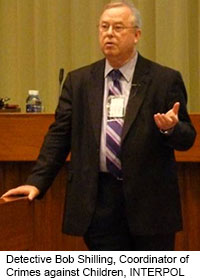
    Trainers for the five-day session included Dr. Geeta Sekhon (UNODC expert and trainer on gender), Warren Bulmer (Canada), Bob Shilling (INTERPOL) and Jane Walsh (Australian Federal Police), all of whom are specialists in the area of crimes against children. Facilitation of the training event was provided by the INTERPOL Coordinator, Annethe Ahlenius. 

    "Cooperation is essential to do this job properly. It does no good if we chase an offender out of one country and into another," said INTERPOL's Mr. Shilling. "The more we cooperate and put these perpetrators behind bars, the better off everyone will be." 

    Mr. Jeremy Douglas, UNODC Regional Representative, Southeast Asia and the Pacific, highlighted the importance of a cooperative effort and the dissemination of training back to their countries. 

    "This is a significant milestone for Project Childhood (Protection Pillar)," said Mr. Douglas. "The training provides an excellent opportunity for officers to learn and share with other police colleagues, and to take what they learned from this event back with them and hold their own training sessions." 

    Curriculum topics included gender issues during police work, first response duties of frontline officers, analysis of evidence and images of child pornography, typologies of sex offenders, and cooperation in the investigation of these cases. Sexual exploitation of boys, a widely unrecognized crime, was also discussed by officers, who agreed that further work was required in this area. 


    Enhanced by Zemanta

    Friday, April 19, 2013

    Child Protection/Trafficking Legal Remedies


    http://vsconfronts.org/news-and-commentary/vs-article/child-protection-trafficking-legal-remedies/

    Source VS Confronting Modern Slavery in America

    by NORMA ABBENE

    When Nadine was five years old, her mother suggested a game of “dress-up.” She remembers her mother putting make-up on her and dressing her in provocative clothing, and that one day, a man came over and proceeded to abuse her in exchange for money. Her mother continued to sexually exploit her, and so did her own boyfriend. She ran away from home at age 11, only to find herself being exploited once more, this time prostituted by professional pimps.
    Nadine wanted to go back to school. Her trafficker refused, not wanting to grant her any measure of independence, and threatened to kill her. Soon after, Nadine became pregnant, and risked her life to escape. Her child was stillborn. Her captor soon found her, and brought her back under his control, going to great lengths to isolate her. When Nadine’s aunt recognized her in a restaurant, her pimp made it clear that she wasn’t to say a word. She knew that other girls had been beaten for talking to outsiders. She stayed quiet.
    Girls like Nadine are not anomalies. Sex trafficking occurs right under our noses, in our own backyards, and it’s not just strangers smuggling girls across foreign borders. These are young women and girls being forced into sexual slavery, often by the people they trust the most. And when they do break free, if they do, there needs to be a system in place that treats them like what they are – children.
    New York State family courts do not have jurisdiction over persons over the age of sixteen, despite their legal status as minors. Sixteen and seventeen year olds are treated as criminals when, in cases like Nadine’s, they need to be treated as victims. Currently, New York prosecutors need to prove that 16- and 17-year-olds being prostituted were subject to force, fraud, or coercion in order for them to be considered victims under the law.
    In order to adequately combat human trafficking and create a protective environment for survivors, we need a new, multi-modal approach combining legal, medical, and service strategies. Most current policies and programs to combat human trafficking face challenges in implementation due to the patchwork nature of the anti-trafficking laws, which offer little operational guidance and unfunded mandates. This is particularly daunting when assisting children, as the core-operating principal should always be the best interest of the child.
    One solution to countering these challenges may be to enhance current child protective laws and policies to include human trafficking. These laws were designed to prevent child abuse and exploitation in addition to punishing the perpetrator. By enhancing existing child protection laws, we can better address the realities faced by children and teens like Nadine.
    Government Response
    Government-sponsored child protective services began in 1962 when medical professionals began publishing accounts of medical conditions resulting from child abuse and neglect. Among the best received of these reports was The Battered Child Syndrome, written by pediatrician Henry Kempe.1 The report brought unprecedented national media attention to the issue of child abuse, creating public awareness and leading to public demand for reform. In direct response to public outcry, Congress amended the Social Security Act to include recommendations that individual states create child protection services and suggested an implementation deadline of July 1, 1975.
    That same year, the Federal Children’s Bureau recommended passage of state legislation requiring medical doctors to report suspicion of child abuse to government authorities. By 1967, every state had passed mandatory reporting laws.
    The United States government recognized the insufficiency of passing state-by-state laws, and in 1974 Congress passed the Child Abuse Prevention and Treatment Act (CAPTA)2, which incentivized state action by funding the mandate for training in regional multi-disciplinary centers. CAPTA also focused on improved investigation and reporting of child abuse and maltreatment.
    Today, child abuse polices and laws continue to be modified as we learn more about the crimes that are committed. New polices, however, seldom recognize that children and teens who are victims of child abuse are at greater risk of child exploitation in the community and are often victims of related/concurrent crimes.
    Many children from troubled homes, like Nadine, run away leading to further exploitation. Existing child protection/trafficking strategies, laws and policies seldom capture the interrelationship between child abuse, human trafficking and other exploitative crimes against children.
    The Trafficking Victims Protection Act (TVPA), passed in 2000,3 was a good start in the government’s response to trafficking. However, it does not focus specifically on children, creating confusion for legislators, law enforcement and service providers. This weakness is compounded by many state laws, enacted after the TVPA, failing to provide definitional clarity of child trafficking. In New York State, for example, because of the gaps in state statutes, having sex with a child who is being prostituted is not treated as rape, but as a transactional “victimless crime” that all parties have entered into willingly.
    In order to make laws more effective, they need to be (1) uniform and (2) specific to children. Talking to children and their advocates is an integral part of this. The Uniform Law Commission (ULC), which provides nonpartisan draft legislation to states aimed at providing clarity and stability to statutory law, is currently working on model state anti-human trafficking legislation. The ULC is focusing specifically on human trafficking involving exploitation of a minor and human trafficking that amounts to involuntary servitude. The ULC has the opportunity to study model laws and incorporate effective aspects into draft legislation.
    Among the models that may be considered is the recent Violence Against Women Reauthorization Act, which includes the Trafficking Victims Protection Reauthorization Act.4 Section 1243 of VAWA is a model state criminal law for child trafficking victims and survivors. The model law calls for protection of children exploited through prostitution by (1) treating minors arrested for engaging in a commercial sex act as a victim of a severe form of human trafficking, (2) prohibiting charging or prosecuting such a victim, (3) requiring the referral of such a victim for appropriate services, and (4) eliminating the requirement to prove force, fraud or coercion for such a victim to be protected by the law.
    A 2011 piece of legislation introduced by California Congresswoman Karen Bass, the Strengthening the Child Welfare Response to Human Trafficking Act of 2011 (H.R. 2730),5 offered a prescriptive solution to some of the shortcomings of current human trafficking laws by following the model set by the federal government in response to child abuse in 1975. The act would have amended the Social Security Act to require child welfare agencies to document and report data on children who they identify to be trafficking victims under federal law. Agencies would also be required to document measures they take to ensure the child is safe and the extent to which the child is receiving services designed specifically for trafficking victims. The bill died in committee, despite bipartisan support.
    Taking cues from VAWA and H.R. 2730, as well as from the federal government’s past success with enacting uniform child abuse guidelines, laws, and policies, the ULC has the opportunity to produce draft legislation that addresses many of the shortcomings of current human trafficking laws. A return to considering the best interest of the child and a model that offers clear formulas for addressing the problem can provide proper support for Nadine and those like her and take steps toward preventing further exploitation of children.
    ©2013, Norma Abbene
    Norma Abbene is an observer on The Uniform Law Commission Drafting Committee on Prevention of and Remedies for Human Trafficking

    1. C. Henry Kempe, et al., The Battered-Child Syndrome, JAMA, 181:17-24 (1962), available at (http://jama.jamanetwork.com/article.aspx?articleid=327895)[http://jama.jamanetwork.com/article.aspx?articleid=327895] ↩
    2. Child Abuse Prevention and Treatment Act of 1974, Pub. L. 93-247 (1974), available at (http://www.gpo.gov/fdsys/search/pagedetails.action?st=public+law+93-247&granuleId=STATUTE-88-Pg4&packageId=STATUTE-88)[http://www.gpo.gov/fdsys/search/pagedetails.action?st=public+law+93-247&granuleId=STATUTE-88-Pg4&packageId=STATUTE-88] ↩
    3. Trafficking Victims Protection Act of 2000, Pub. L.106-386 (2000), available at (http://www.gpo.gov/fdsys/pkg/PLAW-106publ386/content-detail.html)[http://www.gpo.gov/fdsys/pkg/PLAW-106publ386/content-detail.html] ↩
    4. Violence Against Women Reauthorization Act of 2013, Pub. L. 113-4 (2013), available athttp://www.govtrack.us/congress/bills/113/s47/text ↩
    5. Strengthening the Child Welfare Response to Human Trafficking Act of 2011, H.R. 2730, Introduced Aug. 1, 2011 (112th Congress, 2011-2013); Status: Died, available at (http://www.govtrack.us/congress/bills/112/hr2730)[http://www.govtrack.us/congress/bills/112/hr2730} ↩

    Enhanced by Zemanta

    Thursday, November 8, 2012

    A Dangerous Journey - YouTube

    http://www.youtube.com/watch?v=xosVqdLFnRo&feature=youtu.be

    Published on Nov 7, 2012 by 

    As patron of Able Child Africa I am acutely aware of the challenges faced by many countries through poverty. More recently I have been made aware of another form of insidious crime against innocent young victims involving exploitation, abuse and degradation.
    Ruth Beni, Director of Animage Ltd, sent me a video depicting the plight of 2 young girls, Rose and Grace. She asked me to consider composing some music to accompany two animated stories.
    As soon as I had time I duly sat down and began watching the videos. I would say I am a fairly worldly-wise person and I am very well aware of many injustices in this world but nothing prepared me for the impact of the stories about the plight of these two young girls - victims of sex trafficking.
    It is my understanding the characters featured this animated film titled 'A Dangerous Journey' are based on real people, coerced as children, out of their homelands and exploited horribly in other countries including the UK. I cannot comprehend the trauma they must have suffered in their very young lives. I cannot begin to assume I know how they feel or how they and countless others will ever lead normal lives. What I do know is I cannot ignore their plight or forget what I have seen.
    I immediately contacted a composer friend of mine, Philip Sheppard, and we set about writing music to accompany these two animated stories. I hope we did them justice and I hope awareness of crimes like this can be eradicated.
    Please watch the video's and let me have your thoughts but most of all please send the link to as many people as you can and in doing so hopefully we can reduce incidents of this nature and make our world a better place......

    This is part of "The Need to Know Campaign"
    Exposing Global Practices That Harm Women
    The Need to Know Campaign is a growing body of work that uses animated films as a method of informing and warning millions of people worldwide, in particular young people, of the practices that harm women.

    The film is funded by the Home Office and various UK charities (such as Comic Relief and the Tudor Trust)
    The aims of the Need to Know Campaign is
    • To publicise the magnitude of what is essentially a global hate crime against women
    • To mobilise world opinion
    • To translate opinion into effective action
    Enhanced by Zemanta

    Wednesday, August 8, 2012

    Thursday, June 21, 2012

    Swedish queen battles child sex exploitation

    Swedish queen battles child sex exploitation:
    Most royals don't speak openly about subjects like sex-trafficking, much less child sex-trafficking, but for Her Majesty Queen Silvia of Sweden it’s a cause that needs shouting from the rooftops.
    The global problem of child exploitation has long been her passion.
    The mother of three set up the World Childhood Foundation 13 years ago, which has since given nearly $70 million dollars to more than 600 projects fighting child abuse and sexual exploitation in 16 countries.
    Financial grants range from a few thousand to as much as a million dollars – a big deal for anti-trafficking groups on the front-lines in the fight against modern slavery.
    CNN had a rare opportunity to sit down with Queen Silvia and learn more about her mission.


    Enhanced by Zemanta

    Friday, January 7, 2011

    Grooming and our ignoble tradition of racialising crime | Libby Brooks | Comment is free | The Guardian

    Dubious claims about Muslim men grooming white girls hide legitimate worries about a system that fails victims of abuse

    • b
    • Suspects
      'What has not emerged is consistent evidence that Pakistani Muslim men are disproportionately involved in these crimes.' Illustration: Jim Sillavan for the Guardian

      The British National party's website, its logo still sporting a seasonal sprig of holly, is understandably triumphalist as it proclaims that the "controlled media" has admitted this week that "Nick Griffin has been right all along about Muslim paedophile gangs".

      The particular branch of the controlled media the BNP refers to is the Times, which has been running the results of a lengthy investigation into the sexual exploitation and internal trafficking of girls in the north of England. Specifically, the Times has marshalled evidence suggesting that these organised crimes are carried out almost exclusively by gangs of Pakistani Muslim origin who target white youngsters; and it quotes both police and agency sources who refer to a "conspiracy of silence" around the open investigation of such cases, amid fears of being branded racist or inflaming ethnic tensions in already precarious local environments.

      This is not the first time that anxieties about the ethnic dimension of child sexual exploitation have been aired by the media. In 2004 the Channel 4 documentary Edge of the City, which explored claims that Asian men in Bradford were grooming white girls as young as 11, sexually abusing them and passing them on to their friends, was initially withdrawn from the schedules after the BNP described it as "a party political broadcast", and the chief constable of West Yorkshire police warned that it could spark disorder.

      Anecdotally, as far back as the mid-90s, local agencies have been aware of the participation of ethnic minority men in some cases of serial abuse. But what has not emerged is any consistent evidence to suggest that Pakistani Muslim men are uniquely and disproportionately involved in these crimes, nor that they are preying on white girls because they believe them to be legitimate sexual quarry, as is now being suggested.

      The Times investigation is based around 56 men convicted in the Midlands and north of England since 1997, 50 from Muslim backgrounds. Granted, such prosecutions are notoriously difficult to sustain, but, nonetheless, this is a small sample used to evidence the "tidal wave" of offending referred to by unnamed police sources. Martin Narey, the chief executive of Barnardo's, which has run projects in the areas concerned for many years, tells me that, while he is pleased to see open discussion of child sexual exploitation, he worries that "decent Pakistani men will now be looked at as potential child abusers". He insists: "This is not just about Pakistani men, and not just about Asian men. And it is happening all over the country."

      While Narey acknowledges that "in the Midlands and north of England there does seem to be an over-representation of minority ethnic men in [offending] groups", he argues strongly that no useful conclusions can be drawn until the government undertakes a serious piece of research into what is a nationwide problem. (Keith Vaz, who chairs the Commons home affairs select committee called for such an inquiry today.) Narey also refutes the allegation that Muslim men are grooming white girls because of cultural assumptions about their sexual availability, as girls from minority backgrounds have been similarly abused.

      Thus no official data exists on the ethnic or religious background of perpetrators of this form of child abuse, and local charities have stated publicly that they do not consider it a race issue. But it is worth noting that, when asked by the Times to collate its recent work according to ethnicity, Engage – based in Blackburn and one of the largest multi-agency organisations working on this issue – found that in the past year that 80% of offenders were white.

      There is an ignoble tradition of racialising criminality in this country, in particular sexual offences, from the moral panic about West Indian pimps in the 1960s to the statistically dubious coverage of African-Caribbean gang rape in the 90s. But even those who do want further investigation into the apparent preponderance of Asian perpetrators tell me that this is not about cultural expectations regarding the sexual susceptibility of white females but rather about opportunity and vulnerability, especially of young people within the care system. It is certainly admissible to query just how beholden to "the tyranny of custom", as Wednesday's Times leader put it, are these twentysomething males who drive flash cars and ply their victims with alcohol.

      Nevertheless, Muslim voices are now being lined up to attest that serial child molestation is not actually sanctioned by the Qur'an. By building an apparent consensus of voices "bravely" speaking out in the face of accusations of racism, it becomes that much harder for a figure from within the Muslim community to offer a more nuanced perspective or indeed state that these allegations are simply not true. The inevitable and distorting consequence of framing the debate around a "conspiracy of silence" is that it effectively shuts down or taints as mealy-mouthed any criticism.

      The efforts of the Times to stand up this investigation are certainly considerable: selectively quoting or misquoting some groups, and inventing a category of "on-street grooming" that does not exist in law and was not recognised by any of the agencies I spoke to. It is also worth asking how responsible it is to provide ammunition to the violent racist extremists already active in these areas on such flawed evidence.

      Meanwhile, the sunlight of investigative inquiry has yet to shine on our legal system which, all agencies agree, fails to cater to the needs of children who – groomed into acquiescence by practised abusers of all creeds and colours – don't present as the perfect victims our limited version of justice demands.

    Source: guardian.co.uk
    Grooming and our ignoble tradition of racialising crime | Libby Brooks | Comment is free | The Guardian
    Enhanced by Zemanta

    Tuesday, September 28, 2010

    Child Trafficking: 27 on trial in Romania accused of training children to become criminals, then trafficking them to the UK to steal | Mike Hitchen Online: i On Global Trends - news, opinion, analysis

    Tuesday, September 28, 2010

    Twenty-seven people have gone on trial in Romania accused of training children to become criminals and then shipping them to the UK to steal.

    Authorities became suspicious after sports cars and lavish houses began appearing in the small and relatively poor town of Tandarei - allegedly the spoils from the illegal trade.

    It's thought the gang targeted disabled children in particular, as they would earn more money.

    Stephen Cole reports from Miercurea Ciuc, where the trial is taking place.


    Source: Mike Hitchen Online: i On Global Trends - news, opinion, analysis

    Related articles by Zemanta
    Enhanced by Zemanta

    Sunday, August 29, 2010

    Migrant workers in UK suffering 'modern-day slavery' | UK news | The Guardian

    Channel 4's Dispatches says thousands of workers endure sexual, physical and psychological abuse from employers

    Domestic abuse
    The Channel 4 investigation says many migrant workers work up to 20 hours a day for little or no pay. Photograph: Don McPhee

    Thousands of foreign domestic workers are living as slaves in Britain, being abused sexually, physically and psychologically by employers, according to an investigation to be screened tonight.

    More than 15,000 migrant workers come to Britain every year to earn money to send back to their families. But according to a Channel 4 Dispatches investigation, many endure conditions that campaigners say amount to modern-day slavery.

    Kalayaan, a charity based in west London that helps and advises migrant domestic workers, registers around 350 new workers each year.

    About 20% report being physically abused or assaulted, including being burnt with irons, threatened with knives, and having boiling water thrown at them.

    "Two-thirds of the domestic workers we see report being psychologically abused," said Jenny Moss, a community advocate for the charity. "That means they've been threatened and humiliated, shouted at constantly and called dog, donkey, stupid, illiterate."

    A similar proportion say they were not allowed out alone and have never had a day off. Nearly three-quarters say they were paid less than £50 a week.

    "The first thing to understand when we're talking about slavery is that we're not using a metaphor," said Aidan McQuade from Anti-Slavery International. "Many of the instances of domestic servitude we find in this country are forced labour – a classification that includes retention of passports and wages, threat of denunciation and restriction of movement and isolation."

    Lobby groups and charities say that a large proportion of domestic workers are paid less than £50 a week for working 20-hour days. Others have their wages withheld completely. In some cases, the workers are young people who were trafficked over to the UK as children and forced to endure years of violence and forced labour.

    The programme also investigates claims that foreign diplomats are among the worst offenders. Their workers, unlike those brought in on a domestic worker visa, cannot change their employer and face being homeless or being deported if they escape. The Dispatches study says it is also extremely difficult to prosecute diplomats for treating their workers as slaves.

    Accurate figures are hard to establish because the abuse happens behind closed doors. But campaigners say that every year, hundreds of domestic workers run away from employees they claim have mistreated them.

    Marissa Begonia left three young children in the Philippines when she came to Britain as a domestic worker 16 years ago. Now the head of Justice 4 Domestic Workers, a new campaigning organisation run by and for migrant workers, Begonia says most of their clients are forced to work abroad, without ever seeing their families, because of extreme poverty in their home countries.

    "It's a matter of life and death," said Begonia. "You have two choices only: you watch your children die slowly, starving, or you leave them and come to the UK to work to make sure your children survive." The Metropolitan police specialised crime unit specifically targets forced labour, including domestic workers. "We've now got 10 cases of domestic servitude we are investigating," said detective chief superintendent Richard Martin, who heads the unit.

    "Some victims are being chained to the kitchen sink, working seven days a week, 20 hours a day, for little or no pay. We have had cases of workers being forced to eat scraps off the table, so some of them are not even fed properly, and are assaulted and abused. We've had cases where women have been raped."

    Children are also being bought to the UK to work in conditions of slavery. Christina was trafficked from Nigeria to London when she was just 12 years old. She says the woman in charge of her was of Nigerian origin, but worked as a British civil servant first with the Home Office and then Customs and Excise.

    "I got beaten up all the time but I had no choice: I had nowhere to go," said Christina, who worked for the woman for five years, until she escaped in 2005. "She hit me with a frying pan and with a belt, so many, many times. It was horrible. I wanted to die."

    From abuse to justice

    Patience is a domestic worker from west Africa, whose former boss was a London solicitor. She says that for almost three years she worked 120 hours a week for little money. "I was treated like a slave, not allowed to go out, to make friends … she'd pinch me, slap me. I didn't have anyone to talk to." A neighbour helped Patience escape, but then, she says, the police did not believe her. She finally won her case at an employment tribunal and took action against the police, who reopened the investigation. The solicitor was convicted of assault.

    Migrant workers in UK suffering 'modern-day slavery' | UK news | The Guardian
    Enhanced by Zemanta

    Sunday, August 22, 2010

    Governor Quinn Signs Law to Protect Children from Sexual Exploitation

    Friday, 20 August 2010 15:51 Press Release Latest Local News

    CHICAGO--(ENEWSPF)--August 20, 2010. Governor Pat Quinn today signed the Illinois Safe Children Act into law. The new law protects children in Illinois from being forced into the sex trade and gives law enforcement additional tools to fight the human-trafficking groups that exploit them. It also stops the criminal prosecution of victimized children and ensures they receive the necessary protective services.

    “For too long, exploited children have been treated as criminals, while the adults who stole their innocence go free,” said Governor Quinn. “Illinois does not tolerate exploitation of our children. Today, we give important new tools to aid law enforcement in this fight and help our victimized children to heal.”

    The Illinois Safe Children Act makes Illinois one of the first states to pass comprehensive legislation to address the human trafficking of children under the age of 18. The new law ensures that innocent children who are lured or coerced into prostitution will now be immune from criminal prosecution and will be placed in the child protection system instead of the criminal justice system.

    Victims under the age of 18 will now be presumed abused or neglected and can be placed in a secure setting until a proper placement is found. Law enforcement must now report an allegation of human trafficking of a child to the Illinois Department of Child and Family Services (DCFS), which must conduct an investigation within 24 hours.

    Illinois’ laws regarding the sexual exploitation of children will now recognize that anyone under the age of 18 is a child victim, conforming to federal law and state’s human-trafficking laws. The act removes references to “juvenile prostitutes” in Illinois’ criminal code, recognizing that children have no capacity to consent to their own commercial sexual exploitation and are victims of a serious sexual offense.

    The new law allows the same legal tools used to fight groups selling drugs to be used against groups who traffic children. It supports investigations of these organized crime rings by adding the offenses of human trafficking and juvenile pimping to the list of offenses subject to court-ordered interceptions (wire taps). Additionally, it allows officer-safety recordings to protect undercover officers during dangerous sex-trafficking investigations.

    The act allows law enforcement to impound any vehicle used for a variety of human-trafficking and prostitution-related crimes, creating a funding mechanism to support victim services and police operations. The act also limits the defense argument of pimps or traffickers who say that they “believed” that a prostituted child was at least 18 years old.

    Cook County State’s Attorney Anita Alvarez was instrumental to passage of the legislation and her office has led the charge in efforts to proactively address the issue by forming a specialized Human Trafficking Initiative and creating partnerships with social service providers to offer services for children who fall prey to sex trafficking.

    "Many people consider the sex trafficking of children to be an international issue and not a problem that impacts us here right in our own communities, but that is not the case at all," Alvarez said. "The Illinois Safe Children Act is landmark legislation that will provide police and prosecutors with the tools that we need to aggressively tackle this crime. This new law will also put Illinois at the forefront of states who have enacted new laws to protect children from the horrors of sex trafficking."

    In addition to the new law, DCFS is currently establishing an allegation of Human Trafficking of a Child in child protection investigations. Law enforcement officers and mandated reporters of abuse and neglect will be required to report to the DCFS Child Abuse Hotline whenever they have reason to suspect that a minor has been exploited by traffickers, and DCFS will investigate the allegation and provide protective, supportive and therapeutic services to these child victims.

    House Bill 6462 was sponsored by Sen. Jacqueline Collins (D-Chicago) and Rep. Will Burns (D-Chicago) and takes effect immediately.

    Source: illinois.gov


    Governor Quinn Signs Law to Protect Children from Sexual Exploitation
    Enhanced by Zemanta

    Sunday, August 15, 2010

    Revealed: The horrific trade in British children for sex - Crime, UK - The Independent

    FROM THE INDEPENDENT
    The terrible plight of foreign women trafficked into the UK and forced to work as prostitutes has overshadowed a home-grown scandal
    By Emily Dugan
    Sunday, 15 August 2010
    Posing for her first school photograph, Joanne was like any other girl at the age of five. She loved drawing and painting, and her favourite game was to play hide-and-seek in the woods near her home in Leeds with her five siblings. As she grew, Joanne liked to hang around, chatting and laughing with friends. But soon after she turned 12, while out playing, she met a gang of men who were to become her pimps. They took advantage of her freedom, gained her trust and prepared to abuse her.
    In the beginning, the men who befriended her had seemed nice enough: they showered her with compliments, bought her a phone, and one of them – a 42-year-old married man – became her "boyfriend". Within a year, she was forced into prostitution.
    By the time she was 16, Joanne would disappear from the family home for weeks at a time. She was transported between Manchester, Rochdale, Bradford and countless other towns, locked into rooms and made to have sex repeatedly with men for money – not that she saw any of it. 
    Joanne is only one of many young women who have been subjected to such horrific ordeals across the UK. She is the victim of sex trafficking with a twist: not women brought in illegally from abroad and forced into prostitution, but British born. Targeted on estates throughout the country, they are passed from gang to gang, and work from town to town.
    Yet the information on the trafficking of young people for sex within Britain is so scant that experts say the first official figures confirming the trade – seen by The Independent on Sunday – are just "the very, very tip of the iceberg". Figures from the UK Human Trafficking Centre for April 2009 to March 2010 show only 38 Britons were registered as victims. This comes after a snapshot survey by the children's charity Barnardo's revealed it worked with 609 sexually exploited children last year, of whom 90 appeared to have been trafficked within the UK.
    The victims, unlike women coerced or tricked into coming into the UK from overseas, frequently have family and friends who are reduced to despair by what is happening. Joanne's mother, Christine, who was bringing up six children on her own, tried to protect her daughter, but the situation quickly spiralled out of her control.
    "More than once I locked her in. She nearly broke her neck jumping out of upstairs windows," she recalls. Joanne fought her mother to get out of the house, giving her a black eye.
    Before long, what had been flattery turned into violence. Joanne was called on the phone she had been given and was forced to leave the house at all hours to have sex with men. If she didn't do what was wanted. they threatened to hurt her and her family. "They brainwash these girls," her mother says. "A friend said to me 'it's like she'd been hypnotised'. That phone triggered something, and she'd got to respond."
    Her mother says her pleas to police and social services fell on deaf ears. "I used to say: 'When are you going to do something?' They'd say they couldn't do anything unless she complains, but when do you decide that a child has to complain? They said they could do nothing. She was 13. I'd take down the number plates of cars as they drove away, but the police wouldn't accept them."
    The IoS is withholding certain details of the identity of the mother and daughter to protect the family.
    Campaigners say most victims are aged between 12 and 16, groomed by men to provide sex. Young men and women are typically targeted by one person, who wins their trust before pimping them to others and forcibly transporting them around Britain.
    The case in court last month of a 14-year-old girl who disappeared from her home in Manchester after she was offered drugs and alcohol to groom her for sex is typical of the abuse experienced by these victims. Nine men were convicted of sexual crimes – though not for trafficking – and each was sentenced to jail terms ranging from eight months to seven years.
    There has still not been one prosecution for trafficking Britons within the UK. And, despite mounting evidence of the scourge, a police report into trafficking to be released this week, called Project Acumen, chose not to assess the scale of trafficking of British nationals. Of the British women they did interview, they decided none exhibited "the dimensions of the trafficking definition".
    Chief Superintendent Tony Blockley, head of crime at Derbyshire constabulary, tells a different story. He says: "We've always thought of this as a problem that comes from overseas, whereas this is actually happening on our doorsteps. The scale of it is enormous; Derby isn't a hotbed of this – it's just one town that's decided to look at this as a problem.
    "This is a new area of policing for us. As soon as you lift the stone up, you start to find things, but people weren't lifting up the stone before. These are the kids that slip under the radar. Victims come from chaotic backgrounds; they are often in children's homes. As they get more involved in the network, the grooming lessens and the abuse increases."
    After a year of being abused, Joanne started to lash out. "Virtually overnight she became someone we couldn't even recognise," says Christine. "Her attitude changed and she started to get really distant. After a while she got violent towards her siblings and me."
    Social services said she could no longer live in the same place and put her into foster care. The downward spiral accelerated. At 16, Joanne had been missing for seven weeks. "I took social services to court as they said they didn't have a duty of care," says Christine. "The judge said they did, and the next day she was found, locked in a house with an Asian man, with the door handle taken off."
    The gang that subjected her to this ordeal was Asian. The issue of alleged grooming of white teenage girls by Asian gangs is highly contentious. When the former Labour MP Ann Cryer said that Asian men were targeting white girls, she was accused of racism. With scant research available, there is no evidence that perpetrators or victims predominate from any one race.
    Joanne, because she is now 18, is no longer of any interest to her former pimp, says her mother. The teenager is mentally scarred, homeless and drug addicted. "She's not a child any more, so they're not interested. They've used her up and thrown her out. One of them said to her: 'In five years' time you'll be a crackhead out on the street and I'll be cruising with another 14-year-old.' Five years down the line, she is on drugs, on the streets. He – like he told her – is cruising with another 14-year-old."
    Sheila Taylor, chair of the National Working Group for Sexually Exploited Children and Young People, said: "What we're seeing is the tip of the iceberg. This is happening in all cities and many towns. There has been no prosecution of those who sexually exploit children with trafficking legislation."
    Like many parents of victims, Christine is frustrated that the issue has continued to be ignored. "They've known about this happening on my estate for a long time. It's not being dealt with because it's such a big issue. If you acknowledge that it goes on you have to do something and they probably think they wouldn't be able to cope with the sheer numbers."
    Revealed: The horrific trade in British children for sex - Crime, UK - The Independent
    Enhanced by Zemanta

    Thursday, May 27, 2010

    Rise in sex crimes involving children sparks concern | MailTribune.com

    May 26, 2010

    By Sanne Specht
    Mail Tribune

    A recent nationwide sting by federal, state and local law enforcement agencies that placed Portland second in the nation for the number of rescued child prostitutes has local officials concerned about the ramifications for Jackson County.

    "We are seeing more adults traveling to Southern Oregon to have sex with kids who they've met online," said Sgt. Josh Moulin, commander of the Southern Oregon High-Tech Crimes Task Force, adding he's seen ads on Craigslist from teens offering themselves for sale.
    Did you know?

    According to recent Federal Bureau of Investigation statistics, between 100,000 and 300,000 children are prostituted annually. These children service between four to 10 customers a day, which equals 1,460 to 3,600 transactions per child per year, said Marlene Mish, executive director of the Children's Advocacy Center.

    The FBI has determined 90 percent of runaways living on the street were victims of sexual, physical or emotional abuse or neglect, Mish said.

    Ways to help: Become a volunteer or donate to the Mazlow Project, located at 209 W. Main St., 541-608-6868. To become a volunteer or donate to the CAC, call 541-734-5437.

    Runaways trading sex for survival, parents trading their children for drugs or money, older adults preying upon curious kids on the Internet — all these scenarios can end up as a death sentence for a child, said Marlene Mish, executive director of the Children's Advocacy Center.

    "Child sex trafficking is the most hidden form of child abuse in our country today," Mish said.

    According to the Federal Bureau of Investigation, 100,000 to 300,000 children are prostituted annually. They service between four to 10 customers a day, 1,460 to 3,600 transactions per child per year.

    "To call it child prostitution is a very euphemistic way of getting around the brutality," Mish said. "These children are raped, beaten and enslaved."

    The problem of prostituted children is growing because of funding cuts to mental health services, a lack of residential care programs for youths and a child welfare system that is unable to stop runaways, local officials said.

    Most of the estimated 1.6 million children nationwide who flee or are kicked out of their homes each year will return within a week. But nearly a third of those who remain runaways will trade sex for food, drugs or a place to stay, according to studies cited in a story published in the New York Times last fall.

    Nicole Clark, 17, of Ashland spoke of her experiences as a teen runaway in the article. Clark ran away from a Medford group home at age 14. Living on the street and desperate, she eventually accepted a young man's offer of a place to stay. He became her boyfriend, and then her pimp. He threatened to kick her out of the apartment if she did not have sex with several of his friends in exchange for money. Clark's downward spiral continued for 14 months until she escaped from another pimp who kept her locked in his garage apartment for months, she said.

    Mary Ferrell, director of the Maslow Project, a Medford outreach center for homeless youths, said word on the street is that "survival sex" incidents are on the rise.

    "It's just so scary," Ferrell said. "Their lives are literally at risk. The girls are just convinced they are going to die."

    Teens are reluctant to discuss their experiences. "Prostitution is not the kind of thing that kids are going to willingly self-disclose," she said.

    Ferrell is hearing more reports of graffiti on public buildings signaling sex trafficking and prostitution, she said.

    Ferrell said she worries about unaccompanied kids who are seen at her center once or twice, and then never show up again.

    "We don't know what happens to these kids," she said.

    The common assumption that children of inner cities are the ones most often lured into prostitution is a fallacy. Studies show rural children are most at risk. The No. 1 state for recruiting children is Minnesota, Mish said.

    "This is big money worldwide and it's attracting people who are making a science out of it," Mish said. "They are going to smaller towns where kids are less sophisticated and more willing to buy a line. That's why it's significant to us."

    Deputy District Attorney David Hoppe said Jackson County has had a case "where a mother had her daughter perform sex acts for money." But getting teen prostitution victims to come forward is very difficult, he said.

    "Trafficking is a horrible problem in our world," he said.

    Human trafficking is a specific charge created in 2006. There have been no trafficking cases filed in Jackson County. But there have been hundreds of cases involving sex offenses committed by adults against minors. These felony charges can carry Measure 11 consequences, said Hoppe.

    "Compelling prostitution is a Measure 11 crime and carries a minimum 70-month sentence," he said.

    The Southern Oregon High-Tech Crimes Task Force has seen a 29 percent increase in cases involving child pornography and child sexual exploitation over the past year, said Moulin.

    In addition to an increase in adult-generated child pornography, children are self-exploiting by "sexting." Teens and pre-teens are posting sexually explicit photos of themselves to social networking venues, and to strangers they have met online, he said.

    The Internet is a highly effective tool for predators seeking to seduce children, Mish said.

    "If a stranger knocked on your door and asked if he could take your daughter into the bedroom behind closed doors for a few hours, you'd say 'no,'" Mish said. "But we do that with our children when we allow them unsupervised access to the Internet."

    Once teens turn 18, they are considered legal adults and face criminal charges if arrested for prostitution. If convicted, the teen gets a sex crimes record and jail time. The adult "john" often gets only a fine. The pimp usually goes free, she said.

    "They are victimized and re-victimized," Mish said. "We must stop children who are engaged in criminal behavior without criminalizing the child."

    The FBI has determined 90 percent of runaways living on the street were victims of sexual, physical or emotional abuse or neglect, Mish said.

    "The solution is very simple. To reduce the number of kids on our streets, we need to stop sex abuse in the home," Mish said.

    Reach reporter Sanne Specht at 541-776-4497 or e-mail sspecht@mailtribune.com.

    Rise in sex crimes involving children sparks concern | MailTribune.com


    Reblog this post [with Zemanta]