Showing posts with label Servitude. Show all posts

Wednesday, July 6, 2011

Saudi Arabian torment of migrant workers at mercy of abusive 'madams' | World news | The Observer

Foreign workers in Saudi Arabia send £17bn to families back home annually. But for some, the cost in physical and mental abuse is too high, writes Jason Burke
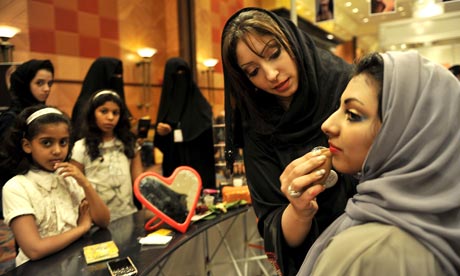
  • A Saudi woman applies makeup
    A Saudi woman applies makeup to a woman at a cosmetics exhibition in Jeddah. Photograph: Amer Hilabi/AFP/Getty Images
     
    Shortly after dawn, as the sun rises over the hills behind the city, tens of thousands of women will wake in the Saudi Arabian port of Jeddah and go to work. Maybe 14 or 16 hours later, their day will be over.
    They are maids, almost all from the Philippines or Indonesia, working for £100-£200 a month. There are more than 500,000 of them in Saudi Arabia, among nearly nine million foreign workers who sweep roads, clean offices, staff coffee shops, drive the cars that women are banned from driving and provide the manpower on the vast construction projects.

    The story of the maids rarely receives attention, except when a new shocking incident reveals once again the problems many of them face. Last weekend a 54-year-old Indonesian maid was beheaded by sword for killing her female boss with a cleaver. Ruyati binti Sapubi had, an Islamic court heard, endured years of abuse before finally attacking her "madam", as the maids call their employers, when denied permission to return home.

    Another Indonesian maid also faces execution for killing her boss whom she alleges tried to rape her. Other recent incidents include a Sri Lankan maid who had nails driven into her legs and arms by her employers, and another who was scalded with a hot iron.

    Every year, thousands of the maids run away from their employers in Saudi Arabia.

    Often physically or mentally scarred, they find themselves in a legal limbo. In Saudi Arabia, the consent of employers or "sponsors" is needed before any worker can leave the country.

    Last week the Observer was able to visit a secret shelter in Jeddah – there are others elsewhere in Saudi Arabia – where 50 women are being looked after by well-wishers. The shelter is tolerated by local authorities, but the women who stay there, often for months on end, are not allowed to leave once they have entered and cannot use mobile phones. Sixteen sleep in a single room.

    The maids say, however, that it is better than what they left behind. Most tell of fleeing employers who did not pay their wages; many talk of physical, mental or sexual abuse.

    Rose, a 40-year-old from the island of Leyte, in the far south of the Phillipines, has spent five months in the shelter after fleeing from her employers after her "madam" threw keys into her face, narrowly missing an eye. "I don't know why she did it. She lost her temper," said Rose, whose wages were consistently in arrears.

    Many exist in an illegal netherworld in the sprawling city itself. Muneera, a 33-year-old from the Muslim south of the Philippines – from where many of the maids in deeply conservative Saudi Arabia come – told the Observer that she was sleeping on friends' floors after fleeing her employers. The family she worked for was "kind", Muneera said, but the hours were unbearable.

    "I worked from 5am to 1am, almost every day. I got up to make the children breakfast and get them ready to go to school and then cleaned the house all day, and in the evening my employers would go out and come back at midnight and want dinner. Finally it was just too much," she said.

    Beth Medina, a 46-year-old maid, said she ran away after two months. "I had no idea what it was going to be like. If there was a single hair on the floor, madam was angry at me. The only food I got was leftovers from their dinner. If there wasn't any, I got bread," she told the Observer.

    Few of the maids, who are often recruited by agencies in the Philippines, have much idea about where they are going or what will be expected of them. Terms of employment are also variable. As domestic workers, they are not protected by Saudi labour law.

    Riyadh recently rejected demands from Manila for medical insurance for maids and for information on employers to be supplied before their departure. For their part, Philippine officials refused to accept a cut in the minimum wage for maids from $400 a month to $200. The result is a moratorium on the hiring of maids. Indonesia has also stopped its citizens travelling to Saudi Arabia following the execution last week.

    Yet the governments are likely to come to some arrangement. There have been such standoffs before, and in relative terms the foreign workers generate huge sums of cash, most of which is sent to needy families at home and provides important revenues for developing nations. Saudi Arabia was the source of £17bn of such "remittances" last year, second only to the US. Entire states in some countries depend on the funds flowing in.

    Money from the Gulf has transformed parts of India, particularly the Keralan coast, where many Muslims who work in Saudi Arabia live, for example. With such huge sums at stake, the plight of the odd "camel shepherd who dies unnoticed in the desert for a wage of $50 per week" is seen as unimportant, said Mohammed Iftikar, an Indian who works on behalf of foreign workers in Jeddah.

    But the problems are growing. The number of foreign workers in the kingdom has been edging up, from a quarter of the total population a decade ago to nearly a third today. At the same time, youth unemployment in Saudi Arabia is approaching 30%.

    The Saudi government is now trying to impose tight restrictions on the number of foreigners any company can hire and clamping down on long-term overseas workers.

    "We have a young population. We need to generate 6.5 million jobs. At the moment we have jobs that people don't like to do. So either we create jobs that people like, or we try to convince people to accept the jobs that are available," Dr Abdul Wahid bin Khalid al-Humaid, the vice-minister of labour, told the Observer in an interview in Riyadh last week. Analysts say it is unlikely, however, that Saudis will replace the foreigners soon.

    Many foreign workers arrive illegally, smuggled in from Qatar, Kuwait or Yemen. There are estimated to be tens of thousands of "absconders" – as those who have run away from the jobs for which their residence permits were issued are called – from Nepal alone. And the wealth of Saudi Arabia, where the per capita GDP is more than £15,000, continues to attract more people.

    Many workers both enjoy their time in Saudi Arabia and are grateful for the opportunity employment there gives them. Their example encourages others to travel too.

    Eileen, a 44-year-old maid from Iloilo in the Philippines, said her employers always paid her monthly wage of £400 on time and even "invited [her] to eat with them sometimes". Though she gets up at 5.30am and works until late in the evening, she has some time off in the day and each summer travels with the family on holiday to Europe.

    With the money she earns, Eileen supports the four children of her brother, who died in a car accident last year. "Maybe I am lucky," she said.

    One result of the huge foreign population is a cosmopolitanism that lightens the otherwise severe and puritanical atmosphere in Saudi Arabia. Every major city has its "immigrant quarter", where people from a score or more countries fill cheap restaurants serving food from across Asia and further afield or simply sit on street corners where a dozen different languages can be heard.

    In Jeddah, it is the old city, Balad. On a Friday night, its car-choked streets were full of Filipino care workers in embroidered headscarves bringing colour to their obligatory black, Saudi-style, abbaya gowns; Indian labourers smoking enthusiastically; Sudanese teenagers earning a few riyals by washing windscreens; and Afghan children begging. Recent arrivals from central Africa collected cardboard packaging to sell for recycling. In the Selamat Datang cafe, Indonesian hotel workers downed traditional dishes from home – with rice, a bowl of soup and a Pepsi – for 14 riyal (£2.30).

    For Rose, the maid stuck in the secret shelter, and Muneera, the runaway sleeping on friend's floors, such scenes hold little attraction. Their needs, they say, are simple. Muneera just needs a way out of the trap she has fallen into. She says she will go to the Philippine consulate and seek help.

    Rose just wants an exit visa, the money for a flight home and enough cash left over to allow her three children to go back to school. "I hope I will go soon," she said.
Source:  The Observer

Sunday, July 3, 2011

Ask the Author: Ask the Author Live: Sarah Stillman on Foreign Workers for the U.S. Military : The New Yorker

May 30, 2011

Ask the Author Live: Sarah Stillman on Foreign Workers for the U.S. Military

110606_r20961_p465.jpg

This week in the magazine, Sarah Stillman writes about foreign workers on U.S. bases in Iraq and Afghanistan. (Subscribers can read the full text; others can buy access to the issue via the digital edition.) On Wednesday, Stillman answered readers’ questions in a live chat. Read a transcript of the discussion below.

Sarah Stillman: Hi all, I’m here and looking forward to your questions!

COMMENT FROM DOUGLAS: Did you consider doing reporting for this story in Afghanistan?

SARAH STILLMAN: Indeed—I not only considered it, I did it. I had the opportunity to travel to Kandahar in the summer of 2010, where I did a significant amount of my reporting. As you’ll read in the piece, many of the stories come from Kandahar Airfield, where I spoke with Filipino, Nepali, Indian, and Sri Lankan workers.

COMMENT FROM WANDA BERSHEN: This is a truly appalling story—yet another instance of utterly corrupt practices overlooked by the US Military. A human rights disaster that is shameful. How can the US claim any legitimacy behaving like this?

SARAH STILLMAN: What’s interesting, Wanda, is that many of the alleged abuses taking place happen at the hands of foreign subcontractors. Many third-country nationals I met viewed the U.S. military as their allies in battling the companies for better treatment. Yet because the Pentagon’s contracting chains in Iraq and Afghanistan are so convoluted — sometimes as many as five or six tiers of subcontracts—accountability is hard to come by, and everyone involved can wash their hands of responsibility.

COMMENT FROM CARMEN CANEDA: Sarah, Was it difficult to get the workers to talk with you as a reporter?

SARAH STILLMAN: Often, yes—the climate of fear was quite pervasive. In some instances, workers were threatened in front of me by their subcontractor bosses, who claimed that the workers would be fired if they were seen speaking to a journalist. In the piece, I write that my reporting took more than a year, but the reality is that this project stretched all the way back to 2008 for me, when I took my first trip to Iraq—it took that long to built trustworthy contacts and create relationships with workers, managers, and soldiers in Iraq and Afghanistan who would be willing to share their stories.

COMMENT FROM MICHAEL: Do other countries use the same practices?

SARAH STILLMAN: Absolutely. As I discuss in the piece, the Pentagon’s contractors in Iraq and Afghanistan draw upon the very same labor pipelines that have long supplied much of the Middle East—countries like Kuwait, Saudi Arabia, and Jordan—with cheap foreign labor.

COMMENT FROM FRED: You really documented some very bad mistreatment of the foreign workers on U.S. bases in Iraq and Afghanistan. Why did it take so long for this story to come to light, given that we’ve been fighting wars in those countries for 8 or 10 years?

SARAH STILLMAN: Back in 2004, there was a devastating incident in which a caravan of Nepalese workers was hijacked by Sunni insurgents; eleven of the men, who were en route to jobs on U.S. bases, were shot, and a twelfth beheaded. Following that gruesome event, there was some brilliant reporting by T. Christian Miller, Cam Simpson, David Phinney, and others, exposing some of the alleged mistreatment of foreign workers on U.S. bases. It was great work, and the Pentagon responded with a range of reforms—after which, I suspect, many people considered the issue “handled.” But the mistreatment has clearly continued, and there are fewer journalists than ever before on U.S. bases to cover it. It’s hard enough to get readers to be willing to engage the issues facing U.S. troops; perhaps it’s war fatigue?

COMMENT FROM GUEST: Sarah, Wars are now commodities, fought and supplied with outsourced labor. Are there any indications from the DOD that more oversight and enforcement will reduce these kinds of exploitations? Thanks, Mark Ratledge

SARAH STILLMAN: Mark, that’s an interesting question, in light of what I wrote above. The reforms I mention from an earlier moment—which included an order from George W. Casey, then the commanding general for Iraq, mandating “measurable, enforceable standards for living conditions,” etc. — certainly made a concrete impact. For instance, at the time, many workers had their passports confiscated by their employer; after Casey’s order, which banned the practice, there seem to be very few workers facing that particular abuse. But the passport confiscation issue was one of the few easily enforceable portions of the order. Most of the other provisions proved toothless. The Commission on Wartime Contracting notes that a lot of positive change might come from more clear laws protecting third-country nationals, and more clear enforcement mechanisms. I suspect they’re right.

COMMENT FROM TOBIN: You write that these mistreated foreign workers lured to the U.S. bases in Afghanistan and Iraq still seem to like the American military, even though it’s that same military that is failing to insure that the TCNs are given adequate food, housing, wages and so on. Isn’t this a contradiction?

SARAH STILLMAN: In some respects, yes. But the troops on the ground and the big decision-makers at, say, the Pentagon, are entirely different populations, and I think the third-country nationals actually recognize that distinction. Some told me that explicitly. Many of these workers are serving and interacting with soldiers on a daily basis — providing their haircuts, cooking their dinners, etc. — and, as a result, friendships sometimes form, and soldiers (or, in some cases, American contractors for companies like KBR) stand up for these workers against their foreign subcontractor bosses. I met several soldiers who would sneak the workers extra food, send gifts home to their families, etc. But the question of why these abuses are allowed to take place on U.S. bases in the first place is a good one.

COMMENT FROM JONES: How have subsidiaries of Halliburton continued to get government contracts at such a rate?

SARAH STILLMAN: This is a great mystery to me. (Although, to clarify, KBR is no longer a subsidiary of Halliburton, I believe.) In the course of my reporting, I encountered several companies who were accused of ignoring rather grave abuses, yet it seemed to have little impact on their ability to obtain new government contracts. It’s an issue the Obama Administration pledged to address, but I’m not sure we’ve seen as much movement on it as one might have expected.

COMMENT FROM GEORGE: What brought your attention to Fiji?

SARAH STILLMAN: I first became interested in the recruitment of workers in Fiji after meeting the three Fijian beauticians whom I write about in the story — Vinnie, Lydia, and Melanie. They worked at a beauty salon on a U.S. military base I visited in northwest Iraq in 2008. When the women told me the story of their deceptive recruitment, I began researching their claims, and I found that the same company that allegedly duped them had also deceived more than 20,000 other Fijians with promises of jobs in the Middle East. The scale of the claims was stunning, and I knew I’d want to incorporate that into the article. The Fijian press has done some fascinating reporting on the topic, too.

COMMENT FROM DARIN: This sort of thing reminds me of the old British tactic of essentially kidnapping and forcing men into the navy. Doesn’t having this sort of forced labor threaten the safety of our Armed Forces, in addition to being a horrible human rights violation?

SARAH STILLMAN: One thing that surprised me was that so many thousands of workers volunteer for these war zone jobs — albeit, quite often, on false terms. Back in 2004/2005, I think outright human trafficking was a bigger issue on U.S. bases; now, most of what you see involves impoverished men who were so desperate for employment that they took out enormous loans, sold their land/livestock, and risked their lives to do some of the world’s most dangerous work for U.S. forces. You’re right, though: having this unregulated, invisible army can pose a serious security risk to U.S. forces. For one thing, many of these workers are not trained to U.S. technical standards in their home countries, by no fault of their own. When a Congressional inquiry was launched into the accidental electrocution deaths of dozens of U.S. troops in Iraq, for instance, it came out that some of the workers who had done the electrical wiring were poorly trained third-country nationals. Then, of course, there’s the security threat posed by workers being smuggled on and off the base without proper clearances, which has also been raised by the bipartisan Commission on Wartime Contracting.

COMMENT FROM FR: What do you think the true cost of war would be if Americans had to support the military by taking these jobs in war zones?

SARAH STILLMAN: Interesting. Huge. Outsourcing so many of the logistics jobs on U.S. bases has also meant outsourcing the costs of war. For instance, a recent study showed that, for the first time in U.S. history, private contractor losses are now on a par with those of U.S. troops in Iraq and Afghanistan. And that’s not even counting the fact that many third-country nationals’ deaths and injuries are never tallied, since contractors are ordered to self-report, with questionable compliance.

COMMENT FROM M. MALIK: What steps have the soldiers themselves taken to help the workers and address some of the issues they face?

SARAH STILLMAN: The workers’ fear of retribution is a major barrier to this. In the piece, I write about a major riot that took place last spring on the largest U.S. base in Baghdad. Workers in one of the labor camps claimed they weren’t getting enough to eat, and eventually, after more peaceful attempts to voice their grievances with the company, they rioted, with more than 1,200 Indian and Nepali workers throwing stones, smashing windows, overturning vehicles, etc. The U.S. military police were brought in to control the scene, and I spent time last summer with one of the military policemen (a sergeant) involved. He told me that his MPs tried everything to find out why the workers had rioted, and to help them, but everyone was too afraid to talk. Many of the workers had paid large recruiting fees to get their jobs, and they couldn’t afford the risk of speaking out, lest they be sent home to face loan sharks in India or Nepal.

COMMENT FROM GREGORY TAYLOR: I was shocked that Al Qaeda has started targeting these workers. Could you elaborate on what’s going on?

SARAH STILLMAN: This was particularly true in Iraq in 2004/2005. AQI and other insurgent groups realized that these foreign workers were one of the keys to the U.S. military’s supply chains. If they could target, say, Ghanaian and Bangladeshi men trucking containers of food and fuel from Kuwait into Iraq, then they could throw a wrench in the military’s ability to feed and move their troops. Often, militants would kidnap these foreign workers, make a video demanding that their home country ban its workers from supporting Coalition forces, and send it to the relevant government entities. In many cases, they were successful. After a Filipino worker named Angelo de la Cruz was kidnapped, the government of the Philippines decided to withdraw its limited number of troops from Iraq and make it illegal for its citizens to work there. Angelo was then freed and became a national celebrity.

SARAH STILLMAN: There are so many more great questions, but, sadly, we’re out of time. Thanks so much for reading and engaging the article, and I hope the conversation will continue in other forums.

THE NEW YORKER: Thanks to readers, and thank you Sarah Stillman.

Photograph by Peter Van Agtmael/Magnum.


Enhanced by Zemanta

The U.S. Military’s “Third-Country Nationals” : The New Yorker

For foreign workers on U.S. bases in Iraq and Afghanistan, war can be hell.

by June 6, 2011

More than seventy thousand

More than seventy thousand “third-country nationals” work for the American military in war zones; many report being held in conditions resembling indentured servitude by subcontractors who operate outside the law. Photographs by Peter Van Agtmael.

It was lunchtime in Suva, Fiji, a slow day at the end of the tourist season in September of 2007, when four men appeared in the doorway of the Rever Beauty Salon, where Vinnie Tuivaga worked as a hair stylist. The men wore polished shoes and bright Hawaiian shirts, and they told Vinnie about a job that sounded, she recalls, like “the fruits of my submission to the Lord all these years.” How would she like to make five times her current salary at a luxury hotel in Dubai, a place known as the City of Gold? How would she like to have wealthy Arab customers, women who paid ridiculous fees for trendy cut-and-color jobs?

“I’ll talk it over with my husband,” she replied, coolly, but her pulse was racing. Vinnie, who was forty-five, had never worked abroad, but she often dreamed of it while hearing missionaries’ lectures at her local church. Nearly six feet tall and two hundred and thirty pounds, Vinnie moved with an arthritic gait. But she took care with her appearance. She wore shiny slacks, with a gold pageboy cap on her perfectly coiffed frosted black hair, and carried a bright-red faux-leather purse, stuffed with silver eyeshadow. She could see herself working in one of the great cosmopolitan capitals. The offer seemed like her big break, the chance to send her teen-age daughter to hospitality college and to pay her youngest son’s fees for secondary school.

Later that week, at a salon around the corner, Lydia Qeraniu, thirty-two, heard a similar offer. A quick-witted woman with a coquettish smile and a figure that prompted Fijian men to call out “uro, uro!”—slang for “yummy”—Lydia was thrilled by the prospect of a career in Dubai. So were many other women in beauty shops and beachside hotels across Fiji. A Korean Air flight to Dubai would be leaving from Nadi International Airport in a few days. The women just had to deliver their résumés, hand over their passports, submit to medical tests, and pay a commission of five hundred dollars to a local recruitment firm called Meridian Services Agency.

Soon, more than fifty women were lined up outside Meridian’s office to compete for positions that would pay as much as thirty-eight hundred dollars a month—more than ten times Fiji’s annual per-capita income. Ten women were chosen, Vinnie and Lydia among them. Vinnie lifted her arms in the air and sang her favorite gospel song: “We’re gonna make it, we’re gonna make it. With Jesus on our side, things will work out fine.” Lydia raced home to tell her husband and explain things to her five-year-old son. “Mommy’s going to be O.K.,” she recalls telling him. “Dubai, it’s a rich country. Only good things can happen.”

On the morning of October 10, 2007, the beauticians boarded their flight to the Emirates. They carried duffelbags full of cosmetics, family photographs, Bibles, floral sarongs, and chambas, traditional silky Fijian tops worn with patterned skirts. More than half of the women left husbands and children behind. In the rush to depart, none of them examined the fine print on their travel documents: their visas to the Emirates weren’t employment permits but thirty-day travel passes that forbade all work, “paid or unpaid”; their occupations were listed as “Sales Coördinator.” And Dubai was just a stopping-off point. They were bound for U.S. military bases in Iraq.

Lydia and Vinnie were unwitting recruits for the Pentagon’s invisible army: more than seventy thousand cooks, cleaners, construction workers, fast-food clerks, electricians, and beauticians from the world’s poorest countries who service U.S. military logistics contracts in Iraq and Afghanistan. Filipinos launder soldiers’ uniforms, Kenyans truck frozen steaks and inflatable tents, Bosnians repair electrical grids, and Indians provide iced mocha lattes. The Army and Air Force Exchange Service (AAFES) is behind most of the commercial “tastes of home” that can be found on major U.S. bases, which include jewelry stores, souvenir shops filled with carved camels and Taliban chess sets, beauty salons where soldiers can receive massages and pedicures, and fast-food courts featuring Taco Bell, Subway, Pizza Hut, and Cinnabon. (AAFES’s motto: “We go where you go.”)

The expansion of private-security contractors in Iraq and Afghanistan is well known. But armed security personnel account for only about sixteen per cent of the over-all contracting force. The vast majority—more than sixty per cent of the total in Iraq—aren’t hired guns but hired hands. These workers, primarily from South Asia and Africa, often live in barbed-wire compounds on U.S. bases, eat at meagre chow halls, and host dance parties featuring Nepalese romance ballads and Ugandan church songs. A large number are employed by fly-by-night subcontractors who are financed by the American taxpayer but who often operate outside the law.

The wars’ foreign workers are known, in military parlance, as “third-country nationals,” or T.C.N.s. Many of them recount having been robbed of wages, injured without compensation, subjected to sexual assault, and held in conditions resembling indentured servitude by their subcontractor bosses. Previously unreleased contractor memos, hundreds of interviews, and government documents I obtained during a yearlong investigation confirm many of these claims and reveal other grounds for concern. Widespread mistreatment even led to a series of food riots in Pentagon subcontractor camps, some involving more than a thousand workers.

Amid the slow withdrawal of U.S. forces from Iraq and Afghanistan, T.C.N.s have become an integral part of the Obama Administration’s long-term strategy, as a way of replacing American boots on the ground. But top U.S. military officials are seeing the drawbacks to this outsourcing bonanza. Some argue, as retired General Stanley McChrystal did before his ouster from Afghanistan, last summer, that the unregulated rise of the Pentagon’s Third World logistics army is undermining American military objectives. Others worry that mistreatment of foreign workers has become, as the former U.S. Representative Christopher Shays, who co-chairs the bipartisan Commission on Wartime Contracting, describes it, “a human-rights abuse that cannot be tolerated.”

PHOTOGRAPHS: MAGNUM
Source: www.newyorker.com
Enhanced by Zemanta

Tuesday, June 28, 2011

Forced labour, ‘child sex tours’: how slavery thrives in India | Firstpost

Bernice Yeung
Jun 28, 2011


Hampered by government corruption, India does not fully comply with minimum US standards to combat modern-day slavery, according to the 2011 Trafficking in Persons (TIP) Report issued on Monday by the US Department of State.

The report, which examines the human trafficking activity in 184 countries, ranked India in the second of three tiers, along with countries like Greece and Guatemala.

Countries are evaluated according to its efforts around trafficking prosecution, protection, and prevention. As a Tier 2 country, India was found to be out of compliance in fighting trafficking, although it was also recognised for making “significant progress” toward combating the problem.

Almost 90% of human trafficking in India involves exploitation of Indians within the country’s borders, including in forced labour. Danish Siddiqui / Reuters

As global enforcement efforts have improved, countries need to do more than pass laws criminalising human trafficking, said Secretary of State Hillary Clinton. “As we assess ourselves and governments around the world, the true test of a country’s anti-trafficking efforts is not just whether a government has enacted strong laws consistent with that approach, but whether these laws are being implemented broadly and effectively. In short, it’s whether they deliver,” Clinton said in a statement accompanying the release of the report.

But anti-trafficking efforts can be difficult to measure in places like India, where activity varies from state to state. “There is genuine, diligent attempt within the TIP office to get the best evidence for the report,” said Ginny Baumann, the associate programs director for Free the Slaves, a US-based nonprofit that has worked in India for a decade. “Those of us who work in a place like India where there are different practices in different states know that it’s hard to generalise across the whole country. Goa could arguably be a Tier 1, Bihar could be a Tier 2, and Uttar Pradesh could be a Tier 3. There’s a lot that happens in Delhi that doesn’t reach down to the places that it needs to.”

India’s forced labour problem

Rankings aside, human trafficking remains a problem in India and for countries around the globe.

As a hidden crime, statistics are difficult to come by, but in its analysis of Indian cases, the State Department found that 90% of human trafficking involves exploitation of Indians within the country’s borders, and that it is home to a significant amount of forced labour. Adults and children alike are coerced through debt and sexual violence—including rape—into working in brick kilns, rice mills, agriculture, and embroidery factories.

The poorest and the ‘lowest castes’ appear to be the most vulnerable, the report noted, and children are also “subjected to forced labour as factory workers, domestic servants, beggars, agricultural workers, and, to a lesser extent, in some areas of rural Uttar Pradesh, as carpet weavers.”

But sex trafficking involving women and girls from India, Nepal, and Bangladesh also thrives in India. In particular, religious pilgrimage centres and cities popular for tourism sometimes facilitate child sex tourism, the report stated.

The circumstances are not benign, said Baumann of Free the Slaves, which works in 350 communities in Uttar Pradesh and Bihar. “It’s not just working long days and not getting paid,” she explained. “There is serious violence being used against them.”

During a Monday briefing on the TIP report, Lou C. Baca, the Ambassador-at-Large for the Office To Monitor and Combat Trafficking in Persons, described a case involving a deaf Mexican boy who was lured to New York City with photos of the Statue of Liberty and who was then forced to beg for change on the subway or face beatings. Clinton also described meeting a Cambodian girl at a shelter for trafficking victims who had been sold into a brothel as a small child. When she tried to fight her way out of her situation, her trafficker stabbed her in one eye with a nail.

Hampered by corruption

Though India has made some strides in improving the prevention of trafficking and protecting those who are victimised by it, enforcement of India’s anti-trafficking laws has been uneven, according to the US State Department. Despite important convictions, including a landmark case in Tamil Nadu in July 2009—where labour traffickers were sentenced to five years in prison—Indian courts do not always handle trafficking with great sensitivity or alacrity.

For example, Indian courts also tend to have a “lenient attitude” towards bail, and upon their release, some perpetrators intimidated their victims. Other challenges to conviction include overburdened courts, a weak understanding of the anti-trafficking laws, and lack of commitment and awareness by some local authorities, the report said.

The complicity of government officials too facilitates human trafficking in India.

According to the report:

The pervasiveness of corruption in India, remained significant and largely unaddressed hurdles to greater progress against trafficking. Corrupt law enforcement officers reportedly continued to facilitate the movement of sex trafficking victims and protected suspected traffickers and brothel keepers from the law. Some police continued to tip-off locations of sex and labour trafficking to impede rescue efforts. Some owners of brothels, rice mills, brick kilns, and stone quarries are reportedly politically connected. India reported no convictions or sentences of government officials for trafficking-related offenses during the reporting period.

Free the Slaves’ Baumann said that when the organisation conducts rescue operations, it does not tell officials where they will be going because otherwise, “when you get there with the official, there won’t be anything to find.” And on the rare occasion where a trafficker is arrested, the police often try to book the perpetrator under a lesser crime, or try to pressure the victim to withdraw the case.

But because the poorest and the most disenfranchised are most vulnerable to trafficking, Baumann said, it’s ultimately the day-to-day government corruption that facilitates bonded labour and sex trafficking. “If the public distribution of food and the employment guarantee schemes were working without corruption, millions of people in India would be much less vulnerable to slavery than they currently are.”

India’s anti-trafficking hero

The report also praised many Indian efforts to address human trafficking. In fact, the report also honoured 10 “TIP Report Heroes” who have dedicated their lives to combating human trafficking. Among them is Magistrate Swati Chauhan, who presides over Mumbai’s new special court that administers the Immoral Trafficking Prevention Act (ITPA). Since her appointment in 2008, Chauhan has cleared hundreds of backlogged trafficking cases, and assisted more than 1,200 victims. Last year, 164 trafficers were convicted in her court. Chauhan has also ensured that sex trafficking victims were no longer hit with a $2 fine for prostitution against their will.

The report also noted that the Ministry of Home Affairs launched the government’s “Comprehensive Scheme for Strengthening Law Enforcement Response in India,” to improve India’s law enforcement response to the issue. Through this initiative, $12 million has been dedicated to the issue, and it established 87 new Anti Human Trafficking Units (AHTUs) in police departments for a total of 125 in 17 states.

Out of India

Indian nationals can also be victims of labour trafficking abroad. This appears especially prevalent in the Middle East, where Indian labourers are lured out of the country through fraudulent recruitment processes. Alternately, they are sometimes forced to pay high recruitment fees that lead to debt bondage.

Many Indian victims of trafficking are brought to the US. The report stated that along with countries like Thailand and Mexico, the top countries of origin for trafficking victims to the US were from India.

Indians are also victims of debt servitude in the US. For example, as we have previously reported, more than 500 guestworkers from India filed a class action lawsuit alleging that they were victims of forced labour by an Alabama-based marine and oil rig manufacturer.

Source: Firstpost.com
Enhanced by Zemanta

Tuesday, February 15, 2011

Sea no evil: the life of a modern sailor - Telegraph

Tuesday 15 February 2011

Forget any romantic notions of life on the ocean wave – most modern-day seafarers are simply ‘prisoners with a salary’

Maersk ship
Image 1 of 3
The Eugen Maersk, the world's largest (397-metre-long) container vessel Photo: AFP/GETTY

It was only late afternoon, but already dark and stormy, on the Thursday of the week before Christmas 2009, when the cargo freighter Danny FII approached the Lebanese port of Tripoli en route from Uruguay to Syria. She carried 18,000 cattle, 10,000 sheep and 83 humans, including four passengers, and had been converted from a car carrier into a modern-day Noah’s Ark.
Danny FII was not a new ship, but it was modern, because her crew was international: a British captain and chief engineer, 59 Pakistanis, some Filipinos, a Lebanese and a Syrian. Though she was Uruguayan, she flew another country’s flag. She was a typical member of the 90,000-strong fleet of freighters that sail the seas, bringing us 95 per cent of everything that we consume.
Eleven miles out from Tripoli, the night, the weather and the Danny FII itself combined to create a fatal outcome. The details are still unclear, but Danny FII changed course, then capsized. Twenty-three sailors reached the lifeboats, but they capsized, too, and the seas filled with drowning animals and men. Forty men survived, 43 did not, including the captain, who went down with his ship. And so Danny FII was added to the 36 other ships that sank that year and the 43 men were added to the estimated 2,000 or so who lose their lives annually.
Why were there no headlines? Consider the reaction if 37 airliners crashed every year, or 37 trains, and if it happened every year, regular as a shipping schedule. In 1910, the journalist FR Bullen wrote that we regarded this ‘indispensable bridging of the ocean’ as ‘no more needing our thoughtful attention than the recurrence of the seasons or the incidence of day and night’. Nothing has changed.
The man who goes to sea, wrote Marco Polo, is a man in despair. This is still true, but today’s man of the sea is also probably poor, probably exploited, and living a life that contains, at the least, chronic fatigue and overwork; boredom, pirates and danger. Suicide rates of seafarers are triple those of land-based occupations and carrying sea cargo is the second-most deadly job on the planet after fishing.
The International Transport Workers’ Federation (ITF), which represents seafarers, said recently that ‘the maritime and fishing industries continue to allow astonishing abuses of human rights of those working in the sector. Seafarers and fishers are routinely made to work in conditions that would not be acceptable in civilised society’. Middle-class shoppers may think they are helping the world’s poor by buying Fairtrade food, but, chances are, they have never given a thought to the conditions on board the ships that bring them those goods.
Only last year a young South African cadet named Akhona Geveza was found floating in the sea, an hour after reporting that she had been raped by a senior officer. An investigation by South Africa’s Sunday Times newspaper interviewed other cadets and found two made pregnant by senior officers; two male cadets raped; and a widespread atmosphere of intimidation. ‘When we arrived,’ one female cadet told the newspaper, ‘we were told that the sea is no-man’s land and that what happens at sea, stays at sea.’
The International Commission on Shipping estimates that thousands of seafarers, working on 10-15 per cent of the world’s ships, ‘work in slave conditions, with minimal safety, long hours for little or no pay, starvation diets, rape and beatings’. All to bring us our Fairtrade coffee and our ethically sourced clothes.
A British Navy Admiral last year accused Britons of ‘sea blindness’; of having no idea what sea life is like. But how can we? Shore and sea lives are nothing alike. You would expect for example that the families of Danny FII’s dead crew would be compensated, because that is what happens in shore life, ideally, where there are checks and balances and courts and redress. But the men of Danny FII lived in a world that is essentially lawless.
When something goes wrong at sea, a seafarer has nowhere to turn. ‘A land-based person would have national jurisdiction,’ says Deirdre Fitzpatrick of the ITF,. ‘I’m in the UK, my problem is here, and I know where to go for help. If you are Filipino, on a Panamanian-flagged ship, travelling from South Africa to the Netherlands, what law is going to govern you? You are a total moving target.’
International, multinational, transnational: this is normal in shipping, an industry whose complexity would impress offshore bankers. Crews of five or more nationalities are standard, and 60 per cent of ships now fly a flag of a country that is not that of their owner. These days, the average ship in British ports is unlikely to have either a British flag or a British crew. The only thing you can predict with certainty about it is that its sailors will be from poor countries, and exhausted. Occasionally, they will also be unpaid, or worse, which is where Tommy Molloy comes in.
An inspector for the ITF, based in Liverpool, Molloy spends his days visiting whichever of the world’s freighters has arrived at the quays of Liverpool and Birkenhead, to see if they pass muster. We meet in New Brighton, old-time seaside resort for Liverpool, now supplanted by Ryanair and short-haul sunshine. His office is on a retirement estate for ex-seafarers run by Nautilus, a seafaring union.
All the old seafarers here are British, and ‘they wouldn’t recognise the industry today’, says Molloy, as we drive at pensioner speed through the lanes. But he hardly ever sees a Briton on the ships that call here, because they cost too much in wages, and expect things like being paid on time, or having the right to be in a union, that shipowners can avoid quite easily and legally by flying a ‘flag of convenience’, a responsibility-avoidance system unique to shipping.
It is common to see ships who are owned by, for example, a Japanese company, flying the flag of Liberia or Panama. This entitles them to operate under a nation state that supplies none of the governance that it should, a practice that makes tracking down bad shipowners near impossible. Flagging out your ship, an Australian maritime union wrote, is like ‘being able to register your car in Bali so you can drive it on Australian roads without having to get the brakes fixed’.
There are decent flag-of-convenience registries, but questionable ones abound. North Korea has a large fleet. When Cambodia-flagged ships got involved in too many sinkings and drug trafficking investigations, the registry office in Singapore was closed and two weeks later reopened as Mongolia’s. The United Nations Law of the Sea specifies that there should be a ‘genuine link’ between the flag-owner and the state. It took years for diplomats to agree on this. They are now spending years deciding what a genuine link should consist of. In practice, when anything goes wrong, the seafarer is on his own.
I drive with Molloy to Birkenhead docks. He has the right to visit ships that have signed an ITF agreement promising to respect certain wage levels and hours of rest. Otherwise he asks politely to visit. Shipping is the only industry that regulates working hours by hours of rest, because it would be impossible to conform to hours of work limits.
On a recent passage I took, conforming to regulations was impossible. In port, crews were working 18 hours a day, because shipping these days is 24 hours, seven days a week. The days of prolonged stays in port are long gone. With containerisation, a ship can be unloaded and loaded and gone in 24 hours. Some of the crew on my ship hadn’t been ashore in months. ‘I’ve been to New York, Hong Kong and Tokyo,’ the chief engineer said, ‘and they all look like my engine room.’
Molloy doesn’t see many decent ships. ‘I deal with the dirty end of the industry,’ he says. The first ship we visit, though, is fine. Hohe Bank is flagged in Antigua, owned by Germans, managed by Britons, built by Chinese, and with an Indonesian crew and Russian officers. Normal, in other words. Molloy hands out ITF magazines in Russian and an Indonesian language, and they are pleased to get them, because it is human contact, which they don’t get much of.
Plenty of seafarers I meet tell me their job is like being ‘at prison with a salary’. Wrong, wrote the Maritime Charities Funding Commission, which found that ‘the provision of leisure, recreation, religious service and communication facilities is better in UK prisons than on many ships’.
The ship ‘house’, where seafarers live, is small but clean. But Molloy gives me a PowerPoint presentation about some other ships he has seen. Mouldy, filthy couches, rotting fruit and meat. I hear complaints that chandlers – suppliers – regularly give ships poor quality food, simply because they can, when a ship is in port for 24 hours. But the crew doesn’t complain here and the paperwork is orderly.
Still, even on the better ships, Molloy can go aboard and be there for days. ‘You’ll find that all the crew have exceeded their contracts. We always try to persuade them to leave but often they don’t want to.’
Non-officers don’t have permanent contracts, so staying at sea longer means more money and less need immediately to look for work. I met Filipinos with four children who had missed every birth and every birthday. It is the price they pay. ‘We call it dollar for homesickness,’ one said.
Many seafarers also find themselves abandoned in a port with no money, no supplies and no way to get home. The abandonment of ships peaks during times of recession, but it happens all the time, usually when an unscrupulous owner has run out of money and disappears.
The worst cases happen overseas, such as that of Arabian Victory, stranded in Dubai in 2002 for 45 days in temperatures of 111F (44C). The Indian and Ukrainian crew didn’t even have water. Appeals to Dubai authorities, the flag state (Belize) and the Indian consulate failed. When the crew decided to sail to India for help, the Iraqi owner tried to arrest them for hijacking.
This case is extreme, but Molloy sees abuse that is alarming for being so routine. He boarded one Greek-owned ship and found that the Filipino crew and officers hadn’t been paid for months. ‘The captain got on the phone to the company and told me $48,000 was being wired immediately. I said, hang on, I haven’t even calculated the total yet, then I did and it was $47,600. They knew exactly what they owed.’
Once, when Molloy got money for the crew, he had a call at 3am from a crew member. ‘He was at Manchester airport on his way home. He said: “I’m the only one who refused to give the money back as soon as we got off the ship, so they kicked me off.”’
But who is going to enforce anything? When a crew is abandoned, the ITF can apply to special maritime courts to have the ship arrested and eventually sold. This can take 12 weeks, and the sailors have no money or food. Welfare organisations such as the Sailors Society, Mission to Seafarers and Stella Maris are often the only solace for exploited seafarers. They are crucial, especially when the crew won’t leave for fear they will never get paid.
Molloy tells of one Sri Lankan who told him: ‘If you send me home, I will cut my throat.’ Like thousands of seafarers, he had coped with not being paid by taking loans from moneylenders, who were threatening to kill his family. Russians and Ukrainians are more likely to stand up for themselves, says Molloy, but the Filipinos will resist longer because of blacklisting, a practice that no one admits to but which is widely used among the crewing agencies in the Philippines.
Roy Paul, who looks after Filipino seafarers for the ITF’s Seafarers Trust, says it is common practice. ‘You’ll have someone who has worked for a ship for four or five years, then makes a complaint against, for example, a racist captain. Suddenly the agency has no ship for him, though it did for four years.’
The conditions that Molloy sees every day would cause outrage ashore. And it’s not just lower ranking crew members who suffer. In South Korea, the Indian captain, Jasprit Chawla, was imprisoned for 18 months after his anchored ship was hit by a runaway barge and leaked oil into the Yellow Sea. He was only released after a protracted campaign. ‘You land a plane at sea and you’re a hero,’ Paul says. ‘You put a ship on land and you’re a criminal.’
Of course, there are many responsible ship owners. As Deirdre Fitzpatrick points out, ‘They know that their most valuable asset is their employees.’ They also know that there is a worldwide shortage of officers (a 33, 000 shortfall at the last count).
Campaigners hope that this shortage will put pressure on the industry to clean up its act. Not much else seems to be working. Even the Fairtrade Foundation is defeated by the complexities and realities of this extraordinary, unique industry. It would be nice, says Fairtrade’s Ian Bretman, to insist on using ships that have signed ITF agreements, or to avoid flags of convenience, but without any way of monitoring, ‘this would be merely an empty gesture. [But] I hope that it will not be too long before we can consider what practical support we would offer trade unions in the maritime and shipping industries so that seafarers can also see the benefits of Fairtrade.’
None of the seafarers I met shares this optimism. In a seafarers’ centre, I ask Menandro, a ship’s cook, if he would send his son to sea. He used to be a civil servant in the Philippines, but the economy collapsed and only the shipping agencies were hiring. He now spends his days bringing us everything we need to survive. Menandro is an educated and articulate man, but his answer is brief. ‘No, no and no. I am doing this so he doesn’t have to. This is no life.’
Sea no evil: the life of a modern sailor - Telegraph
Enhanced by Zemanta

Saturday, February 12, 2011

Sunday, January 17, 2010

A blow against slavery - Hawaii Editorials - Starbulletin.com

By Star-Bulletin staff

POSTED: 01:30 a.m. HST, Jan 17, 2010

Attention to human trafficking has focused in recent years on sexual exploitation, but one of every five victims is estimated to endure forced labor in factories or on farms. The Obama administration has recognized that reality and is to be commended for bringing to justice two farm owners who conspired with others to hold 44 men from Thailand in forced labor through debts, threats and restraint.

Brothers Alec and Mike Sou, co-owners of Aloun Farm on the Ewa plain, pleaded guilty Wednesday in federal court to conspiring to commit forced labor. Each faces up to five years in prison for their roles in a labor trafficking operation.

The Justice Department should honor the Thai government's request that it take care of the workers who were victims of the scheme. The workers, most of them married with children, secured loans to pay the recruitment fees, using their homes and subsistence farmlands as collateral.

Slavery became illegal in the United States 145 years ago, but President Barack Obama said in Tokyo two months ago that the industry has become a vast "transnational problem." He urged countries to put a "stop to this scourge of modern-day slavery once and for all."

The Sou brothers were accused of lying on visa applications to import the workers. California businessman Matee Chowsanitphon admitted having brokered the agreement in a trip to Thailand in 2003 and escorted the workers to Hawaii the following year for a price of $5,500 per worker. Once they arrived, the Sous took their passports, put them to work at paltry wages and restricted their contact with others.

"Holding other human beings in servitude against their will is a violation of individual rights that is intolerable in a free society," said Thomas E. Perez, assistant attorney general for civil rights.

In the past fiscal year, his division brought the highest number of labor trafficking cases to court in a single year, according to a Justice news release.

"Labor traffickers prey on vulnerable victims and their dreams of a better life," added U.S. Attorney Florence T. Nakakuni. "Those who conspire to hold workers in forced labor undermine this country's promise of liberty and opportunity. We will continue to hold accountable those who seek to enrich themselves at the expense of the freedom, rights and dignity of others."

Farm workers are especially vulnerable, since they are denied by federal labor law the right to organize and form unions or receive overtime pay, while minimum wage and workplace safety protections are hardly enforced.

The Sou brothers are not likely to be the only employers in Hawaii to have exploited foreign workers. The Justice Department should use the Sous' case as a starting point for an extensive crackdown on employers that enslave their workers in Hawaii.

Attention to human trafficking has focused in recent years on sexual exploitation, but one of every five victims is estimated to endure forced labor in factories or on farms. The Obama administration has recognized that reality and is to be commended for bringing to justice two farm owners who conspired with others to hold 44 men from Thailand in forced labor through debts, threats and restraint.
Click Here For More Info!

Brothers Alec and Mike Sou, co-owners of Aloun Farm on the Ewa plain, pleaded guilty Wednesday in federal court to conspiring to commit forced labor. Each faces up to five years in prison for their roles in a labor trafficking operation.

The Justice Department should honor the Thai government's request that it take care of the workers who were victims of the scheme. The workers, most of them married with children, secured loans to pay the recruitment fees, using their homes and subsistence farmlands as collateral.

Slavery became illegal in the United States 145 years ago, but President Barack Obama said in Tokyo two months ago that the industry has become a vast "transnational problem." He urged countries to put a "stop to this scourge of modern-day slavery once and for all."

The Sou brothers were accused of lying on visa applications to import the workers. California businessman Matee Chowsanitphon admitted having brokered the agreement in a trip to Thailand in 2003 and escorted the workers to Hawaii the following year for a price of $5,500 per worker. Once they arrived, the Sous took their passports, put them to work at paltry wages and restricted their contact with others.

"Holding other human beings in servitude against their will is a violation of individual rights that is intolerable in a free society," said Thomas E. Perez, assistant attorney general for civil rights.

In the past fiscal year, his division brought the highest number of labor trafficking cases to court in a single year, according to a Justice news release.

"Labor traffickers prey on vulnerable victims and their dreams of a better life," added U.S. Attorney Florence T. Nakakuni. "Those who conspire to hold workers in forced labor undermine this country's promise of liberty and opportunity. We will continue to hold accountable those who seek to enrich themselves at the expense of the freedom, rights and dignity of others."

Farm workers are especially vulnerable, since they are denied by federal labor law the right to organize and form unions or receive overtime pay, while minimum wage and workplace safety protections are hardly enforced.

The Sou brothers are not likely to be the only employers in Hawaii to have exploited foreign workers. The Justice Department should use the Sous' case as a starting point for an extensive crackdown on employers that enslave their workers in Hawaii.

A blow against slavery - Hawaii Editorials - Starbulletin.com


Reblog this post [with Zemanta]

Saturday, November 28, 2009

Rescued - seven foreign human trafficking victims, Sabah, Malaysia.

Location of Tawau District in Sabah, MalaysiaImage via Wikipedia

Published on: Friday, November 27, 2009

Kota Kinabalu: Police rescued seven foreign women, believed to be victims of human trafficking, from a house in Tawau on Nov. 24.

Acting on a tip-off, an anti-vice raid by a team from the Crime Investigation Department at State police headquarters, zeroed in on a double-storey wooden house where the women, aged between 19 and 30, were being kept.

State Officer-in-Charge of Crime Investigation, SAC II Zainal Abidin Kasim, said the team also arrested four other foreigners, including three men aged between 21 and 30 and a 24-year-old woman.

"We arrested them under the Anti-Trafficking In Persons Act 2007 (ATIP 2007). The four suspects acted as their (victims) guardians and have used these seven women for the purpose of exploitation," he said, Thursday.

He said police also seized a Proton Wira car belonging to the suspects.

"We suspect they have been using the car to transport the victims to locations to carry out immoral services. For the time being, we have placed the women in a safe house where we will keep them for a maximum of three months.

"They are now under the Interim Protection Order (IPO) care. We will provide counselling and record their statements before sending them back," he said.

Police have so far solved six cases under the Act and rescued 26 women throughout the State this year.

Suspects would be investigated under Section 12 of the ATIP 2007, which provides for imprisonment of up to 15 years and a fine, if convicted.

Zainal Abidin advised the public to act as a watchdog for the police and provide information should there be any exploitation cases in their respective area.

"Exploitation here means all forms of sexual exploitation, forced labour or services, slavery, servitude, any illegal activity (example: trading in persons being a child) or the removal of human organs. We urge the public to work together with the police to eradicate such activities," he said.

http://www.dailyexpress.com.my/news.cfm?NewsID=69132
Reblog this post [with Zemanta]