When a country is in huge disarray, will a shout for justice for the thousands of subjects who fled from it and fell victims to all kinds of violence in the several hell-holes of the African continent be heard at all? In the likelihood that fatigue from misery has been reached, any attempt for stopping the latest suffering may be regarded as totally futile. This cry for action however may be doable largely for its being a commendable cause. By boycotting the demand of the syndicates of human trafficking, Eritreans would not only save potential victims but also be honorable and responsible citizens of their host countries in the West. This proposal requires the reading of the following anecdote that enthralled millions of people.
In a villa somewhere in Pakistan, the commander of Al Qaeda, Osama Bin Laden, was living in “hiding” from his nemesis, almost completely isolating himself. The million-dollar-worth safe haven he had been living in for several years was without either a telephone or access to the internet. He thought this would protect him from the prying eyes of his pursuers, but that same thing was the clue that leads to his final demise. Whereas the headquarter of this warrior was mostly silent, the cell phones of the equally evil human traffickers, who held captive hundreds of Eritrean refugees in Sinai, Egypt, have been unusually busy lately, relaying tormenting threats and instructions to wire money in lieu of the lives.
Although human trafficking has been recognized as a crime by many nations, it has not hindered the clandestine activities of the countless people who are fleecing a lot of money. The operators of this cruel enterprise that comprise mainly the Rashaida, the Bedouin, Eritrean nationals and, not strangely, the Eritrean regime have yet to attract the attention of the FBI, the Interpol or other agencies with a similar mandate.
The fate of these helpless victims, among whom are still several hundreds in the Sinai triangle, and future unsuspecting refugees may have been changed if there was the political will in the Western nations that happen to be the final destination of the refugees. If a small resource for the purpose of monitoring the traffickers was allotted, it would without doubt intimidate and diminish the ongoing inhuman practice. It is not, however, the magic potion.
In order to deal a final blow to this rampant exploitation of numerous Eritreans and other nationals, the collaboration of the relatives and friends of the hostages mostly living in America and Europe is the most essential. The origin of the money that flows to the coffers of the gangs comes largely from the people employed or otherwise in the affluent societies of the West. Likewise, they are the ones who facilitate the remit of undisclosed money oblivious to the aspect of the crime in progress. In other words, the disbursers of the money demanded are nothing but “coyotes” laundering money that contravenes the laws of the host nations they happen to belong.
Though mostly intended for a noble purpose, such illegal transfer of money into the hands of people considered as criminals by the laws of their respective countries must not be tolerated. In light of this circumstance, the law enforcing agencies such as the FBI and others in Europe should launch an awareness program. Its purpose would be to define the law related to the subject to any ordinary Eritrean without any exclusion. It would be more efficacious if they are also sternly asked for information on the identity of the traffickers.
This policy may restrain most of the intended group who incidentally live in the margins of the society. There will always be some who flagrantly violate the codes on trafficking persons, and these must be apprehended and brought to trial. The effect of this policy will inform the targeted audience that though ransom payment is a common practice of the regime of their place of origin, it is a heavy offense in their current domicile. Eritrea’s rank in the Trafficking in Persons Report 10th Edition was reported as "Tier 3", the lowest of all. Among this group are the rogue states such as North Korea, Burma and the Democratic Republic of the Congo. What is enabling these predators is none other than the cell phone technology.
The paradox of the use of cell phone is nowhere transparent than in Eritrea. The rapidly growing use of the mobile phone in countries such as Ghana, Kenya, and Uganda has bettered the opportunities of small and medium sized businesses, which were mostly ignored by the mainstream economy. And more significantly, the informal sector, which is sizable in sub-Sahara Africa, has been benefiting from the revolution in phone technology. Its impact in Eritrea in the business sector, however, has been very minimal. The private sector, which has been decimated by the state sector, has little need for it without a conducive business environment. For the draft dodgers and others preyed by the regime, however, it was cleverly used to sabotage the various dragnets. Nonetheless, its function has largely been for receiving messages from the global Diaspora.
If it is underused in this nation, the busy traffic witnessed among its users in the Sinai desert camps and elsewhere is nothing but a symptom of the Eritrean community under strife. The sudden increase in phone traffic and wired money (mostly through Western Union) to the back-waters of the Middle East economy is a good example. The human traffickers of our times, like their counterparts, the drug smugglers that emerged decades ago, have adapted to the use of modern technologies. They have smartly used the cover of legal money wiring businesses such as Himbol, Transhorn Money Transfer (TMT), Tewekel, etc., operating in the West. These establishments have also helped the regime in Eritrea to access a much needed foreign currency. The irony is that the regime that harbors little black market economy is itself fully dependent on such schemes.
Nature seems to have conspired against the people from this nation. As if the hostage-like environment under the totalitarian regime does not suffice, the people fleeing its realms to Sudan, Libya, and Egypt are likewise falling into criminal groups, who have made ransom-taking as their commerce. According to reliable sources, a number of those held in the Bedouin camps adjacent to the border of Israel have died as a result of torture, malnutrition and also neglect.
The lucky ones, who are deposited in Israel, are still suffering from the trauma they have undergone, and the livid scars are the living testimony. The problems stacked against the people of Eritrea are gargantuan, and its solutions are not around the horizon yet. In comparison, the appalling violence and exploitation of the refugees in the hands of human traffickers can speedily be ameliorated with a modest effort of the law enforcing agencies of the democracies. In the meantime, the message to the traffickers should be: No to ransom payment.
Conclusion: A sizable number of these criminals in human trafficking both men and women are Eritrean nationals. People who have been researching this modern-slavery have ascertained its verity. What we ascertain from this is that the alleged “social capital” that we were endowed with was so degraded that we have now instead a moral debauchery, or a time of Satan-triumphant.


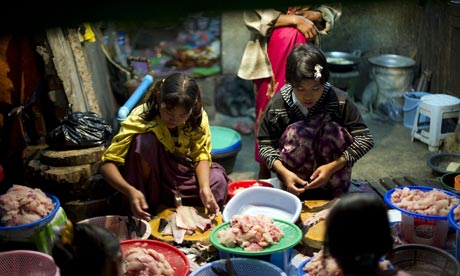


 At Pretoria-based Tshwane Home of Hope, the jubilant young faces of the girls who live there hide the truth of the horrors they have encountered.
