Human trafficking is a grim tale. Now and then one learns of a story that brings a smile. Read on.
Students and alumni band together to rescue girls from human trafficking | Local News - Home:
Showing posts with label Africa. Show all posts
Showing posts with label Africa. Show all posts
Wednesday, April 15, 2015


Wednesday, March 11, 2015
Mekong Trafficking Report Uncovers Mental Health, Abuse Issues - International Organization for Migration
“Trafficking in human beings is a gross violation of human rights that often involves extreme exploitation and abuse,” said Jeff Labovitz, IOM’s Thailand Chief of Mission. “People are trafficked for various forms of exploitation, most frequently into low-skilled labour sectors and for forced labour and sexual exploitation. In these circumstances, trafficked persons are exposed to a multitude of health risks, including violence, deprivation and serious occupational hazards.”

READ MORE:
Mekong Trafficking Report Uncovers Mental Health, Abuse Issues - International Organization for Migration:
Related articles
Tuesday, November 25, 2014
U.N. Report Shows an Increase in Child Trafficking - NYTimes.com
One in three human trafficking victims is a child, most victims are female, and traffickers operate with wide impunity, the United Nations said Monday in a report on modern-day slavery.
The 2014 Global Report on Trafficking in Persons, produced by the United Nations Office on Drugs and Crime, also found that the proportion of children among victims appeared to be rising. Its first report, in 2012, said the proportion had been closer to one in four.Read more
U.N. Report Shows an Increase in Child Trafficking - NYTimes.com:

Tuesday, September 9, 2014
John Hoffmire: Understanding the harsh realities of child slavery in Africa | Deseret News
Source: Deseret News:
John Hoffmire:
John Hoffmire:
We all know poverty wreaks havoc on families, but rarely do we see the corrosive effects extreme poverty has on even the strongest of bonds, such as those between parents and children.
Jake Roble was an intern for me at the University of Oxford this summer and has just come back from studying child slavery in Ghana in West Africa, where he witnessed up close the devastating effects poverty had on people. These are some of the stories he told me. The names of some of the people have been changed.
Continue:
Monday, June 16, 2014
Exploitation In Taiwan's $2bn Fishing Industry
Source: malaysiandigest,com
"THE story of Yim Bun Then, a Cambodian rice farmer, is one you will not hear about when buying "Made in Taiwan" seafood at your local supermarket.
The 34-year-old is among 1,000 Cambodian men recruited by a Taiwanese-managed agency - Giant Ocean - from 2009 to work on mostly Taiwanese-owned fishing boats.
The workers were sent to waters off Africa as well as Japan, Fiji, Qatar and Malaysia. According to NGOs and the men themselves, they were promised $150 (£90) a month, but were paid about half that."
Continue:
http://malaysiandigest.com/world/504543-exploitation-in-taiwan-s-2bn-fishing-industry.html
"THE story of Yim Bun Then, a Cambodian rice farmer, is one you will not hear about when buying "Made in Taiwan" seafood at your local supermarket.
The 34-year-old is among 1,000 Cambodian men recruited by a Taiwanese-managed agency - Giant Ocean - from 2009 to work on mostly Taiwanese-owned fishing boats.
The workers were sent to waters off Africa as well as Japan, Fiji, Qatar and Malaysia. According to NGOs and the men themselves, they were promised $150 (£90) a month, but were paid about half that."
Continue:
http://malaysiandigest.com/world/504543-exploitation-in-taiwan-s-2bn-fishing-industry.html

Thursday, June 5, 2014
'Everyone has a little bit of Congo in their pocket' - Telegraph
Source: Telegraph:

A tiny portion of the price you paid for your smartphone, tablet or laptop could have been funneled to warlords in the Congo, lengthening a war that has already cost six million deaths - the deadliest conflict since WWII. It could also have led to slavery and systematic rape.
Continue here:

Tuesday, May 27, 2014
'Forced labor is tolerated in many countries' | Business | DW.DE | 20.05.2014
Source: DW.DE | 20.05.2014:

The International Labor Organization (ILO) report revealed that more than half the people in forced labor are women and girls, primarily in commercial sexual exploitation and domestic work. Men and boys are primarily forced to work in agriculture, construction, and mining. At the same time, about 5.5 million of the victims are children.
The Asia-Pacific region is home to more than half of forced workers worldwide with some 11.7 million exploited people generating around $51.8 billion each year for their abusive employers. Africa takes the second slot with 3.7 million forced laborers, followed by Latin America and the Caribbean with 1.8 million.
In a DW interview Ekkehard Ernst, ILO's labor market expert, says slave labor is rife in some countries because of the tolerance for the practice in these places.
Read the interview here:


Thursday, January 9, 2014
Agricultural Sector Companies Face Increased Scrutiny On Human Rights-Related Risks - Corporate/Commercial Law - United States
Source: Foley Hoag LLP
Agricultural sector companies, and companies with large agricultural supply chains, face new scrutiny from investors and other stakeholders concerning human rights-related risks in their corporate supply chains. Key issues for this sector include the risks of human trafficking and forced labor and the potential for suppliers to be complicit in land grabs which displace vulnerable populations.
Continue here:
http://www.mondaq.com/unitedstates/x/284242/Corporate+Governance/Agricultural+Sector+Companies+Face+Increased+Scrutiny+On+Human+RightsRelated+Risks

Agricultural sector companies, and companies with large agricultural supply chains, face new scrutiny from investors and other stakeholders concerning human rights-related risks in their corporate supply chains. Key issues for this sector include the risks of human trafficking and forced labor and the potential for suppliers to be complicit in land grabs which displace vulnerable populations.
Continue here:
http://www.mondaq.com/unitedstates/x/284242/Corporate+Governance/Agricultural+Sector+Companies+Face+Increased+Scrutiny+On+Human+RightsRelated+Risks

Saturday, November 9, 2013
Human trafficking: Contemporary slavery a part of every life – The Express Tribune
Source: The Express Tribune
"Screened by United Nations office on Drugs and Crime (UNODC), the documentary depicting cruel practices of human trafficking and modern slavery comes from Academy award nominated director, Robert Bilheimer. Filmed across five continents, it takes viewers into a world where millions of children are exploited everyday, for real."
Continue here:
http://tribune.com.pk/story/624939/human-trafficking-contemporary-slavery-a-part-of-every-life/

"ISLAMABAD:
Covering children suffering from malnutrition in Africa and
begging on the streets of Mumbai to Nepalese girl entrapped in a vicious
cycle of prostitution, “Not My Life” keeps its viewers engaged till the
end.
"Screened by United Nations office on Drugs and Crime (UNODC), the documentary depicting cruel practices of human trafficking and modern slavery comes from Academy award nominated director, Robert Bilheimer. Filmed across five continents, it takes viewers into a world where millions of children are exploited everyday, for real."
Continue here:
http://tribune.com.pk/story/624939/human-trafficking-contemporary-slavery-a-part-of-every-life/

Friday, August 30, 2013
Egypt’s chaos fuels Africa’s human trafficking | Africa | DW.DE | 27.08.2013
Egypt’s chaos fuels Africa’s human trafficking | Africa | DW.DE | 27.08.2013
Adrian Kriesch:
"Egypt’s political unrest has brought suffering not only to its own people but also to hundreds of African refugees. Their goal is Israel but many end up as hostages on the Sinai Peninsula."
Read with the full article here: http://www.dw.de/egypts-chaos-fuels-africas-human-trafficking/a-17050151

Adrian Kriesch:
"Egypt’s political unrest has brought suffering not only to its own people but also to hundreds of African refugees. Their goal is Israel but many end up as hostages on the Sinai Peninsula."
Read with the full article here: http://www.dw.de/egypts-chaos-fuels-africas-human-trafficking/a-17050151
Wednesday, August 28, 2013
Trafficked into labour, a young girl tries to regain what she's lost
SOURCE: UNGIFT.ORG
"Blessing's story is short, and it has many holes, because she simply doesn't remember much of her life - at least the part before she came to Lagos, West Africa's biggest metropolis.
"Years ago, she left her native Ghana with an aunt who was headed for
neighbouring Nigeria. The aunt promised Blessing's parents that the girl
would go to school and work to send them money. Like millions before
them, they arrived in Lagos looking for opportunity."
CONTINUE READING:
http://www.ungift.org/knowledgehub/stories/August2013/trafficked-into-labour-a-young-girl-tries-to-regain-what-shes-lost.html

"Blessing's story is short, and it has many holes, because she simply doesn't remember much of her life - at least the part before she came to Lagos, West Africa's biggest metropolis.
CONTINUE READING:
http://www.ungift.org/knowledgehub/stories/August2013/trafficked-into-labour-a-young-girl-tries-to-regain-what-shes-lost.html
Thursday, August 8, 2013
Malians Call for Criminalization of Slavery
http://www.voanews.com/content/malians-call-for-criminalization-of-slavery/1725960.html
Voice of America
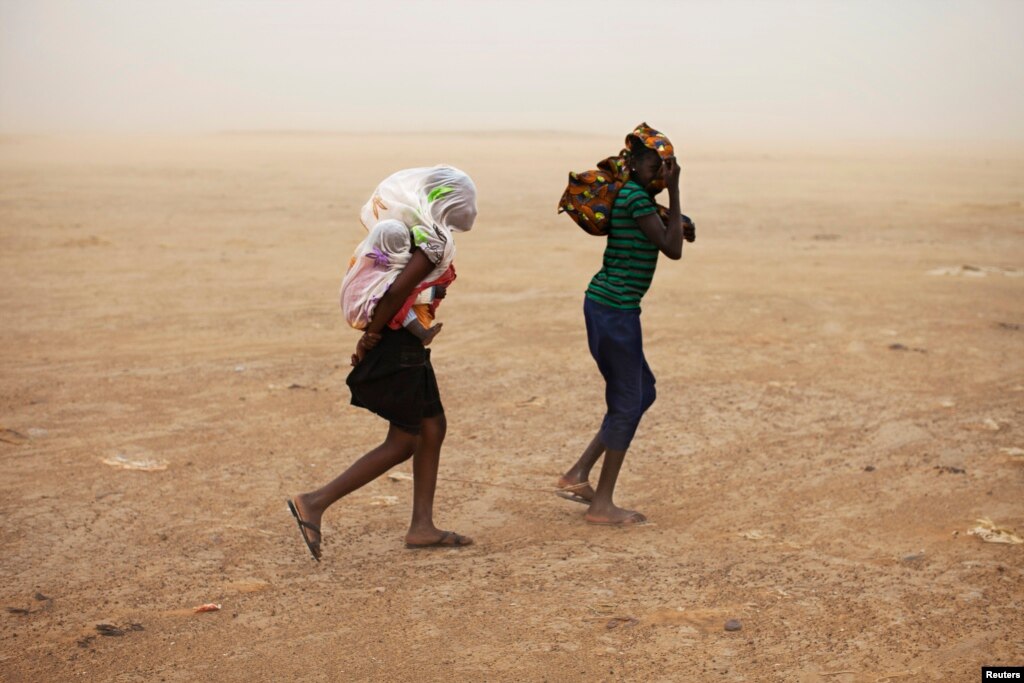
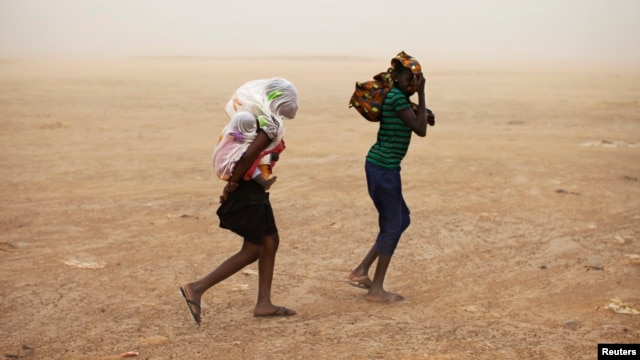 Women wrapped in shawls walk through a sandstorm in Timbuktu, July 29, 2013.
Pursuing freedom, redress
Jim Wormington is a senior legal analyst with the American Bar Association's Rule of Law Initiative. He described how, in 2012, the ABA opened a legal clinic in the northern city of Gao providing advocacy support to subjugated Malians seeking freedom and redress.
“Certainly they described themselves as ‘slaves.’ They will say they have a 'master' whom they work for, often without pay, whether watching cattle or performing household tasks," he said. "People also described the violations they suffered... like, being beaten if they made a mistake. We’ve heard a number accounts of women who are raped, by their ‘masters’".
The clinic prepared cases against 18 slaveholders for crimes including assault and sexual offenses. Wormington said that while the coup occurred before the first case went to trial, the ABA continues to document slavery among internally displaced Malians.
“We’ve actually supported Temedt’s effort to draft that law for slavery itself to be clearly criminalized at the beginning of 2012. Advocating for the adoption of that law would be most appropriate after Mali’s elections, when there is again a government we can advocate to,” said Wormington.
Mali’s recent turmoil has concentrated the will of activists to eradicate slavery. Oyahit said Temedt has been lobbying the country's presidential candidates. “We wrote to all the candidates about our draft law,” he explained. “They know our 45,000 members are prepared to vote for any presidential candidate who will back our proposal.”
Exposing problem
Sarah Mathewson, Africa program coordinator for Anti-Slavery International, believes 250,000 Malians may be living in slavery. She said persuading national leaders about the extent of the problem has always been a challenge.
“Even if it were a few thousand people, even if it were one person, it should be an urgent priority to emancipate people. How can Mali move forward to re-establish democratic systems, with all its citizens equal, engaged and participating in the progress of society if a significant number remain enslaved to others? I think that’s critical to address,” said Mathewson.
The fight is unlikely to end, however, even if a law is passed. Niger criminalized slavery in 2003 and Mauritania in 2007. In Mauritania, only one slave owner has since been prosecuted. Mathewson said the process is complicated by other factors too.
“There are strong economic interests in the slavery system, and strong interests in not upsetting the slave-owning classes who are often quite privileged elites with connections to government,” she said.
In Mauritania, the anti-slavery group, IRA Mauritanie, formed its own political party ahead of legislative elections expected in October. Temedt members look forward to achieving the same political acceptance. Mali’s recent conflict set their cause back years, they say, and now is the time to redouble the effort to end slavery, not just in Mali, but across the Sahel.

Voice of America
August 08, 2013
BAMAKO, MALI — Slavery is still practiced among some groups in Mali. Activists had made some gains in their fight to outlaw the custom until early 2012, when a Tuareg rebellion and subsequent military coup plunged the country into chaos. Now, as Mali prepares to elect its next president, activists say the time is right to push for a law banning the centuries-old
Although slavery was prohibited by the Malian constitution of 1960, it was never formally criminalized in law. Soumaguel Oyahit, secretary-general of the human rights association, Temedt, and himself a member of Mali’s slave caste, said the practice continues in conservative religious communities and among ethnic groups, including the Tuareg.
“We are trying to prioritize the eradication of a tradition that we call descent-based slavery,” said Oyahit. “What this means is that across northern Mali and the Sahel, a child born to a woman who is a member of the slave caste, living in a family that has traditionally kept slaves, is itself condemned to being a slave. There is no law criminalizing this practice.”Pursuing freedom, redress
Jim Wormington is a senior legal analyst with the American Bar Association's Rule of Law Initiative. He described how, in 2012, the ABA opened a legal clinic in the northern city of Gao providing advocacy support to subjugated Malians seeking freedom and redress.
“Certainly they described themselves as ‘slaves.’ They will say they have a 'master' whom they work for, often without pay, whether watching cattle or performing household tasks," he said. "People also described the violations they suffered... like, being beaten if they made a mistake. We’ve heard a number accounts of women who are raped, by their ‘masters’".
The clinic prepared cases against 18 slaveholders for crimes including assault and sexual offenses. Wormington said that while the coup occurred before the first case went to trial, the ABA continues to document slavery among internally displaced Malians.
“We’ve actually supported Temedt’s effort to draft that law for slavery itself to be clearly criminalized at the beginning of 2012. Advocating for the adoption of that law would be most appropriate after Mali’s elections, when there is again a government we can advocate to,” said Wormington.
Mali’s recent turmoil has concentrated the will of activists to eradicate slavery. Oyahit said Temedt has been lobbying the country's presidential candidates. “We wrote to all the candidates about our draft law,” he explained. “They know our 45,000 members are prepared to vote for any presidential candidate who will back our proposal.”
Exposing problem
Sarah Mathewson, Africa program coordinator for Anti-Slavery International, believes 250,000 Malians may be living in slavery. She said persuading national leaders about the extent of the problem has always been a challenge.
“Even if it were a few thousand people, even if it were one person, it should be an urgent priority to emancipate people. How can Mali move forward to re-establish democratic systems, with all its citizens equal, engaged and participating in the progress of society if a significant number remain enslaved to others? I think that’s critical to address,” said Mathewson.
The fight is unlikely to end, however, even if a law is passed. Niger criminalized slavery in 2003 and Mauritania in 2007. In Mauritania, only one slave owner has since been prosecuted. Mathewson said the process is complicated by other factors too.
“There are strong economic interests in the slavery system, and strong interests in not upsetting the slave-owning classes who are often quite privileged elites with connections to government,” she said.
In Mauritania, the anti-slavery group, IRA Mauritanie, formed its own political party ahead of legislative elections expected in October. Temedt members look forward to achieving the same political acceptance. Mali’s recent conflict set their cause back years, they say, and now is the time to redouble the effort to end slavery, not just in Mali, but across the Sahel.
Monday, May 13, 2013
Cambodian court charges woman from China's Taiwan with trafficking fishermen - Xinhua | English.news.cn
http://news.xinhuanet.com/english/china/2013-05/12/c_132376896.htm
Source: Xinhua | English.news.cn

Source: Xinhua | English.news.cn
PHNOM PENH, May 12 (Xinhua) -- Cambodia's Phnom Penh Municipal Court on Sunday charged a woman from China's Taiwan region with trafficking Cambodians to work in slave-like conditions on fishing boats off the coast of Africa, police said.
Instigating Judge Leang Samnak accused Lin Yu Hshin, 53, owner of Giant Ocean International Fishery Co. Ltd., of "illegally exporting Cambodian people with a purpose" and ordered the pre- trial detention of the woman, Lt. Gen. Chhiv Phally, deputy chief of the Ministry of Interior's anti-human trafficking and juvenile protection department, told reporters after the court questioned the lady on Sunday.
Lin Yu Hshin was arrested Friday in Siem Reap City after an investigation since late 2011, he said. "Our investigation was made after 169 victims have filed complaints against her," he said."According the complaints, she has been accused of trafficking Cambodian people to work on fishing boats in slave-like conditions -- working 18 hours a day with physical torture and without wages."
He said some victims are still on fishing boats off the coast of Africa.
Thursday, May 2, 2013
Burkina Faso: Childhoods Lost in the Gold Mines | Pulitzer Center

Barefoot and shirtless, Karim Sawadogo, 9, works with his
uncle at a gold mine. He has been to school, but only for a while.
"My dream," he says, "is to make enough money so I don't
have to do this anymore." Image by Larry C. Price. Burkina Faso, 2013.
TIÉBÉLÉ, Burkina Faso - On the rocky ground outside the Kollo mining village near the border between Burkina Faso and Ghana, about 100 people are working, 30 or so of them children. They smash boulders into pebbles and pebbles into grit with primitive hammers and sticks. They haul buckets of well water up the hillside and, pouring this water into shallow pans filled with rock and dirt, they swirl the muddy mix, looking in the silt for tiny flecks of gold.
Click below to read the complete article:
Burkina Faso: Childhoods Lost in the Gold Mines | Pulitzer Center

Wednesday, March 6, 2013
BBC News - Sinai torture for Eritreans kidnapped by traffickers
BBC News - Sinai torture for Eritreans kidnapped by traffickers


"The kidnappers would make me lie on my back and then they would get me to ring my family to ask them to pay the ransom they wanted," she says, lifting up the back of her shirt to expose a rash of deep scars.
"As soon as one of my parents answered the phone, the men would melt flaming plastic over my back and inner thighs and I would scream and scream in pain.
"This, they hoped, would put extra pressure on my mother and father to find the money."
To read the full article, go to:

Monday, February 11, 2013
Women trafficked into crime in UK are imprisoned without support or protection
Read more at: http://phys.org/news/2013-02-women-trafficked-crime-uk-imprisoned.html#jCp
February 8, 2013

Enlarge Credit: India.ca from Flickr Research reveals extent of shortcomings in UK justice and immigration to adequately define and intervene in such cases.
Most foreign national women trafficked into the UK and forced to commit offences are given custodial sentences without help or support if arrested – despite being victims of often horrifying crime and abuse themselves, says a Cambridge-led report.
The research shows that violence, intimidation and rape are common experiences among the women, but evidence of their suffering is often overlooked and they do not receive the protection supposedly guaranteed to them as victims of human trafficking under international law.
The report's findings and policy implications were presented to MPs and Peers in the House of Lords last week, at a seminar convened by the University's Institute of Criminology and the Prison Reform Trust.
The research, conducted last year, involved interviewing 103 of the over 600 foreign national women incarcerated in the UK at that time. Foreign nationals account for roughly one in seven of the total female prison population.
The offences of 58 interviewees were linked directly to their victim status. Researchers identified 43 women as victims of human trafficking. Five more who entered the country freely had since worked in slave-like conditions.
Only one quarter of the women identified by researchers as having been trafficked were processed though the National Referral Mechanism (NRM) – the framework set up in 2009 to ensure that victims of human trafficking receive help.
Some women were not processed by the NRM until their sentences were complete, and even referrals to the NRM that resulted in positive decisions still left victims spending an average of four months in custody.
For the rest, no formal recognition of victim status – and consequent support and protection – was given. In only one case of human trafficking of all those identified by researchers did victim disclosure result in police investigating the crimes perpetrated against them.
Nearly half the women had been forced into prostitution. Other coerced crimes included drug smuggling, cannabis production and street robberies. Several cases of domestic servitude were also identified.
Five women had been trafficked as children, one of whom had been re-trafficked to the UK following deportation back to Africa from another country.
All the women interviewed had suffered physical and/or emotional abuse. Over half those identified as trafficking victims had experienced multiple rapes, with some turning to prison doctors for help with severe pain and bleeding following extensive physical and sexual abuse.
For some women, abuse was the key reason for migration and harrowing stories of persecution in their homeland were relayed to the researchers – from extreme torture to the execution of their own children. For many, the threats made by those who moved and controlled them continued, even after the women had been arrested and detained.
Those interviewed spoke of confusion and powerlessness when confronted by UK authorities. A common problem was the failure by justice and immigration agencies to provide interpreter support and access to documents in a language the women could understand.
One victim of sex trafficking – arrested for false documents – told how she was never asked if she needed an interpreter: "I did not understand what was going on. I was crying… I just wanted to be able to tell them everything – I wanted them to listen and understand. If I had been able to talk then maybe I would not be here."
Another stated that her sense of powerlessness during court proceedings felt like "being in the hands of the people who brought me here".
"The message is clear: the powerlessness of these women in the hands of their traffickers is terrifyingly replicated within the criminal justice system," said Professor Loraine Gelsthorpe from Cambridge's Institute of Criminology, who conducted the research with Dr Liz Hales.
"The legitimacy of our criminal justice system stands or falls on the way in which we treat victims as well as offenders. There should be renewed efforts to recognise that 'offenders' can also be 'victims', and to ensure that appropriate credence is given to women's accounts of their own experiences.
"We hope this research will encourage government agencies to implement better training and procedures in relation to this."
The report The Criminalisation of Migrant Women can be viewed here. Provided by University of Cambridge.


Tuesday, December 18, 2012
Top Ten Business and Human Rights Issues 2013 - Business and Human Rights Issues
Check this out!
Source: Institute for Human Rights and Business
The 2013 Top Ten List of Business and Human Rights Issues was published by the Institute for Human Rights and Business (IHRB) on International Human Rights Day, 10 December 2012.
For an elaboration of each of the ten issues listed below, go to:
http://www.ihrb.org/top10/business_human_rights_issues/2013.html
Note: These ten issues are not ranked in order of importance.
1. Embedding respect for human rights across all business relationships
2. Expanding action to combat forced labour and human trafficking
3. Tackling challenges of dual-use internet-based technologies that may undermine privacy rights and freedom of expression
4. Advancing uptake of the UN Guiding Principles in key enabling sectors including finance, ICT and infrastructure
5. Leveraging government as an economic actor through public procurement policies that ensure respect for human rights
6. Renewing efforts to protect lives in the work-place
7. Mitigating the ‘resource curse’ by preventing negative human rights impacts of oil and gas exploration
8. Linking respect for human rights to calls for greater transparency in lobbying by businesses
9. Ensuring responsible investment in conflict-affected and 'high risk' areas
10. Addressing the impacts of land and water grabs linked to transport, fishing, security, mineral extraction and other sectors

Source: Institute for Human Rights and Business
The 2013 Top Ten List of Business and Human Rights Issues was published by the Institute for Human Rights and Business (IHRB) on International Human Rights Day, 10 December 2012.
For an elaboration of each of the ten issues listed below, go to:
http://www.ihrb.org/top10/business_human_rights_issues/2013.html
Note: These ten issues are not ranked in order of importance.
1. Embedding respect for human rights across all business relationships
2. Expanding action to combat forced labour and human trafficking
3. Tackling challenges of dual-use internet-based technologies that may undermine privacy rights and freedom of expression
4. Advancing uptake of the UN Guiding Principles in key enabling sectors including finance, ICT and infrastructure
5. Leveraging government as an economic actor through public procurement policies that ensure respect for human rights
6. Renewing efforts to protect lives in the work-place
7. Mitigating the ‘resource curse’ by preventing negative human rights impacts of oil and gas exploration
8. Linking respect for human rights to calls for greater transparency in lobbying by businesses
9. Ensuring responsible investment in conflict-affected and 'high risk' areas
10. Addressing the impacts of land and water grabs linked to transport, fishing, security, mineral extraction and other sectors
Thursday, November 8, 2012
A Dangerous Journey - YouTube
http://www.youtube.com/watch?v=xosVqdLFnRo&feature=youtu.be
Published on Nov 7, 2012 by DameEvelynGlennie

Published on Nov 7, 2012 by DameEvelynGlennie
As patron of Able Child Africa I am acutely aware of the challenges faced by many countries through poverty. More recently I have been made aware of another form of insidious crime against innocent young victims involving exploitation, abuse and degradation.
Ruth Beni, Director of Animage Ltd, sent me a video depicting the plight of 2 young girls, Rose and Grace. She asked me to consider composing some music to accompany two animated stories.
As soon as I had time I duly sat down and began watching the videos. I would say I am a fairly worldly-wise person and I am very well aware of many injustices in this world but nothing prepared me for the impact of the stories about the plight of these two young girls - victims of sex trafficking.
It is my understanding the characters featured this animated film titled 'A Dangerous Journey' are based on real people, coerced as children, out of their homelands and exploited horribly in other countries including the UK. I cannot comprehend the trauma they must have suffered in their very young lives. I cannot begin to assume I know how they feel or how they and countless others will ever lead normal lives. What I do know is I cannot ignore their plight or forget what I have seen.
I immediately contacted a composer friend of mine, Philip Sheppard, and we set about writing music to accompany these two animated stories. I hope we did them justice and I hope awareness of crimes like this can be eradicated.
Please watch the video's and let me have your thoughts but most of all please send the link to as many people as you can and in doing so hopefully we can reduce incidents of this nature and make our world a better place......
This is part of "The Need to Know Campaign"
Exposing Global Practices That Harm Women
The Need to Know Campaign is a growing body of work that uses animated films as a method of informing and warning millions of people worldwide, in particular young people, of the practices that harm women.
The film is funded by the Home Office and various UK charities (such as Comic Relief and the Tudor Trust)
The aims of the Need to Know Campaign is
• To publicise the magnitude of what is essentially a global hate crime against women
• To mobilise world opinion
• To translate opinion into effective action
Ruth Beni, Director of Animage Ltd, sent me a video depicting the plight of 2 young girls, Rose and Grace. She asked me to consider composing some music to accompany two animated stories.
As soon as I had time I duly sat down and began watching the videos. I would say I am a fairly worldly-wise person and I am very well aware of many injustices in this world but nothing prepared me for the impact of the stories about the plight of these two young girls - victims of sex trafficking.
It is my understanding the characters featured this animated film titled 'A Dangerous Journey' are based on real people, coerced as children, out of their homelands and exploited horribly in other countries including the UK. I cannot comprehend the trauma they must have suffered in their very young lives. I cannot begin to assume I know how they feel or how they and countless others will ever lead normal lives. What I do know is I cannot ignore their plight or forget what I have seen.
I immediately contacted a composer friend of mine, Philip Sheppard, and we set about writing music to accompany these two animated stories. I hope we did them justice and I hope awareness of crimes like this can be eradicated.
Please watch the video's and let me have your thoughts but most of all please send the link to as many people as you can and in doing so hopefully we can reduce incidents of this nature and make our world a better place......
This is part of "The Need to Know Campaign"
Exposing Global Practices That Harm Women
The Need to Know Campaign is a growing body of work that uses animated films as a method of informing and warning millions of people worldwide, in particular young people, of the practices that harm women.
The film is funded by the Home Office and various UK charities (such as Comic Relief and the Tudor Trust)
The aims of the Need to Know Campaign is
• To publicise the magnitude of what is essentially a global hate crime against women
• To mobilise world opinion
• To translate opinion into effective action
Monday, November 5, 2012
Slavery Still Exists - Lisa Kristine - The Atlantic
http://www.theatlantic.com/international/archive/2012/09/slavery-still-exists/262847/#.UGTI_aY_TP0.wordpress
Source: The Atlantic
SEP 26 2012, 1:10 PM ET
- Lisa Kristine is a California-based photographer. Her personal website is LisaKristine.com.
 Lisa Kristine
Around the world human traffickers trick many people into slavery by false promises of good jobs or good education, only to find themselves forced to work without pay, under the threat of violence. Trapped by phony debt, these slaves are hunted by local police and private security guards if they try to escape.
Sometimes slaves don't even understand that they're enslaved, despite people working 16 or 17 hours a day with no pay. They're simply used to it as something they've been doing their whole lives. Their bodies grow weak and vulnerable to disease, but they have nothing to compare their experience to.
For the last 28 years I have documented people in more than 100 countries on six continents. In 2009, at the Vancouver Peace Summit, I met a supporter of Free the Slaves, an NGO dedicated to eradicating modern-day slavery; weeks later, I flew down to Los Angeles and met with the director of Free the Slaves; thus began my journey into exploring modern-day slavery.
Oddly, I'd been to most of the locations where I started photographing slavery many times before. I even considered some of them homes-away-from-home. But there can be dark corners in familiar places.
 Accra, Ghana: These gold miners have just come out of the shaft, their pants soaked from their own sweat. Most had spent all their money coming from the north hoping to strike it rich in legal mines. But legal operations require certifications. When they can't get a job, the men take high-interest loans or join groups of slaves in mines abandoned by legitimate operations.
 Accra, Ghana: 200 feet underground, a man labors in an illegal gold mine. He and others enslaved like him are underground for as long as 72 hours at a time.
 Accra, Ghana: Many of those enslaved had children with them while panning for gold, wading in waters poisoned by mercury that is used in the extraction process.
 Kathmandu, Nepal: For this photo, I was escorted by women who had previously been enslaved themselves. They brought me down a narrow set of stairs leading to a green fluorescent-lit basement. This wasn't a brothel as such; it was a "cabin restaurants," as they are known in the trade -- venues for forced prostitution. Each has a small private room where slaves, some as young as seven, entertain and serve the clients, encouraging them to buy alcohol and food. These cubicles are small, dark, and dingy, each identified with a number painted on the wall, and partitioned by plywood and a curtain. The workers here often endure sexual abuse at the hands of the customers. Standing in the near darkness, I realized there was only one way out -- the stairs where I came in: no back doors, no windows large enough to climb through, no escape at all.
 Kathmandu, Nepal: A worker blends in with the bricks at a Nepalese kiln. Workers mechanically stack 18 bricks at a time, each weighing four pounds, and carry them to nearby trucks for 18 hours a day without any payment or compensation.
 Lake Volta, Ghana: Fhanaian NGOs estimate that between 4,000 and 10,000 trafficked children are enslaved on Lake Volta, the largest man-made lake in the world. At first glance this image appears to be a family fishing in the lake, two older brothers and some kids. I was alarmed to learn that they were actually enslaved, working in plain sight. These children have been lost to their parents and are forced to work endless hours in boats on the lake, though they're unable to swim.
 Lake Volta, Ghana: Child workers usually work from 1 a.m. to 5 a.m. on cold, windy nights to reel in nets weighing as much as 1,000 pounds when they are full of fish. Skeletal tree limbs submerged in Lake Volta frequently entangle the fishing nets, and and slave masters will throw weary, frightened children into the water to free the trapped lines, sometimes drowning them. I didn't meet one child who didn't know another who had drowned.
 Lake Volta, Ghana: There are triumphs, too. Meet Kofi, a young boy who was rescued from slavery in a fishing village. I met Khofi at a shelter where Free the Slaves rehabilitate victims of slavery. He was bathing at the well, pouring big buckets of water over his head. Thanks to the efforts of organizations like Free the Slaves, today Kofi has been reunited with his parents, who were provided tools to make a living and to keep their children safe from human traffickers.
 In the Himalayas I found children hauling stone for miles down steep mountain terrain to trucks waiting at the road below. These huge sheets of slate were heavier than the children themselves. The kids hoisted them with their heads using handmade harnesses made from sticks, rope, and torn cloth.
 Uttar Pradesh, India: In India I visited a village where whole families were enslaved in the silk industry. This is a family portrait. The father (hands in black) and his sons (hands in red and blue) are held captive in a "silk dyeing house." The dye they work with is toxic. It's common for entire families to be enslaved for generations. My translator told me their story. "We have no freedom," they said. "But we hope, some day, we will be able to leave this house and make dyes in a place where we actually get paid for it."
 Uttar Pradesh, India: Slaveholders burned down these people's villages after they declared their freedom. Many of the neighbors wanted to give up, they were so frightened -- but the woman in the center encouraged them to persevere. Abolitionists helped them get a quarry lease of their own. Now they do the same backbreaking work, but they at least get paid for it, and they do it in freedom.

Source: The Atlantic
SEP 26 2012, 1:10 PM ET
- Lisa Kristine is a California-based photographer. Her personal website is LisaKristine.com.
Photographs of human trafficking and enslavement around the world
Lisa Kristine
It was 130 degrees when I was first introduced to the brick kilns of Nepal. In these severe temperatures, men, women, and children -- whole families, in fact -- were surrounded by a dense cloud of dust while mechanically stacking bricks on their heads, carrying them, 18 at a time, from the scorching kilns to trucks hundreds of yards away.
These are slaves. Deadened by monotony and exhaustion, they worked without speaking, repeating the same task 16 hours a day. They took no rest for food or water, no bathroom breaks -- although their dehydration suppressed their need to urinate.
Around the world human traffickers trick many people into slavery by false promises of good jobs or good education, only to find themselves forced to work without pay, under the threat of violence. Trapped by phony debt, these slaves are hunted by local police and private security guards if they try to escape.
Sometimes slaves don't even understand that they're enslaved, despite people working 16 or 17 hours a day with no pay. They're simply used to it as something they've been doing their whole lives. Their bodies grow weak and vulnerable to disease, but they have nothing to compare their experience to.
For the last 28 years I have documented people in more than 100 countries on six continents. In 2009, at the Vancouver Peace Summit, I met a supporter of Free the Slaves, an NGO dedicated to eradicating modern-day slavery; weeks later, I flew down to Los Angeles and met with the director of Free the Slaves; thus began my journey into exploring modern-day slavery.
Oddly, I'd been to most of the locations where I started photographing slavery many times before. I even considered some of them homes-away-from-home. But there can be dark corners in familiar places.
These are not images of "problems." They're images of people. There are 27 million slaves in the world today: That's more than double the number of people taken from Africa during the entire transatlantic slave trade. A hundred and fifty years ago, an average agricultural slave cost over three times the average yearly wage of an American worker, about US$50,000 in today's money. Yet now, entire families can be enslaved for generations over a debt as small as $18. Slavery is illegal everywhere, but it exists all over the world.
Accra, Ghana: These gold miners have just come out of the shaft, their pants soaked from their own sweat. Most had spent all their money coming from the north hoping to strike it rich in legal mines. But legal operations require certifications. When they can't get a job, the men take high-interest loans or join groups of slaves in mines abandoned by legitimate operations.Accra, Ghana: 200 feet underground, a man labors in an illegal gold mine. He and others enslaved like him are underground for as long as 72 hours at a time.Accra, Ghana: Many of those enslaved had children with them while panning for gold, wading in waters poisoned by mercury that is used in the extraction process.Kathmandu, Nepal: For this photo, I was escorted by women who had previously been enslaved themselves. They brought me down a narrow set of stairs leading to a green fluorescent-lit basement. This wasn't a brothel as such; it was a "cabin restaurants," as they are known in the trade -- venues for forced prostitution. Each has a small private room where slaves, some as young as seven, entertain and serve the clients, encouraging them to buy alcohol and food. These cubicles are small, dark, and dingy, each identified with a number painted on the wall, and partitioned by plywood and a curtain. The workers here often endure sexual abuse at the hands of the customers. Standing in the near darkness, I realized there was only one way out -- the stairs where I came in: no back doors, no windows large enough to climb through, no escape at all.Kathmandu, Nepal: A worker blends in with the bricks at a Nepalese kiln. Workers mechanically stack 18 bricks at a time, each weighing four pounds, and carry them to nearby trucks for 18 hours a day without any payment or compensation.Lake Volta, Ghana: Fhanaian NGOs estimate that between 4,000 and 10,000 trafficked children are enslaved on Lake Volta, the largest man-made lake in the world. At first glance this image appears to be a family fishing in the lake, two older brothers and some kids. I was alarmed to learn that they were actually enslaved, working in plain sight. These children have been lost to their parents and are forced to work endless hours in boats on the lake, though they're unable to swim.Lake Volta, Ghana: Child workers usually work from 1 a.m. to 5 a.m. on cold, windy nights to reel in nets weighing as much as 1,000 pounds when they are full of fish. Skeletal tree limbs submerged in Lake Volta frequently entangle the fishing nets, and and slave masters will throw weary, frightened children into the water to free the trapped lines, sometimes drowning them. I didn't meet one child who didn't know another who had drowned.Lake Volta, Ghana: There are triumphs, too. Meet Kofi, a young boy who was rescued from slavery in a fishing village. I met Khofi at a shelter where Free the Slaves rehabilitate victims of slavery. He was bathing at the well, pouring big buckets of water over his head. Thanks to the efforts of organizations like Free the Slaves, today Kofi has been reunited with his parents, who were provided tools to make a living and to keep their children safe from human traffickers.In the Himalayas I found children hauling stone for miles down steep mountain terrain to trucks waiting at the road below. These huge sheets of slate were heavier than the children themselves. The kids hoisted them with their heads using handmade harnesses made from sticks, rope, and torn cloth.Uttar Pradesh, India: In India I visited a village where whole families were enslaved in the silk industry. This is a family portrait. The father (hands in black) and his sons (hands in red and blue) are held captive in a "silk dyeing house." The dye they work with is toxic. It's common for entire families to be enslaved for generations. My translator told me their story. "We have no freedom," they said. "But we hope, some day, we will be able to leave this house and make dyes in a place where we actually get paid for it."Uttar Pradesh, India: Slaveholders burned down these people's villages after they declared their freedom. Many of the neighbors wanted to give up, they were so frightened -- but the woman in the center encouraged them to persevere. Abolitionists helped them get a quarry lease of their own. Now they do the same backbreaking work, but they at least get paid for it, and they do it in freedom.Monday, September 24, 2012
A Bewitching Economy: Witchcraft and Human Trafficking
http://thinkafricapress.com/society/african-witchcraft-contemporary-slavery-human-trafficking-nigeria
Source: thinkafricapress.com
| BY ELIZABETH WILLMOTT HARROP


Source: thinkafricapress.com
| BY ELIZABETH WILLMOTT HARROP
A juju ceremony. Still from "Nigeria: Sex, Lies and Black Magic" episode of Unreported World on the UK's Channel Four, presented by Jenny Kleeman.
In parts of Africa, witchcraft is becoming increasingly linked to a modern form of slavery: human trafficking. Through ritual “oaths of protection”, witchcraft provides a convenient way to traffic and mentally dominate victims, who are easily silenced with the threat that any disobedience will be punished by the spiritual world. This has left the phenomenon hard to detect. The International Labour Organisation (ILO) has recently almost doubled its 2005 estimate, and revealed that there are currently 20.9 million victims of trafficking in the world. 3.7 million of these victims reside in Africa. Yet in 2011, there were only 257 prosecutions, 218 convictions and 10,094 victims identified on the continent.
Control through fear
A detective from London's Metropolitan Police Human Trafficking Team at New Scotland Yard, Andrew Desmond was responsible for the first successful prosecution of a Nigerian organised crime network.
Speaking to Think Africa Press, Desmond comments: “When I first explained the difficulties of getting victims to give evidence against their traffickers, because of their fears of being cursed and punished by the spirit world, my colleagues at Scotland Yard were pretty bemused. But we have to fully understand the issues and what we have in common in order to work with victims - is the concept really so far removed from asking those appearing in a UK court to swear an oath on the bible before giving testimony? After all, they are both about regulating what is said through fear of a powerful spirit.”
A September 2012 report by ActionAid comments that “it is no coincidence that the witch camps are found only in northern Ghana, which is one of the poorest regions of the country and suffers from low education and literacy standards”. However, Gary Foxcroft, co-founder of Stepping Stones Nigeria stresses that the belief in child witches in Nigeria cuts across all facets of society:
“The literate and illiterate, the wealthy and poor, law enforcement agents, social welfare workers, law makers and most specifically the leaders of revivalist Pentecostal churches believe in child witches … All accidents, drunkenness, madness, smoking of marijuana, divorce, infertility, and misfortunes are perceived to be their handiwork.”
Empty promises, full wallets
For those who live in abject poverty, something that promises to explain their predicament can be very alluring. Oaths that purportedly ensure prosperity, health and happiness are also on offer.
But the financial gain is usually one-way: pastors who promote the belief in child witches are accused of doing so to extract fees for “delivering” the children.
UNICEF comments that “the earnings … are not insignificant. Consequently, a number of pastor‐prophets, including women, have found their calling in the anti‐witch hunt, as is the case with Prophet Helen Ukpabio in Nigeria … whose primary goal has become the detection and deliverance of child witches”.
In the European witch hunts of 400 years ago, victims tended to be of lower social status and elderly women. The demographic profile of the contemporary witch-accused are also mainly older women, but include successful younger women and increasingly children. Over 95% of the children on the streets of Akwa Ibom State in Nigeria have been stigmatised as "witches" by pastors, according to Stepping Stones Nigeria.
According to UNICEF, “Living in the street is one of the common consequences of witchcraft accusations and is also an indicator of the scale of the phenomenon”. One Nigerian studyrevealed that 19% of school children and 40% of street children surveyed had been trafficked.
Super eagles?
Africa’s regional trafficking hub is Nigeria. Its police force has not been very eagled-eyed in its crackdown on trafficking. A 2011 report by Europol, the European Law Enforcement Agency, identified Nigeria as one of the top four “most threatening” countries in the world in terms of trafficking groups. It is also the top sending country for those trafficked into the UK for purposes of sexual exploitation.
UNESCO notes that “poverty is the most visible cause of the vulnerability of women and children to trafficking in Nigeria”. An ILO report revealed that of the children who were released to traffickers by their parents in Nigeria, over 72% did so because they could not afford school fees. Half of those children never returned home.
According to Debbie Ariyo of child advocacy organisation Afruca, Nigerian traffickers “use the ritual of oath swearing as their most powerful weapon of coercion”. In 2008, the Nigerian National Agency for Prohibition of Traffic in Persons (NAPTIP) advised that 90% of girls that had been trafficked to Europe were taken to shrines to take “oaths of secrecy”.
Desmond explains: “The human traffickers of Edo and Delta States of Nigeria have hijacked the cultural beliefs in Juju to blackmail their victims to satisfy the greed for money for those involved, including traditional priests paid to carry out the ceremonies. The strong belief in the spirits makes this a powerful weapon for modern day slave traders.”
Desmond explains the significance of the Juju ritual: “One 14-year old Nigerian victim I interviewed had taken up the offer of a family friend to become a house maid in the UK. Before leaving she was taken to a Juju priest to undergo a ritual. She was told by the priest that if she disobeyed her trafficker, she would incur the wrath of the spirit world through nightmares, madness and death. Once in the UK, it became clear she was to be a sex slave or her trafficker would use Juju to kill her.”
These deeply-held spiritual beliefs, which facilitate the Juju oath, cause huge problems for law enforcement officials who want victims to testify against their traffickers.
Symptoms of post-traumatic stress disorder (PTSD) incurred by a trafficking victim will often seem to them to confirm that the spirit world is inflicting retribution upon them. A 2011 report by the National Board of Social Services in Denmark says that Nigerian trafficking victims “often have a very high frequency of PTSD symptoms … the related mental and psychosomatic symptoms [are] interpreted as a result of Juju.”
Structural adjustment
The bond between witchcraft and human trafficking is not spiritual but economic. Structural factors have created a system of inequality, in which the vulnerable have to fight against multiple risk factors in order to maintain the most basic level of human dignity. Many reports cite the lack of social protection to help families in poverty, a lack of access to education for vulnerable children, corruption, the influence of senior religious and political figures, and culturally entrenched gender norms are all at play. It is important to recognise that witchcraft should not become the sole focus in the fight against human trafficking. It remains a fundamental problem with the distribution of wealth and needs to be challenged as such.
Think Africa Press welcomes inquiries regarding the republication of its articles. If you would like to republish this or any other article for re-print, syndication or educational purposes, please contact: editor@thinkafricapress.com
Subscribe to:
Posts (Atom)
