Trafficking Monitor is a blog I created and curate. It offers posts highlighting the multifaceted nature of human trafficking and forced/indentured labour. I draw on a diversity of sources for my posts. You are invited to recommend materials for posting.
UN report to be launched by Gordon Brown says there will still be 190m child labourers in eight years unless issue is tackled Randeep Ramesh, social affairs editor, The Guardian,
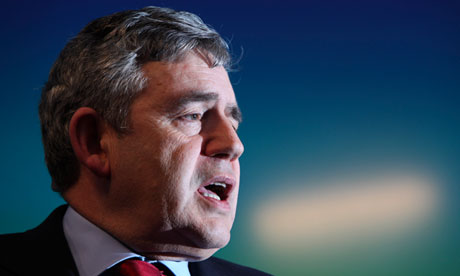
Gordon Brown, the UN's special education envoy, who is launching the report on child labour. Photograph: Bloomberg via Getty Images
The United Nations is to announce ambitious plans to eliminate child labour by 2020 after research revealed high growth in developing nations will not substantially reduce the number of children working worldwide.
Warning that "current trends are … of great concern" the UN says there will still be about 190 million child labourers in eight years' time – a drop of just 25 million on today's figures. Even worse is that in the poorest parts of the world, the UN says, the numbers will rise: child labourers in sub-Saharan Africa will jump by around 15 million over the next decade, reaching 65 million by 2020.
A UN report – to be launched on Monday morning by the UN's special envoy on education, the former Labour prime minister Gordon Brown – warns that unless the issue is tackled, the internationally agreed millennium development goal that all children should complete primary school by 2015 will not be achieved. Child labour, the UN says, "exacerbates the risk of being out of school. In India, non-attendance rates for child labourers are twice the level for children not involved in child labour."
The research says the "sheer scale of child labour is not widely recognised". About 60 million under-17-year-olds are involved in global agriculture. Mining, it says, is a "magnet" for child labour, with children as young as six digging shafts and scuttling around mounds of rock with little more than a hammer and chisel. Around half of the workforce in Afghanistan's brick kilns is aged under 14. In Ethiopia almost 60% of children work.
Multinational companies also come under fire. The report points out that in China, underage labour recruited by networks of agents from poor rural areas "has been found in factories supplying companies such as Apple, Samsung and Google".
It also chides industry for failing in the past to keep its side of the bargain in tackling the problem. US chocolate companies, the UN notes, had promised to educate all children in areas where it grew cocoa in west Africa – a commitment that would cost the industry $75m or 0.1% of annual sales. Instead it spent about $20m over eight years and reached just 4% of children in cocoa-growing communities in Ivory Coast and 30% in Ghana.
The UN says that the first step would be to make education compulsory for all children – and perhaps go as far as paying families to send their children to school, an approach that has worked in Brazil. This would mean that by 2015 an extra $13bn in funding would be needed.
Many children are forced to combine education and employment, and are consequently more likely to drop out, to complete fewer years in school and to achieve lower test scores. The UN warns that child labourers suffer a 17% achievement gap with non-working children in language and maths.
Despite a host of international treaties and domestic laws prohibiting child labour in poorer nations, authorities rarely have the will – or the money – to enforce them.
Brown told the Guardian that child labour was the "new slavery" for our age. "Efforts to combat child labour are failing in the face of inertia, indifference and an indefensible willingness on the part of too many governments, international agencies and aid donors to turn a blind eye," he writes in the foreword to the report.
The UN's roadmap takes its inspiration from how Victorian Britain first came to terms with – and then eradicated – child labour in the 19th century. The country began by offering education to child workers in the 1830s, then banned children from working in hazardous conditions a decade later. By the 1880s Britain was imposing heavy fines on industries for employing children.
The report's author, Kevin Watkins, a former UN official who now works at the respected Washington-based thinktank the Brookings Institution, said: "The conditions of millions of child labourers would shock even the most hardened Victorian social reformers. National governments and international agencies are failing these kids, and reneging on their commitments."
A powerful three-part Channel 4 series on sex slave trafficking promised more than it delivered. Its timing was excellent: the three-hour film was shown in the week the Guardian revealed the government's decision to opt out of the new EU directive on sex slave trafficking. Twenty years ago a Tory government opted out of EU directives protecting workers. Today David Cameron and Nick Clegg are opting out of a directive aimed at protecting teenagers and young women from being trafficked into the UK's burgeoning brothel and massage parlour industry.
With luck the C4 documentary should alert public opinion to this depressing aspect of globalisation and the new patriarchalism which obliges young women to "have sex with 10 to 15 men a day against their will" as one detective constable told the film-makers. Shot and edited with consummate skill with a breathy linking commentary read by Helen Mirren in the style of Laurence Olivier declaiming the World at War script, the programme eschewed analysis in favour of showing police work in close-up detail. Two small west country forces co-operated fully with C4. The officers came over as decent, good men with female officers on the margin to help arrest women pimps and their victims.
But a huge amount of police time and work, including a trip to Thailand for Devon and Cornwall officers, results in a meagre haul. Minor Chinese and Thai pimps get prison sentences of between 12 and 18 months. At the same time there were court cases against Albanian and Slovakian pimps which resulted in longer prison sentences and details of the most brutal cruelty against trafficked women. There is no shortage of cases in all major cities, though it is not clear why the Devon and Cornwall or Gloucestershire chief constables agreed to co-operate with C4 rather than the Met where more dramatic examples of trafficking abound. But the documentary noted that the Home Office is winding down the Pentameter operations against trafficking. Mirren concluded: "You will find brothels and victims in every English town. Those individuals who use these brothels should think about what they are doing and stop using these services."
Thanks, Helen. Actually it is British men – not genderless "individuals" – who insist on a right to put money down and insert their penises into women's bodies. Serving this demand has led to massive increase in the supply of prostituted women. There is a sterile debate over numbers which C4 sensibly ignored. Getting the figures is impossible. The United Nations' International Labour Organisation says there are 2.45 million women trafficked into sex slavery worldwide. The Red Cross and other global outfits also insist that millions of women are traded. The idea Britain has only a few is laughable, despite a report in the Guardian by Nick Davies claiming that sex slave trafficking was hugely exaggerated. ACPO produced a report recently which talked of 4,000 trafficked women but British NGOs who work with the victims of sex slave trafficking criticised the methodology of ACPO's work and said the figure was much higher.
An organisation called the English Collective of Prostitutes, which has spokespersons but no details of membership or finances, is always available for Newsnight or the Guardian to pooh-pooh the problem of trafficking into or within Britain. Its solution is to legalise prostitution. Where this has been tried as in Nevada, the death and injury rate of prostituted women rises and students at universities in the US state believe it is impossible to rape a prostituted woman.
The C4 film avoided this debate or any effort to examine the ideology of male oppression that lies behind the extraordinary growth in sex trafficking. Detectives held up adverts in the Southampton Echo placed by one of the pimps in which "fresh" bodies were on offer for the delight of Southampton men. There was no challenge to the newspaper editors who are complicit in the sex slave industry by carrying adverts for sexual services.
After one raid, a detective talks to a punter and politely asks him to stay in touch. But there is no arrest even though a brave group of Labour women ministers and MPs changed the law to make it a crime to pay for sex with a victim who has been coerced in any way into working as a prostitute. Another detective described how a trafficked woman's "customer insisted on putting bits of metal into his condom causing her injury". So why wasn't the man arrested and charged? The C4 policemen donned armour and dramatically crashed their way into brothels. But no British male was arrested.
It is only by dealing with the demand side that any real progress will be made in reducing the inflow of trafficked women. The low-life, high-income foreign pimps arrested in the film have thousands ready to replace them because trafficking women is hugely profitable.
One of the last acts of Tony Blair's government was to sign and ratify the Council of Europe's convention on trafficking which I campaigned for in the Commons. The Home Office originally fought the convention, as Whitehall is today trying to derail the EU directive. Later under Gordon Brown the law was changed to make men open to naming and shaming if they paid for sex with a woman who had been trafficked or coerced into working in the sex trade. It is up to the police to apply the law and to editors to stop being accomplices of sex slavery by publishing the industry's adverts. It would be good if the liberal male media establishment could rethink their denigration of campaigners against sex slave trafficking.
The C4 documentary deserves loads of prizes. It was compelling television. But we need analysis, policy and police work to squeeze the demand side.
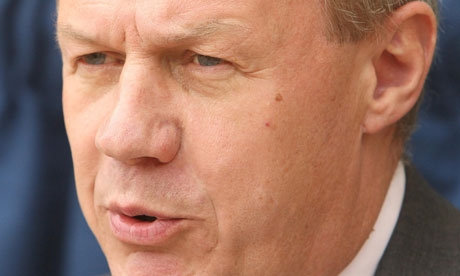
Damian Green, the immigration minister, said the arrests proved the value of close co-operation between the UK and France. Photograph: Dominic Lipinski/PA
French and British police say they have broken a human trafficking ring, arresting 26 people who were attempting to smuggle hundreds of migrants to the UK.
Scores of officers raided properties in Kent and France today in what is believed to be one of the biggest initiatives of its kind between forces from the two countries.
Damian Green, the immigration minister, said the arrests proved the value of close co-operation between the UK and France.
"Secure border controls are an absolute priority if we are to put an end to abuses of the system, and prevent people from coming to the UK through illegal routes," he said.
"That is why I am committed to working with my French counterpart to continue to improve security, and why we will continue with our successful summer operations against illegal immigration."
The French authorities said 18 suspected traffickers were arrested in France and eight more in Britain.
They are accused of smuggling hundreds of Albanians and Sri Lankans to the UK, charging between £1,500 and £4,000 a person.
Dozens of migrants were also detained during the operation, according to a statement from the French immigration ministry.
Last year France and the UK signed a deal aimed at tackling the growing number of migrants gathered at Calais. The agreement saw the UK allocate £15m to tighten British border controls and France promise to begin voluntary and forced repatriations.
The deal, agreed as Gordon Brown met Nicolas Sarkozy for a pre-G8 summit, was hailed as a breakthrough by the UK authorities who said it was the first time France had explicitly agreed to step up removal flights from northern France.
In September last year the French authorities closed down a makeshift camp in Calais known as "the jungle", which was home to hundreds of migrants, mostly Afghans. It signalled the start of a widespread crackdown by the French authorities that some campaign groups say has lead to the heavy-handed treatment of minority groups across the country.
The French authorities said today's arrests were part of an ongoing operation.
Green said: "This operation demonstrates how crucial it is that the UK Border Agency [UKBA], Serious Organised Crime Agency [Soca], the police, and French law enforcement work together to crack down on immigration crime, and put a stop to the trafficking that preys on the vulnerable and destroys lives."
The Home Office said the operation was co-ordinated by the Joint Intelligence Unit in Folkestone, which consists of the UKBA, Soca, Kent police, the French border police and the French anti-illegal immigration agency.