Tuesday, April 29, 2014
Indonesian Fishermen Stranded in South Africa After Horror Voyage
Tuesday, June 12, 2012
How we help modern slaves - Daily News | Lifestyle | IOL.co.za
June 5 2012 at 07:17am
By Noor-Jehan Yoro Badat
Related articles
Thursday, April 19, 2012
New Agreement to Fight Human Trafficking | Africa | English
Source: VOA
April 17, 2012
Joe DeCapua

Related Articles

Australia Faces Growing Human Trafficking Trend
Officials launch series of forums aimed at identifying traffickers and victims
Tuesday, February 28, 2012
Human trafficking prevalent in South Africa | The New Age Online
The recent kidnapping of a South African woman by her Pakistani husband’s family in Pakistan, and her subsequent rescue by Pakistani authorities and South African officials, has highlighted the problem of human trafficking.
While the issue of South African women marrying abusive foreigners and being cut off from the outside world is serious, there are other, more prevalent forms of human trafficking.
South Africa is used by human traffickers as a source, transit point and destination country for the trafficking of men, women and children.
While the trafficking of people into South Africa is a bigger problem than the trafficking of people outside of the country, there is also internal trafficking.
European, Asian, and African women are brought into the country for commercial sex exploitation, domestic servitude and service sector jobs, while South African women are moved around internally in the country for the same purposes.
Boys and young men from southern African countries including Mozambique, Zimbabwe and Malawi are trafficked into South Africa to be used as a form of cheap labour on farms, sometimes working months without being paid by the farmers.
The farmers are able to exploit the boys as many of them are illegal immigrants and the boys are unlikely to complain to the authorities, as the farmers may have them arrested and deported if they do.
The Human Sciences Research Council conducted a research on the issue on behalf of the South African government’s National Prosecuting Authority and identified a number of factors and patterns defining human trafficking in the country.
These included:
• South Africa is a destination county for long-distance flows for people (mainly women) trafficked from Thailand, Philippines, India, China, Bulgaria, Romania, Russia and the Ukraine. The main point of entry of this trafficking stream is OR Tambo airport in Johannesburg.
• People are trafficked from within Africa across the extensive land borders of South Africa, mostly from Mozambique and Zimbabwe, and to a lesser extent Malawi, Swaziland and Lesotho.
• The largest movement of trafficked people is from rural areas to cities.
• Trafficking of South Africans out of the country is less of a problem, but eight cases were identified between January 2004 and January 2008. Destination countries included Ireland, Zimbabwe, Israel, Switzerland, the Netherlands and Macau.
In all cases, the victims were women trafficked for either sexual exploitation, labour exploitation or forced marriages.
The perpetrators include large organised crime networks involving South African men with a former military background. Criminal drug, smuggling and weapons groups are mainly behind the trafficking.
Points of destination for victims of trafficking in South Africa are the major cities, where the greatest demand exists, and towns and cities close to national borders.
Some of the most disturbing factors are the collusion of border and immigration officials through bribery, and lax border controls, which enable illegal transportation.
melf@thenewage.co.za
Related articles
- EILEEN FISHER on Preventing Human Trafficking with SB657 and SA8000 (trafficking-monitor.blogspot.com)
- Ontario truckers asked to watch for human trafficking - Ottawa - CBC News (trafficking-monitor.blogspot.com)
- Human Trafficking a Growing Global Scourge - New America Media (trafficking-monitor.blogspot.com)
Saturday, February 25, 2012
Trafficking in Mozambique: 'Every minute was the worst' – The CNN Freedom Project: Ending Modern-Day Slavery - CNN.com Blogs
By Brent Swails, CNN
The mansion sits in the heart of Maputo, Mozambique. From the street it looks abandoned. Its walls are crumbling, the windows are broken and overgrown shrubs and trees hide the once grand entrance.
But inside there are signs that this place is still a home. The ceiling is black from cooking fires. In the bedrooms, mattresses line the floors and pages torn from magazines decorate the walls.
Local anti-trafficking activist Katie Magill often visits the mansion and other squatter housing in the city. She says its residents are at an age where they idolize the singers and actresses pictured on the pages. But they are much too young for the work they’re forced to do every night.
Many here say that Mozambique’s label of “the land of prawns and prostitutes” is well deserved. Prawns dominate trade by day, and at night, it’s Mozambique’s girls that are for sale.
Early last year police identified a network that trafficked up to 40 women and girls each month through Mozambique’s border with South Africa. They were allegedly being sold for $1,000 (US).
Inside Mozambique’s borders, buying girls for the trade can cost as little as $2 and the victims often know the perpetrators.
Ofelia says she was sold into prostitution at age 12. Four years ago, she escaped and found safety in Magill’s organization, Project Purpose. “I always had hope I could leave,” Ofelia said. “I feel good knowing that you can actually do it.”
Another former victim, Tachina, says she lost hope when she was trafficked for sex at the age of 15. “They’d do horrible things to you and then not give you money. Every minute was the worst. Only, when you’re in that situation, you can’t always see that,” she said.
The U.S. State Department’s annual trafficking in persons report notes an improvement in the Mozambique’s government’s efforts to end the trade. There have been several successful prosecutions since an anti-trafficking law was enacted in 2008. But enforcement remains difficult in this resource-strapped country.
A unit recently set up to deal with trafficking has only seven members charged with policing the entire country. Mozambique also lacks a national plan and a coordinating body. CNN requests for an interview with police went unanswered.
For now the fight against traffickers can’t do without people like Magill. Her organization rehabilitates young victims, many of them mothers, providing shelter for their children.
But she says it’s the ones she wasn’t able to bring to her safe house that continue to haunt her. “I cry now just thinking about the people who should have been in these buildings, the kids who should have a chance to live like that.”
Thursday, October 27, 2011
Kristin Lindsey: None of Us Are Free
Kristin Lindsey
Posted: 10/26/11 01:21 PM ETTwo weeks ago, an estimated 50,000 people gathered with the president and civil rights leaders to honor the new Martin Luther King Jr. Memorial on the National Mall. Dr. King's courage moved our nation to unite for racial equality and human dignity. He inspired countless others around the globe to demand freedom from oppression. Dr. King's return to the Mall is a reminder that we must keep fighting for justice. What was true in Dr. King's time remains true today: None of us are free until all of us are free.
Last weekend, I had the distinct honor of speaking at the third annual DC Stop Modern Slavery Walk, where thousands gathered on the Mall to raise awareness about human trafficking and lend their voices to those silenced by slavery. It is fitting that King's dedication led into this event, symbolizing a passing of the torch to the next generation of civil rights leaders and advocates.
Growing up, just after the 1960s, I feared that I had missed my chance to take part in the most important movement in our country. I now know that I have found my place -- and that all of us can step up and join a movement that matters. This year, I became CEO of The Global Fund for Children, which invests in innovative grassroots organizations that fight for millions of the world's most vulnerable children. They are vulnerable because they were born poor, or born in places where they were forced to work. Or to be soldiers. Born disabled, or born girls. Our work serves the larger dream that King envisioned. It is their potential that should matter, the content of their lives. Not their color, religion, gender or the circumstances of their birth.
Some of the most important work we do ensures that children are safe from trafficking and exploitation. We have the privilege of working with grassroots leaders in 72 countries whose work and dedication ensures that children can be free from slavery. These are some of the most courageous people I have ever known, working with children in circumstances many of us could never imagine or survive. They make sacrifices every day, putting their own safety at risk, to help others gain freedom and independence. To be rescued, rehabilitated, reunited with their communities and to be whole -- and children -- again.
Human trafficking is the third largest and fastest-growing criminal industry in the world. In fact, more people are enslaved today than at any other time. It affects over 1.2 million children and young people each year, of which 80 percent are under the age of twenty-four and some are as young as six.
In South Africa, I met girls as young as seven who were trafficked into Johannesburg. I've also met incredible grassroots leaders working in Johannesburg who ensure these rescued girls are sheltered, safe, counseled, educated, and never return to trafficking.
I am humbled by brilliant, brave leaders like James Kofi Annan with whom I shared the stage on Saturday. James established Challenging Heights in Ghana so that his experience as a child slave would not be repeated.
Whether in Guatemala, Serbia, India, Mongolia, Senegal or other places around the world, The Global Fund for Children finds and supports local NGO leaders, visionaries and slavery survivors who fight so that all of us can be free.
Before I give you the wrong impression, let me be clear. Slavery is not confined to remote parts of the world. It happens in our own country, even here in Washington, every day. There are workers in hotels and factories and farms of every sort who don't get paid and who aren't free to leave.
The partner groups involved in the DC Modern Slavery Walk have come together to spread the word that anyone and everyone can help put an end to human trafficking. There are various ways to get involved and make a difference. Whether it's by donating, partnering, interning, volunteering, or learning more about organizations that specialize in the cause, we must stand behind these courageous men and women who fight to end exploitation and trafficking in their communities. We have the ability to help them become seen and heard.
The torch has been passed to us. Putting an end to modern day slavery is our civil rights movement. Now it's our time to make a difference, and we must continue to work together to ensure that people everywhere are free.
Kristin Lindsey is the CEO of The Global Fund for Children in Washington, DC. For over twenty years she has worked with foundations, nonprofits and policymakers in Chicago, DC and various spots around the globe. The Global Fund for Children invests in innovative, community-based organizations working with some of the world's most vulnerable children and youth. To date, GFC has invested $21 million in over 500 grassroots organizations in 78 countries, serving over 1 million children.
Related articles
- TODAYonline | Commentary | A modern-day slavery problem on our hands (trafficking-monitor.blogspot.com)
- Integrated and sustained efforts are key in ending human trafficking (trafficking-monitor.blogspot.com)
- Global Anti-Slavery Action Map Advances Fight Against Human Trafficking - MarketWatch (trafficking-monitor.blogspot.com)
Wednesday, June 8, 2011
Nieman Reports | Visual Stories of Human Trafficking’s Victims
An Essay in Words and Photographs
By Melanie Hamman[Clicking on this link will take you to photos:}
Nieman Reports | Visual Stories of Human Trafficking’s Victims
Yet this is what I do, and so my journey brings me face to face with many victims of the global trafficking of human beings, most of whom are women, many still children. In most cases they are helpless to escape the horror of what their lives have become, though some do. In hearing their stories and, in some cases, following their journey of recovery, I have come to understand the interwoven layers of my responsibility—as a photographer, a journalist, and a human being.
The pursuit of any documentary photographer or photojournalist is to tell a story visually—so the image conveys the story without the necessity of words. To do this, I find ways to personify the issue, to bring an abstract subject into the realm of reality. Data about human trafficking, while horrifying to learn, can’t do justice to this story: Visual images—with the capacity to draw us in to another human being’s existence—have a vital role to play as powerful storytelling vehicles. Absent this personal connection, people remain detached.
The fine line between being a journalist and being someone who exploits a victim has become clear to me in my attempt to cover this story. During the past year, as I have met with women and young girls who were victims of domestic sex trafficking in South Africa and with social workers who work with victims who have escaped, I have more fully understood the human dimensions of this issue—and how it connects to our efforts to report on these lives. Merely by retelling her story, a victim can be retraumatized, severely complicating her recovery. For minors, the risk is even greater since the level of manipulation and trauma they’ve been exposed to often leaves them with severe psychological problems.
I experienced this with the first young woman I spoke to in South Africa who had been trafficked. She was 17 years old and had been entrapped in this circumstance for five years before she escaped and found refuge. Even after she was “safe,” she suffered from psychotic spells; the effects of her trauma meant that she could not recall with any certainty the timeline of her experiences. Soon after she related her story to me, I learned that she had relapsed into a mental health crisis. Additionally, questioning victims too early (or at all) can risk jeopardizing possible police investigations, which in South Africa are frustratingly more the exception in such cases than the rule.
As a photographer I often ask myself whether what I’m doing is in the victim’s best interest. I use visual images to tell a story; it’s how I communicate a person’s humanity, how I convey their pain and anguish or their hope for and pursuit of survival. I’ve come to accept that it is not always possible for me to remain emotionally detached, as much as I might feel this to be a journalist’s obligation.
When human trafficking surfaced as a story during the World Cup in South Africa, numerous reporters sought me out, and they asked me “Can you get me a victim?” The insensitivity of their request hit me hard, revealing the ugly side of journalism. Insensitive sensationalist reporting of human trafficking—conveying little beyond the hype of headlines based on hugely exaggerated speculation—has led to a media backlash. The surge of misinformed reporting during the World Cup resulted in small but unrealistic expectations that government or legal authorities would respond in some positive way and in the public’s belief that once the World Cup left the stage, so, too, would the issue of human trafficking. It was as if South Africans convinced themselves that something foreign arrived with the sports event—and would be gone when the games were over.
Yet the truth is that human trafficking, even though it hadn’t been covered by the news media, has been part of the migrant flow into South Africa for decades. Nor does it happen only to women who aren’t South African. And eradicating it will not take place in a vacuum.
Similarly, reporting about it needs to be embedded in the complexities of how this nation’s poor women and children are marginalized—and yes, trafficked—as they confront obstacles in acquiring an education and in being kept healthy and safe. It should surprise no one that human trafficking is happening in this country in which two-thirds of children live in poverty and sex crimes against women and children climb year after year, and yet these crimes remain among the least of the government’s priorities.
Through my photography I work to reveal the reality and horror of human trafficking. Yet in doing so I am acutely aware of the traumatic scars these experiences leave inside their victims. Being a journalist does not give me the right to invade their lives in ways that will reignite their pain. Photos and text by Melanie Hamman.
Melanie Hamman is a photographer whose work on child protection and trafficking was exhibited in late 2010 at Constitution Hill in Johannesburg, South Africa [PDF]. Her photographs also accompanied a story about human trafficking by E. Benjamin Skinner in Time magazine in early 2010. She has developed a website to which journalists can go for information about covering human trafficking: www.mediamonitoringafrica.org/cpt.
“Modern-Day Slavery: A Necessary Beat—With Different Challenges”
- E. Benjamin Skinner
Tuesday, May 3, 2011
Southern Times - Spotlight on human trafficking as SA cops swoop on syndicate
Johannesburg - The spotlight is back on the age-old problem of human trafficking as reports emerged that South African police are racing against time to save more than 100 young girls allegedly spirited away by a sex slave syndicate.
Police narrowly missed the syndicate of Nigerians and South Africans when they recently raided a farm outside Paulpietersburg in KwaZulu-Natal.
It is believed that a brothel has been operating on the farm since 2006 and that it has been used as a holding point for young girls and women trafficked into South Africa from SADC and Asian countries in transit to Europe.
Police, the National Intelligence Agency and other government security agencies carried out the raid.
As forensic experts from Pretoria seized potential evidence, Organized Crime Unit detectives questioned suspects in a bid to rescue the girls.
South Africa is a source, transit, and destination country for trafficked men, women, and children.
Girls are trafficked for commercial sexual exploitation and domestic servitude, while boys are trafficked internally for use in street vending, food services and agriculture.
Anecdotal evidence suggests that South African children are forced to provide unpaid labour for landowners in return for their family occupying land or accommodation, or maintaining labour tenancy rights.
Child sex tourism is also prevalent in a number of South Africa's cities.
South African women are trafficked trans-nationally to Ireland, the Middle East, and the United States for domestic servitude.
Women and girls from other African countries are trafficked to South Africa for commercial sexual exploitation, domestic servitude, and other jobs in the service sector.
They are occasionally trafficked onward to Europe for sexual exploitation.
Thai, Chinese, and Eastern European women are also trafficked to South Africa for debt-bonded commercial sexual exploitation.
Young men and boys from Mozambique, Zimbabwe, and Malawi are trafficked to South Africa for farm work, often laboring for months without pay before 'employers' have them arrested and deported as illegal immigrants.
Organized international criminal groups — including Nigerian, Chinese, and Eastern European syndicates — and local gangs facilitate trafficking into and within South Africa.
The South African government has been trying to comply with minimum international standards for the elimination of trafficking.
South Africa is placed on Tier 2 Watch List for a fourth consecutive year for its failure to show increasing efforts to address trafficking over the last year.
The government provided inadequate data on trafficking crimes investigated or prosecuted or on resulting convictions or sentences.
In addition, it did not provide information on its efforts to protect victims of trafficking and continued to deport and or prosecute suspected foreign victims without providing appropriate protective services.
Commenting on the KwaZulu-Natal case, provincial police spokesman Lieutenant-Colonel Vincent Mdunge said: 'We were very close. We almost had them, but somehow those behind this were tipped off that we were coming for them and disappeared with these young children. 'Our big fear now is what has happened to these children. We have evidence of serious harm being caused to them and the longer they remain away from safety, the greater the danger they face.'
He said they believed the syndicate trafficked girls from Mozambique, Swaziland and Zimbabwe.
'Once across the border the girls are apparently brought to the farm, which we believe is being used not only to house them, but also as a brothel.
'Intelligence we have gathered indicates that the girls are then trafficked either to other destinations in South Africa or on to European countries such as Holland.'
He said they were working with their SADC counterparts and Interpol to fight human trafficking.
Home Affairs Department inspectorate head Modiri Matthews said their role in such operations was varied.
'This includes looking at the victims of trafficking and how we can help them, such as repatriation to their home countries and providing whatever other assistance is needed, such as permits to stay in the country should a trial of their captors be underway.'
Southern Times - Spotlight on human trafficking as SA cops swoop on syndicate
Source: southerntimesafrica.com
Related articles
- Detailed Report and research about sex Trafficking, Sex Slavery, Prostitution, Human Trafficking (bebopper76.wordpress.com)
- Schuster Institute for Investigative Journalism: Britain's Long Fight Against Slavery (huffingtonpost.com)
- Abolition: On the Front Lines in South Africa With Darla Bardine (humantrafficking.change.org)
Monday, March 28, 2011
Human Trafficking as a Public Health Crisis Part 3: What One Person Can Accomplish | Health
I'm a writer at Justmeans in the Health category. I am also currently the Director of Biomedical Research and Development at Gallifrey Systems. I finished my PhD in experimental psychology in 1997 and have worked covering legislative initiatives, building statistical models and in technology development. I'm an expert in the areas of health behavior and health policy. I'm a huge proponent of c... Read More>>
What can one person accomplish? Dr. Paula Heron is a a postdoctoral fellow at the University of Kentucky. Born in Zimbabwe, she's lived most of her life in South Africa. Ten years ago, Ms. Heron came to the US to complete her Ph.D. in neuroscience and has remained here. She decided to combine her triathlon experience with a passionate stand against human trafficking. The following is a verbatim record of my interview with Dr. Heron. For her, it began with a movie...1.. What is Tri4Freedom and when did you start it?
2. What motivated you to take such an interest in human trafficking?
"Initially my own awareness about human trafficking stemmed from a movie about a young woman from an eastern European country who thought she was coming to the United States to pursue a dream job as a model but once she arrived she was forced into sex slavery. What struck me was the relative ease with which this travesty was committed by the trafficker and the finality of what had occurred from the victim's perspective. The excitement associated with arriving in a new country - something I can well relate to - is abruptly replaced with an indescribable fear. This I find terrifying and the realization that human slavery occurs within our communities and areas we deem safe to live, haunts me."3. How surprised are people to learn the extent of human trafficking, both in sheer numbers and global extent?
"I have found that the majority of people I speak to either have no idea what human trafficking is or they have heard of it but fail to recognize how prevalent it is in the United States. Most people see it as a third-world issue. People's responses have varied greatly when they hear that human trafficking occurs in their own cities. Some people prefer to continue ignoring the issue, while some are alarmed and take a genuine interest in what they can do to help the situation."4. It's literally an ancient crime. In terms of modern solutions, do you feel governments willfully ignore human trafficking or is it just so difficult to solve that it slips below the radar?
"Governments are certainly aware of the issue. Many states have anti- human trafficking laws; however law enforcement alone is not sufficient to combat the problem. The Not For Sale Campaign, a non-profit organization committed to the fight against human trafficking, maintains that abolishing slavery can only be achieved by creating a community task force. I think the fact that human trafficking occurs unnoticed to the general public has contributed to its escalation into the 32 billion dollar industry it is now. If people knew the extent of human trafficking it should prompt public outrage which would force governments into finding effective ways to combat it."5. How doe Tri4Freedom help the problem?
"As an individual deeply disturbed by the issue of human trafficking I created tri4freedom in an attempt to merge my passion for triathlon with my desire to see an end to human slavery. Firstly, Tri4freedom can raise substantial awareness about human trafficking within the triathlon community, including spectators of major races such as Ironman. Secondly, Tri4freedom aims to support The Not for Sale Campaign by raising funds and highlighting the efforts this organization is doing to combat the issue."
6. Why the link between triathlon and the cause?
"Triathlon by definition is comprised of three sports presenting a challenge that only the most dedicated and zealous individuals find appealing. Not surprisingly, demographics have indicated that the majority of triathletes are highly successful and educated professionals. For this reason I am hopeful that tri4freedom will spark enthusiasm from fellow triathletes who are entrepreneurs, lawyers, healthcare workers, teachers and community leaders. Collectively triathletes are in professional positions most likely to have an influential impact on finding effective solutions to combat human trafficking."
7. How much support are you receiving through the Tri4Freedom website? Domestically, internationally?"The support I have received so far has stemmed from letters I have written requesting sponsorship or from individuals that know me. The purpose of the website is to provide interested people with information and resources to help in the fight against slavery. As I promote my site more in the coming months I hope to achieve greater support from the general public and fellow triathletes."
8. Who are some of the "good actors" organizations that either partner w/Tri 4 Freedom or provide support in some way?"First and foremost the Not For Sale Campaign has demonstrated continuous support for Tri4freedom, which is raising funds for their Free2play initiative. In collaboration with this organization, we are working on promoting fair trade athletic apparel and increasing media awareness about Tri4freedom's contribution to their efforts in abolishing human slavery.
Local businesses have been very supportive. Most notably, Green's Toyota of Lexington has provided financial assistance to help promote the Tri4freedom event in June. This event would not have been possible without the support of SpindleTop Hall who kindly offered to host the event and help with local promotion. Ad-Venture Promotions, and In His Image Designs have also shown enthusiastic support for Tri4freedom. HFP racing has been very supportive in helping promote Tri4freedom at two of their race weekends this summer which will reach almost 1500 athletes. Newton Running has generously donated a free pair of their running shoes for me to wear during my 27 hour triathlon."9. What is this 27-hour event you are planning this summer?
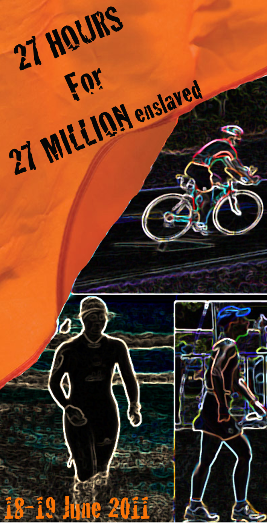
June 18th-19th I will do a solo triathlon lasting 27 hours, which I named "Free2tri" after Free2play, which is the sole recipient of all funds we raise. 27 hours has significance- 27 million people are currently enslaved around the world. The event will be hosted by Spindletop Hall and will begin at 6am starting with a 2.5 hour swim, followed by a bike ride until sunset and ending with an overnight run until 9am the following morning. In collaboration with Not For Sale and our sponsors, planning is underway to encourage public attendance and donation incentives. As the date approaches we will release updates on the website. The purpose of "Free2tri" is to showcase Tri4freedom in the hopes of gaining athlete support, to raise funds for the Not For Sale Campaign and most importantly to highlight the widespread travesty of human trafficking.10. How can individuals help draw attention to and combat the problem of human trafficking?Talk about it. Get angry. Acknowledge that human trafficking exists and accept the reality that an end to human trafficking is going to require a change in behavior. For example one way to help is by only purchasing fair trade products. This ensures that employee's lives are enhanced. The current reality is that fair trade is expensive because there is no overwhelming consumer demand to drive the price down. We need to demand that companies and their supply chains adhere to a slave-free workforce. The success of this approach has been demonstrated in the chocolate industry where a few companies have been pressured by the public to make their chocolate fair trade.
People could further this issue by being vigilant in identifying potential victims of human trafficking and contacting local authorities or dialing the National Human Trafficking hotline 1888-3737-888. There are numerous resources available on the web that describes human trafficking cases and how the public can help. I good place to start is http://www.notforsalecampaign.org and my site http://www.tri4freedom.comSource: justmeans.com
Human Trafficking as a Public Health Crisis Part 3: What One Person Can Accomplish | Health
Thursday, March 10, 2011
AFP: Asian human traffickers seek Mozambican route to S.Africa
By Johannes Myburgh (AFP) – 11 hours ago
MAPUTO — Kazi Jarangir Alam fled his native Bangladesh in a $11,000 (8,000-euro) journey over thousands of kilometres and climbed a border fence for a better life in South Africa only to be caught and sent back.
Like hundreds of other illegal immigrants, his journey ended in Mozambique, from where authorities say trafficking syndicates are smuggling Asians into South Africa, the continent's powerhouse and strongest economy.
Alam was flown into Mozambique's capital Maputo, and then quickly crossed into South Africa but was detained in Johannesburg when he asked for asylum.
Rather than send him back to Bangladesh, South Africa deported him to Mozambique, where he was held in a transit camp with hundreds of other migrants.
Mozambique this week repatriated the last of the 444 detainees from Bangladesh, Pakistan, India and China, more than a month after South Africa bussed them back over the border.
In a secret phone interview from the Massaca transit camp south of Maputo, Alam explained he left his country because "there are political problems."
"Bangladesh is a full country. I left for political reasons, others for business," the 28-year-old told AFP.
The head of his political party paid a syndicate for the journey to South Africa, he said.
Mozambican authorities say many syndicates could be involved in human trafficking.
"This is a direct manifestation of organised crime," Maputo province police spokesman Joao Machava told journalists during a recent tour of the camp.
"We think many syndicates are linked to it. This could be a cell," he said, as Bangladeshis in worn clothes collected rehydration tablets from the Red Cross.
"This is a new phenomenon. In past times it was not normal," said Machava.
Corrupt police and border officials facilitated the process, said Maputo city police spokesman Arnaldo Chefo, noting some officials have already been arrested.
During their detention in Mozambique, the haggard migrants were housed in rows of soiled tents in the dusty Massaca camp. Ten tried to escape across a nearby river, but were recaptured.
Among those deported these past weeks were 268 Bangladeshis, 124 Pakistanis, 11 Indians and 41 Chinese. Only 15 were women, all of them Chinese.
One of the world's poorest countries, Mozambique had to raise the funds to repatriate them. The Chinese embassy and the Muslim community in Maputo carried some food and repatriation costs, though other donors are unknown.
South Africa, the continent's richest country, is a magnet for African migrants, but a spate of arrests this year indicate a new wave from Asia.
In January, Mozambican police arrested 148 Bangladeshis in a raid around Maputo's airport. Later that month, a South African farmer discovered 96 Asians on his land just across the border.
In February six Indians and six Thais were found trying to enter neighbouring countries illegally through central and northern Mozambican towns.
Mozambican police worry those arrested are just a fraction of the migrants trying to get to South Africa.
"We have no doubt that this avalanche of people can create national instability," Chefo said.
Source: AFPAFP: Asian human traffickers seek Mozambican route to S.Africa
Related articles
- Law School Combats Human Trafficking in Haiti (conversationswiththelivingofficial.wordpress.com)