Business must do more to protect the world's most vulnerable workers | Guardian Sustainable Business | Guardian Professional
Governments and businesses need to take further action to prevent trafficking, forced labour and staff exploitation
John Morrison and Neill Wilkins
Guardian Professional, Friday 5 October 2012 09.23 EDT
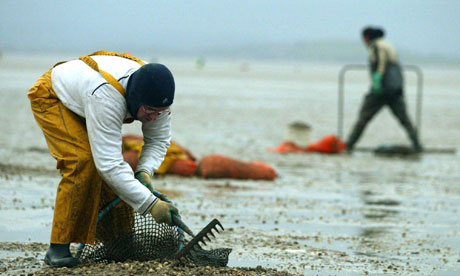
Cocklers on the sands of
Morecambe Bay, where 17 men and two women died while harvesting cockles. Photograph: Phil Noble/PA
At this week's Labour Party Conference in Manchester, Ed Miliband, the UK opposition leader, said the time had come to tackle abuses of worker rights. He pledged to "crack down on employers who don't pay the minimum wage" and to "end the shady practices, in the construction industry and elsewhere, of gangmasters" if he came to power.
These are welcome commitments and should be seen as non-partisan issues. Foreign minister William Hague has taken important steps to make the broader business and human rights agenda a permanent commitment of the UK Government. Yet these critical issues still don't receive the attention they deserve on the national agenda.
It is now over eight years since 23 Chinese workers drowned in Morecambe Bay while picking cockles, prompting many to look again at the underside of employment practices in the UK. The UK
Gangmasters Licensing Authority (GLA), founded shortly after the Morecambe Bay incident, mobilises a range of political, business, trade union and civil society interests. Together, they seek to protect some of the UK's most vulnerable workers, migrant and non-migrant, in horticulture, agriculture, shellfish gathering and forestry. Any employment agency, labour provider or gangmaster providing workers for these sectors in the UK needs a licence. The GLA, formed under the previous government, has been maintained by the current coalition government. However, there is still no equivalent for the construction sector – or for other sectors where workers remain highly vulnerable to exploitation.
There are issues, for example, in the hotel and catering sector – a point picked up by BBC Newsnight last week in two reports revealing the exploitation of agency staff at top London hotels. The Institute for
Human Rights and Business (IHRB), together with the
Anti-Slavery International, has called for greater protection for workers in this sector through the Staff Wanted Initiative and for hotels to undertake greater due diligence of all third parties through which they subcontract.
Before the London Olympics, the IHRB distributed leaflets to all 1,500 hotels in the Greater London Area providing practical advice for ensuring ethical and legal standards were maintained in the recruitment and employment of staff, including those supplied by agencies. Some action is being undertaken, such as that by the International Tourism Partnership and some major hotel chains, but the industry needs to take far more responsibility for the business model it operates, which leaves its reputation at risk and its workforce vulnerable to exploitation.
The Metropolitan Police, who are increasingly finding a crossover between labour exploitation and other forms of criminality, have endorsed the Staff Wanted Initiative. It now appears on the Police Knowledge Database used by all police forces in the UK. Early day motion 276 of the 2012/13 session of the UK parliament, which explicitly references the initiative, has so far attracted cross-party support, and there is interest from key government departments in the steps that can be taken to combat trafficking and forced labour.
In December 2012, the European Commission will launch its draft guidance to employment and recruitment agencies operating worldwide, and two other business sectors, on how best to implement the United Nations Guiding Principles on Business and Human Rights. It is important that all those who support the recruitment and employment industry, but also want to see better standards for ensuring that bottom feeders do not exploit workers, engage in this process. For example, they can comment on the draft guidance, the result of a multistakeholder process involving industry actors, civil society, UN agencies and other experts.
The UK is not immune to even the worst forms of human rights abuse, such as forced labour and trafficking. But often the greatest risks will lie elsewhere in the world, possibly in the supply chains of many companies or even within a government's own purchasing practices. Last week, President Obama announced a new US executive order strengthening protections in US public procurement in order to fight human trafficking worldwide – specifically related to cross-border recruitment activities. We must hope that we will soon see similar approaches in the UK: ensuring the way government uses its own purchasing power aligns fully with international human rights standards.
These are small steps, but perhaps encouraging signs. We also look forward to the UK government's implementation plan for the UN guiding principles on business and human rights as another sign that government, industry, trade unions and civil society will continue to work closely on ending exploitation and protecting the rights of all those engaged in helping to revive the UK economy. We also look forward to increasing attention to the global supply chains of both
UK-based companies and the British government itself.
Michael Connarty MP's private members bill – Transparency in Company Supply Chains (Eradication of Slavery) will have its second reading in the house of commons on Friday 19 October, during Anti-Slavery Week. This is a UK version of the California Transparency Act, requiring all companies over a certain size to report on their efforts to ensure a slavery-free supply chain. Significantly, unlike the American act, the British bill will include not just companies producing tangible goods but also those offering services such as hospitality. A commitment from the British government to find time for this legislation would be a welcome sign of their commitment to help root out exploitation and forced labour wherever it occurs. Or, as President Obama called it last week, this "debasement of our common humanity – the injustice, the outrage of human trafficking which must be called by its true name modern-day slavery".
John Morrison is executive director and Neill Wilkins is programme manager at the Institute for Business and Human Rights


