Showing posts with label International Day for the Remembrance of the Slave Trade and its Abolition. Show all posts

Friday, August 24, 2012

How to teach … slavery | Education | The Guardian

http://www.guardian.co.uk/education/2012/aug/20/how-to-teach-modern-slavery-resources

Source: The Guardian

This week sees the international day for the remembrance of the slave trade and the Guardian Teacher Network has resources to make children aware of contemporary slavery
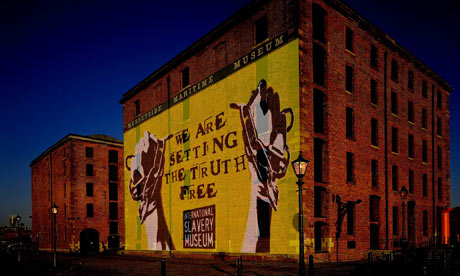

The International Slavery Museum, Liverpool, which has created a teachers' resource pack giving information about contemporary forms of slavery
More than 200 years after the abolition of the transatlantic slave trade, forms of slavery such as child labour remain prevalent around the world. To coincide with the international day for the remembrance of the slave trade on 23 August, the Guardian Teacher Network (teachers.guardian.co.uk) brings you a range of resources on slavery.
The British Library has developed a teaching pack for secondary schools that explores the principles behind the campaign to abolish the slave trade and the ways in which it was successful. The resource includes information about the history of the slave trade, historical sources from the campaign to abolish slavery, and activities that explore aspects of campaigning.
Slavery today is a resource from Amnesty that aims to raise awareness of modern forms of slavery, with a particular focus on trafficking. Suitable for use with 14- to 16-year-olds, students consider how traffickers use deception or coercion to take people away from their homes, and how victims are forced into situations of exploitation. The resource includes case studies of people affected by slavery and useful definitions of modern forms of slavery.
For upper primary and lower secondary pupils, the International Slavery Museum in Liverpool has created a contemporary slavery teachers' resource. The pack, produced in partnership with the Wilberforce Institute for the study of Slavery and Emancipation (WISE) and Unesco, includes information on contemporary forms of slavery and initiatives to outlaw and combat them, a set of lesson plans and supporting materials for use with 10- to 14-year-olds, and a glossary of key concepts to help students understand, think about and discuss contemporary slavery.
Ending Slavery: An Unfinished Business is a booklet created by theCitizenship Foundation and Church Mission Society that aims to inspire young people to take a stand against the continuation of slavery. The booklet includes information sheets on William Wilberforce and Olaudah Equiano, key players in the campaign to abolish the slave trade, along with ideas to develop students' understanding of pressure groups and the methods they use to influence decision makers.
Anti-Slavery International has produced an extensive range of teachingmaterials for both primary and secondary pupils. Child Slavery is an assembly for upper primary that focuses on the rights of the child in relation to child labour. For secondary pupils, the Universal Declaration of Human Rights is explored in the assembly Human Rights and Slavery. Other materials include: a slavery and human rights lesson plan, case studies and photographs about forced and bonded labour, and a quiz.
On the broader themes of justice and fairness, the Red Cross has produced a series of resources including Conflict lines, a lesson that focuses on international humanitarian law.
Join the Guardian Teacher Network community for free access to teaching resources and an opportunity to share your own. There are also thousands of teaching, leadership and support jobs on the site; visitGuardian jobs for schools.

Enhanced by Zemanta

Tuesday, September 27, 2011

Slavery Fund Exhausted — U.N. Calls for Donations | Political News and Opinion from a Multicultural Point of View

un seeks donation to anti slavery fund

A United Nations fund that aids victims of modern-day slavery is seriously depleted, and the world body issued an urgent plea for nations to donate to the U.N. Voluntary Fund on Contemporary Forms of Slavery.

According to the U.N. Office of the High Commissioner for Human Rights, donations have decreased sharply in recent years. This year the fund received a record 436 grant applications, totaling more than $6 million. However, the fund has less than $400,000 available.

“With the present funds, only 6 percent of the projects requested will receive support,” spokesperson Rupert Colville said in a statement.

The General Assembly established the fund 20 years ago to support human rights and humanitarian organizations that provide help to slavery victims. These organizations provide housing, food and medical care, psychological and social support and more to those freed from slavery.

Modern slavery commonly involves forced labor, debt bondage, human trafficking and child labor.

According to State Department figures reported in the New York Times, as many as 100,000 people are in bondage in the United States and about 27 million people worldwide. “These victims of human trafficking are vulnerable men, women or children coerced into servitude for sex or labor,” the Times stated. “They might be transported from Russia to Europe, from the Philippines to Dubai, or held in their hometown.”

Gulnara Shahinian, a U.N. expert on contemporary forms of slavery, said the fund has supported more than 400 projects and changed thousands of lives.

“I have visited projects funded through grants provided to local actors and seen the tangible results,” Shahinian said in a statement. “I have met survivors, heard their terrible stories and hopes and witnessed real change.”

Navi Pillay, the U.N.’s high commissioner for human rights, said slavery was widespread and eradication required a global focus on root causes, including poverty, exclusion, marginalization, racism and discrimination.

“The Voluntary Fund has helped thousands break free from slavery and recover their lives – not through expensive projects, but through small grants to grass-roots initiatives,” she said. Relatively small contributions of $10,000 can go a long way toward advancing the cause of eliminating slavery, Pillay added.

The urgent call for donations comes as the global community celebrates the International Year for People of African Descent, to recognize the estimated 200 million descendents of the trans-Atlantic slave trade.

August 23 marked the International Day for the Remembrance of the Slave Trade and its Abolition. According to some estimates, about 12.5 million Africans were transported to the Americas and the Caribbean for enslavement.

Author: Nigel Roberts
Nigel Roberts is the United Nations correspondent for Politic365. He has been a political, economic and international affairs reporter for more than a dozen years. Nigel also freelances in public relations and communications. He holds a master’s degree in Political Science/International Relations from the City University of New York Graduate School & University Center.

Source: politic365.com

Related articles
Enhanced by Zemanta

Sunday, August 28, 2011

Abuses in Ghana's fishing industry highlighted on anti-slavery day - The Irish Times - Tue, Aug 23, 2011

The Irish Times - Tuesday, August 23, 2011

LORNA SIGGINS, Western Correspondent

ON THE eve of the UN international anti-slavery day today, a Ghanaian campaigner who was sold as a child to work on fishing crews has appealed for Irish support for a project aimed at saving children from slavery.

James Kofi Annan, a former banker who is due to attend a Front Line international conference in Ireland next month, was just six years old when he was sold to work in fishing.

He escaped seven years later, put himself through education, went to college and secured a job in Barclays Bank. However, he subsequently quit his job to found Challenging Heights, an organisation dedicated to rescuing children like him.

Mr Annan has received a number of international awards for his work, which has resulted in 78 children being rescued from work in fishing so far. Children are rehabilitated and placed in foster homes if their families are unable or unwilling to take them back, he told The Irish Times.

“The situation is very complex,” he admits, as in his case his mother was “overjoyed” when he escaped but his father was not. He had been forced to work up to 17 hours a day, with little food and shelter and constant abuse.

“Children are used by fishing interests, on Lake Volta and other areas, because of their size. They can be forced to dive down to free trapped nets, and sometimes they don’t survive,” he says.

“The parents might have sold the child, or might be persuaded to hand him or her over as a form of child-rearing or for repayment of a debt.”

He founded Challenging Heights in 2003 to empower children through education. The campaign has devised peer programmes, which work with adults and children, to stress the merits of education and the risks of financial offers from slave-traffickers.

The charity requires funds and volunteers. Mr Annan says the Government can assist by raising the issue with the Ghanaian government. He has also received death threats due to his work.

“The Ghanaian government has supported work to eradicate child labour in the cocoa industry, but the problem with the fishing industry here is that the trade is not international – and so consumer agencies are not so interested in highlighting it,” he says.

Mr Annan is among some 100 invited participants at the Front Line Platform for Human Rights Defenders in Dublin on September 14th-16th.

The International Day for the Remembrance of the Slave Trade and its Abolition will be marked today by events worldwide. The date was selected by Unesco to mark the uprising of August 22nd and 23rd, 1791, on the island of Santo Domingo (today’s Haiti and the Dominican Republic).

Source: The Irish Times
Enhanced by Zemanta