Tuesday, March 25, 2014
Where does human trafficking happen? Right in front of you
Human trafficking has many faces and forms. There’s the pimp enslaving and exploiting young girls in cities across the United States – where an estimated 100,000 girls are trafficked at present. There are the men who buy young boys in Ghana, forcing them into lives of servitude and hard labour, spending long days in flimsy boats in the Lake Volta region, hunched over their fishing lines under a scorching sun.
Continue here:
http://www.trust.org/item/20140321194210-2mur5/?source=hpeditorial
Wednesday, September 7, 2011
Despite death threats, activists continue mission to bring kids better life – The CNN Freedom Project: Ending Modern-Day Slavery - CNN.com Blogs
[TRAFFICKING MONITOR: Click on headline to go to a video report]
September 6th, 2011
Emmanuel Otoo is a man with a simple message: Poverty is not a reason to sell children into slavery.
For many people, that's a pretty obvious sentiment. But if you come from Otoo's background, it's easy to see why he would say that. He's the Ghana Director for the non-profit group Free the Slaves, and it's his mission to make parents understand that selling their children isn't going to bring anyone a better life.
Otoo has a lot to be thankful for, and he mostly credits his mother for not making the choice that so many families around him in Ghana made when he was a child.
"We observe a lot of situations currently where out of poverty, out of need, out of desire to give their children the basic necessities, parents tend to traffic their children - give them out or sell them out," he told CNN. "So I compare this to our relationship with our mother that in spite of the difficult times, in spite of the lack, the need, and the want, she did not give us out. She could've done that, but she did not."
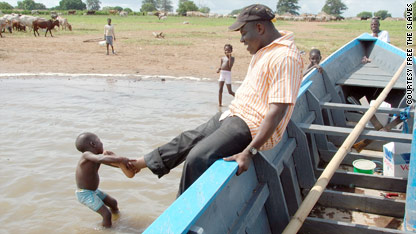
Otoo's mother kept the family together, and he went on to college, majoring in sociology and earning a master's degree in business administration. But instead of taking his education and moving away, Otoo stayed where he felt he was needed most - in the heart of some of the worst areas for trafficking in his country. One of the sites is Lake Volta, where he documents child slavery in the fishing industry.
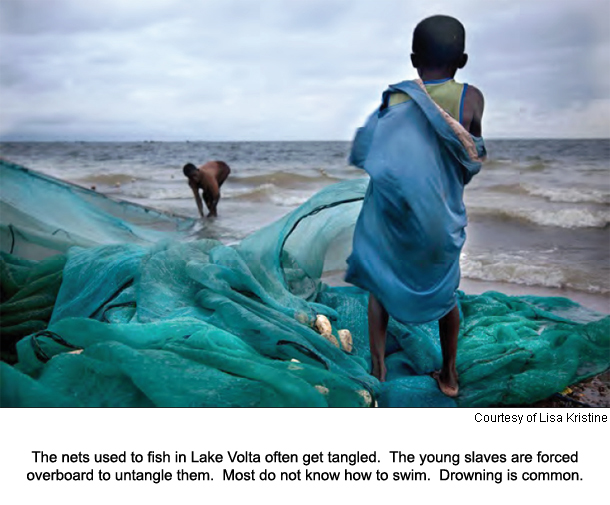
"Children are put on canoes, they work long hours. And to help you understand long hours - long hours is over 12 hours. Some work 16 hours," he said. "And they perform various forms of activities, from casting nets to dragging nets, emptying water in the boat, and diving deep into the water to disentangle nets. Children dive into the water and some of them do not return again. That is the last time some of them are seen."

Ghana Director Emmanuel Otoo at work on Lake Volta
It is dangerous work to fight a practice that can be very profitable for the traffickers. But the peril means nothing to Otoo, who is driven in part by his two young children.
“The danger is there, we receive death threats, people who don't like what we're doing. Others come up to you and actually warn you to stop doing what you're doing," he said. "But my motivation is the fact that I would've ended up as one of the people who was enslaved so if I am lucky to escape, I believe that I have a huge responsibility to contribute all that I can within me to make sure that this unacceptable practice ends.”
Otoo is one of several directors working in seven countries for Free the Slaves. The directors conduct research, provide education and bring together community groups from other non-profits, churches and schools. They're not just trying to free slaves - though that is their obvious goal - but they say making sure the community can make a change is the foundation for ending slavery.
"You meet families who are not rich families, don't have cars to drive in or other things, but they have their families back," said Otoo. "They have their children back, and they sit happily, chat, eat and give the children opportunity to play. And that is a success story for me."
Free the Slaves has headquarters just outside of Los Angeles and in Washington. They are one of hundreds of non-profit groups fighting human trafficking, and they bring these groups together every year for what co-founder Peggy Callahan calls "the largest anti-slavery gathering in the world." Their annual Freedom Awards honor people working to free slaves, handing out awards ranging from $10,000 to $50,000 for the recipient's organization
The group also documents anti-slavery work done around the world, to show others that the fight can be won.
| | Post by: CNN's Misty Showalter |
Source: The CNN Freedom Project - CNN.com Blogs
Related articles
- Abuses in Ghana's fishing industry highlighted on anti-slavery day - The Irish Times - Tue, Aug 23, 2011 (trafficking-monitor.blogspot.com)
- Brentwood teen, African child rescuer share message of hope - Inside Bay Area (trafficking-monitor.blogspot.com)
- Joshua Kors: Q&A With Lisa Kristine, Photographer of Slaves (huffingtonpost.com)
- Labour trafficking, not sex trafficking needs more attention - The Drum Opinion (Australian Broadcasting Corporation) (trafficking-monitor.blogspot.com)
- Human trafficking victims could be pouring through Wales' ports - Need to Read - News - WalesOnline (trafficking-monitor.blogspot.com)
- ATEST/CNN Forum on Human Trafficking on Vimeo (trafficking-monitor.blogspot.com)
Wednesday, August 31, 2011
Brentwood teen, African child rescuer share message of hope - Inside Bay Area
Contra Costa Times
It might take an outboard motor, a bucket of fish fingerlings or even 50-pound sack of salt.
It could take a day, several months or even years to convince a fisherman to release an enslaved child in Ghana, but 14-year-old Tyler Page of Brentwood is determined to do whatever it takes to make that happen.
The Heritage High freshman first learned of the Ghanaian children's plight four years ago while watching "The Oprah Winfrey Show." He went on, at 10 years old, to form a nonprofit to raise money to help end the human trafficking and exploitation, which continues despite Ghanaian legislation that has made it illegal.
Now, with the help of his mother, Laura, and a visiting African social worker, Eric Peasah, who first inspired him with his story on a TV talk show, Tyler is speaking to groups to raise awareness and making plans so he and a small entourage of friends can learn firsthand about the Ghanaian children's struggles.
"I thought it would be just one car wash and we would raise $50 and we would be done, but it just kept going," Tyler said of his first fundraiser to help the trafficked children. "It's the greatest job in the world to empower kids to try to impact someone's life, to try to do their best to help someone in the community."
The Pages and Peasah this week launched The Five Campaign, an effort to get as many as 1 million people to donate $5 monthly to help rescue and help sustain the untold number of children toiling away in the murky waters of the largest man-made lake in the world.
Laura Page called the donation "a small number with a big impact," noting it takes $4,300 to rescue, rehabilitate and reintegrate an enslaved child but only $240 a year to sustain a rescued child with enough for school tuition, supplies and medical care.
Peasah to date has rescued 651 Ghanaian children, some as young as 4, who were sold for as little as $20 to work as slaves in the fishing industry there. Some are sold because their parents cannot afford to feed them; others to pay for simple necessities such as a parent's coffin.
With small, nimble fingers ideal for untangling nets below the water, the children have been forced to work 12 to 16 hours a day, living in fear of an attack by crocodiles or electric eels, drowning in the chilly waters or being beaten by their masters.
Though others have rallied to raise money to free the enslaved children of Lake Volta, Peasah said he chose to visit Tyler, whom he has befriended, because his Kids Helping Kids nonprofit is unique. No one as young as Tyler has ever done what he's done to help the enslaved children, not to mention other disadvantaged children in his community and beyond, Peasah said.
"I'm really touched; he touched my heart," Peasah said of Tyler and his philanthropic efforts. "He's really reaching out to others and making his world a better place ... You want to come to give (Kids Helping Kids) new energy, to motivate them to go on."
The African social worker, who was wrapping up his fifth trip to Contra Costa County this week, spoke about the plight of the lake children at eight gatherings in 10 days from Brentwood to Walnut Creek, and to a group of doctors in Oakland, whom he hoped to convince to visit Ghana.
Tyler was only able to accompany him on one of those recent talks because of school and sports obligations. Heritage freshman football coach Doug Sanders, however, let him leave practice early last week to speak at an event with Peasah, because, he said, in his 17 years of coaching, he has never known a child who started his own nonprofit.
Although Tyler's mother, Laura, admits it is much harder now that her son is in high school, she said he still finds time to speak at public functions -- several engagements are lined up this fall in Washington, Los Angeles and Georgia -- and to help with Kids Helping Kids' fundraisers.
"It's definitely time-consuming but worth it in the end," Tyler said. "The fact that they only get one meal a day and are often beaten by their masters but keep on going and never lose hope -- if they can go that long without comfort, I can do something to raise money to help them."
Through carwashes, lemonade and root beer float stands, cookie sales and more, Kids Helping Kids has sent $50,000 to an intergovernmental organization that rescues child slaves in Ghana and raised another $100,000 for other children in need in the community.
Kids Helping Kids now sends its Ghana donations to Peasah's newly formed Right to Be Free nonprofit, which he says he formed to help all children in need, not just those who are enslaved.
"I want to reach out to more children who aren't being trafficked but still need help, like the son of the fisherman who was left behind but still works like a slave," he said.
Kids Helping Kids once sent more than 6,000 bags of candy to soldiers in Iraq and Afghanistan; has raised money for sick children and a local shelter; and founded a leadership academy that meets twice a month at REI in Brentwood.
"I never imagined it would grow so much," Laura Page said. "You just take one thing every day to make it move forward, and it seems to go."
Peasah called Tyler and his nonprofit a great example. "By the age of 10, Tyler can make a difference in someone's life ... My message to everyone is it's great to help the people of Ghana but also look into your own neighborhood for someone in need. If all of us make an attempt to reach out to others, it'll be a better world."
The Pages' next big challenge will be to raise money and collect enough donations for a planned two-week rescue mission to Ghana's Lake Volta during Tyler's spring break. While there, they will help negotiate the release of child workers, build a new playground, and bring soccer balls, toys and clothes to the children who eventually will be reunited with family members.
Though a rescue mission could be considered dangerous -- Peasah has been met with machetes before -- the African humanitarian says foreigners are welcomed with open arms.
He also says his organization does extensive research and outreach before venturing on a rescue, often meeting with members of a village for several months to identify the enslaved workers and masters and decide upon the correct approach.
To convince a fisherman, Peasah might offer an outboard motor to several men to share so they don't need the small children's help, or sacks of salt to preserve their catch or buckets of tilapia fingerlings as seeds for a fishery. After gaining their trust and having them sign a "social contract" not to enslave children, the nonprofit will continue to educate them about alternative livelihoods.
"My philosophy is to not just give them something but to teach them principles, how to manage their finances, business skills," he said.
For Tyler, who has long dreamed of visiting Ghana, the reasons to go on a mission are more simple.
"We're going to build a center of hope and do this fun stuff for the kids who are rescued so they know someone is watching over them," Tyler said. "My mom decided it was time to go. We need to expand our minds, see with our own eyes and love on the kids."
Reach Judith Prieve at 925-779-7178.
What: Kids Helping Kids, a Brentwood-based global fundraising nonprofit
Info: 925-759-4806 or www.kidzhelpingkids.com
SOURCE: www.insidebayarea.com
Related articles
- Abuses in Ghana's fishing industry highlighted on anti-slavery day - The Irish Times - Tue, Aug 23, 2011 (trafficking-monitor.blogspot.com)
- Joshua Kors: Q&A With Lisa Kristine, Photographer of Slaves (trafficking-monitor.blogspot.com)
Monday, August 29, 2011
Joshua Kors: Q&A With Lisa Kristine, Photographer of Slaves
Joshua Kors
Posted: 8/26/11 03:35 PM ETThe most pernicious lie still taught in elementary school is that slavery ended in 1865 with the ratification of the Thirteenth Amendment. The truth is more disturbing. Today, 146 years later, slavery is rampant, both in the U.S. and abroad. It lives in the dusty, pitch-black mine shafts of Ghana, where young men are sent to chip for gold, in the scorching brick kilns of India, where children spend endless hours lugging bricks, behind the hidden walls of San Francisco's massage parlors, where young girls are forced to perform sexual services.
According to the non-profit organization Free the Slaves, 27 million people are currently enslaved. Who are they? Lisa Kristine was determined to find out.
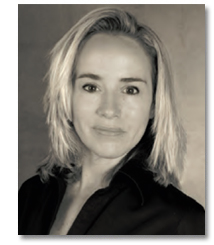
The acclaimed photographer spent a year traveling the world—from Ghana to India to Nepal—photographing slaves, recording their stories. Her new book, Slavery, presents those stories with hauntingly memorable images: the cracked, dried fingers of a young slave stricken with malaria, the glimmer in the eyes of an eight-year-old boy still hoping to be free.
Kristine spoke with me about the people she met, the cruelty she witnessed, and what every reader can do to help bring slavery to an end.
Kors: In your first two books, A Human Thread and This Moment, you photograph the vibrant, joyous colors of indigenous people: warriors dancing in Papua New Guinea, young men in Thailand splashing around in a lake with elephants. Now slavery.
Kristine: Quite a contrast, isn't it?
Kors: It is. What got you interested?
Kristine: Well, I was presenting my photos at the Peace Summit in Vancouver when I was introduced to one of the founders of Free the Slaves. He said there are 27 million slaves in the world right now. That freaked me out. I've been to a lot of countries, and I never saw slavery. Did I overlook it? Did I not realize what I was seeing? Twenty-seven million people. The whole thing lit a fire under me that I just couldn't get rid of. Finally I bought a ticket to Los Angeles, met with the organization's directors and told them I wanted to step up. I wanted to tell these people's stories.
Kors: Tell me a little about Free the Slaves?
Kristine: They're an amazing organization with partners in India, Nepal, Ghana. Their work is going in and freeing people. Sometimes you have people who don't even know they are slaves, people working 16, 17 hours a day in awful conditions with no pay. This has been their whole lives, working all day breaking rocks or dyeing silk. They have nothing to compare it to. The organization comes in, gets them lawyers and a set-up where they can profit from their own work.
Kors: This is not a life people choose.
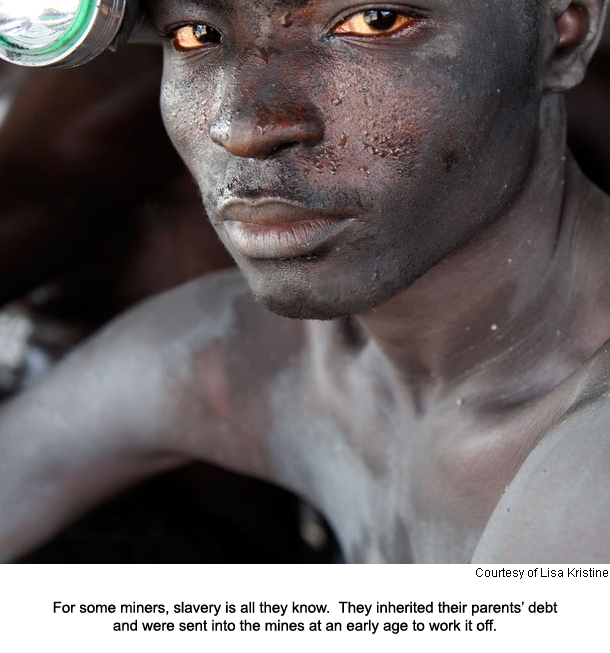
Kristine: Absolutely not. These are young men, boys, who are under threat of violence. They can't walk away. A lot of them are born into it based on their parents' debt. It's generation after generation.
Kors: Most people think slavery is over.
Kristine: (Kristine laughs.) I know. When people think of slavery, they think of an era from the distant past. Grainy photographs from Civil War times. And yet it goes on. The New York Times just did a chilling piece about sex slavery in Oakland. They reported that between 100,000 to 300,000 American children are sold into sex slavery every year. It's all around us. But people don't see it.
Kors: Maybe these photos can change that.
Kristine: I hope so. Because when people find out what's going on, their attitude changes. I've seen this issue light a fire under people the way it did with me.
Kors: You spent a year on this project.
Kristine: Yes, all 2010 in Nepal, Ghana, the brick kilns in India.
Kors: Tell me about those kilns.
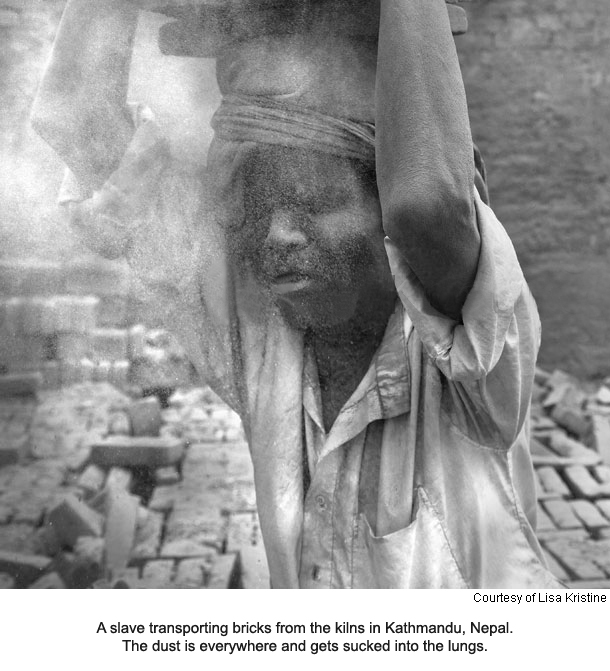
Kristine: Oh, it was like walking into Dante's inferno: 120, 130 degrees. So hot that my camera would cease to function, and I couldn't touch it because the metal would burn my hands. The slaves would take the bricks from the kiln, stack the bricks on their heads, then load them to the trucks to be carted away. Most of the slaves were women, young girls. They were covered in dust, and it was constantly getting into their lungs.
Kors: Didn't you want to reach out to those girls and say, "I'm taking you with me." Or at least, "Here's $20. Pay off your debt. Now you can be free."
Kristine: Of course there's that urge. But I was given very strict instructions not to give any money, that that is not the way to create change. Think about the women who are taken from their families and forced into the sex industry. A raid come and frees you. You're rescued. Well, you're still separated from your family. You're stained with the social shame of having been a sex slave, and you have no education. Nobody's going to hire you to do anything else. Women freed under those circumstances slip back into slavery very quickly. ... What's needed is to give these women an education and a sense that they are human, that they deserve better.
Kors: Looking at your photos, I kept thinking about the history textbooks I read in school and why those failed while your book succeeds. In the textbooks, slavery was an issue, an amorphous political problem. Your book is about real people—not an issue, but individuals. Like Kofi.
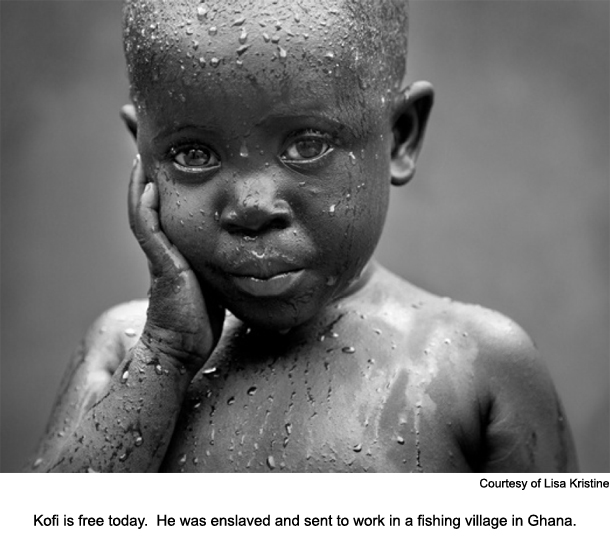
Kristine: Oh, Kofi. He's so cute, isn't he?
Kors: He is. Tell me about him.
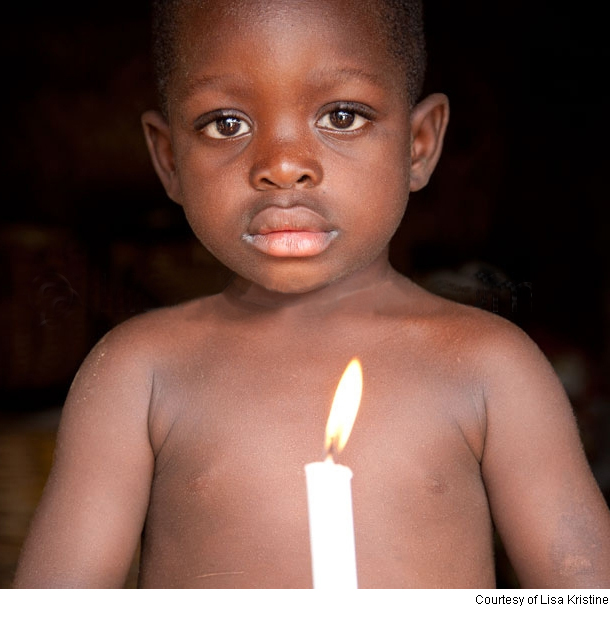
Kristine: A man had come to his family's home, told his parents, "We'd like to bring your son to a wonderful school, give him a great education." The broker takes the son, sells him to the slave owners at Lake Volta, then disappears. Lake Volta, in the Brong Ahafo region of Ghana, is the largest man-made lake in the world. Children are stolen from all over to work in the lake, heading out in boats, dragging back nets filled with fish that weigh over 1,000 pounds. The nets often get tangled, so the slave owners will throw the children overboard to untangle the nets. Few of the children know how to swim. Every child I met knew another slave who had drowned.
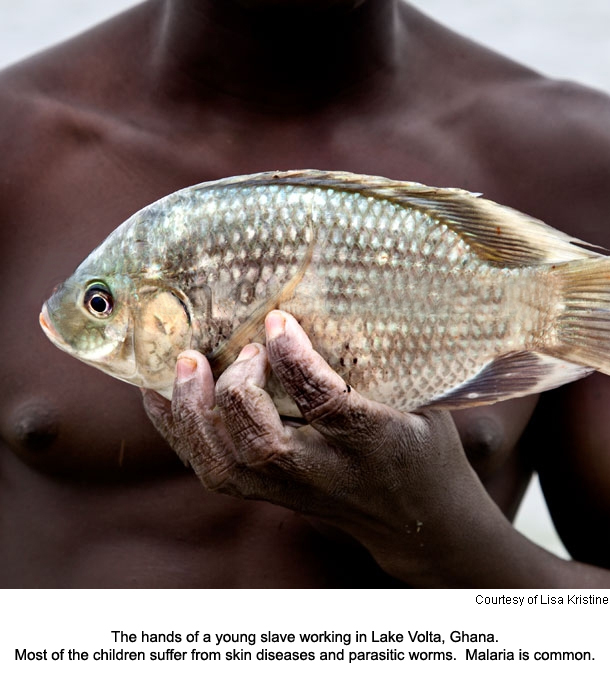
Kors: But Kofi is recovering.
Kristine: Yes, he was rescued by a partner of Free the Slaves. I met him at a shelter, and he spent a lot of time bouncing on my knee. He has now been reunited with his parents. I think he's going to be fine.
Kors: Abeiku is also free.
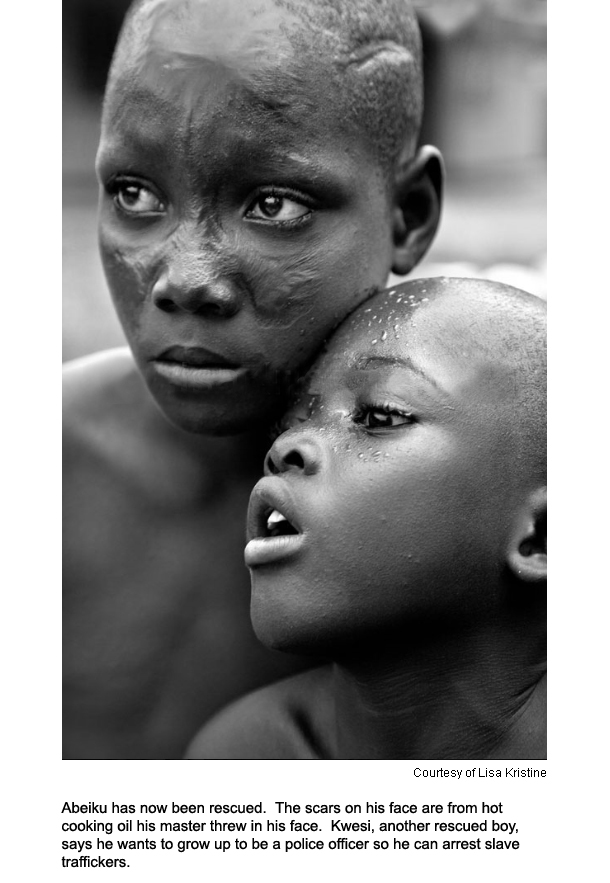
Kristine: Yes, though you can still see the scars on Abeiku's face. His owner threw hot cooking oil onto his face, punishment for speaking up. He had been beaten severely for many years before being rescued. For a long time at the shelter, he wouldn't talk. He had been raped. And at the shelter, they had to separate him from the other kids after he tried to be aggressively sexual.
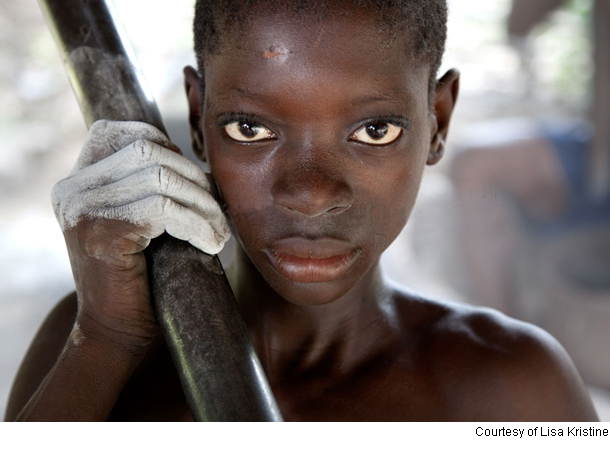
Kors: Most of the people in your photos are still enslaved. I think of that miner, looking into the camera, those sad, deadened eyes surrounded by darkness.
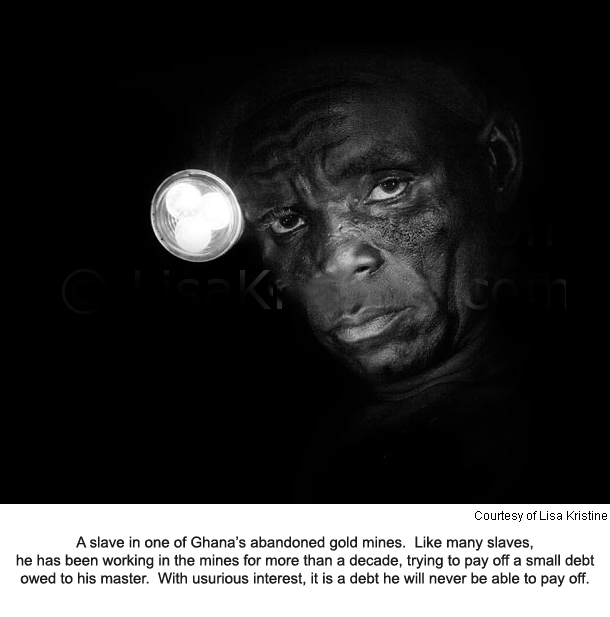
Kristine: I remember taking that photo. That miner, he was 44 years old. Been working down in the mine shaft for 15 years. When the gold rush occurred, people from all over Ghana came storming in, thinking this was their break. They were going to make it rich. Brokers come in and say, "I'll give you $70. You come work at my mine, and you can pay me back." The men sign their names, and now, with the massive interest, they have a debt they can never pay off.
Kors: These are illegal mines.
Kristine: Right. These are mines that have been shut down and abandoned. Most of the gold has already been extracted. And because they're illegal, if any of the miners get caught by police, they'll get arrested. ... Just photographing it was a dangerous operation. We got in a van, which headed into the jungle. Soon as we stepped out, the van disappeared. We cut a long, winding path through the jungle, wading through rivers that were waist-high, until we reached canyon with hundreds of slaves. There was a quarry with these mineshafts. I took my camera and crawled in. The shaft was three feet by three feet, extending hundreds of feet into the ground. It was pitch black, there's no oxygen pumped down there, and it is was hot. Some of the slaves stay down there for 24, 48, 72 hours at a time. And when they come up, they're holding a sack loaded with rocks, climbing the shaft's ladder, rung by rung, with one hand.
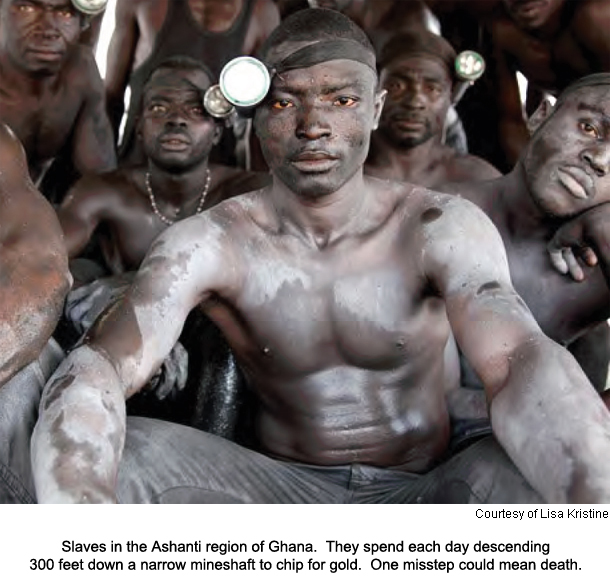
Kors: You must have been scared out of your mind.
Kristine: (Kristine exhales.) It's strange. I should have been but I wasn't. ... As I descended, I had one hand on my camera, the other on the rungs of the ladder. I could feel my hand slipping. And if you fall, you're dead. There are no safety mechanisms down there. It was dark and eerie, like descending into The Twilight Zone. ... I think part of my calm was the men I was with. Manuru especially. He has been in the mines for 10 years, since he was 9 years old. That's when his father died. His uncle then took him and headed to the mines. After a few years of mining, his uncle died of a lung disease, like a lot of the miners. Now it's just him.
Kors: Let me say something offensive that many readers might secretly be thinking. They're thinking, "Look, it's sad that slavery still exists. But the photos in her book are all from other countries. Most of the slaves are black. And a lot of the pics were taken in Africa, which is basically an unfixable disaster. I can't really do anything about it anyway. So I'm turning on Jersey Shore."
Kristine: Right. "It's them, not us. Who cares?" I think it's very easy to turn your head away from something troubling like this, to dismiss it and say, "These people are separate from us." But they're not. The stones in your driveway may have come from the slaves who spend all day breaking rocks because it's cheaper for the company to get them from India, where the labor is free. We are all connected. And we all have human value. That's what my work is about.
Kors: But do you think there's a racial component here? Jaycee Lee Dugard was essentially enslaved, and the public reaction was ferocious. The slavery of these people: virtual silence.
Kristine: I think everyone saw Jaycee as the girl next door. People freaked out thinking this had happened in the suburbs, in their own backyard. I don't know if they related to her because she was white.
Kors: Maybe not. I just wondered if you had thought about these racial issues, especially since your children were adopted from abroad.
Kristine: That's right. My son, who is five, was adopted from Ethiopia. My daughter was adopted from Guatemala. Her parents died of typhoid and malaria. We got her from an orphanage. They are the lights of my life.
Kors: When you met the boys in the gold mines of Ghana and the girls lugging stones in Nepal, did you think, this could have been my son. This could have been my daughter.
Kristine: I thought, this could have been anyone's son and anyone's daughter. Under different circumstances, this could have been me.
Kors: What makes your photos so amazing is the way you capture the eyes: the hope, the pain, the anger, sorrow and eventually, after years of captivity, a vacant, dead expression. Kevin Bales and Jolene Smith, co-founders of Free the Slaves, say it best in the intro to your book: "The eyes are the last part of a person to be devoured by slavery."
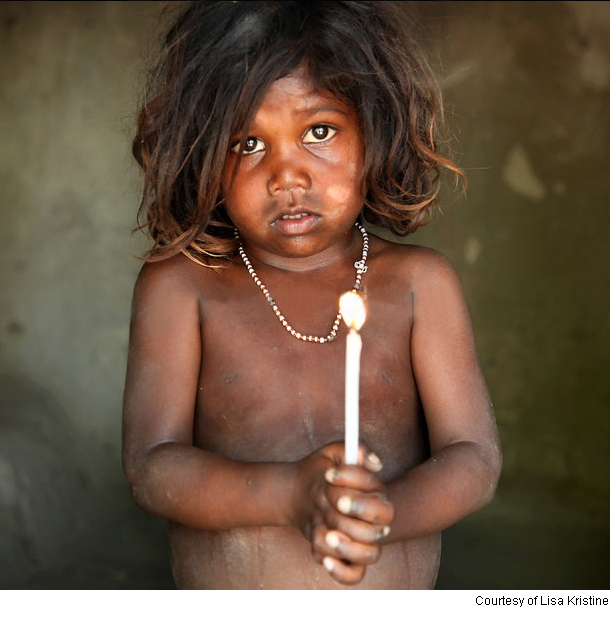
Kristine: It's true. After a few years, their eyes glaze over, and the light dims, as if their soul is turning off. From the eyes alone, you can almost tell how many years they've been enslaved.
Kors: I'm wondering if you saw the documentary War Photographer, a stunning film about acclaimed photojournalist James Nachtwey.
Kristine: I did see it. Nachtwey is one of my favorites.
Kors: Well, he says something in that film that really stayed with me. He says, "If war is an attempt to negate humanity, then photography can be perceived as the opposite of war."
Kristine: It can. Absolutely it can. Of course, it depends on who's holding the lens. I didn't come to Ghana to document horrors for their own sake. I came to show that these children still had dignity—and to put that on film.
Kors: Do you consider yourself a journalist?
Kristine: No, I don't. I see myself as a witness to humanity.
Kors: Have any of the slaves seen the photos?
Kristine: Not yet. I gathered some of the photos and will be sending them back in packages. But it's tricky. If these pictures fall into the wrong hands, there could be severe consequences. If a slave holder sees them, some of the children could be hurt.
Kors: I love that at the end of your book, there's an entire page devoted to easy ways readers can make a difference: in a minute, with a day, by devoting a week, or a lifetime. Because even readers horrified by these photos will say, "But what can I do?"
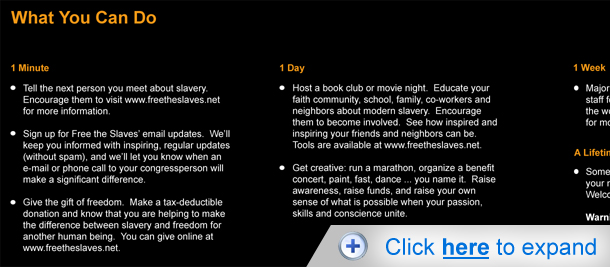
Kristine: And the truth is, we can make a difference. Each of us has a lot more power than we think.
Kors: I love the warning under the "Devoting a Lifetime" section: "Warning: your life may become filled with meaning."
Kristine: (Kristine laughs.) That's right. This is a book about hope. People will look into Kofi's eyes, see the water droplets on his forehead, the hint of a smile, and realize that after being liberated, there is a positive future waiting for him. This is a book about what's possible. ... But we can't just wish an awful thing away. We have to make it happen.
Source: The Huffington Post
Related articles
- Museum of London exhibition lifts the lid on modern day slavery in the capital | Culture24 (trafficking-monitor.blogspot.com)
- The modern day slaves GreaterKashmir.com (trafficking-monitor.blogspot.com)
- Forced labour, 'child sex tours': how slavery thrives in India | Firstpost (trafficking-monitor.blogspot.com)
Sunday, August 28, 2011
Abuses in Ghana's fishing industry highlighted on anti-slavery day - The Irish Times - Tue, Aug 23, 2011
LORNA SIGGINS, Western Correspondent
ON THE eve of the UN international anti-slavery day today, a Ghanaian campaigner who was sold as a child to work on fishing crews has appealed for Irish support for a project aimed at saving children from slavery.
James Kofi Annan, a former banker who is due to attend a Front Line international conference in Ireland next month, was just six years old when he was sold to work in fishing.
He escaped seven years later, put himself through education, went to college and secured a job in Barclays Bank. However, he subsequently quit his job to found Challenging Heights, an organisation dedicated to rescuing children like him.
Mr Annan has received a number of international awards for his work, which has resulted in 78 children being rescued from work in fishing so far. Children are rehabilitated and placed in foster homes if their families are unable or unwilling to take them back, he told The Irish Times.
“The situation is very complex,” he admits, as in his case his mother was “overjoyed” when he escaped but his father was not. He had been forced to work up to 17 hours a day, with little food and shelter and constant abuse.
“Children are used by fishing interests, on Lake Volta and other areas, because of their size. They can be forced to dive down to free trapped nets, and sometimes they don’t survive,” he says.
“The parents might have sold the child, or might be persuaded to hand him or her over as a form of child-rearing or for repayment of a debt.”
He founded Challenging Heights in 2003 to empower children through education. The campaign has devised peer programmes, which work with adults and children, to stress the merits of education and the risks of financial offers from slave-traffickers.
The charity requires funds and volunteers. Mr Annan says the Government can assist by raising the issue with the Ghanaian government. He has also received death threats due to his work.
“The Ghanaian government has supported work to eradicate child labour in the cocoa industry, but the problem with the fishing industry here is that the trade is not international – and so consumer agencies are not so interested in highlighting it,” he says.
Mr Annan is among some 100 invited participants at the Front Line Platform for Human Rights Defenders in Dublin on September 14th-16th.
The International Day for the Remembrance of the Slave Trade and its Abolition will be marked today by events worldwide. The date was selected by Unesco to mark the uprising of August 22nd and 23rd, 1791, on the island of Santo Domingo (today’s Haiti and the Dominican Republic).
Source: The Irish TimesRelated articles
- Museum of London exhibition lifts the lid on modern day slavery in the capital | Culture24 (trafficking-monitor.blogspot.com)
- AFP: Hong Kong professionals form anti-slavery club (trafficking-monitor.blogspot.com)
- Joshua Kors: Q&A With Lisa Kristine, Photographer of Slaves (huffingtonpost.com)
Wednesday, December 15, 2010
From servitude to safety in northern Ghana
At both locations, I met the 68 girls and boys who were rescued from the lake, and some from cocoa fields. It is amazing to see how children, all of whom were once traded for less than 20 American dollars in exchange for years of strenuous (and illegal) labor, can have the chance to pursue their dreams and live their lives fully.
TAL gives these children the love, safety, nourishment, education and family that they so desperately deserve and need. This is all immediately evident in the moment one arrives at the children's homes. Instantly, one is overwhelmed (and even physically knocked over) by hugs and smiles from these kids. I had the great fortune of spending a week with TAL, mainly in Kete Krachi, where I documented the medical exams conducted by nurse practitioner Brad Gautney, as well as the human trafficking on the lake. Being there and seeing these kids has changed my life forever.
From servitude to safety in northern Ghana
Monday, September 6, 2010
Helping Ghana’s Youngest Victims: Child Trafficking in Ghana
From: Government of Canada
Human trafficking is an international problem affecting millions of people and in Ghana, the internal trafficking of children is one of its biggest challenges. Many Ghanaian children are trafficked from their home villages to work in the fishing industry.
Living in tough conditions and working long hours every day, they are exploited by fishermen desperate to feed their families and eke out a living along the banks of Lake Volta. Child labour and even trafficking are deeply ingrained in the fishing industry in Ghana. Through conversations with child traffickers, it becomes clear that many of them simply do not realize that it is wrong for children to be away from their parents, missing school and performing dangerous physical work for long hours.
Enslavement Prevention Alliance West Africa (EPAWA) is an NGO at the forefront of combating human trafficking in all its forms in the West African sub region. With the support of the Canadian High Commission, EPAWA carried out a massive educational campaign in Ghanaian schools in an effort to make children aware of their rights and the dangers of trafficking.
EPAWA emphasizes the importance of teaching adults and youth alike that children should not be made to work like adults by building trust and winning the hearts and souls of parents and children. Reducing trafficking is a process that requires patience and commitment to youth, as much as it involves legal arguments.
As a result of their campaigns in schools, the organization is publishing a book that captures youth pespective – their stories, poems and drawing that capture this issue – that will be given to Ghanaian government officials to encourage their action. It will also be sold to raise money for future activities.
EPAWA is a regional anti-trafficking organization well-known for its campaigns and investigations into trafficking for sexual exploitation, and it was was directly responsible for helping to expose and dismantle a brothel involved trafficked Chinese women in Accra in 2009. You can follow EPAWA on Facebook and Twitter.
Helping Ghana’s Youngest Victims: Child Trafficking in Ghana
Related articles by Zemanta
- Truck Driver's 911 Call Stops Trafficking (humantrafficking.change.org)
- Human trafficking - four in court (bbc.co.uk)
- In West Africa, Sex Trafficking is a River (humantrafficking.change.org)
- Craigslist Shuts Down Adult Services. Will Change Be Permanent? (humantrafficking.change.org)
- When Victims Become Traffickers (humantrafficking.change.org)
- UN voluntary trust fund for trafficking victims urged (globalnation.inquirer.net)


View All Images 

This photo essay was selected by Photo Philanthropy as a finalist for their 2010 Activist Awards in the amateur category. To see all the award winners and finalists, go to www.PhotoPhilanthropy.org.