Showing posts with label Native women. Show all posts

Tuesday, April 17, 2012

Native Women and Sex Trafficking: An Overlooked Crisis - Working In These Times

http://inthesetimes.com/working/entry/13002/native_women_and_sex_trafficking/

Source: In These Times

TUESDAY APR 17, 2012 11:38 AM

BY R. M. ARRIETA
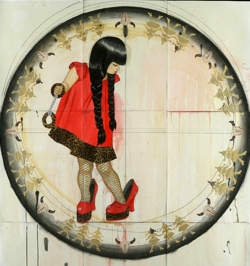

"Sundance in Red" is part of the Traded Moons exhibit at San Francisco's Galeria de la Raza. (Artwork by Geri Montano)
Many people have read or heard reports of the global crisis of sex trafficking and prostitution. But few are aware of how disproportionately Native American women and girls are impacted.
In San Francisco, native artist Geri Montano examines this critical overlooked issue in her exhibit, “Traded Moons,” which runs from April 14 to May 12 at the Galeria de la Raza gallery.
Montano told In These Times, “I acknowledge sex trafficking is a crisis overseas and in many cultures around the globe. It’s reached crisis proportions. But being of Native descent and rarely hearing about the sex trafficking which affects Native American women here in the U.S. and First Nations people..., I was moved to bring this to public attention.”
Montano addresses this ongoing crisis in her mixed medium work, which includes collages, sketches, drawings and images of indigenous women and girls, surrounded by symbols of native culture.
In “Sundance in Red,” a young girl with long black braids wears a red fur-lined dress and oversized red high heels, a pair of handcuffs dangle from one wrist. Paper doll cutouts surround the image. Another work, “7th Moon,” shows a young girl wearing her hair in traditional Hopi buns and necklace, in a garter belt, black stockings and red shoes. There are moon images around her. She stares out at the viewer.
Says Montano, “The forced removal of native children and the trauma of relocation and abuse correlates strongly to sex trafficking. There is a socio-political link. Traffickers target women and girls who are living in vulnerable conditions due to poverty, previous abuse, or during times of political upheaval.”
A bill introduced in October by U.S. Senate Indian Affairs Committee Chairman Daniel K. Akaka (D-Hawaii)—S.B. 1763, or the Stand Against Violence and Empower Native Women (SAVE Native Women) Act—would provide Indian Country with jurisdiction over non-Indians who commit crimes on Indian lands, improve the Native programs under the Violence Against Women Act (VAWA), and improve data gathering programs to better understand and respond to sex trafficking of Native women. It would also require the National Institute of Justice to include women in Alaska Native Villages and sex trafficking in its study of violence against Indian women.
Nicole Matthews, executive director of the Minnesota Indian Women’s Sexual Assault Coalition (MIWSAC) told Indian Country Today, “Native women are at exceptionally high risk for poverty and sexual violence, which are both elements in the trafficking of women.” Matthews co-authored "Garden of Truth," an October 2011 report on prostitution and trafficking of native women in Minnesota. Conducted by MIWSAC and the San Francisco-based Prostitution Research & Education, the study is based on interviews with more than 100 Native women.
("Garden of Truth" follows a 2009 report by MIWSAC, “Shattered Hearts” (PDF), which documented the commercial exploitation of native women and girls in Minnesota and was sparked by various reports from tribal advocates in South Dakota and Minnesota of indigenous females being trafficked over state lines and into Mexico as well as police rescuing native girls who had been lured off reservations and taken onto ships in port.)
A United Nations report released this month, “Global Report on Trafficking in Persons,” says 2.4 million people around the world are traded into slavery each year. Eighty percent, or 1.9 million, are victims of sex trafficking.
Yuri Fedotov, the head of the U.N. Office on Drugs and Crime, told a day-long General Assembly meeting on trafficking that 17 percent are trafficked to perform forced labor, including in homes and sweatshops. He said $32 billion is being earned annually by those who run human trafficking networks, and that two-thirds of victims are women. “At any one time, 2.4 million people suffer the misery of this humiliating and degrading crime,” Fedotov told the assembly.
Some of the traffickers pull women and girls from Native American reservations. In its "Shattered Hearts" report, MIWSAC says the historic experiences of native women in the United States make them “uniquely vulnerable to commercial sexual exploitation, and unique in the ways that such exploitation impacts their well-being.”
Melissa Farley, founder of Prostitution Research and Education, who co-authored the "Garden of Truth" report, and who spoke April 14 at a panel on Montano’s exhibit, told Indian Country Today, “It has rarely been included in discussions of sexual violence against Native women. The...women in this study did not choose prostitution. Instead, prostitution chose them, through a combination of harms perpetrated against them and a lack of escape options.”

Montano added, “Global sex trafficking has reached crisis proportions. ... Sex trafficking of Native American women ... is widespread.”
Related articles
Enhanced by Zemanta

Friday, December 30, 2011

Landmark child trafficking case catches advocates' eyes | CTV British Columbia

http://www.ctvbc.ctv.ca/servlet/an/local/CTVNews/20111223/bc_human_trafficking_reza_moazami_111223/20111223/?hub=BritishColumbiaHomea

CTV News Video
Lisa Rossinngton on human trafficking law


By: ctvbc.ca
Date: Friday Dec. 23, 2011 5:39 PM PT
Anti-human trafficking advocates say they're keeping a close watch on the case of a Vancouver man charged with pimping out four young girls.

Reza Moazami, 27, was released from custody Thursday night after two months in jail on 18 criminal counts including trafficking in underage persons, living on the avails of a juvenile, sexual interference and sexual exploitation.

The case marks the first time that the charge of trafficking in underage persons has been used in B.C. since it came into effect last year, and legal experts it signals a change in how prostitution cases are prosecuted.

"Police are no longer willing to look these cases as simply prostitution cases, which is historically how they have been dealt with and often dismissed by many people.... Now they're being recognized for what they are, which is serious allegations of child sex trafficking," UBC law professor Ben Perrin told CTV News after the charges were announced.

The trafficking charge carries a minimum sentence of five years in prison.
Advocates say that human trafficking can encompass crimes far beyond illegal trade in people.

"It's the exploitation, using people as property, as slaves, to some extent," said Rosalind Currie of the Office to Combat Trafficking in Persons.

She says human traffickers prey on the most vulnerable people in society.

"We believe aboriginal women and girls are often very vulnerable, runaways kids that are in trouble with the law.... We really need to protect them," she said.

The father of one of Moazami's alleged victims describes what happened to his daughter as abduction.

"They were lured into it. It's not like my daughter decided, ‘I want to be a prostitute.' It doesn't work that way. It was well planned," said the dad, whose identity is protected by law.

"She's a very, very confused kid. The damage is done."

Moazami is scheduled to make his next appearance in court in January.

With reports from CTV British Columbia's Mi-Jung Lee and Lisa Rossington


Related articles
Enhanced by Zemanta

Tuesday, November 1, 2011

Sex Trafficking of Native Women Report Jarring - Native News Network

Source: http://www.nativenewsnetwork.com/sex-trafficking-of-native-women-report-jarring.html

Levi Rickert, editor-in-chief in Native Briefs. Discussion »
"Garden of Truth: The Prostitution and Trafficking of Native Women in Minnesota"Prostitution and Trafficking
 
Native Brief: SAINT PAUL, MINNESOTA - The "Garden of Truth: The Prostitution and Trafficking of Native Women in Minnesota" report released this afternoon is the excellent research work of the Minnesota Indian Women's Sexual Assault Coalition and Prostitution Research & Education.

The report was released at a press conference at the William Mitchell College of Law in Saint Paul. US Senator Al Franken, D - Minnesota, commented to Native News Network Thursday morning. Senator Franken is a member of US Senate Committee on Indian Affairs.

"One-in-three American Indian women is raped or sexually assaulted in her lifetime.
Forty percent of American Indian women experience domestic violence.
And nearly one-in-five American Indian women is a victim of stalking.
These startling statistics underscore that the state of affairs is simply not acceptable,"


Stated Senator Franken.
"The Violence Against Women Act is up for reauthorization this year. And as a member of the Judiciary Committee and the Indian Affairs Committee, I am committed to making sure we update the law to more effectively address the needs of women in Indian Country." The Senator continued.

The "Garden of Truth: The Prostitution and Trafficking of Native Women in Minnesota" report is the first comprehensive study to detail the personal experiences of 105 Native women who have been prostituted and trafficked in the state, as well as the specific resources and support they need to escape prostitution and trafficking.

The report follows on earlier studies by Amnesty International and the US Justice Department which found that Native women experience the highest rates of sexual assault in the United States.

"Native women are at exceptionally high risk for poverty and sexual violence, which are both elements in the trafficking of women," says report co-author Nicole Matthews, Executive Director of the Minnesota Indian Women's Sexual Assault Coalition. "The specific needs of Native women are not being met. Our goal was to assess the life circumstances of Native women in prostitution in Minnesota, a group of women not previously studied in research such as this."

The report draws on both quantitative and qualitative surveys, with researchers spending approximately 1.5 hours with each woman interviewed and administering four questionnaires that asked about family history, experiences of sexual and physical violence, homelessness, symptoms of Post Traumatic Stress Disorder (PTSD) and dissociation, and their use of available services such as domestic violence shelters, homeless shelters, rape crisis centers, and substance abuse treatment. Researchers also asked about the extent to which women connected with their Native cultures and their personal experiences of racism.

Many of the women surveyed said they owed their survival to Native cultural practices, and most wanted access to Native healing approaches integrated with a range of mainstream services. Their most frequently stated needs were for housing, individual counseling, and job resources.

Several the findings contained within the report are disturbing and jarring:

  • 79 percent of the women had been sexually abused as children by an average of four perpetrators;
  • 92 percent had been raped;
  • 48 percent had been used by more than 200 sex buyers during their lifetimes;
  • 16 percent had been used by at least 900 sex buyers;
  • 84 percent had been physically assaulted in prostitution.

“In order for a woman to have the real choice to exit prostitution, a range of services must be offered,”

says Nicole Matthews. "However, there are very few services especially designed for Native women in prostitution."

The report calls for increased state and federal funding for transitional and long-term housing for Native women and others seeking to escape prostitution, along with funding for Native women's programs, including physical and mental health care, job training and placement, and legal services. It also urges state, local, and tribal officials to reexamine policies toward victims of prostitution and trafficking - for example, arresting and prosecuting sex buyers rather than victims of prostitution.

posted October 27, 2011 3:01 pm edt