Showing posts with label World Health Organization. Show all posts

Tuesday, October 11, 2011

Child labour: the tobacco industry's smoking gun | Global development | guardian.co.uk

Child labour: the tobacco industry's smoking gun | Global development | guardian.co.uk

In Malawi and beyond, child workers as young as five are being exposed to the toxic dangers of tobacco harvesting

Kristin Palitza
MDG : Malawi tobacco child labour story
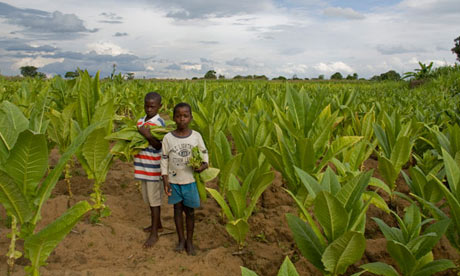
A tobacco farm in Malawi. Many of the country's estimated 80,000 child tobacco workers suffer from nicotine poisoning. Photograph: Kristin Palitza

At the height of the tobacco harvest season, Malawi's lush, flowing fields are filled with young children picking the big green-yellow leaves. Some can count their age on one hand.

One of them is five-year-old Olofala, who works every day with his parents in rural Kasungu, one of Malawi's key tobacco growing districts. When asked if he will go to school next year, he shrugs his shoulders.

One thing is clear to Olofala already: work comes first, education second. His sister, Ethel, 12, is only in year three. She attends school irregularly because she has to work, or because she is sick. "I cough," she says. "I have chest pains and headaches. Sometimes it feels like you don't have enough breath."

Such complaints are not uncommon. Many of Malawi's estimated 80,000 child tobacco workers suffer from a disease called green tobacco sickness, or nicotine poisoning. Symptoms include severe headaches, abdominal cramps, muscle weakness, breathing difficulties, diarrhoea and vomiting, high blood pressure and fluctuations in heart rate, according to the World Health Organisation.

Since the handling of the leaves is done largely without protective clothing, workers absorb up to 54 milligrams of dissolved nicotine daily through their skin, equal to the amount of 50 cigarettes, according to 2005 research by Prof Robert McKnight, of the College of Public Health at the University of Kentucky, Lexington. Farm owners routinely plead ignorance of the health implications. "I never heard about touching tobacco leaves being dangerous," says Fraston Mkwantha, who plants 15 hectares of tobacco in Kasungu district.

At the consumer end of the chain, smokers are constantly reminded of the associated health risks. Most are oblivious to the reality that, far from harming only themselves, their toxic habit is slowly killing the underage children involved in the production process.

Until the 1980s, much of the world's tobacco was grown in the US. Today, however, about 85% of worldwide production comes from the global south, where tobacco child labour is a major problem, according to a 2010 US Department of Labour report (pdf).

"In any developing country where tobacco is grown, you find child labour starting at the age of five," says Marty Otañez, a researcher at the University of California's tobacco control research and education centre.

Malawi, which has the highest number of child labourers in Africa, is a key offender. Health issues aside, children are also financially exploited. Olofala and Ethel often work 12-hour days, but neither earns a salary. They "help" their parents, who work on one of Kasungu's 22,000 registered tobacco farms and estates. Other kids receive an average of $0.25 for long hours of unrelenting work.

They are arguably the lucky ones; some never see their money at all. "We have many reports of children who were lured into labour with promises of good pay. But at the end of a season, all they get is an old sweater," says Grace Masanya, Malawi project manager for Plan, the international child rights NGO.

At the heart of the problem is Malawi's poor economic situation. Parents involve their children in economic activities to provide food for the family.

Over the past decade, the country has become one of the five largest tobacco producers in the world, largely due to low tariffs on unmanufactured tobacco imports, cheap labour and lack of regulations. According to the UN's statistical division, more than 98% of Malawi's low-cost leaf is exported, with the EU and the US top destinations.

And more than 90% of Malawi's tobacco is bought by two US-based leaf buyers, Universal Corporation and Alliance One International, which resell it to international tobacco firms. Their main clients are two of the world's biggest cigarette manufacturers, Philip Morris (Marlboro) and British American Tobacco (Lucky Strike). Consequently, Malawi's tobacco is found in the blend of almost every cigarette smoked in the west.

Child labour rights

The country is a signatory to the UN and International Labour Organisation (ILO) child labour conventions, and also has its own legislative framework barring the employment of children under 14. So why does the government turn a blind eye? The answer is simple: Malawi's economy is heavily dependent on tobacco, which makes up 70% of its export earnings, according to the UN Food and Agriculture Organisation.

"Some estates follow anti-child labour regulations, but others purposefully flaunt the law in the interest of higher profits," says Plan Malawi advisor MacDonald Mumba. Over the past two years, only 49 farm owners have been prosecuted in Malawi, he says. Most received a $34 fine.

Gaps and inconsistencies in Malawi's legislative framework contribute to the problems of child labour, according to the ILO.

"The legal framework is very weak," confirms Unicef child protection programme officer Tomoko Horii, who believes promises to eliminate child labour amount to little more than window dressing presented in response to mounting international pressure. The laws lack specific targets to reduce child labour and, most importantly, an appropriate budget. "The budget allocation is minimal. So far all projects have to be financed by international NGOs," says Horii.

Her sentiments are echoed by Khalid Hassan, the ILO's child labour adviser in Malawi. "Ratifying conventions and passing laws doesn't solve the problem," says Hassan. "You need money, commitment, cost-effective programmes, infrastructure and hard work."

The tobacco giants, who all have anti-child labour policies in place, insist they abide by the rules. British American Tobacco (BAT) says on its website that it does "not employ children in any of our operations worldwide", but admits that using intermediaries to purchase tobacco makes it difficult to trace the country from which they buy the leaf and ensure all farm owners follow the rules.

That is bad news for countries such as Malawi, where the education system is feeble and only a third of children complete primary school. "Unless the education sector scales up to offer quality education to all children, they will continue to work," says Horii.

Tobacco growing is extraordinarily lucrative for the industry. Financial reports for 2008 by the five big tobacco companies - BAT, Philip Morris, China National Tobacco Company, Imperial Tobacco and Japan Tobacco - show that they collectively earned $300bn. This is more money than the GDP of all but 40 countries worldwide.

Part of the reason for those huge profits is that tobacco giants benefit from $1.2bn in unpaid child labour costs, according to Otañez's colleague Prof Stanton Glantz. Replacing child labour with adults paid the minimum wage would increase the production costs by $10m per year in Malawi alone, he says.

For Glantz, the solution is simple: "If major tobacco companies were genuinely committed to improving the socio-economic conditions of child workers, they should rectify harmful business practices by enforcing a policy that they will not purchase any tobacco grown using child labour."

The tobacco giants disagree. "Simply stopping altogether our purchases of tobacco from Malawi will do nothing to alleviate the serious issue of child labour in this country," says Anne Edwards, director of external communications for Philip Morris.

While this standoff continues, the people of Malawi benefit little from their "green gold". Malawi remains one of the least developed nations in the world, ranking 153 out of 169 countries on the 2010 Human Development Index. About 40% of the 13.2 million Malawians live below the poverty line of $1.25 a day.

• Kristin Palitza is a freelance journalist based in Cape Town, South Africa. The research for this article was financially supported by the Fund for Investigative Journalism in Washington DC.

Related articles
Enhanced by Zemanta

Sunday, March 27, 2011

Human Trafficking as a Public Health Crisis: Part 2 | Health

Mar 23, 2011 9:24 PM CDT

I'm a writer at Justmeans in the Health category. I am also currently the Director of Biomedical Research and Development at Gallifrey Systems. I finished my PhD in experimental psychology in 1997 and have worked covering legislative initiatives, building statistical models and in technology development. I'm an expert in the areas of health behavior and health policy. I'm a huge proponent of c... Read More


This is the second part of a three-part series focusing on human trafficking from a public health perspective.

Malaria affects over six million people per year. Worldwide, more than two million individuals are infected with tuberculosis. Each year, there are about two - three million new people who are newly infected with HIV. Each disease is considered a public health problem and is preventable. The World Health Organization estimates that up to four million people are direct victims (captives) or indirect victims (for example, affected by disease or family member loss) of human trafficking. If 16,000 US citizens died from an epidemic, there might reasonably be national outrage. However, 14,500 - 17,500 individuals, including children, are estimated to be illegally brought into the United States per year for the purposes forced labor, among other crimes. It is even more difficult to estimate how many people once within US borders are moved between states and communities without leaving the country. Worldwide, hundreds of thousands of men, women and children are direct victims.

The standard governmental model for handling criminal behavior includes punishment for offenders, protection for victims and despite best intentions, preventive measures come last. Human trafficking is a complex social and economic problem, much like the war on drugs. Similarly, it cannot be stopped by single, law-enforcement focused approach. Criminal law tends to address events after they have occurred rather than through encouraging attitudinal and behavioral change. To abate human trafficking, it might be time to change tactics to put a premium on prevention.

Even if one does not view human trafficking as a public health problem, there are aspects of the model that fit well in this fight. Public health is a unique field among the health professions. There is a focus on populations rather than individuals and prevention rather than cure. It is a scientific, evidence-based endeavor with a firm link to government and politics. Additionally, outcomes of violence prevention initiatives benefit from a public health model, so it seems reasonable to extend this methodology to human trafficking.

Following the model proposed by the Center for Disease Control for preventing violence, there are four steps that must be fulfilled. The root cause of trafficking must be understood. This means a scientific analysis that evaluates individual risk factors, social relationships that increase personal risk, the role of the local environment and community and finally sociocultural standards.

Public health campaigns must bring the problem to a level of social consciousness. According to the report "U.S. Awareness of Human Trafficking: Executive Summary of Survey Findings", most Americans are quite unaware that the United States is affected. Individuals, communities and non-governmental organizations can, if motivated, provide government officials with feedback about what efforts work well for the local population, what resources are necessary and generally guide lawmakers on how government can effectively intervene rather than government blindly and unwisely throwing resources at the problem.

Finally, at the level of personal responsibility, each person should be able to see how even small actions can help ameliorate the issue of human trafficking. Just in the same way that people learn how diligent hand-washing and how to properly "cover and cough" can help prevent the spread of colds and the flu, small efforts can make a difference. The next posting in this series examines one person's efforts to raise awareness about the problem of human trafficking and how to combat it.

Image courtesy of Antonu

Source: .justmeans.com
Human Trafficking as a Public Health Crisis: Part 2 | Health
Enhanced by Zemanta

Tuesday, March 22, 2011

Human Trafficking as a Public Health Crisis | Health

Mar 21, 2011 10:04 PM CDT

'm a writer at Justmeans in the Health category. I am also currently the Director of Biomedical Research and Development at Gallifrey Systems. I finished my PhD in experimental psychology in 1997 and have worked covering legislative initiatives, building statistical models and in technology development. I'm an expert in the areas of health behavior and health policy. I believe that ideal economic and social policy is public health policy. I'm a huge proponent of commuting and public transportation. I don't own a car, but ride a bicycle almost every day. It's a lifestyle, and I love it! When I'm not doing this, I'm competing in triathlons and playing with my Australian Shepherd, Marley.

Jonathan Todres, Associate Professor of Law at Georgia State University, has a unique perspective on human trafficking. Whether this complex crime is a public health problem or not, Todres views it as a treatable disease using the public health model of prevention first. His paper, Moving Upstream: The Merits of a Public Health Law Approach to Human Trafficking presents the argument that governments could attack the problem of human trafficking similarly to health hazards such as smoking, community violence and highway fatalities. While such a preventive, public health approach is insufficient by itself, this represents a method uniquely different from standard criminal law model currently in place in many countries. This is the first of a three-part series on the health consequences of human trafficking, along with government and non-governmental efforts to prevent the problem.

Forced labor. Sexual exploitation and forced prostitution. Debt bondage. Anything that constitutes the unlawful motion of men, women and children into slavery-like practices and conditions can constitute human trafficking. It is a global phenomenon, including within the United States, but does occur more frequently in underdeveloped countries and states where human rights are not as protected. The Institute of Medicine defines health as a complete state of physical, mental and social well-being, and human trafficking clearly does not mesh with that vision. Aside from gross repugnance, what are some of the public health concerns such a violation raises?

Individuals in forced labor situations often are channeled into poorly-regulated work environments. Agriculture, mining, manufacturing and construction industries using such workers may be overcrowded, have improper indoor environments, present harm to workers by exposure to toxic and carcinogenic materials and be generally unsanitary. These conditions are precisely what allow for the development and spread of diseases such as malaria, tuberculosis, and cholera depending on the location. This clearly constitutes an environmental health problem.

Sexually-transmitted diseases (STDs) are a recognized public health problem. Not surprisingly, individuals involuntarily made participants in involved in exploitative work environments are at greater risk of contracting and spreading HIV and other STDs. This can occur within local populations, but can spread across international borders as humans are transported from one area to another.

Finally, the World Health Organization provides data showing that human trafficking has a specific population-based effect with prevalence considerably greater than other diseases, even in industrialized countries. Infectious diseases and diseases more specific to sanitation such as cholera that are more prevalent in underdeveloped countries are of minimal concern in the United States. For example, less than 5000 cases of tuberculosis were reported in the United States in 2007. In contrast, approximately 15,500 individuals are estimated to have been smuggled into the United States in 2007. From an epidemiological perspective, this constitutes a public health crisis.

The victims of human trafficking directly suffer illness, injury, violence, and mental disorders such as post-traumatic stress syndrome as result of the conditions in which they are forced to work and live. Combined with risks inherent even in transporting smuggled humans across borders, and one sees a total condition in which not only are victims directly harmed, but populations in proximity - even if uninvolved - are placed at risk as well.

His paper, Moving Upstream: The Merits of a Public Health Law Approach to Human Trafficking can be downloaded free of charge from The Social Science Research Network Electronic Paper Collection at http://ssrn.com/abstract=1742953.

Image courtesy of Antonu

Source: justmeans.com
Human Trafficking as a Public Health Crisis | Health
Enhanced by Zemanta