Showing posts with label Malawi. Show all posts

Monday, November 28, 2016

Malawian housemaid wins U.S. human trafficking case after ...

"A Malawian woman trafficked to the United States by a diplomat, confined to a house for three years and forced to work long hours for little pay has been awarded $1 million in damages in a human trafficking lawsuit against her former employer."

Read MORE

Malawian housemaid wins U.S. human trafficking case after ...:

(Reporting by Zoe Tabary, additional reporting by Sebastien Malo, editing by Ros Russell. Please credit the Thomson Reuters Foundation, the charitable arm of Thomson Reuters, that covers humanitarian news, women's rights, trafficking, property rights and climate change. Visit http://news.trust.org)

    Sunday, June 17, 2012

    Southern Times-Trading in Souls

    http://www.southerntimesafrica.com/news_article.php?id=7183&title=Trading+in+Souls

    Source: SOUTHERN TIMES

    By Charles Mkula Published: 20120615


    Experts have said that despite the lack of comprehensive statistics on human trafficking in Malawi, the Southern African nation is facing an alarming increase in such cases, especially involving women and girls who are exploited as sex workers in brothels, bars and restaurants.

    Nkhata Bay District ‑ the northern lakeshore tourist destination ‑ is reported to be one of the worst affected areas in the country.

    Many victims end up in South Africa, Europe and the United States of America.

    According to Nkhata Bay District Police Sub-Inspector Brown Ngalu, apart from the trafficking of people from the area, Nkhata Bay is also a conduit for international human trafficking and people smuggling.

    Ngalu has said the police have in the recent past intercepted illegal moving of humans from the DRC, Somalia, Ethiopia and Sudan through Lake Malawi, Africa’s third largest lake.

    Malawi Human Rights Commissioner Grace Malera acknowledges that the problem of human trafficking is not clearly understood by people because of the difficulties in verifying cases “since the practice is veiled and because of the ignorance about the conduct among law enforcers and the communities”.

    She observes that 500 to 1 500 adults are trafficked; while 400 women and 50 children are taken from their homes for exploitation every year in Malawi.

    Malera says there have been efforts to track down victims and return them to their homes, but “because of poverty, when the victims come back home they are faced with the same poverty situations that tempt them to find other means of earning a living thereby being susceptible to be lured into the human trafficking trap again”.

    The biggest problem though, despite efforts by law enforcement agents to stem the trafficking in people, could be the absence of comprehensive laws in Malawi to deal with the scourge.

    Assistant Commissioner Noel Kayira, the National Community Policing Co-ordinator, says the Malawi Police Service intercepts around 90 percent of human trafficking attempts – a claim that NGOs and activists dispute, using the argument that such crimes are under-reported and the authorities simply cannot have a full picture of the problem on a national scale.

    Kayira concedes that the absence of laws dealing with the crimes are frustrating their efforts.

    “In the absence of specific laws on human trafficking, prosecutors use the existing statutes such as the Penal Code, the Labour Act, Immigration Act and the Child Rights and Protection Act,” he says.

    But, he notes, the sentences handed down to perpetrators are just not stiff enough to deter would-be offenders from engaging in human trafficking.

    “It is frustrating for the police to mobilise and expend resources in investigating and prosecuting when the courts would not give stiff punishments to offenders.”

    Another problem with confronting human trafficking in Malawi is that in some communities, there simply is no awareness that the practice is a crime.

    Families are convinced to sell off their children to traffickers and they do so in the belief that the children are destined for a better life abroad.

    For a poor family, promises of a better life for their children – combined with a small “down payment” for those who remain behind – is sufficient inducement to unwittingly participate in human trafficking.

    The police have embarked on awareness campaigns so that people are empowered to make informed decisions when approached by human traffickers.

    But there is another factor that the country must deal with: police corruption.

    It is has been alleged that in some cases, police officers accept bribes from traffickers. The bribes are offered, and paid, either before the crime has been committed so that the police look aside, or after perpetrators have been apprehended and they want to be released.

    There are other institutional challenges to confronting human trafficking.

    One of these is the passport issuance regime. Critics say the authorities issue passports too readily and thus abet human trafficking as it is not difficult for perpetrators to procure legal documentation both for themselves and for the people they are trafficking.

    Yoneco Nkhata Bay District Manager, Wezi Ntonga, says that human trafficking in Malawi mostly thrives on poverty and a knowledge gap among and within communities.

    Her assessment is that trafficking of human beings for exploitative purposes is once again ‑ after the slave trade ‑ a growing industry which poses serious threats to human security and development.

    “Within Malawi, human trafficking is mostly for labour and sexual exploitation,” she says, adding that “this is a serious human rights violation against human dignity”.

    Norwegian Church Aid (NCA), an NGO with funding from the Royal Norwegian Embassy, is one of the groups that are assisting the government of Malawi and other stakeholders in combating the vice through various strategies. One of the strategies is raising awareness among the public on the different forms of human trafficking and how they can go about making reports to stop the practice.

    Recently, NCA and the Free Expression Institute organised a public discussion in Nkhata Bay District to stimulate public debate and generate the necessary action against human trafficking.

    During the public discussion, which was broadcast in full by at least one radio station, participants largely agreed that Malawi was experiencing an upsurge in trafficking of people – particularly females – both within the country and outside its borders.

    They noted that males were targeted for cheap agricultural and factory labour, as well as for work in the fishing industry that is a mainstay of the national economy.

    Responding to a contribution by participant Jeremiah Phiri, who had alluded to the fact that human traffickers more easily targeted and enticed women and girls because of their economic and social vulnerability, Ntonga said they had introduced Village Savings and Loans economic empowerment programmes in a number of communities to empower female members of society.

    The logic is that if women have a greater say over their destiny, human traffickers are less likely to target them.

    Jacob Nyirongo of World Vision International asked the residents of Nkhata Bay to be more creative and find ways of using Lake Malawi as a source of employment.

    In her response to complaints over the absence of a specific law on human trafficking in Malawi, Habiba Osman – who is the Project Co-ordinator for the Prevention of Human Trafficking at the Norwegian Church Aid ‑ said that since 2010 the Malawi Law Commission has been working on a comprehensive Anti-Human Trafficking Bill.

    The Bill is awaiting Parliamentary approval.

    Osman, a human rights lawyer, stressed that human trafficking was difficult to confront without strong laws and regulations.

    She pointed out that while the country uses legal frameworks provided for by the Penal Code, the Immigration Act, the Malawi Citizenship Act, the Employment Act, the Extradition Act and the Mutual Assistance in Criminal Matters Act together with the provisions of Chapter IV of the Constitution (which guarantee the right to liberty, dignity, prohibition of inhuman and degrading treatment or torture and protection of children against economic exploitation among other rights), Section 27 of the constitution prohibits slavery and servitude, forced, tied or bonded labour and Section 31 provides for fair and safe labour practices.

    “Human Trafficking is linked to poverty and it is imperative that human trafficking stakeholders should come up with a holistic approach that addresses the factors that disposes women and girl children to the act,” she warned.

    Osman has urged stakeholders to lobby MPs to pass the Anti-Human Trafficking Bill.

    • To report suspected incidences of human trafficking, the Malawi public can call the police anonymously on 997 and 990; or they can contact the NGO Yoneco on toll-free number 80001234.

    Enhanced by Zemanta

    Tuesday, October 11, 2011

    Child labour: the tobacco industry's smoking gun | Global development | guardian.co.uk

    Child labour: the tobacco industry's smoking gun | Global development | guardian.co.uk

    In Malawi and beyond, child workers as young as five are being exposed to the toxic dangers of tobacco harvesting

    Kristin Palitza
    MDG : Malawi tobacco child labour story
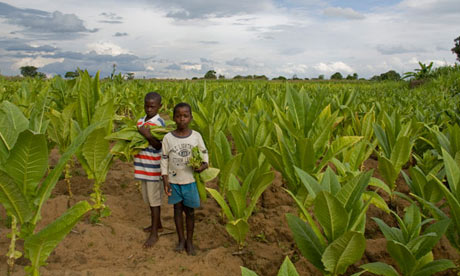
    A tobacco farm in Malawi. Many of the country's estimated 80,000 child tobacco workers suffer from nicotine poisoning. Photograph: Kristin Palitza

    At the height of the tobacco harvest season, Malawi's lush, flowing fields are filled with young children picking the big green-yellow leaves. Some can count their age on one hand.

    One of them is five-year-old Olofala, who works every day with his parents in rural Kasungu, one of Malawi's key tobacco growing districts. When asked if he will go to school next year, he shrugs his shoulders.

    One thing is clear to Olofala already: work comes first, education second. His sister, Ethel, 12, is only in year three. She attends school irregularly because she has to work, or because she is sick. "I cough," she says. "I have chest pains and headaches. Sometimes it feels like you don't have enough breath."

    Such complaints are not uncommon. Many of Malawi's estimated 80,000 child tobacco workers suffer from a disease called green tobacco sickness, or nicotine poisoning. Symptoms include severe headaches, abdominal cramps, muscle weakness, breathing difficulties, diarrhoea and vomiting, high blood pressure and fluctuations in heart rate, according to the World Health Organisation.

    Since the handling of the leaves is done largely without protective clothing, workers absorb up to 54 milligrams of dissolved nicotine daily through their skin, equal to the amount of 50 cigarettes, according to 2005 research by Prof Robert McKnight, of the College of Public Health at the University of Kentucky, Lexington. Farm owners routinely plead ignorance of the health implications. "I never heard about touching tobacco leaves being dangerous," says Fraston Mkwantha, who plants 15 hectares of tobacco in Kasungu district.

    At the consumer end of the chain, smokers are constantly reminded of the associated health risks. Most are oblivious to the reality that, far from harming only themselves, their toxic habit is slowly killing the underage children involved in the production process.

    Until the 1980s, much of the world's tobacco was grown in the US. Today, however, about 85% of worldwide production comes from the global south, where tobacco child labour is a major problem, according to a 2010 US Department of Labour report (pdf).

    "In any developing country where tobacco is grown, you find child labour starting at the age of five," says Marty Otañez, a researcher at the University of California's tobacco control research and education centre.

    Malawi, which has the highest number of child labourers in Africa, is a key offender. Health issues aside, children are also financially exploited. Olofala and Ethel often work 12-hour days, but neither earns a salary. They "help" their parents, who work on one of Kasungu's 22,000 registered tobacco farms and estates. Other kids receive an average of $0.25 for long hours of unrelenting work.

    They are arguably the lucky ones; some never see their money at all. "We have many reports of children who were lured into labour with promises of good pay. But at the end of a season, all they get is an old sweater," says Grace Masanya, Malawi project manager for Plan, the international child rights NGO.

    At the heart of the problem is Malawi's poor economic situation. Parents involve their children in economic activities to provide food for the family.

    Over the past decade, the country has become one of the five largest tobacco producers in the world, largely due to low tariffs on unmanufactured tobacco imports, cheap labour and lack of regulations. According to the UN's statistical division, more than 98% of Malawi's low-cost leaf is exported, with the EU and the US top destinations.

    And more than 90% of Malawi's tobacco is bought by two US-based leaf buyers, Universal Corporation and Alliance One International, which resell it to international tobacco firms. Their main clients are two of the world's biggest cigarette manufacturers, Philip Morris (Marlboro) and British American Tobacco (Lucky Strike). Consequently, Malawi's tobacco is found in the blend of almost every cigarette smoked in the west.

    Child labour rights

    The country is a signatory to the UN and International Labour Organisation (ILO) child labour conventions, and also has its own legislative framework barring the employment of children under 14. So why does the government turn a blind eye? The answer is simple: Malawi's economy is heavily dependent on tobacco, which makes up 70% of its export earnings, according to the UN Food and Agriculture Organisation.

    "Some estates follow anti-child labour regulations, but others purposefully flaunt the law in the interest of higher profits," says Plan Malawi advisor MacDonald Mumba. Over the past two years, only 49 farm owners have been prosecuted in Malawi, he says. Most received a $34 fine.

    Gaps and inconsistencies in Malawi's legislative framework contribute to the problems of child labour, according to the ILO.

    "The legal framework is very weak," confirms Unicef child protection programme officer Tomoko Horii, who believes promises to eliminate child labour amount to little more than window dressing presented in response to mounting international pressure. The laws lack specific targets to reduce child labour and, most importantly, an appropriate budget. "The budget allocation is minimal. So far all projects have to be financed by international NGOs," says Horii.

    Her sentiments are echoed by Khalid Hassan, the ILO's child labour adviser in Malawi. "Ratifying conventions and passing laws doesn't solve the problem," says Hassan. "You need money, commitment, cost-effective programmes, infrastructure and hard work."

    The tobacco giants, who all have anti-child labour policies in place, insist they abide by the rules. British American Tobacco (BAT) says on its website that it does "not employ children in any of our operations worldwide", but admits that using intermediaries to purchase tobacco makes it difficult to trace the country from which they buy the leaf and ensure all farm owners follow the rules.

    That is bad news for countries such as Malawi, where the education system is feeble and only a third of children complete primary school. "Unless the education sector scales up to offer quality education to all children, they will continue to work," says Horii.

    Tobacco growing is extraordinarily lucrative for the industry. Financial reports for 2008 by the five big tobacco companies - BAT, Philip Morris, China National Tobacco Company, Imperial Tobacco and Japan Tobacco - show that they collectively earned $300bn. This is more money than the GDP of all but 40 countries worldwide.

    Part of the reason for those huge profits is that tobacco giants benefit from $1.2bn in unpaid child labour costs, according to Otañez's colleague Prof Stanton Glantz. Replacing child labour with adults paid the minimum wage would increase the production costs by $10m per year in Malawi alone, he says.

    For Glantz, the solution is simple: "If major tobacco companies were genuinely committed to improving the socio-economic conditions of child workers, they should rectify harmful business practices by enforcing a policy that they will not purchase any tobacco grown using child labour."

    The tobacco giants disagree. "Simply stopping altogether our purchases of tobacco from Malawi will do nothing to alleviate the serious issue of child labour in this country," says Anne Edwards, director of external communications for Philip Morris.

    While this standoff continues, the people of Malawi benefit little from their "green gold". Malawi remains one of the least developed nations in the world, ranking 153 out of 169 countries on the 2010 Human Development Index. About 40% of the 13.2 million Malawians live below the poverty line of $1.25 a day.

    • Kristin Palitza is a freelance journalist based in Cape Town, South Africa. The research for this article was financially supported by the Fund for Investigative Journalism in Washington DC.

    Related articles
    Enhanced by Zemanta

    Monday, June 14, 2010

    Report: Malawi has 1.4 million child workers (Includes first-hand account)

    let children be free to be childrenImage by shashish via Flickr
    By Chancy Namadzunda.

    Lilongwe - A report on labour standards has shown that there are 1.4 million child workers in Malawi, especially in tea plantations and domestic servitude.

    The Ministry of Labour report indicates that the situation is worse in the rural areas than in provincial towns. 
     
    "Forty-one percent of children younger than 15 years of age were working part of full time, while 78 percent of rural children between 10 and 14 old worked at least part time in their parent’s farms 
     
    "Most of the child labour is found in tobacco farms, herding cattle, fishing industry, street vending and domestic servitude, particularly for girls," reads part of the report. 
     
    Village headman Gomani, Traditional Authority (TA) Simphasi in Mchinji district where there are a lot of tobacco farmers, concurred with the report saying most of the children work to support their poverty stricken families.
     
    "These are children born from very poor families whereby their parents even fail to provide them daily food. They don't even dream of going to school because they know that they cannot go further than primary school because of resources shortage," he said 
     
    The reports also indicate that the problem of street children, mostly orphans whose parents died from HIV/AIDS has increased.
     
    It adds that many boys are trafficked for working in tobacco and plantations and animal herding while girls are trafficked for commercial sexual exploitation or work in bars and restaurant as well as domestic servitude. 
     
    "The 150 labour inspectors of Malawi do not have competence to prosecute offenders against child labour legislation, for which they have to request interventions from police who are hindered in their efforts by lack of resources," adds the report. 
     
    According to the report, government spent more than US$2 million in 2008 to eliminate child labour, in order to intensify labour inspections, raise awareness through campaigning and community action and provide agricultural assistance and money transfers, particularly to rural families. 
     
    It says Malawi participates in the ILO-IPEC project which from hazardous work in agriculture and in domestic servitude and prevented 3, 942 children from being employed.
     
    In an interview, Foundation of Irrigation and Sustainable Development Moses Chirambo, whose organization is implementing a programme to eliminate child work and trafficking, said the tendency is deep-rooted in the rural areas because of high illiteracy rate and poverty. 
     
    According to Chirambo, the project themed; “Inclusive sustainable child labour and trafficking reduction in Southern Africa” is being financed by the Help a Child Organization from Netherlands,and is being carried out in five border districts of Malawi which are the source, recruitment and transportation centers.
     
    “People from these areas have no knowledge as to what child trafficking is all about. Parents are easily tricked by some people that they will offer the children some work but they end up into forced prostitution and criminal gangs. 
     
    “We want to sensitize them on the dangers of giving out their children without knowing exactly where they are being taken to,” said Chirambo. He said FISD is working hand in hand with the district social welfare offices, district youth offices, police, the immigration department, judiciary and youth organizations at the grassroots levels. 
     
    "Most of the parents are offered money, cloths and sometimes tricked that their children are going to be send to schools and work in good jobs in towns and cities not knowing that they are selling their children," he said. 
     
    Malawi's employment act of 2000 allows for children older than 14 years of age to perform work in any public or private agricultural, industrial or non-industrial undertaking or any branch thereof but does not apply for cases of "work done in homes, vocational technical schools or other training institutions". 
     
    Malawi’s minister of gender and children development Patricia Kaliati said the government will carry out anti-child trafficking and to eliminate child labour. 
     
    “We realize that during this event more children could be trafficked to South Africa because they will be looking for different opportunities hence we need to tighten our security in the boarders to avoid losing more children due to the problem” she said. 
     
    On the other hand, the constitution sets the age limit at 16 years of age for admission in hazardous work, creating a legislative collision which is currently being by the Tripartite Labor Advisory Council. 
     
    Report: Malawi has 1.4 million child workers (Includes first-hand account)
    Enhanced by Zemanta