Showing posts with label Brazil. Show all posts

Wednesday, July 16, 2014

Brazil's fight against slave labor | Globalization | DW.DE | 27.05.2014

Sourcr: DW.DE | 27.05.2014:

In Brazil, the extreme exploitation of workers has been shifting from rural areas toward the cities. In 2013, for the first time, more people were freed from slave-like conditions in urban centers than the countryside.

Continue:
http://www.dw.de/brazils-fight-against-slave-labor/a-17664728

Friday, May 2, 2014

Face of Slave Labour Changing in Brazil - Inter Press Service

Source:  Inter Press Service:

'RIO DE JANEIRO, Apr 30 2014 (IPS) - The upcoming mega sporting events in Brazil are paving a new route for slave labour among those migrating from rural areas to the cities in search of work.

The dream of a good job draws many rural migrants from Brazil’s poorest regions, as well as neighbouring countries, to try their luck in big cities. But sometimes their dreams turn into nightmares.
Slave labour remains largely a rural phenomenon in Brazil, where it still occurs on cattle ranches, sugar cane plantations and charcoal farms in remote areas. But it has been growing more recently in the textile and garment industry as well.
The shift to urban areas has made it difficult to fight, said experts consulted by IPS.
Continue:
Enhanced by Zemanta

Wednesday, August 28, 2013

Modern-day slavery: an explainer | Global development | theguardian.com

SOURCE: theguardian.com

What is modern-day slavery?

"About 150 years after most countries banned slavery – Brazil was the last to abolish its participation in the transatlantic slave trade, in 1888 – millions of men, women and children are still enslaved. Contemporary slavery takes many forms, from women forced into prostitution, to child slavery in agriculture supply chains or whole families working for nothing to pay off generational debts. Slavery thrives on every continent and in almost every country. Forced labour, people trafficking, debt bondage and child marriage are all forms of modern-day slavery that affect the world's most vulnerable people."

CONTINUE READING:

 http://www.theguardian.com/global-development/2013/apr/03/modern-day-slavery-explainer
Enhanced by Zemanta

Wednesday, May 22, 2013

IPS – Brazil Lagging in Fight against Human Trafficking | Inter Press Service

http://www.ipsnews.net/2013/05/brazil-lagging-in-fight-against-human-trafficking/

Source: IPS

By Fabiola Ortiz

Trafficking turns people into merchandise. Credit: Amnesty International

RIO DE JANEIRO, May 20 2013 (IPS) - In contravention of international law, in Brazil trafficking in human beings remains invisible and unpunished, which encourages the practice of trafficking for sexual exploitation, forced labour, illegal adoption and the trade in human organs, according to experts.
Local laws punish drug trafficking more severely than human trafficking. The sale of drugs carries penalties of between five and 15 years, while trafficking of persons for sexual exploitation is punished with a maximum sentence of eight years, with work release allowed.
“Human trafficking is still an invisible crime. What we have here now is real impunity,” judge Rinaldo Aparecido Barros, a member of the National Council of Justice’s working group on human trafficking, told IPS.
An average of 1,000 persons a year are recruited in Brazil and sent abroad, the public prosecutor’s office said at a public hearing on “Tráfico de pessoas: prevenção, repressão, acolhimento às vítimas e parcerias” – Trafficking in persons: Prevention, repression, care of victims and (illegal) associations – that it held in this city on Friday, May 17.
The goal was to gather and share information about combating human trafficking and to organise joint action to prevent and crack down on the crime. The meeting focused on Brazil’s role as a source country of victims for other parts of the world.
Brazil is also a destination country for victims of human trafficking, and there is internal trafficking of Brazilians for exploitation within the country’s borders as well.
In the last three years, 3,000 Brazilians were transported abroad and subjected mainly to sexual exploitation and slave labour, participants at the meeting described.
“This is a significant number. A large group of people have been deprived of their dignity. The thousands of cases documented every year do not represent the total, because we do not know how many cases escaped our notice,” said federal deputy attorney-general Raquel Elias Ferreira Dodge.
The actual number of victims sent abroad by human trafficking rings is unknown, participants at the meeting agreed.
“We have to work more effectively so that these crimes are condemned without delay. The crime of trafficking in persons injures human dignity,” said Dodge, who is a member of the Higher Council of the federal public prosecutor’s office (MPF).
She said, “Slave labour negates the personhood of the individual and converts the victim into merchandise that can be smuggled and trafficked.”
But hindering the fight against human trafficking in Brazil is the fact that it is only a crime when it leads to sexual exploitation or slave labour, Erick Blatt, the representative of the federal police in Rio de Janeiro, told IPS.
“It is very hard to identify the crime; investigations can only be initiated on the basis of reports, without the certainty that illegality can be proved,” said Blatt, who is also the representative of Interpol, the international criminal police organisation, for the state of Rio de Janeiro.
Moreover, when it comes to international trafficking, “most people go voluntarily to the place where they are exploited: the majority do not know that their passports are going to be taken away,” he said.
The International Organisation for Migration (IOM) defines human trafficking as “the recruitment, transportation, transfer, harbouring or receipt of persons, by means of the threat or use of force or other forms of coercion, for the purpose of exploitation.”
The forms of coercion cited are “abduction, fraud, deception, the abuse of power or of a position of vulnerability or the giving or receiving of payments or benefits to achieve the consent of a person having control over another person.”
People smuggling, on the other hand, is limited to profiting from covertly transporting migrants, at their request, from one country to another where legal entry would normally be denied at the border. This is illegal, but no deception may be involved.
Article 231 of Brazil’s criminal code defines the crime of sexual exploitation, and article 149 describes subjection to slave-like conditions. Both crimes are punished relatively leniently, with lighter sentences than for other offences.
The United Nations Convention against Transnational Organised Crime, adopted in 2000 and ratified by Brazil in 2003, specifically identifies human trafficking crimes and proposes wide-ranging punishments, which Brazil has still not incorporated in its laws.
“We are going against the flow of international legislation. In Brazil, the issue has been inadequately treated. Human trafficking is a crime against humanity that robs people of their human dignity,” Judge Barros complained.
He said the best measures for fighting human trafficking were those that block the assets of the trafficking rings, in order to attack their economic flank.
Trafficking in persons is run by complex international crime syndicates that, in Brazil, recruit poor women who have no opportunities for a better life, lawyer Michelle Gueraldi of the Trama Project, an umbrella group for NGOs that combat human trafficking, told IPS.
These women emigrate voluntarily, often out of the desire to improve their lives, and end up being exploited in Spain, the United States, Portugal and Caribbean countries, among others, she said.
Blatt added that Brazil, in turn, is a destination country for women victims of human trafficking from Eastern Europe, especially Hungary and Poland.
“Trafficking in persons is a violation of human rights. The Trama Project is working on prevention and on victim protection. We also receive denunciations of cases, and we find that the majority of recruiters are persons known to and trusted by the victims,” Gueraldi said.
In February the Brazilian government established its Second Plan to Combat Trafficking in Persons, but the challenge is to put these policies into practice, she said.
Blatt admitted that tracing victims of human trafficking across borders is difficult for the local police and for Interpol.
“If communications between the police and the prosecutors are slow here in Brazil, imagine what communications are like between police forces internationally,” he said.
Human trafficking is extremely lucrative. In Europe alone it generates some 3.2 billion dollars a year, according to speakers at the meeting.
The United Nations Office on Drugs and Crime (UNODC) says there are at least 2.5 million victims of human trafficking worldwide. A survey by UNODC found that 58 percent of respondents were victims of sexual exploitation and 36 percent of slave labour.

Enhanced by Zemanta

Monday, April 8, 2013

Modern-day slavery: an explainer | Global development | guardian.co.uk

http://www.guardian.co.uk/global-development/2013/apr/03/modern-day-slavery-explainer

Source: guardian.co.uk
 
Slavery was abolished by most countries 150 years ago, but bonded and forced labour, trafficking and exploitation persist
 

guardian.co.uk,


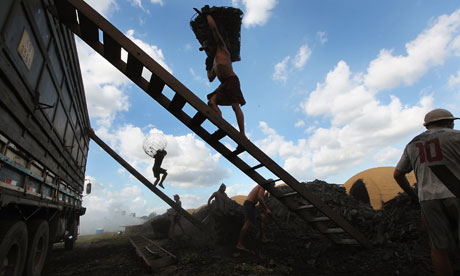
MDG : Slavery : slave workers found in illegal charcoal camps in Amazon, Brazil
A worker carries a bag of charcoal on to a truck in Rondon do Para. Brazil was the last country to withdraw from the transatlantic slave trade. Photograph: Mario Tama/Getty

What is modern-day slavery?

About 150 years after most countries banned slavery – Brazil was the last to abolish its participation in the transatlantic slave trade, in 1888 – millions of men, women and children are still enslaved. Contemporary slavery takes many forms, from women forced into prostitution, to child slavery in agriculture supply chains or whole families working for nothing to pay off generational debts. Slavery thrives on every continent and in almost every country. Forced labour, people trafficking, debt bondage and child marriage are all forms of modern-day slavery that affect the world's most vulnerable people.

How is slavery defined?

Slavery is prohibited under the 1948 Universal Declaration of Human Rights, which states: "No one shall be held in slavery or servitude: slavery and the slave trade shall be prohibited in all their forms."
Definitions of modern-day slavery are mainly taken from the 1956 UN supplementary convention, which says: "debt bondage, serfdom, forced marriage and the delivery of a child for the exploitation of that child are all slavery-like practices and require criminalisation and abolishment". The 1930 Forced Labour Convention defines forced labour as "all work or service which is exacted from any person under the menace of any penalty and for which the said person has not offered himself voluntarily".
As contemporary systems of slavery have evolved, new definitions, including trafficking and distinguishing child slavery from child labour, have developed.

Some of the forms of slavery are:

Bonded labour: people become bonded labourers after falling into debt and being forced to work for free in an attempt to repay it. Many will never pay off their loans, and debt can be passed down through the generations.

Forced labour: where people are forced to work, usually with no payment, through violence or intimidation. Many find themselves trapped, often in a foreign country with no papers, and unable to leave.

Descent-based slavery: where people are born into slavery because their families belong to a class of "slaves" within a society. The status of "slave" passes from mother to child.

Trafficking: the transport or trade of people from one area to another and into conditions of slavery.

Child slavery: children are in slavery as domestic workers, forced labour – in, for example, the cocoa, cotton and fisheries industries – trafficked for labour and sexual exploitation, and used as child soldiers.

Early and forced marriage: women continue to be married without consent, often while still girls, and forced into sexual and domestic servitude.

How many people are enslaved across the world?

Due to its illegality, data on modern-day slavery is difficult to collate. The UN's International Labour Organisation (ILO) estimates that about 21 million people are in forced labour at any point in time. The ILO says this estimate includes trafficking and other forms of modern slavery. The only exceptions are trafficking for organ removal, forced marriage and adoption, unless the last two practices result in forced labour.

The ILO calculates that 90% of the 21 million are exploited by individuals or companies, while 10% are forced to work by the state, rebel military groups, or in prisons under conditions that violate ILO standards. Sexual exploitation accounts for 22% of slaves.

On trafficking – that is, people trapped in forced labour as a result of internal or cross-border migration – the ILO calculates that 29% end up in forced labour after crossing international borders, the majority through trafficking for sexual exploitation. About 56% of the 21 million are exploited where they live.

Where does slavery exist?

Slavery exists in one form or another in every country. Asia accounts for more than half of the ILO's 21 million estimate. In terms of percentage of population, central and south-east Europe has the highest prevalence of forced labour, followed by Africa, the Middle East, Asia Pacific, Latin America and the Caribbean.

Who is affected?

Although modern-day slavery affects a cross-section of the population, some groups are more vulnerable. Unsurprisingly, women and girls are more at risk than men and boys. Women make up the majority of those being exploited – 55% are women and girls, and account for the vast majority of sexually exploited people.
Children make up a quarter of all those in slavery.

Slaves usually come from the most vulnerable, minority or socially excluded groups. For instance, forced and bonded labour is often interlinked with the caste system in south Asia. Caste-based slavery is carried down through the generations, embedded in traditional beliefs and customs, and underpinned by cultural discrimination. Anti-Slavery International estimates that 80-98% of bonded labourers in the region are from dalit (formerly "untouchable") or indigenous communities. Migrant workers are also highly vulnerable.

Who is profiting?

In 2005, the ILO estimated that illegal profits from forced labour amounted to more than $44bn. The UN's global initiative to fight trafficking says people trafficking is the third-largest global criminal industry (pdf) behind drugs and arms trafficking.

The ILO estimates that people in forced labour lose at least $21bn each year in unpaid wages and recruitment fees. Given that remittances to developing countries account for more than three times the global aid budget, there is an impetus for governments to ensure that migration for work is not manipulated by traffickers.

Slavery also exists within global supply chains, generating huge profits for those who control this industry in free labour. Recent economic research has shown that forced labour has broader social and economic costs, in terms of impeding economic development and increasing or perpetuating poverty.
 
Enhanced by Zemanta

Thursday, August 16, 2012

Can a Picture Free 1000 Slaves?

BY  ON AUGUST 7, 2012  

Source: FTS Blog


In this image from Brazil, a trafficker (red) dreams of enslaving a worker (blue). The worker dreams of earning money for his family. | Image created by International labor Organization, used by CPT.
When it comes to fighting slavery, creativity and innovation are essential. So Free the Slaves and our frontline partners use art to teach community members around the world about their rights.
We’ve found that picture strips are remarkably successful. The images allow those in slavery—and those who are vulnerable to slavery—to quickly see that life can be different.
“They came to identify their own situation when looking at these cartoons,” says Xavier Plassat, a FTS board member and frontline organizer with the Pastoral Land Commission in Brazil.
“They used to tell me, in their own words: ‘eu me achei‘ (translation: I found myself),” Xavier says. ”Because the laborers were able to visualize themselves in the pictures, they could learn how to prevent similar situations from happening to them or others.”
A comic strip from CPT Brazil.
In Haiti, picture books are used for small-group discussions in remote villages where parents often send children away to work as domestic help in cities, in hopes they’ll be fed and educated. Many of the children end up in slavery, and the books “open the eyes of parents who sent children” according to FTS Haiti Coordinator Smith Maxime.
Christmas Barjon leads a community discussion in Bresilienne, Haiti. | FTS Photo
The pictures act “like a fire that heats the consciousness of parents,” Smith says. Village leaders, trained by our Haitian partner Fondasyon Limyè Lavi, guide parents through a story of children falling into slavery.
“At first contact with the book, parents feel the need to go retrieve their children,” Smith says. “Pictures speak a thousand words.”
Pictures are carefully crafted to tell stories of individuals in risky situations, such as those intending to migrate, as well as stories of enslaved individuals and the abuse they are suffering. The stories are designed to teach community members what their rights are, and how to assert them.
In Nepal, for example, one strip tells the story of a woman who is offered a job abroad by a tricky trafficker. She is enslaved, and then jailed for being undocumented. When she eventually returns home, she seeks justice – ultimately sending the trafficker to jail – and she shares her story to warn others. The strip was developed by FTS partner AATWIN, and is being used by all our Nepali partner groups.
Nepal picture strip shows a woman being lured away from home by the false promises of a trafficker.
Pictures help FTS bridge communication gaps between communities and activists, making learning more accessible and interesting. Art is particularly effective in areas where people are unable to read.
“The reality is that children often don’t have the words to convey what they are needing and wanting,” says FTS Associate Programs Director Ginny Baumann. “So the pictures form stories that allow adult participants to try to imagine what the children might be feeling.”
In some cases, pictures help people escape slavery.
“There’s a situation where a trafficked worker in another part of India, where he didn’t speak the language, used a comic strip picture about slavery to show the police the situation he was in,” Ginny explains. “Using the leaflet, the police could then help him get back home with the help of our partner organization.”
Slavery thrives when the vulnerable are discouraged from thinking and reflecting on their situation. Visual images can be helpful because they sometimes raise questions more effectively than words can. Art can get groups of people to think together about their lives, what is happening, and what is right and wrong.

Enhanced by Zemanta

Tuesday, June 12, 2012

Brazil workers exploited as modern-day Amazon slaves

Brazil workers exploited as modern-day Amazon slaves: Brazil's slavery victims are promised work and find themselves toiling in brutal conditions for little or no pay in the Amazon. A culture of impunity persists.

ACAILANDIA, Brazil — After months of chopping down trees in the forest without pay and living on rice, beans and dirty water, Gil Dasio Meirelles decided he had to escape from the remote clearing in the middle of the vast Brazilian Amazon.
Enhanced by Zemanta

Friday, March 9, 2012

Senator's Trial Points to Modern-Day 'Slaves' in Brazil

http://insightcrime.org/insight-latest-news/item/2329-senators-trial-points-to-modern-day-slaves-in-brazil


Source: insightcrime.org

Friday, 09 March 2012 11:28


The upcoming Supreme Court trial of a senator in Brazil charged with employing workers in 'slave-like conditions' highlights the issue of forced labor in the country, which affects as many as 40,000 people.

When auditors from the Labor Ministry inspected Senator João Ribeiro's farm in 2004, they found 35 employees forced into working nearly 80-hour weeks under conditions described as "sub-human." Ribeiro, who was re-elected to the Senate in 2010, has been embroiled in a legal suit ever since, which will soon be heard by Brazil's highest court of law.

Workers had allegedly been brought to Ribeiro's farm attracted by the promise of a decent salary, but once they arrived they racked up debts with the management and were coerced into staying. Such practices are especially common in rural states along the Amazonian frontier like Para, where Ribeiro kept his country estates. Employers charge their laborers for food, housing, and equipment, withholding their wages until their debts are paid off. Workers are forced to keep long hours and safety regulations are ignored.

More recently, 24 workers were freed by a federal task force in the northeast Piaui state. The labourers were fed spoiled food, and forced to pay for their housing, transportation, and the tools they used for work.

According to Rogenir Costa, the head of Brazil programs for humanitarian agency Catholic Relief Services, there are between 25,000 and 40,000 slaves in Brazil. Most work in the cattle industry, but slaves also work in sugar cane fields, mines, and factories.

Workers are often recruited by fixers known as gatos. The gatos lure workers to farms, ranches, and factories where they are then coerced into working under illegal conditions, but as Costa noted, some workers follow their families into slavery because they have no other opportunities. She said 80 percent of these modern slaves are illiterate and 90 percent were already working by age 16.

Those who try to escape may be threatened with violence. A recent report from O Globo told the story of Daniel Moraes Ferreira, who worked in stonemasonry in the Amazonian state Matto Grosso. His employers were armed and patrolled the work site constantly. "When the police cars show up, the slaves are put in the brush and hidden. I couldn't leave the farm. How, with a .38 revolver threatening me? Anyone who leaves is beaten or shot," he said.

The problem is not confined to rural areas. Spanish high-fashion retailer Zara was denounced in August 2011 for its relationship with a Brazilian supplier that employed 14 Bolivians and one Peruvian in an illegal São Paulo "sweatshop." While Zara quickly ended its relationship with that supplier, the scandal was a reminder that multinationals that have outsourced work to Brazil still risk hiring subcontractors reliant on forced labor.

While most of Brazil's forced labor victims originate from poor states like Piaui, Tocantins, and Bahia, to a lesser extent Brazil is also a destination for labourers trafficked from other Southern Cone countries. Costa told InSight Crime that Bolivians and Peruvians are frequently employed in slave-like conditions in Brazil. This suggests that the gatos prey on migrant workers, who are particularly vulnerable to labor abuse.

Police are rescuing more workers from illegal conditions in a higher number of states, an encouraging sign that the government has successfully expanded their operations against slave labor. In 2010, according to a report from Brazil's Ministry of Labor and Employment (MTE), authorities rescued 2,628 workers. And according to Brazilian NGO the Pastoral Land Commission, in 2011 authorities freed slaves in 19 states, a number which had never risen about 15 before 2006. But even so, those who are rescued from slavery reportedly represent less than 10 percet of the total number of estimated victims.

Successful prosecutions are few and far between, which is partly why Senator Ribeiro's case may prove to be a landmark one, should the Supreme Court find him guilty of slave labor charges. Gulnara Shahinian, the United Nations Special Rapporteur on slavery, has urged the country to pass legislation allowing the expropriation of land used for forced labor, which so far has not occured.

Many offending employers operate with relative impunity even once they are caught. The statute of limitations for slavery cases often expires by the time cases are processed in the Labor Courts, which handle labor violations. This, along with relatively weak sentences, means employers in certain industries and regions have little incentive to play by the rules.

Related articles
Enhanced by Zemanta

Monday, November 14, 2011

Rule of Law Resource Center: Issues Spotlight: Rule of Law: Brazil, Human Trafficking and Perversion of the Rule of Law:

http://law.lexisnexis.com/webcenters/RuleofLawResourceCenter/Issues-Spotlight/Rule-of-Law/Brazil-Human-Trafficking-and-Perversion-of-the-Rule-of-Law

11/13/2011 10:07:23 PM EST

When China hosted the Summer Olympics, the government flagrantly violated human rights of citizens in order to put a “happy face” on the country for those who attended and watched the games. Forced relocations and misappropriation of water supplies are but two examples. The only unintended beneficial side effect was the temporary protection of animal rights as Beijing temporarily banned canines from local restaurant menus to prevent Westerners from being offended by the service of Fido as the main course.

With the 2016 Summer Olympics scheduled in Rio, one must wonder how many human rights abuses will occur or be covered up by governmental authorities in a public relations effort intended to show Brazil as a developed country. Sadly, we will see more focus on a Potemkin Rio built for the media than the human trafficking and other rights abuses pervasive throughout the country.

Although Brazil banned slavery per its1888 Golden Law, forced labor of tens of thousands of workers occurs daily driving the economic “miracle” talked about by financial analysts. Whether it is a São Paulo domestic servant, a Mato Grosso cattle farm laborer, or a northern Brazilian charcoal burning worker helping to fill global demand for pig iron, men and woman are working as de facto slaves.

In many cases, the laborers do not have employment contracts and are not paid for their services. To the extent that payment is made, these victims are in turn required to use such earnings to partially pay for food and shelter while incurring debt for the balance that will never be repaid. This situation ensures a dependency and corresponding perpetual servitude...not to mention a growing sense of hopelessness and depression among the victims. Such “contracts” as many exist are contracts of adhesion with one-sided exploitative terms, thus employing Brazilian law as a tool to enslave those that it is expected also to protect.

Rampant poverty has made it possible for many women and children, particularly in rural areas, to become international trafficking victims. Traffickers promise a better life and then ship the victims abroad to be abused in other countries.

Race and ethnicity appear to play a role in this tragedy. Forced labor and trafficking victims invariably are dark-skinned descendants of slaves while those who take advantage of them more often than not have light skin. Perhaps there is a cultural disposition for such mistreatment despite laws banning it.

To be sure, the Brazilian government condemns slavery. Whether it is a lack of law enforcement resources or simply misplaced governmental priorities, forced labor and human trafficking remains common. One has to wonder how many Brazilian lives could be improved if the resources being invested in the 2016 bread and circuses were instead committed to stamping out human trafficking and de facto slavery, and providing more access to fundamental human rights and economic opportunity for the Brazilian masses regardless of skin tone.

Recommended Reading

Slavery: A 21st Century Evil – Charcoal Slaves, Al Jazeera (Nov. 8, 2011)

Latin America fights human trafficking, Costa Rica News (Oct. 23, 2011)


Brazil has thousands working in forced labor: ILO, AFP (Oct. 25, 2011)

Enhanced by Zemanta

Monday, October 17, 2011

Spend Matters: Zara and Beyond: Does Your Supply Chain Support Modern Slavery? (Part 1 and Part 2)

Source: Spending Matters

Part 1

When we think of slavery, we usually think about the term historically. African Americans were enslaved in America, Jews were enslaved by Pharaoh, so and so forth -- essential history lessons that should inform modern thinking, but something out of the past, not today. Unfortunately, this is not the case at all. In fact, even in the US, large retailers such as Home Depot have been accused of indirectly taking advantage of low-prices resulting from slave-labor in their supply chains, despite supplier codes of conduct that (obviously) prohibit such activity. Among other companies in the textile/retail space, Zara has faced similar scrutiny recently

According to one industry source, Zara was accused of running "sweatshops for their outsourced production" and subsequently after the accusation, "closed a factory that produced Zara's clothing for it's poor labor conditions." In this particular case, "Bolivians were brought illegally to Brazil, locked in small apartments and sewed clothes for 12-14 hours a day. They could not leave the apartment without the consent of the supervisor and didn't have hot water for taking showers or food for lunch...Many of the workers were forced into paying their wages to human traffickers who had smuggled them into the country."

We can learn just as much from Zara's response and corrective actions as we can from their transgressions and oversight failure in the first place. This effort goes beyond one-off codes of conduct that suppliers must adhere to. Rather, they rely on adhering to the strictest industry-based standards in the region (e.g., "introduction of a detailed procedure for verifying that any supplier wishing to work with Zara meets the corporate social responsibility criteria applied by ABVTex (initials in Portuguese for the Brazilian Textile Industry Association), the drafting of a Best Practice Guide, in collaboration with the Ethos Institute for the manufacturing sector," etc.).

Zara is also up to some other activities to combat supplier slave-labor employment in Brazil that can serve as a basis for other companies to model their anti-slavery supply programs on. Stay tuned as we investigate these initiatives and other related recommendations in more detail.

- Jason Busch


Part 2

Supply chain slavery is a topic that's getting more attention than any time in recent memory. CNN and others have covered the topic in detail of late, calling attention to a new website and mobile app "created by the U.S. State Department and a watchdog group" that offers to pinpoint your "slavery footprint." When I went to take the survey last week, I was surprised at the response I got on a site backed by the US government: "Due to overwhelming global traffic on slaveryfootprint.org, we're switching over to servers with 50 times the capacity [as before]. We'll be right back though, so check in soon." Clearly, consumers are more than curious to know their slavery footprint. No doubt, procurement and operations organizations should react to this interest by taking action and rid their supply chains of this type of labor.

In the first installment of this post, we shared some of the programs Zara has undertaken in their Brazilian supply chain to end slavery. We'll continue this analysis today, sharing two strategies Zara has ordered which we feel other organizations should consider as well. The first is the launch of a "dedicated toll-free number" supervised by non-Zara employees, with the "main purpose [being] to create a channel for citizen cooperation through which the company can become aware of and resolve possible irregularities within the shortest possible timeframe." This will also help pinpoint other labor issues within the Zara supply chain.

Additionally, Zara is working closely with an organization, the National Association of Foreign Immigrants in Brazil, to "identify potential sources of instability among immigrant communities and to develop training and skills programs within the textile industry in order to facilitate their integration in the workforce." The importance of monitoring immigration trends in emerging markets can't be overstated. As the illegal trafficking of humans can often result in migrant workers being taken advantage of or even enslaved. Companies doing business in Mexico, China, Vietnam and other global markets should identify local groups to work with in this capacity too.

In the final installment of this post, we'll examine ways that supplier management technologies and data enrichment solutions can help organizations more systematically monitor and mitigate slave labor risk in their supply chains.

- Jason Busch

Related articles
Enhanced by Zemanta

Monday, October 10, 2011

Investigating a very modern evil - Slavery: A 21st Century Evil - Al Jazeera English

Last Modified: 10 Oct 2011 13:34

In this eight-part series, Rageh Omaar uncovers the truth about the flourishing 21st century slave trade.

Today, 27 million men, women and children are held, sold and trafficked as slaves throughout the world.

From the sex slaves of Eastern Europe to China's prison labour slaves; from Brazil's hellish charcoal slave camps to entire families enslaved in Pakistan's brick kilns, this series exposes the people behind modern slavery and the companies who profit from it.

Weaving the testimony of current and former slaves with investigations into some of the biggest global slave masters, we ask why this age-old evil continues to flourish.


Slavery: A 21st Century Evil can be seen from Monday, October 10, at the following times GMT: Monday: 2230; Tuesday: 0930; Wednesday: 0330; Thursday: 1630.

Click here for more on the series.


Source:

Enhanced by Zemanta