Showing posts with label Mauritania. Show all posts

Friday, October 25, 2013

IRIN Global | Anatomy of modern-day slavery | Global | Human Rights

Source: IRIN Global 

NAIROBI, 18 October 2013 (IRIN) - More than two centuries after slavery was outlawed, 29.8 million people globally continue to be subjected to new and diverse forms of servitude, a new index ranking 162 countries shows.

Continue here:

http://www.irinnews.org/report/98964/anatomy-of-modern-day-slavery
Enhanced by Zemanta

Tuesday, October 22, 2013

384,000 Burmese people live in slavery | DVB Multimedia Group

Source:

Nearly 30 million people are living in slavery around the globe, many of them trafficked by gangs for sex work and unskilled labour, according to a global slavery survey released on Thursday.

The survey by anti-slavery charity Walk Free Foundation ranked 162 countries on the number of people living in slavery, the risk of enslavement, and the strength of government responses to combating the illegal activity.

Continue:
http://www.dvb.no/dvb-video/384000-people-live-in-slavery-in-burma/33604
Enhanced by Zemanta

Friday, August 17, 2012

Slavery still shackles Mauritania, 31 years after its abolition | World news | guardian.co.uk

http://www.guardian.co.uk/world/2012/aug/14/slavery-still-shackles-mauritania

Source: guardian.co.uk


Rigid caste system and ruling elite have enabled a centuries-old practice to continue into the 21st century
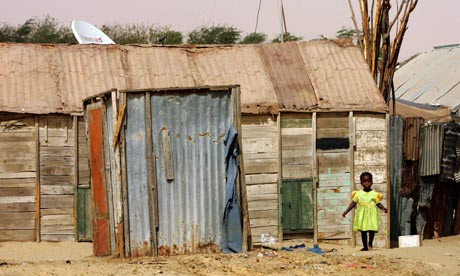
Poverty in Nouakchott, Mauritania
A shanty town hut in Nouakchott, Mauritania. Activists estimate many of Mauritania's 3.5 million population are willing chattels. Photograph: Georges Gobet/AFP/Getty Images
Mbarka Mint Aheimed first met her father on the day he forced her intoslavery. The man who dragged her from her mother when she was aged five needed "a drudge" in his wife's mansion. Since Aheimed was the result of him raping her mother – one of his slaves – she was a natural choice, he told her.
"Because my mother was her husband's slave, his wife saw us all as personal property. It was completely normal for her to do what she wanted with us," Aheimed would later tell anti-slave activists inMauritania. Living in a tiny hut that opened to the fierce heat of the orange dune-swept deserts, she worked from dawn to dusk. For 15 years, she never had a day off. "The family lived in a mansion but I was the only person who lifted a finger to work," she said.
Once she was old enough to start covering her head – but forced, against tradition, to leave her arms bare to carry out heavy lifting – one of the slaveowner's sons drove her miles into the desert and raped her. Later he would only take her far enough to collect firewood for making tea on their return.
Aheimed's story isn't uncommon. In 1981 Mauritania became the last country to abolish slavery, although it was only criminalised in 2007. Officials repeatedly denied it existed and refused to talk to the Guardian about slavery. But activists and former slaves spoke of a centuries-old practice, a relic of the trans-Sahara slave trade when Arabic-speaking Moors raided African villages, flourishing in remote outposts of this vast desert country.
A rigid caste system that favours "noble-borns", and zealous efforts to brand the country an Arab republic, concentrates power and wealth among overwhelmingly lighter-skinned Moors, leaving slave-descended darker-skinned Moors and black Africans on the edges of society. Up to 800,000 people in a nation of 3.5 million remain chattels, according to activists who routinely document cases like Aheimed's.
But slavery is often harder to pin down. With almost half the population living on less than $2 a day, many slaveowners work alongside their slaves.
Boubacar Messaoud grew up in a grey area between slavery and freedom, paid a token salary in return for farming. "One day when we were about seven, the slaveowner's son, whose name was also Boubacar, said I should be called Boubacar abd [the black slave], so people didn't confuse us. That was when I understood."
And many do not identify themselves as slaves. "When people talk of slavery, they talk of chains, prisons, and threats. That was the slavery of those who had known liberty – the Africans who jumped into the sea rather than be enslaved in America," said Messaoud, who founded the abolitionist organisation SOS Slaves. "Today we have the slavery American plantation owners dreamed of. Slaves believe their condition is necessary to get to paradise."
Thirteen years after slavery was abolished, SOS Slaves began holding secret meetings beneath rugs to muffle voices, in moonlight on the flat rooftop of a building in Nouakchott. Messaoud and his co-founder, a "noble" who had chosen a slave as a seventh birthday gift, were harassed and imprisoned. Even today, state agents lurking outside the building trail visitors afterwards.
Family members initially voiced opposition, too. "My mother believed she was protecting me when she reminded me that I was a slave – that I shouldn't forget my place," Messaoud said.
Statistics paint a bleak – and complicated – picture. A judge told the Guardian Mauritania is unlikely to improve on its record of one successful prosecution anytime soon: "[Recently] three runaway children overheard me saying we had to imprison their master. They immediately started crying in horror. They suddenly changed their story, they said he always treated them well, fed them, sheltered them. They wanted to go back with him."
Some former slaves like Malaka, 28, tended his owner's goats unsupervised for weeks at a time in the desert. "I didn't want to leave because I was scared to leave my family behind. And I was scared because I had heard about money, but I had never seen it in my life," he said.
Escape is no guarantee of freedom. When Ahmeid went to her local magistrate, her mother testified against her. Her uncle beat her savagely. After weeks shuttling between sympathisers, she found herself crouching in a two-storey building in Nouakchott late one evening as truckloads of policemen stormed an anti-slavery organisation where she had been sheltering. The group's leader, Birame Ould Abeid, and three others were jailed after publicly burning religious texts that have been used to justify slavery, and calling for black Moors and black Africans to unite.
With black Moors used as foot-soldiers in state crackdowns that target black populations, mutual suspicion between the two populations is unlikely to fade soon. But the routine arrests and beatings of abolitionists show how a ruling elite, having woven slavery into the heart of political power in Mauritania, are fearful of it unravelling, Nouakchott-based campaigner Toure Balla said. "There are places where one family has 5,000 slaves – that is 5,000 guaranteed votes," said Balla, who attends a growing swell of weekly protests.
Abolitionists say Mauritania is only the tip of the iceberg: "Slavery exists in all the countries of the Sahara desert. But it's only when the slave lifts their head to speak that the crime is discovered," said Messaoud.

Around the world

• An estimated 27 million people, spread across countries such as Nigeria, Indonesia, and Brazil, live in conditions of forced bondage.
• Every year at least 700,000 people are trafficked across borders and into slavery.
• About 300,000 children serve as child soldiers in 30 armed conflicts worldwide. Many female child soldiers are also forced into sexual slavery.
• In 1809, the average price of a slave in the southern US states was $40,000 (£25,500), in today's money. In 2009, the average price of a slave was $90.
• At least 2,600 women are working as prostitutes in England and Wales having been trafficked from abroad
Sources: US state department; International Organization for Migration; Unicef; Kevin Bales; 2010 police report

Enhanced by Zemanta

Friday, August 10, 2012

CNN: Mauritania: Slavery's last stronghold - YouTube


Published on Mar 18, 2012 by 
Mauritania's endless sea of sand dunes hides an open secret: An estimated 10% to 20% of the population lives in slavery.


http://www.youtube.com/watch?v=5yQlOPD8mNo&feature=player_embedded&noredirect=1#!


Tuesday, October 11, 2011

Guinea-Mauritania: Worst forms of child labour still widespread

Source: IRIN News

200612262.jpg
Photo: Nicholas Reader/IRIN Child labour is common in Guinea (file photo)
DAKAR, 10 October 2011 (IRIN) - The law does not necessarily make much difference when it comes to child labour: In Guinea and Mauritania the worst forms of child labour persist despite it being banned by law, leading child protection experts to call for a better understanding of the dynamics behind it.

West Africa adviser for child protection at the UN Children's Fund (UNICEF) Joachim Theis told IRIN: "Until now there has been very little discourse which makes the links between strategies taken by parents to find a solution for each child in the context of informal employment, and the application of international norms."

Mauritania

In Mauritania the law prohibits putting children under 14 to work, and penalizes those who are guilty of exploiting minors. But in reality, according to a late September report the International Trade Unions Federation (ITUC) under-14s continue to be sent to work, including some in "slave-like" conditions.

While most of the children are girls working as domestics for families, boys are often forced to beg; or are sent to work in the construction industry, on buses as money-collectors, or in criminal gangs. They are also forced to beg by Koranic teachers who are supposedly giving them a religious education - as is the case with hundreds of thousands of children across West Africa. In rural areas, boys work in the fields or herd animals.

Domestics work on average 10-hour days, according to a 2009 study by UNICEF and the Ministry of Welfare for Children and the Family; while those working as beggars or in agriculture may work as many as 16 hours. Of 265 children interviewed, just under half said they were beaten by their bosses.

A long tradition of slavery complicates the situation. A law was passed in 2007 forbidding slavery but it is not rigorously enforced, according to Mamadou Niang, head of external relations at the General Confederation of Workers in Mauritania."The authorities are usually lax in these cases, and the administration often ignores them - in some cases they may dissuade the families of enslaved children from bringing a case forward," he said.

One fifth of the Mauritanian population is affected by slavery in one form or another, according to a 2009 study by NGO SOS Slavery.

Guinea

In Guinea, despite legislation banning work for under-16s, "children carry out dangerous work in farms, in mines and in fisheries." According to the ITUC, some children in artisanal mines work 15-hour-days, seven days a week, from age five.

Child trafficking is also a problem: Moving children across borders into forced begging and other activities is still prevalent, though it has declined in recent years.

ITUC calls on both governments to more rigorously impose child labour laws and penalize individuals and organizations that do not comply, while recognizing that capacity in ministries remains very low.

Grégoire Tonguino at the child protection and pre-school education department of Guinea's Ministry of Children and the Family, told IRIN: "Guinea is good at developing laws, but applying them still poses some problems." Few people other than child protection experts even know about child labour laws in Guinea, he added.

However, a gap in the law means that even with boosted capacity, it would be hard to crack down: the law does not cover children in the informal sector, where most domestics and agricultural helpers work.

Cultural reality

Child labour is commonplace in poor rural societies in West Africa, as it is a way of training children and assuring them jobs in the future. In Guinea, for example, "fostering" or giving a child to a family as an apprentice, is considered beneficial to the child.

Sending a child into work is part of a family's risk-spreading strategy to combat poverty, said Theis.

As Olivier Feneyrol, regional adviser for NGO Terre des Hommes in West Africa once put it to IRIN: "Children have been moving around the region for centuries and working just as long. That is the cultural reality here."

"The debate on this issue is contentious," says Mariama Penda Diallo, head of international relations, solidarity and humanitarian action at the Trade Union of Workers of Guinea (USTG), "because people say that it's better to place the child from an early age so they can learn how to work," she said.

Most poor urban families have no choice but to send their children to work, added Niang in Mauritania. "With the rural exodus, many families have settled in slums with their children. In the absence of public strategies to look after them, poor parents have no alternative but to send their children to work."

To make a difference to children's lives, authorities need to better understand the context they are working in, said Theis: "It is important to understand the decision-making process that families go through because policies are not necessarily based on real situations that can have concrete results."

For the ITUC the priorities are clear: it recommends investigating instances of children being forced into work to pay for their religious education; more prosecutions of those individuals who force children to work; turning the Mauritania anti-slavery law from theory into practice; and expanding Guinea's child labour law to include children involved in unpaid, temporary, contract work.

But given the reality, just as important, said Diallo is to improve conditions for the thousands of children who will inevitably end up working, and to find a way to help them also attend school.

Enhanced by Zemanta

Friday, January 7, 2011

Anti-slavery activists jailed in Mauritania | Amnesty International

Amnesty InternationalImage via Wikipedia

7 January 2011

Amnesty International is calling for the release of three anti-slavery activists who were jailed after exposing a case of two young girls allegedly forced to work as servants.

Biram Dah Ould Abeid, Cheikh Ould Abidine and Aliyine Ould Mbareck Fall, all members of an anti-slavery NGO, were sentenced to one-year in jail - including six months suspended - on Thursday in the capital, Nouakchott.

"Those jailed are prisoners of conscience, detained solely on the basis of their actions in the struggle against slavery," said Erwin van der Borght, Africa Director at Amnesty International.

"The three men must be immediately and unconditionally released and Biram Dah Ould Abeid urgently treated for injuries he apparently sustained when ill-treated in detention."

The men were arrested last month by security forces after reporting that the two girls, aged nine and 14, were being held in slavery in the home of a female civil servant. Biram Dah Ould Abeid said he was beaten in custody and denied medical treatment for his injuries.

"The heavy-handed reaction to the work of these activists suggests that the Mauritanian authorities are trying to cover up the fact that slavery takes place in the country," said Erwin van der Borght.

The three jailed men are members of the Initiative for the Resurgence of the Abolitionist Movement in Mauritania (IRA), which is not recognized by the authorities despite its attempts to become officially registered.

After alerting authorities to the case, two IRA members accompanied police to the home where alleged slavery was taking place on 13 December 2010.

They learned that the nine-year-old girl had worked in the house as a servant for the past three years, while the 14-year-old had worked there for two and a half years.

The police took the two young girls to the police station for questioning but refused to allow IRA members to be present at the hearing, as had previously been planned.

Several IRA members were charged with “assaulting agents” and “obstructing public order” after holding a rally outside the police station in protest at being frozen out of the investigations. They were also charged for their membership of an "unrecognized organization".

Nine IRA members were initially taken into custody and some were beaten, with the group's president Biram Dah Ould Abeid sustaining injuries to his head and knee.

The woman in whose home the girls were found is being investigated for "exploitation", despite the case originally being dropped.

Slavery was officially abolished in Mauritania in 1981. It only became a criminal offence in August 2007 but no cases have since made it to court, despite NGOs including the IRA regularly documenting slavery-like practices.

Source: amnesty.org

Anti-slavery activists jailed in Mauritania | Amnesty International
Enhanced by Zemanta