3 Ways My Church Could Have Helped Free Me - Shared Hope International:
Showing posts with label Florida. Show all posts
Showing posts with label Florida. Show all posts
Monday, March 14, 2016


Wednesday, February 17, 2016
Sunday, November 15, 2015
Sunday, September 20, 2015
Monday, June 1, 2015
Saturday, May 23, 2015
Friday, October 17, 2014
Florida teacher in Belize child-sex sting faces life - Orlando Sentinel
TAMPA — Trying to persuade a 13-year-old girl in Belize to have sex with him, Pasco County middle school teacher David Wendel Thompson used a tactic officials say is common among adults wanting to exploit impoverished children.
"But u need help," he said in an online conversation last December. I want u to have a better life."
Read more:
Florida teacher in Belize child-sex sting faces life - Orlando Sentinel:
Tuesday, September 9, 2014
Teachers learning to recognize child trafficking - FOX 35 News Orlando
Source: FOX 35 News Orlando:
ORANGE COUNTY, Fla. (WOFL FOX 35 ORLANDO) -The Orange County Classroom Teachers Association is spearheading an effort to educate its members about child trafficking so that they may recognize warning signs inside the classroom. The organization that represents 13,000 teachers has posted statistics, presentations even questionnaires about this crime on its website.
Continue:
http://www.myfoxorlando.com/story/26431179/teachers-learning-to-recognize-child-trafficking
ORANGE COUNTY, Fla. (WOFL FOX 35 ORLANDO) -The Orange County Classroom Teachers Association is spearheading an effort to educate its members about child trafficking so that they may recognize warning signs inside the classroom. The organization that represents 13,000 teachers has posted statistics, presentations even questionnaires about this crime on its website.
Continue:
http://www.myfoxorlando.com/story/26431179/teachers-learning-to-recognize-child-trafficking

Wednesday, July 16, 2014
Invisible Victims: Sexual Exploitation And Trafficking Of Women In Mexico • SJS
Source: SJS'
Sex trafficking is now recognized as a global public health issue. Our study in Mexico has identified that trafficking of women for the purpose of sexual exploitation is highly associated with health risks such as psychological trauma, injuries from violence, sexually transmitted infections, HIV and AIDS, other adverse reproductive health outcomes, and substance misuse. Apart from that, we have seen from the study that trafficked women experienced a wide range of health problems, for example, frequent fever, back pain, stomach pain and sleep disorder (Acharya, 2014).

Read here:
http://www.socialjusticesolutions.org/2014/07/14/invisible-victums-sexual-exploitation-trafficking-women-mexico/
Sex trafficking is now recognized as a global public health issue. Our study in Mexico has identified that trafficking of women for the purpose of sexual exploitation is highly associated with health risks such as psychological trauma, injuries from violence, sexually transmitted infections, HIV and AIDS, other adverse reproductive health outcomes, and substance misuse. Apart from that, we have seen from the study that trafficked women experienced a wide range of health problems, for example, frequent fever, back pain, stomach pain and sleep disorder (Acharya, 2014).
Read here:
http://www.socialjusticesolutions.org/2014/07/14/invisible-victums-sexual-exploitation-trafficking-women-mexico/


Tuesday, April 29, 2014
Human Trafficking Law Blog: In Florida Tomato Fields, a Penny Buys Progress
Source: Human Trafficking Law Blog
IMMOKALEE, Fla. — Not long ago, Angelina Velasquez trudged to a parking lot at 5 each morning so a crew leader’s bus could drop her at the tomato fields by 6. She often waited there, unpaid — while the dew dried — until 10 a.m., when the workers were told to clock in and start picking.
Back then, crew leaders often hectored and screamed at the workers, pushing them to fill their 32-pound buckets ever faster in this area known as the nation’s tomato capital.
Continue:
http://humantraffickinglaw.blogspot.ca/2014/04/in-florida-tomato-fields-penny-buys.html
Related articles

IMMOKALEE, Fla. — Not long ago, Angelina Velasquez trudged to a parking lot at 5 each morning so a crew leader’s bus could drop her at the tomato fields by 6. She often waited there, unpaid — while the dew dried — until 10 a.m., when the workers were told to clock in and start picking.
Back then, crew leaders often hectored and screamed at the workers, pushing them to fill their 32-pound buckets ever faster in this area known as the nation’s tomato capital.
Continue:
http://humantraffickinglaw.blogspot.ca/2014/04/in-florida-tomato-fields-penny-buys.html
Related articles

Tuesday, April 8, 2014
Is jailing victims of sex trafficking constitutional? | HeraldTribune.com
Source: HeraldTribune.com
By J. David McSwane
SARASOTA - Severely traumatized child sex-trafficking victims
could be confined in secure safe houses, or lockups, for up to 10 months
under bills being discussed by Florida lawmakers.
And that proviso means that two bills aimed at providing services for
sex trafficking victims could fail even before reaching the governor's
desk.
Read more:
http://www.heraldtribune.com/article/20140407/ARTICLE/140409713/-1/news50?Title=Is-jailing-victims-of-sex-trafficking-constitutional-

By J. David McSwane
SARASOTA - Severely traumatized child sex-trafficking victims
could be confined in secure safe houses, or lockups, for up to 10 months
under bills being discussed by Florida lawmakers.
And that proviso means that two bills aimed at providing services for
sex trafficking victims could fail even before reaching the governor's
desk.
Read more:
http://www.heraldtribune.com/article/20140407/ARTICLE/140409713/-1/news50?Title=Is-jailing-victims-of-sex-trafficking-constitutional-


Thursday, February 27, 2014
Southeast sex-trafficking case exposes horrors of the trade - CNN.com
Source: CNN.com
"In a statement to federal officials in Savannah, Georgia, one woman said she was pregnant and lying face down on the floor when a trafficker literally jumped on her back, forcing her to miscarry. Others described being forced to go without sleep or food until having had sex with at least 40 men."
Read the full story here:
http://edition.cnn.com/2014/02/19/justice/southeast-sex-trafficking-ring/

"In a statement to federal officials in Savannah, Georgia, one woman said she was pregnant and lying face down on the floor when a trafficker literally jumped on her back, forcing her to miscarry. Others described being forced to go without sleep or food until having had sex with at least 40 men."
Read the full story here:
http://edition.cnn.com/2014/02/19/justice/southeast-sex-trafficking-ring/

Friday, February 21, 2014
Staggering report exposes US sex trafficking | MSNBC
Source: MSNBC
When Kery Rodriguez
was arrested earlier this year during a drug sting in Florida, law
enforcement agents discovered that heroine wasn’t the only thing that
Rodriguez and his crew were trafficking.
According to detectives and informants, Rodriguez also sold young women whom he referred to as “fresh meat.”
Continue here:
http://www.msnbc.com/msnbc/sex-trafficking-america-0
TRAFFICKING MONITOR: In the article, the link to the Polaris Report is broken. I located the URL of that report::
http://www.polarisproject.org/media-center/news-and-press/press-releases/915-report-spotlights-human-trafficking-trends-in-the-us

When Kery Rodriguez
was arrested earlier this year during a drug sting in Florida, law
enforcement agents discovered that heroine wasn’t the only thing that
Rodriguez and his crew were trafficking.
According to detectives and informants, Rodriguez also sold young women whom he referred to as “fresh meat.”
Continue here:
http://www.msnbc.com/msnbc/sex-trafficking-america-0
TRAFFICKING MONITOR: In the article, the link to the Polaris Report is broken. I located the URL of that report::
http://www.polarisproject.org/media-center/news-and-press/press-releases/915-report-spotlights-human-trafficking-trends-in-the-us
Wednesday, February 19, 2014
Artworks for Freedom uses the arts to raise awareness of human trafficking
Source: First Coast News
JACKSONVILLE, Fla. -- Sexual slavery exists in Jacksonville
neighborhoods. Children are being sold and forced into a life of
prostitution. Florida ranks the third highest for cases of human trafficking in the United States. And Jacksonville is third in the state.
Read on:
http://www.firstcoastnews.com/story/news/local/2014/02/17/human-trafficking-freed-espinosa/5569831/

JACKSONVILLE, Fla. -- Sexual slavery exists in Jacksonville
neighborhoods. Children are being sold and forced into a life of
prostitution. Florida ranks the third highest for cases of human trafficking in the United States. And Jacksonville is third in the state.
Read on:
http://www.firstcoastnews.com/story/news/local/2014/02/17/human-trafficking-freed-espinosa/5569831/


Monday, February 18, 2013
Professor explains horrors of human trafficking - The Oracle: University of South Florida
http://www.usforacle.com/professor-explains-horrors-of-human-trafficking-1.2811410#.USKDVR3Wj0t
Source: The Oracle: University of South Florida

Source: The Oracle: University of South Florida
Published: Monday, February 18, 2013
Updated: Monday, February 18, 2013 00:02
For many students, the thought of a young child sold into a world of violence and abuse for a mere $200 by her mother or father is a scenario thought about when watching Hollywood-produced movies such as “Taken.”
Yet for numerous women and children around the world, the scenario is a ruthless reality.
The topic was the focus of a lecture by Leonardo Territo, a professor in the department of criminal justice at Saint Leo University and professor emeritus in the department of criminology at USF, who spoke to a small crowd of about 20 in the John and Grace Allen Building on Friday.
Territo, who served as chairman of the department of police administration and director of the Florida Institute for law enforcement at St. Petersburg College, gave students in the Honors College a deeper insight into the content of the book he co-wrote titled “International Sex Trafficking of Women and Children.”
Due to corrupted living conditions in many countries such as Russia and Cambodia, Territo said the appeal of coming to America runs high for many women living in such places looking for a better way of life.
According to Territo, about 14,500 to 17,000 foreign women and children are trafficked into the U.S each year and physically controlled by their captor.
Territo said a reason for this is the use of false advertisements that con many women into becoming sex slaves unknowingly.
“Generally there will be ads in newspapers offering lucrative job opportunities such as waitress jobs or nanny openings,” he said. “She will be drugged and repeatedly raped. She’ll be moved place to place, not able to establish relationships with others.”
Territo spoke of the brutality of human trafficking.
He shared the story of a 13-year-old Cambodian girl named Long Pross, who had her eye gouged out with a piece of metal by a pimp because she asked to be set free.
“Many girls in places such as Cambodia may be sold for as little as $200 to $300 and will not likely see their parents again,” Territosaid.
But foreign women and children are not the only casualties of this brutal business.
According to Territo, roughly 100,000 to 300,000 American children are sexually exploited annually.
Students such as Monica Restro, a freshman majoring in civil engineering, were alarmed by the statistics.
“Coming in, I knew it was a problem in foreign countries but not in the U.S.,” Restro said. “It really opened my eyes to the awful people who live here and do these things.”
In the U.S, Territo said pimps seek out troubled young women, often runaways, at public places such as shopping malls or bus stops in order to take advantage of them. The pimps, he said, are master manipulators and work by schmoozing their underage prospects at first. These pimps will buy them lavish gifts and shower the girls with affection.
“It’s often the first time in these girls’ lives that a man has treated them that way,” Territo said. “The average age of a young person entering prostitution is 14 years old. Many think, ‘Who would want to be intimate with a girl that small?’ You’d be surprised.”
Often times the younger the girl is the more expensive she is to the customer, Territo added.
Territo said he hopes education about human trafficking continues to spread throughout the community. He said the industry is all about money, and there is no lack of customers.
“It’s a tragic subject, but an important subject,” Territo said.


Thursday, February 7, 2013
Broward Human Trafficking Coalition grows as awareness does, too - Sun Sentinel
http://articles.sun-sentinel.com/2013-02-05/news/fl-human-trafficking-meeting-20130204_1_law-enforcement-victims-pace-center
Source: Sun Sentinel

Source: Sun Sentinel
Broward Human Trafficking Coalition a forum for law enforcement, community workers
Andy Rodriguez and Cynthia Tapia-Rodriguez, Broward County Public Schools… (Brett Clarkson/South Florida…)
Adriane Reesey remembers that small, first meeting in a church back in 2008.
There were about seven people, all of them gathered to discuss an age-old issue – slavery – that was beginning to be viewed in a new context.
And so that Broward Human Trafficking Coalition was born.
"We started out as a working group," said Reesey, a Broward Sheriff's Office community specialist and chair of the coalition. "I wanted to take it to the next level. It needed to have everybody sitting around the table."
On Tuesday, about 65 people sat around a series of tables arranged in a giant horseshoe in a meeting room at Central Broward Regional Park, near Sunrise Boulevard and State Road 7 in Lauderhill.
"It's a blessing to see the room full of people," said Cynthia Tapia-Rodriguez, a family counselor with Broward County Public Schools who has been attending the coalition meetings for four years.
The focus of the meetings? Human trafficking, or, as law enforcement would say, the exploitation of victims through force, fraud or coercion for financial gain.
Among those attending Tuesday were representatives from law enforcement, shelters for at-risk youth and adults, schools, the justice system, and others whose work puts them in contact with potential victims of a crime that President Barack Obama highlighted in September as "modern slavery."
Their goal is to get the public thinking about the crime and its victims: young people preyed upon by coercive pimps, adults recruited falsely into jobs that turn out to be forced sex work, labor trafficking victims forced to work on farms for no pay, or women forced to perform sex acts in brothels posing as legitimate massage establishments.
Other victims can be found in restaurants, hotels, nail salons, or virtually any other business, law enforcement and human trafficking experts say.
"Some of our victims don't even know they're victims," said Aggie Pappas, founding executive director of the Pace Center for Girls Broward, a counseling center for girls between the ages of 11 to 18.
Pappas was referring to situations involving vulnerable young women and girls who are lured or "groomed" by an exploiter who showers them with gifts and affection – then pimps them out. The victims, some of whom love their trafficker, don't realize they are being coerced and exploited.
"There's definitely a Stockholm Syndrome that is taking place," Pappas said.
But the awareness is starting to trickle down from law enforcement to even the youngest among us, noted one Broward Schools counselor whose 11-year-old son started asking questions recently.
Andy Rodriguez, a family counselor, said his son Gabriel became curious about human trafficking after hearing about Toronto Blue Jays pitcher R.A. Dickey's recent trip to India. Dickey traveled to Mumbai in January to bring attention to child sex trafficking in India.
Rodriguez, who has experience working with kids exposed to gang activity, said students who are aware of a human trafficking situation – but might not feel comfortable talking to police – should feel safe talking to a teacher or counselor.
"They should go to a safe person," Rodriguez said. "They need to be aware they can go to somebody."
bsclarkson@tribune.com, 561-243-6609 or Twitter @BrettClarkson_


Thursday, January 31, 2013
Ma’am Anna Rodriguez, champion against human trafficking

Anna Rodriguez said she’s passionate about her work and even when exhausted she feels she can’t walk away. Her experiences are shared in a memoir: Ma’am Anna: The Remarkable Story of a Human Trafficking Rescuer. (Submitted photo)
Founder of the Florida Coalition Against Human Trafficking (FCAHT) Anna Rodriguez, just returned home from Panama, a country that has become a source, transit and destination for women and children trafficked for the purpose of commercial sexual exploitation.
A member of the training delegation of the Organization of American states (OAS), Rodriguez is packing bags again to go do another training, this time in Guatemala, Antigua, Uruguay, Bahamas.
Sponsored by the respective country, the training include the history of human trafficking; how to care for and protect victims; international law and exercises focused on human rights.
In exclusive interview for VOXXI, Rodriguez said the FCAHT, with headquarters in Clearwater, FL, has grown faster than she ever expected since she opened the first office in Naples, FL in 2004. Entirely volunteer-driven, the coalition has evolved into an international and domestic anti-trafficking agency.
Related articles


Monday, July 30, 2012
Recipe for Change campaign targets forced labor on US tomato fields
Recipe for Change campaign targets forced labor on US tomato fields:

The
International Justice Mission (IJM) launched this summer the Recipe for Change campaign to end forced labor on tomato fields in the US state of Florida.


The
International Justice Mission (IJM) launched this summer the Recipe for Change campaign to end forced labor on tomato fields in the US state of Florida.
Saturday, April 14, 2012
Graduate student makes film on domestic slavery - News - Central Florida Future - University of Central Florida
http://www.centralfloridafuture.com/news/graduate-student-makes-film-on-domestic-slavery-1.2726462#.T4nQvVFSRgh
Source: Central Florida Future
By Emily Blackwood
Members working on Pembroke Circle, a movie project by UCF graduate student Max Rousseau that tells a tale of human trafficking, gather at the Kickstarter campaign launch on March 15 to help raise funds for the film. The film stars an incoming UCF student and a Winter Park High School student.

Source: Central Florida Future
By Emily Blackwood
Sunday, April 8, 2012

Though the history books may say slavery ended with the Civil War, there are currently 27 million people enslaved throughout the world, with 2.5 million located in the United States, according to the Florida Coalition Against Human Trafficking. These people are exploited for sex, physical labor and servitude, and UCF film graduate student Max Rousseau wants to do something about it.
Human trafficking is not centrally focused around prostitution, as some people might think. Domestic slavery, also known as domestic servitude, happens when people are brought in to work as maids but are taken advantage of by their employers and become subjected to sexual and physical abuse. They are forced to work up to 19 hours a day for little pay and are not allowed to leave the home, according to GlobalResearch.ca. This is one of the least-reported varieties of human trafficking.
Domestic servitude often happens without people knowing, and in places it wouldn’t be expected. This is the idea that Rousseau wanted to recreate. His movie Pembroke Circle, which he is set to start filming in June, is about a young girl named Grace who notices dark changes when her father takes in a foreign maid.
“I wanted to portray the issue, but I also wanted to show a character that you could relate to,” Rousseau said. “It’s told in the audience’s point of view where they are just thinking that this could never happen and they slowly realize, like the main character does, that this could happen to anyone.”
Sarah Sculco, a freshman at Winter Park High School who plays lead role Grace, said that this movie is not only a great story, but that it will give people more information on an issue that isn’t very well understood.
“The importance is awareness of human trafficking and that it really is going on because I had no idea what it even was,” Sculco said. “The most important thing is to inform people.”
Rousseau used to be part of the majority who were unaware of domestic slavery. When he was in middle school, he wrote a fictional script on how different the world would be if slavery still existed.
“I kept going back to that script I wrote and was like, ‘Wow, I thought this was a figment of my imagination, but it is actually happening,’” Rousseau said. “Ever since then, I knew I wanted to tell a story about it.”
Initially, Rousseau wanted to make a film about sex trafficking, but the more research he did and people he talked to, he discovered his script was portraying domestic servitude.
“It’s completely different from sex trafficking,” Rousseau said. “Sex trafficking is for prostitution and things like that. What I was looking at was domestic servitude, where somebody is basically forced to work inside somebody’s home as a maid but they are also raped and physically abused.”
Laura Mejia, who will attend UCF in the fall, plays Mariela, the subject of domestic slavery.
Mejia said that many students are unaware of what human and sex trafficking really are. She hopes this movie will help people understand that this can happen to anyone.
“Evil can be found anywhere. Horrible acts like human and sex trafficking can occur anywhere, behind closed doors,” Mejia said. “I hope that people will see this film and become aware that what the characters Grace and Mariela experience in the film is something that people have gone through in real life.”
Pembroke Circle launched a Kickstarter campaign on March 15 for people to help fund the project. With a goal of $15,000 and only 20 days to go, the team is doing all it can to try to raise money for filming.
“The way Kickstarter works is that you set a time limit and a funding goal and you have to reach that goal in the time allotted or nobody gets charged,” Rousseau said. “So this film is not going to get made unless we reach our goal.”
To donate or to watch a preview scene of the movie visit: http://www.kickstarter.com/projects/1153862509/pembroke-circle-feature.
Sunday, March 18, 2012
Immokalee Farm Workers Still Fighting for One More Penny - IPS ipsnews.net
http://ipsnews.net/news.asp?idnews=107089

Source: IPS ipsnews.net
LAKELAND, FLORIDA, U.S., , Mar 15, 2012 (IPS) - Dozens of Immokalee Florida farm workers left tomato fields behind last week and set up camp on the lush, corporate grounds of Publix supermarket to fast and protest the company's refusal to pay a penny more per pound for tomatoes.
"If there were better conditions, like a fair wage, you would have the opportunity to provide for your family," explained Nely Rodriguez, previously a farm worker and today an employee with the Coalition of Immokalee Workers (CIW), which has been pushing to improve the lives of Florida farm workers since 1993 and organised the Publix protest.
Rodriguez spoke on day three of the six-day fast-protest, over laughter and chatting from the 75 or so farm workers, students and members of religious organisations at the event. Every now and then, truckers and cars exiting the Publix compound honked their support as they drove by.
"It's been an extremely powerful experience," Marc Rodrigues, a CIW employee, said. "The only way it's not going well is we have empty seats reserved for Publix officials and they haven't come over and sat in our seats."
By the close of the protest, which was visited by more than 1,000 supporters, including Ethel Kennedy and Kerry Kennedy, widow and daughter of Robert F. Kennedy, Publix still had not budged.
"If productivity standards are too strenuous, farmworkers should work for another employer," Publix says in a statement.
"The CIW's campaign against Publix is one directed at an acknowledged employer of choice and a great place to work," Publix says.
"The truth is, it's very difficult out there in the sun and heat," Emilio Faustino said at the protest about the 12 years he has spent in the Florida tomato fields.
Faustino and 33,000 other Florida farm workers pick most of the tomatoes distributed to the U.S. East Coast, six to seven days a week in the south Florida sun, filling, carrying and lifting 32-pound bins of fruit by hand for 10-12 hours per day, while getting paid 50 cents per bin, or about 200 to 283 dollars per week.
"I see the Publix ads that say they support families. I would say we support our families. And for the betterment of our families we would like to work together with Publix and improve conditions," said Faustino, 50, who lives in Immokalee with about 16 other men in a trailer with one bathroom, he said.
The 4,000 members of the Coalition of Immokalee Workers has been fighting for the per-pound increase - and more humane working conditions like providing shade and water to pickers in the fields - with unprecedented success.
Through marches, boycotts and public pressure, today more than 90 percent of Florida tomato growers abide by the improved working conditions, which include protection from pesticides and the right to complain about violations without being threatened.
Ten large food companies, from Subway to Whole Foods to Sodexo food service, have agreed to pay the penny increase and buy tomatoes only from those growers who are on board with the Immokalee workers' agreement.
But Giant, Kroger's, Martin's, Publix and Stop and Shop have refused to sign on and continue to purchase tomatoes from the 10 percent of Florida growers who impose harsh conditions on workers. Other protests are planned and on Apr. 15, the CIW will march against Stop and Shop, in Boston.
"The wages have been very low. That's how it's been always been until recently," Faustino said through a translator.
In 2011, the penny-per-pound increase made it into workers' paycheques for the first time, and it matters, Faustino said. Depending on how much he works, he may see an additional 15 to 100 dollars in his paycheck, he said.
"I'm seeing changes in my life. I can buy better food," Faustino said. "We never had shade in the fields. Now we have shade," he said.
The new benefits are available to all eligible 33,000 farm workers, not just CIW members.
Some Florida tomato pickers work and live in desperate conditions where extreme exploitation thrives, including indentured servitude and rape by bosses.
CIW uses its radio station and visits to farms to get the word out to farm workers about their new rights under the Fair Food Program.
Since 1997, nine entities have been prosecuted under U.S. federal slavery and human trafficking laws, for actions involving about 1,000 tomato pickers. Workers in these cases were held against their will, beaten, forced to work, chained, and their wages taken.
The CIW is taking action against sexual exploitation of workers by crew leaders and bosses, Rodriguez said, and has set up a 1-800 hotline for workers with complaints.
"We've been able to go to farms and speak with workers directly about their rights," she said.
She remembers that one crew boss was notorious for preying on young women when they left the group to use the toilet, she said.
"People were scared and didn't know their rights," so they didn't complain, Rodriguez said.
Today, the Fair Food Program spells out that workers can't be threatened with firing or violence if they complain. And CIW is there to back them up, Rodriguez said.
*Translators for this story include Marc Rodrigues, Brigitte Gunther and Jordan Buckley.
By Adrianne Appel
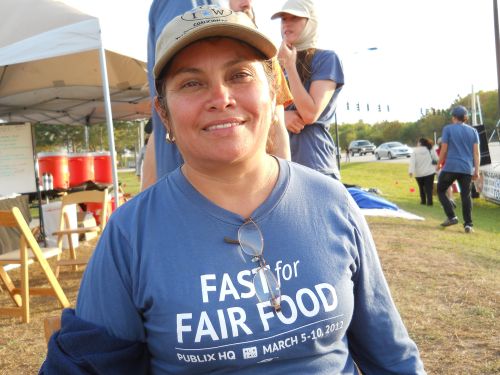
LAKELAND, FLORIDA, U.S., , Mar 15, 2012 (IPS) - Dozens of Immokalee Florida farm workers left tomato fields behind last week and set up camp on the lush, corporate grounds of Publix supermarket to fast and protest the company's refusal to pay a penny more per pound for tomatoes.
"If there were better conditions, like a fair wage, you would have the opportunity to provide for your family," explained Nely Rodriguez, previously a farm worker and today an employee with the Coalition of Immokalee Workers (CIW), which has been pushing to improve the lives of Florida farm workers since 1993 and organised the Publix protest.
Rodriguez spoke on day three of the six-day fast-protest, over laughter and chatting from the 75 or so farm workers, students and members of religious organisations at the event. Every now and then, truckers and cars exiting the Publix compound honked their support as they drove by.
"It's been an extremely powerful experience," Marc Rodrigues, a CIW employee, said. "The only way it's not going well is we have empty seats reserved for Publix officials and they haven't come over and sat in our seats."
By the close of the protest, which was visited by more than 1,000 supporters, including Ethel Kennedy and Kerry Kennedy, widow and daughter of Robert F. Kennedy, Publix still had not budged.
"If productivity standards are too strenuous, farmworkers should work for another employer," Publix says in a statement.
"The CIW's campaign against Publix is one directed at an acknowledged employer of choice and a great place to work," Publix says.
"The truth is, it's very difficult out there in the sun and heat," Emilio Faustino said at the protest about the 12 years he has spent in the Florida tomato fields.
Faustino and 33,000 other Florida farm workers pick most of the tomatoes distributed to the U.S. East Coast, six to seven days a week in the south Florida sun, filling, carrying and lifting 32-pound bins of fruit by hand for 10-12 hours per day, while getting paid 50 cents per bin, or about 200 to 283 dollars per week.
"I see the Publix ads that say they support families. I would say we support our families. And for the betterment of our families we would like to work together with Publix and improve conditions," said Faustino, 50, who lives in Immokalee with about 16 other men in a trailer with one bathroom, he said.
The 4,000 members of the Coalition of Immokalee Workers has been fighting for the per-pound increase - and more humane working conditions like providing shade and water to pickers in the fields - with unprecedented success.
Through marches, boycotts and public pressure, today more than 90 percent of Florida tomato growers abide by the improved working conditions, which include protection from pesticides and the right to complain about violations without being threatened.
Ten large food companies, from Subway to Whole Foods to Sodexo food service, have agreed to pay the penny increase and buy tomatoes only from those growers who are on board with the Immokalee workers' agreement.
But Giant, Kroger's, Martin's, Publix and Stop and Shop have refused to sign on and continue to purchase tomatoes from the 10 percent of Florida growers who impose harsh conditions on workers. Other protests are planned and on Apr. 15, the CIW will march against Stop and Shop, in Boston.
"The wages have been very low. That's how it's been always been until recently," Faustino said through a translator.
In 2011, the penny-per-pound increase made it into workers' paycheques for the first time, and it matters, Faustino said. Depending on how much he works, he may see an additional 15 to 100 dollars in his paycheck, he said.
"I'm seeing changes in my life. I can buy better food," Faustino said. "We never had shade in the fields. Now we have shade," he said.
The new benefits are available to all eligible 33,000 farm workers, not just CIW members.
Some Florida tomato pickers work and live in desperate conditions where extreme exploitation thrives, including indentured servitude and rape by bosses.
CIW uses its radio station and visits to farms to get the word out to farm workers about their new rights under the Fair Food Program.
Since 1997, nine entities have been prosecuted under U.S. federal slavery and human trafficking laws, for actions involving about 1,000 tomato pickers. Workers in these cases were held against their will, beaten, forced to work, chained, and their wages taken.
The CIW is taking action against sexual exploitation of workers by crew leaders and bosses, Rodriguez said, and has set up a 1-800 hotline for workers with complaints.
"We've been able to go to farms and speak with workers directly about their rights," she said.
She remembers that one crew boss was notorious for preying on young women when they left the group to use the toilet, she said.
"People were scared and didn't know their rights," so they didn't complain, Rodriguez said.
Today, the Fair Food Program spells out that workers can't be threatened with firing or violence if they complain. And CIW is there to back them up, Rodriguez said.
*Translators for this story include Marc Rodrigues, Brigitte Gunther and Jordan Buckley.
Subscribe to:
Posts (Atom)
