European banks join drive to combat human trafficking using data - Business Insider:
Showing posts with label Human trafficking in the United States. Show all posts
Showing posts with label Human trafficking in the United States. Show all posts
Tuesday, June 9, 2015


Monday, June 1, 2015
Wednesday, May 13, 2015
Ohio salon employees taking required course in human trafficking - WOWK 13 Charleston, Huntington WV News, Weather, Sports
"Salons are not necessarily a hotbed for human trafficking, but are among the industries where labor trafficking specifically can be found, according to the Polaris Project, a non-profit that researches and informs about human trafficking in the United States."
Read HERE
Ohio salon employees taking required course in human trafficking - WOWK 13 Charleston, Huntington WV News, Weather, Sports:
Read HERE
Ohio salon employees taking required course in human trafficking - WOWK 13 Charleston, Huntington WV News, Weather, Sports:


Wednesday, February 19, 2014
Artworks for Freedom uses the arts to raise awareness of human trafficking
Source: First Coast News
JACKSONVILLE, Fla. -- Sexual slavery exists in Jacksonville
neighborhoods. Children are being sold and forced into a life of
prostitution. Florida ranks the third highest for cases of human trafficking in the United States. And Jacksonville is third in the state.
Read on:
http://www.firstcoastnews.com/story/news/local/2014/02/17/human-trafficking-freed-espinosa/5569831/


Tuesday, December 17, 2013
Polaris Webinar: Human Trafficking in Domestic Servitude
Source: Polaris Project
Check out this Webinar from the Polaris Project
( Polaris Project) - Every month, we provide the human trafficking field with vital resources, including trainings, indicators cards, and statistics. Recently, we released a training for service providers seeking to help survivors of labor trafficking through domestic work. Check out the training and pass it on: http://ow.ly/rP5Qs


Thursday, November 21, 2013
Human Trafficking Trends in the United States | Polaris Project | Combating Human Trafficking and Modern-day Slavery
Source: Polaris Project
Since 2007, we have worked closely with local partners to help tens of thousands of callers connect with the help and services they need. As a result of the calls, emails, and online tip reports fielded by the hotline over the course of our first five years of operation, the NHTRC maintains one of the most extensive data sets on the issue of human trafficking in the United States.
Continue here:
http://www.polarisproject.org/resources/hotline-statistics/human-trafficking-trends-in-the-united-states
Monday, April 1, 2013
Lawyers: Caution with human trafficking laws key
http://www.usatoday.com/story/news/nation/2013/03/31/human-trafficking-laws-legal/2036077/
Source: USA Today
Is each person equally liable for the crime? Does it matter how much each knew? What was each person's intent?
As efforts to combat human trafficking in the United States gain momentum, some legal experts say questions like these must be asked as lawmakers draft legislation that could unintentionally lead to wrongful convictions and unfair stigmatization.
Supporters of the laws, however, say strong legislation is critical to fighting the problem. They say that like drug trafficking, human trafficking can involve many players working toward a criminal goal.
"We are seeing more human-trafficking indictments coming down, and we're seeing more instances of the government's grasp expanding to include marginal players," said Ryan Blanch, a federal criminal attorney and managing partner of the Blanch Law Firm, which has handled several human-trafficking cases.
Human trafficking is defined by the State Department as the recruitment, transportation or harboring of people by means of deception or coercion. Victims, often mentally and physically abused, can be forced into prostitution, unfair working conditions or other exploitative situations.
In some cases, "marginal players" are people running legitimate businesses like car services and advertising companies who may have unknowingly helped traffickers and find themselves charged as equal participants in cases, Blanch said. He added that those charged may not even know the traffickers but are charged as if they forced victims into the actions themselves.
Advocates working to end human trafficking argue that asking how much everyone involved in a trafficking scheme knows is key to understanding how such enterprises work and who should be charged.
"There are usually multiple players involved in the bigger cases," said Mary Ellison, director of policy for Polaris Project, a non-profit group that runs the national human-trafficking hotline. "It's like any other type of organized crime. There are a whole slew of people who are involved in the crime."
Meanwhile, there's no evidence that any laws are being applied unjustly, as the number of convictions is far less than the number of cases nationwide, she said. For Ellison, the past few years illustrate that politicians, law enforcement officials, and prosecutors are just starting to understand how trafficking affects the United States.
Evidence for that can be seen across the country. New Jersey Gov. Chris Christie, a Republican, will soon consider whether to sign a bill to toughen human-trafficking laws in his state ahead of the 2014 Super Bowl, the kind of event that historically prompts an increase in sex trafficking. A bill in Maryland aims to seize the property of people charged with the crime. And in Nevada, lawmakers want to provide an avenue for victims to sue their captors in civil court.
Despite the rising number of trafficking laws and convictions, Ellison says that the burden to prove someone is a trafficker is high, and prosecutors in every case must prove that the person charged knew about the trafficking and intended to further it.
Still, Blanch argues trafficking charges at times attempt to wrongfully limit the free speech of advertisers and make legitimate businesses responsible for investigating what their clients are doing with their services.
Steven Benjamin, president of the National Association of Criminal Defense Lawyers, said being charged with human trafficking can ruin someone's life even if they are acquitted. While criminal records can be cleared, the Internet continues to connect someone to trafficking.
As a result, lawmakers must be as specific as possible in crafting legislation and avoid hastily passing bills aimed at trafficking, because it's the current crime getting a lot of attention, he said.
"If lawmakers attempt to criminalize certain actions associated with human trafficking, the risk is that they will criminalize socially appropriate, if not desirable, activities in the process," Benjamin says. "Too often lawmakers will pass legislation that addresses a problem without paying attention to the unintended consequences."
Maryland State Delegate Kathleen Dumais, a Democrat, heard such arguments for more than three years as she unsuccessfully tried to get a trafficking asset-forfeiture bill past her state's House Judiciary Committee.
Several defense attorneys on the committee were uncomfortable with seizing assets of suspects and successfully blocked the bill from coming up to a vote.
Last week, however, the bill, which would allow authorities to seize the assets of suspected traffickers and confiscate them if they are convicted, made it out of the committee after some changes.
It was passed unanimously by the House on Monday. It will now head to the Maryland State Senate next week, Dumais said.
"Sometimes defense lawyers exaggerate things too much," she said. "It's really difficult to prosecute traffickers without better tools and statutes."
Contributing: The Associated Press

Source: USA Today
As human trafficking gains national momentum as an issue that must be dealt with harshly in the courts, some worry that laws may over-reach.
Scenario: Police discover a human-trafficking ring. Fifteen people are charged, including the men who physically held the young women captive, the driver of the car who took the victims to clients, and the person who created the advertisements used to sell them.Is each person equally liable for the crime? Does it matter how much each knew? What was each person's intent?
As efforts to combat human trafficking in the United States gain momentum, some legal experts say questions like these must be asked as lawmakers draft legislation that could unintentionally lead to wrongful convictions and unfair stigmatization.
Supporters of the laws, however, say strong legislation is critical to fighting the problem. They say that like drug trafficking, human trafficking can involve many players working toward a criminal goal.
"We are seeing more human-trafficking indictments coming down, and we're seeing more instances of the government's grasp expanding to include marginal players," said Ryan Blanch, a federal criminal attorney and managing partner of the Blanch Law Firm, which has handled several human-trafficking cases.
Human trafficking is defined by the State Department as the recruitment, transportation or harboring of people by means of deception or coercion. Victims, often mentally and physically abused, can be forced into prostitution, unfair working conditions or other exploitative situations.
In some cases, "marginal players" are people running legitimate businesses like car services and advertising companies who may have unknowingly helped traffickers and find themselves charged as equal participants in cases, Blanch said. He added that those charged may not even know the traffickers but are charged as if they forced victims into the actions themselves.
Advocates working to end human trafficking argue that asking how much everyone involved in a trafficking scheme knows is key to understanding how such enterprises work and who should be charged.
"There are usually multiple players involved in the bigger cases," said Mary Ellison, director of policy for Polaris Project, a non-profit group that runs the national human-trafficking hotline. "It's like any other type of organized crime. There are a whole slew of people who are involved in the crime."
Meanwhile, there's no evidence that any laws are being applied unjustly, as the number of convictions is far less than the number of cases nationwide, she said. For Ellison, the past few years illustrate that politicians, law enforcement officials, and prosecutors are just starting to understand how trafficking affects the United States.
Evidence for that can be seen across the country. New Jersey Gov. Chris Christie, a Republican, will soon consider whether to sign a bill to toughen human-trafficking laws in his state ahead of the 2014 Super Bowl, the kind of event that historically prompts an increase in sex trafficking. A bill in Maryland aims to seize the property of people charged with the crime. And in Nevada, lawmakers want to provide an avenue for victims to sue their captors in civil court.
Despite the rising number of trafficking laws and convictions, Ellison says that the burden to prove someone is a trafficker is high, and prosecutors in every case must prove that the person charged knew about the trafficking and intended to further it.
Still, Blanch argues trafficking charges at times attempt to wrongfully limit the free speech of advertisers and make legitimate businesses responsible for investigating what their clients are doing with their services.
Steven Benjamin, president of the National Association of Criminal Defense Lawyers, said being charged with human trafficking can ruin someone's life even if they are acquitted. While criminal records can be cleared, the Internet continues to connect someone to trafficking.
As a result, lawmakers must be as specific as possible in crafting legislation and avoid hastily passing bills aimed at trafficking, because it's the current crime getting a lot of attention, he said.
"If lawmakers attempt to criminalize certain actions associated with human trafficking, the risk is that they will criminalize socially appropriate, if not desirable, activities in the process," Benjamin says. "Too often lawmakers will pass legislation that addresses a problem without paying attention to the unintended consequences."
Maryland State Delegate Kathleen Dumais, a Democrat, heard such arguments for more than three years as she unsuccessfully tried to get a trafficking asset-forfeiture bill past her state's House Judiciary Committee.
Several defense attorneys on the committee were uncomfortable with seizing assets of suspects and successfully blocked the bill from coming up to a vote.
Last week, however, the bill, which would allow authorities to seize the assets of suspected traffickers and confiscate them if they are convicted, made it out of the committee after some changes.
It was passed unanimously by the House on Monday. It will now head to the Maryland State Senate next week, Dumais said.
"Sometimes defense lawyers exaggerate things too much," she said. "It's really difficult to prosecute traffickers without better tools and statutes."
Contributing: The Associated Press
Wednesday, March 20, 2013
"Zero-Tolerance" on Trafficking Must Mean What It Says
http://www.aclu.org/blog/human-rights/zero-tolerance-trafficking-must-mean-what-it-says
03/18/2013


03/18/2013
U.S. officials have acknowledged that human trafficking is a problem of "crisis proportions," both outside and inside America's borders. Yet despite professed intent to end this scourge, including with the help of a "zero-tolerance, one strike approach," human trafficking remains a pervasive and ongoing problem in this nation. As part of ongoing efforts to combat the phenomenon, the ACLU and a coalition of anti-trafficking organizations submitted a written statement last week to the Federal Acquisition Regulatory (FAR) Council, urging the U.S. government to translate its words into actions.
The statement was submitted on the heels of a hearing entitled "Measures on Human Trafficking in the United States" before the Inter-American Commission on Human Rights. In his testimony, the ACLU's Steven Watt commended recent efforts by the U.S. government to close loopholes that enable human trafficking on federal government contracts, such as an executive order on human trafficking and a provision in the 2013 National Defense Authorization Act, which codifies many of these essential protections. Still, Watt cautioned:
This legislation and the E.O. are important first steps to ending trafficking on government overseas contracts. Together they improve oversight of the contracting process and allow for more effective enforcement of anti-trafficking laws and policies. However, they will only achieve their objectives if properly implemented.
As the ACLU and Yale Law School documented in our 2011 report, Victims of Complacency, since 2003 thousands of foreign workers (known as Third Country Nationals or "TCNs") hired to work on U.S. government contracts in Iraq, Afghanistan and elsewhere have been subjected to illegal recruitment, trafficking, and forced labor, in stark violation of U.S. and international law. Disturbingly, although these abuses are well known, the U.S. government has utterly failed to hold those responsible accountable: in fact, in the past decade the government has yet to prosecute one single contractor for involvement in trafficking and forced labor.
In our submission to the FAR Council, we recommend the adoption of standards essential to ensuring better oversight of the government contract process so that trafficking does not occur. These include the elimination of recruitment fees, which place workers in a situation of debt bondage and make them more vulnerable to abuse by their employers; provision of written contracts to workers and use only of licensed recruitment agencies; the implementation of grievance procedures so that workers are able to report violations without fear of retaliation; independent verification to ensure recruitment of TCNs follows ethical guidelines; training programs to educate contractors about human trafficking; and the development of a wage compliance program to verify that employees are actually paid the wage they are promised.
Implementation of regulations incorporating these standards is vital to ensuring that the executive order and the new statutory provision are not empty promises. As Watt said before the Inter-American Commission hearing on trafficking, "Only then, will the government's oft touted zero-tolerance on trafficking become a reality for TCNs working for the government and the American public."
Learn more about human trafficking and other civil liberty issues: Sign up for breaking news alerts, follow us on Twitter, and like us on Facebook.


Thursday, December 20, 2012
New report creates a pathway for Obama administration to abolish modern-day slavery | Latina Lista
http://latinalista.com/2012/12/new-report-creates-a-pathway-for-obama-administration-to-abolish-modern-day-slavery/
Source: n Latina Lista


Source: n Latina Lista
LatinaLista — It’s estimated that 27 million people are victims of child prostitution, forced labor, sex trafficking, domestic servitude and other forms of modern-day slavery. It has become a $32 billion industry worldwide, second only to drug trafficking.
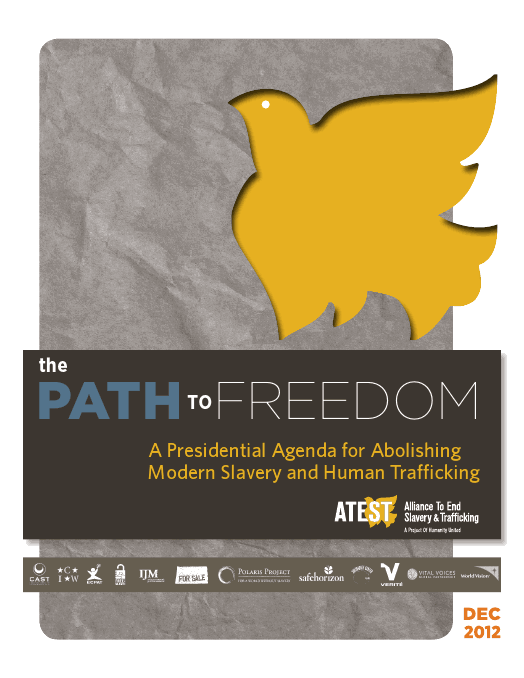
Some countries have renewed their efforts to combat this grossly inhumane for-profit industry. Today, the Alliance to End Slavery and Trafficking (ATEST) wanted to remind President Obama of his September pledge at the Clinton Global Initiative where he vowed to step-up efforts to abolish human trafficking in the United States.
The organization created a road map for the administration by listing 84 detailed recommendations to help the President achieve his pledge. Titled The Path to Freedom: A Presidential Agenda for Abolishing Modern Slavery and Human Trafficking, the report, according to David Abramowitz, vice president for Policy & Government Relations, Humanity United and an ATEST Spokesperson, “is a step-by-step guide for Administration action that will increase protection for human trafficking victims, put more offenders behind bars and improve awareness and prevention efforts.”
Highlights of the recommendations include:
- Begin immediately to work with Republicans and Democrats in Congress to reauthorize the lapsed Trafficking Victims Protection Act (TVPA), which provides critical resources and new tools in the fight against human trafficking and modern-day slavery;
- Develop a National Action Plan based on a “whole of government approach” that coordinates all available resources and tools instead of providing piecemeal solutions;
- Back up its commitment to fighting human trafficking and modern-day slavery with an FY14 budget request that fully funds critical initiatives; and
- Partner with willing countries to create innovative, focused and comprehensive approaches to combat human trafficking, forced labor, and other forms of modern-day slavery around the world.
In addition to seeking bipartisan and multinational cooperation, the report’s authors also stress that the administration must also include the voices of survivors.
As survivors of this crime they are one of the best resources to understand how the U.S. government can ensure a victim-centered approach to addressing modern-day slavery and prevent this crime from occurring in the first place.Too often, survivor voices remain absent from important discussions and decisions concerning promising practices, protocols for services, and other tools to combat modern-day slavery.Survivors should be treated as stakeholders. Survivors are more than just a story; they need to be viewed as important participants in discussions on human trafficking.
Saturday, July 16, 2011
Nita Belles: A Christian Call to End Human Trafficking

Nita Belles
Posted: 6/29/11 07:54 PM ETIf you believe that human trafficking -- modern-day slavery -- primarily takes place in Asia, Africa and Eastern Europe, you're like most people.
There are more slaves in the United States today than at any time in history. Upon learning that fact people often ask me, "What can I do to help stop modern-day slavery or human trafficking?" Reading this article is a good start.
There is nothing the criminals involved in the modern-day atrocities of human trafficking and slavery -- the recruiters, the traffickers, the pimps and others -- want more than for decent people to remain ignorant about what they do. All they ask is that we do nothing. Simple silence. If the myth that "it doesn't happen here" can prevail, they have won.
This paragraph from my book, "In Our Backyard: A Christian Perspective on Human Trafficking in the United States," is part of the battle call to Christians to take up the fight against slavery as Christians did in the Underground Railroad.
Jesus was clear about Christian's responsibility to do something regarding issues such as human trafficking when he told the parable of the Good Samaritan. When asked what it takes to inherit eternal life, Jesus immediately replied we must love God with all our heart and love our neighbor as ourselves. To clarify, he pointed to someone who sacrificially cared for a socially outcast stranger who had been stripped, beaten and left for dead. Jesus said "Go and do likewise."
In Luke 4:18-19 Jesus describes his mission. It includes evangelism, healing and proclaiming freedom for prisoners, and releasing the oppressed. That certainly describes the list below:
• There are 27 million slaves in the world today.
• Human trafficking is the second largest -- and fastest growing -- criminal enterprise in the world.
• About 80 percent of all U.S. trafficked individuals are female, about 50 percent are children.
• In addition to the 100,000 youngsters trafficked annually, 244,000 to 325,000 American children are at risk for sexual exploitation and sex trafficking every year.
Although more brutal than ever, modern-day slavery is not as obvious as it was centuries ago. Today human trafficking isn't limited by race, class or gender. Victims are not just the poor or disenfranchised. They come from every socio-economic group. And U.S. victims are not just foreign-born nationals. In fact, the vast majority of sex-trafficked children are American-born citizens.
Modern-day slavery looks like the fresh-faced young girl or boy who is being sold for sex by a pimp via the Internet. It looks like the domestic worker living with a family who abused her physically and sexually and where she lives in fear for her life. It looks like the factory or migrant worker who lives in a compound with barbed wire designed to keep slaves in, rather than bad guys out.
Human trafficking is the dirty secret that has been hidden too long in our country. It is in every state of this great country, from large cities to small towns to rural areas. It's in our backyard whether we live in the city or the countryside.
In written testimony Ernie Allen, President & CEO of the National Center for Missing & Exploited Children, quoted one police commander who told him, "The only way not to find this problem in any community is simply not to look for it."
But wait. There is some good news here. One in three human trafficking victims is rescued because someone saw something that didn't look just right and reported it. If you are reading this article, you could be one to notice that incongruous detail and spare a young girl or boy or an adult a life of torture and pain.
Learning to recognize the signs of human trafficking is not as difficult as it may sound. From my experience, once you're aware, you will no longer aid and abet the traffickers with silence, but be an effective weapon in the fight to stop human trafficking. In following Christ's example, stopping my busy lifestyle to help is a must.
In short, as Christians each one of us can and should help protect our children and others from this horrific crime in our backyard. And indirect ministry such as prayer, donations of time or money, are no more valid than front line work. Whether by prayer, being aware, or giving time or money, faith means taking action. James put it well, "In the same way, faith by itself, if it is not accompanied by action, is dead" (James 2:17).
If you would like to be the hero of faith who opens the door to freedom for an enslaved stranger, I would urge you to read "In Our Backyard" or learn to recognize the signs of human trafficking by searching other resources.
Be a hero. Simple silence is simply not an option.Nita Belles: A Christian Call to End Human Trafficking

Wednesday, December 1, 2010
Plan to End Slavery Earns Grawemeyer Award -- LOUISVILLE, Ky., Nov. 29, 2010 /PRNewswire-USNewswire/ --
 Image by redmaxwell via Flickr
LOUISVILLE, Ky., Nov. 29, 2010 /PRNewswire-USNewswire/ -- A blueprint for eliminating modern slavery has earned its creator the 2011 University of Louisville Grawemeyer Award for Ideas Improving World Order.
Kevin Bales, president of Free the Slaves, a human rights organization based in Washington, D.C., won the $100,000 annual prize for ideas set forth in his 2007 book, "Ending Slavery: How We Free Today's Slaves."
In the book, Bales outlines steps to end the enslavement of some 27 million people worldwide. Slavery and human trafficking are tightly interwoven into the modern global economy, so new political and economic policies must be enacted to suppress them, he says.
Slavery, illegal in every country but still widely practiced, can be stopped within 30 years at a cost of less than $20 billion, a much cheaper price tag than most other social problems, he argues.
Several high-profile organizations already have adopted elements of Bales' plan.
In 2008, the U.S. Congress passed the William Wilberforce Trafficking Victims Reauthorization Act, an anti-slavery law which includes recommendations from his book. The non-profit group International Justice Mission added "the end of slavery" to its goals, while Lexis-Nexis' charitable foundation gave away hundreds of copies of "Ending Slavery" to the American Bar Association.
"Bales lays out an urgent human challenge, offers ways to make a difference and challenges the reader to become part of the solution," award jurors said.
Since 2001, Bales' group has liberated thousands of slaves in India, Nepal, Haiti, Ghana, Brazil, Ivory Coast and Bangladesh.
A consultant to the U.N. Global Program on Trafficking of Human Beings, Bales also has advised governments in Britain, Ireland, Norway and Nepal on slavery. He developed policies on slavery and human trafficking for the West African States, co-wrote a report on forced labor for the International Labor Office and studied human trafficking in the United States for the National Institutes of Justice.
In 2008, the Association of British Universities named his work one of the top "100 world-changing discoveries." His 1999 book, "Disposable People: New Slavery in the Global Economy," was translated into nine languages and made into a documentary that won Emmy and Peabody awards.
Five Grawemeyer Awards are presented each year for outstanding works in music composition, ideas improving world order, psychology, education and religion. Winners of the other 2011 Grawemeyer Awards also are being announced this week.
SOURCE University of Louisville
Plan to End Slavery Earns Grawemeyer Award -- LOUISVILLE, Ky., Nov. 29, 2010 /PRNewswire-USNewswire/ --
Subscribe to:
Posts (Atom)
