Showing posts with label Barack Obama. Show all posts

Thursday, August 21, 2014

5 Things You Didn't Know About Human Trafficking | Rolling Stone

Source: Rolling Stone:


By  | 

Human trafficking is a travesty that many consider a problem of the past, or at least one limited to outside the United States. Unfortunately, in today's globalized society, the problems of human trafficking are embedded in aspects of Americans' daily lives in ways that many may not be aware of – taking on new forms and presenting new challenges for human-rights defenders worldwide.

President Obama has called the figt against human trafficking one of the great human-rights causes of our time. Though statistics vary widely, human trafficking is estimated to impact between 600,000 and 800,000 people worldwide; between 14,500 and 17,500 people are trafficked into the United States annually. Next year will mark the 150th anniversary of the 13th Amendment, which abolished slavery in the U.S., but freedom remains elusive for many. Here's why:


Read more: http://www.rollingstone.com/politics/news/5-things-you-didnt-know-about-human-trafficking-20140819#ixzz3B3HD2G5C

Tuesday, May 13, 2014

Denise Brennan Examines America's Labor Trafficking Problem - US News

Source: US News

By


President Obama called the fight against human trafficking “one of the great human rights causes of our time” and doubled down on efforts, which have been ongoing since 2000, to combat it. But 14 years after the passage of landmark anti-trafficking legislation, eradication of this form of exploitation remains elusive. In “Life Interrupted: Trafficking into Forced Labor in the United States,” Denise Brennan, chair of the department of anthropology at Georgetown University, uses a decade of field work to explain human trafficking and to identify its causes. She recently spoke to U.S. News about
misconceptions that have caused setbacks and what she says needs to be done to protect the vulnerable. Excerpts:


Continue: 

http://www.usnews.com/opinion/articles/2014/04/24/denise-brennan-examines-americas-labor-trafficking-problem
Enhanced by Zemanta

Wednesday, August 28, 2013

William Wilberforce's heirs are ready to tackle the great evil of the age - Telegraph

Source: Telegraph


"The picture of slavery in modern Britain exists in fragments, scattered around the news pages, so horrific and anachronistic that you can barely discern a pattern. The first problem is terminological. If Wilberforce and Thomas Clarkson had spent the 1780s mumbling about “human trafficking”, it’s unlikely that anyone would have paid attention. It was Barack Obama who said last year that it was time to call modern slavery by its name. If girls are being forced into domestic service and beaten if they try to leave, it’s slavery. If Lithuanian workers are being kept in debt bondage working on a Kent chicken farm, that’s slavery." 

Continue here:
http://www.telegraph.co.uk/news/politics/david-cameron/10259927/William-Wilberforces-heirs-are-ready-to-tackle-the-great-evil-of-the-age.html
Enhanced by Zemanta

Thursday, February 7, 2013

Broward Human Trafficking Coalition grows as awareness does, too - Sun Sentinel

http://articles.sun-sentinel.com/2013-02-05/news/fl-human-trafficking-meeting-20130204_1_law-enforcement-victims-pace-center

Source: Sun Sentinel


Broward Human Trafficking Coalition a forum for law enforcement, community workers

  • Andy Rodriguez and Cynthia Tapia-Rodriguez, Broward County Public Schools counselors, after the Feb. 5 meeting of the Broward Human Trafficking Coalition.
Andy Rodriguez and Cynthia Tapia-Rodriguez, Broward County Public Schools… (Brett Clarkson/South Florida…)
February 5, 2013|By Brett Clarkson, Sun Sentinel
Adriane Reesey remembers that small, first meeting in a church back in 2008.
There were about seven people, all of them gathered to discuss an age-old issue – slavery – that was beginning to be viewed in a new context.
And so that Broward Human Trafficking Coalition was born.
"We started out as a working group," said Reesey, a Broward Sheriff's Office community specialist and chair of the coalition. "I wanted to take it to the next level. It needed to have everybody sitting around the table."

On Tuesday, about 65 people sat around a series of tables arranged in a giant horseshoe in a meeting room at Central Broward Regional Park, near Sunrise Boulevard and State Road 7 in Lauderhill.
"It's a blessing to see the room full of people," said Cynthia Tapia-Rodriguez, a family counselor with Broward County Public Schools who has been attending the coalition meetings for four years.
The focus of the meetings? Human trafficking, or, as law enforcement would say, the exploitation of victims through force, fraud or coercion for financial gain.
Among those attending Tuesday were representatives from law enforcement, shelters for at-risk youth and adults, schools, the justice system, and others whose work puts them in contact with potential victims of a crime that President Barack Obama highlighted in September as "modern slavery."
Their goal is to get the public thinking about the crime and its victims: young people preyed upon by coercive pimps, adults recruited falsely into jobs that turn out to be forced sex work, labor trafficking victims forced to work on farms for no pay, or women forced to perform sex acts in brothels posing as legitimate massage establishments.
Other victims can be found in restaurants, hotels, nail salons, or virtually any other business, law enforcement and human trafficking experts say.
"Some of our victims don't even know they're victims," said Aggie Pappas, founding executive director of the Pace Center for Girls Broward, a counseling center for girls between the ages of 11 to 18.
Pappas was referring to situations involving vulnerable young women and girls who are lured or "groomed" by an exploiter who showers them with gifts and affection – then pimps them out. The victims, some of whom love their trafficker, don't realize they are being coerced and exploited.
"There's definitely a Stockholm Syndrome that is taking place," Pappas said.
But the awareness is starting to trickle down from law enforcement to even the youngest among us, noted one Broward Schools counselor whose 11-year-old son started asking questions recently.
Andy Rodriguez, a family counselor, said his son Gabriel became curious about human trafficking after hearing about Toronto Blue Jays pitcher R.A. Dickey's recent trip to India. Dickey traveled to Mumbai in January to bring attention to child sex trafficking in India.
Rodriguez, who has experience working with kids exposed to gang activity, said students who are aware of a human trafficking situation – but might not feel comfortable talking to police – should feel safe talking to a teacher or counselor.
"They should go to a safe person," Rodriguez said. "They need to be aware they can go to somebody."
bsclarkson@tribune.com, 561-243-6609 or Twitter @BrettClarkson_

Enhanced by Zemanta

Sunday, February 3, 2013

Forget 'Django Unchained' — Human Trafficking is the New Face of Slavery

http://www.policymic.com/articles/24314/forget-django-unchained-human-trafficking-is-the-new-face-of-slavery

Source: Policymic


forget, django, unchained, —, human, trafficking, is, the, new, face, of, slavery,
Forget Django Unchained — Human Trafficking is the New Face of Slavery

The blood-splashing Western Django Unchained deals with America’s horrible slavery past. The Academy Award-nominated film follows Django, a freed slave, finding his way to free Broomhilda, Django’s wife, alongside a bounty hunter.

Django was unchained, and slavery was abolished, in 1865 with the ratification of the Thirteenth Amendment. Now, 148 years later, Barack Obama has declared January of 2013 National Slavery and Human Trafficking Prevention Month. Modern day slavery is human trafficking, and it is not a new phenomenon. With globalization, the increasing accessibility of travel, and an international black market, the new face of slavery has developed and expanded.
Today, around 12-27 million boys, girls and women are victims of trafficking. The new face of slavery involves physical and psychological coercion. People have become disposable and economically profitable. Trafficking as we know it now involves sex traffickingforced labor, involuntary servitude, or debt bondage. These human rights violations happen in various industries and markets, such as hotel services, agriculture, domestic service, street prostitution and brothels, to mention only a few.
Forget the slave trade triangle of supply-demand Europe-Africa-America: Today's routes are scattered. Countries are affected as a source, transit or destination point. Mexico, Thailand, Guatemala, Honduras, India and Philippines were the top countries of origin for foreign victims in 2011, according to 2012 Trafficking in Persons Report. While the U.S. is a common destination, it is also a transit and source country. The TIP report notes that “a sex trafficking victim from the United States was identified in Croatia.”
In other words, human trafficking is not just an issue “over there.”
Have you heard about the young aspiring singer in Missouri trafficked by the man helping her make her dream come true? Perhaps you know a teenager running away from home? “One out of every seven children will run away from home before the age of 18,” states the Protection Project’s TVPA in 4 Colors report. Between 1,300,000 and 2,800,000 homeless runaway youth live on the streets, easy victims of domestic trafficking for commercial sexual exploitation. Insome cases, the boyfriend turns out to be a pimp.
Though you don’t see chains, slavery could happen in your neighborhood.  
With Django, it was obvious that he was a slave from the very start of the movie. The sound and sight of the chains clinging and digging into his feet imprinted itself in my mind. The new face of slavery is different; a person can become a victim of trafficking independent of ethnicity, gender, class, nationality or education-level. Still, slavery is difficult to spot. The issue is often neglected because of who it impacts the most, according to GEMS founder Rachel Lloyd: “Low-income people, people of color, and people in the juvenile system — those who are not high on anybody’s priority list.”
Hope for a better future drives people to be attracted to opportunities that might seem shady. The common push and pull factors of economic insecurity, discrimination, dissolution of families and lack of education and employment opportunities can push anyone into trafficking, like 14-year-old Keisha, a girl who fell into the invisible chains of physical and psychological coercion.
After running away from her foster home, she fell into the first phase of the trafficking process. She was recruited by a man concealing himself as a friend helping find her biological family. The situation turned into the second phase where the transportation to the destination occurs. He paid for her travel to Florida to find her family, but he coerced her into commercial sexual activities to cover the cost of stay and return travel. Through threats that she would never see anyone else in her family if she did not engage in sex with other men of his choosing, Keisha felt like she had no choice when she found herself in the third phase: exploitation.
It is essential that girls like Keisha be treated as human beings to restore their dignity. Somaly Mam, the founder of AFSEIP Cambodia (Acting for Women in Distressing Situations), and a survivor of sex trafficking herself, explains, "You can’t just go into brothels and get the women. You have to empower them, be with them, and listen to them. Don’t look at them as victims, but as human beings."
How can we free slaves, like Django and the bounty hunter? (Though with less bloodshed.) Throughout the movie, the bounty hunter follows the Three Musketeers motto “One for all and all for one.” Education is a key solution to prevent and protect. Take action to act as “one for all” and educate yourself on the ways to contribute to ending modern slavery.
Picture Credit: Journal Live

Enhanced by Zemanta

Thursday, December 27, 2012

Virginia Releases Report on Human Trafficking Services Needs

Virginia Releases Report on Human Trafficking Services Needs:
VA Victims Services Report Inforgraphic 2012When survivors of human trafficking are able to leave their trafficking situation, it is vital that they have access to services that will help them rebuild their lives. Legislation that supports victim assistance is an imperative step towards providing these services.
Holly Austin Smith, a survivor of child sex trafficking, described how these laws could have made a difference during her recovery process. Smith said,
“I am… a big advocate for the victim assistance law. After I was trafficked, I received no assistance at all: no counseling, no support. I was put back into the situation from which I was running in the first place. I attempted suicide within days of my rescue. In fact, that was the only way I got counseling, because I was put into a psychiatric facility. Victims of trafficking need immediate aftercare and placement and counseling from therapists who have been trained in this type of victimization.”
Virginia has been improving access to services since 2011 when the state passed HB 2190. This law requires the Department of Social Services to develop a plan for the delivery of services to victims of human trafficking. Since then, the Department of Social Services has formed a steering committee and has begun to review current victim service needs in Virginia. The committee is comprised of representatives from victim service organizations, law enforcement, academia, and survivors of trafficking.
Next, the Department of Criminal Justice Services (DCJS) conducted an online survey on human trafficking services in the summer of 2012. The survey asked staff at state parole agencies, correctional facilities, domestic violence and sexual assault service providers, and other core agencies to  identify what resources are available to assist them in their work with human trafficking victims.
The report (pdf) found that overall, 53% of all responding agencies do not know whether or not there is a human trafficking services organization in their local service area. Of those agencies that could identify a services organization, nearly all are located in the Washington D.C. / Baltimore / Northern Virginia metropolitan areas. Further, none of the responding agencies have formal procedures or protocols that guide how to serve trafficking victims.
According to the report, trafficking victims’ most needed services include food, emergency housing, sexual assault services, counseling, case management, and coordination of services. The report also found that trafficking victims need this assistance for about 3 months. However, over 80% of agencies said that their organization is unable to adequately meet the needs of trafficking victims and the majority of respondents felt that more training is needed to improve services to victims.
Without the passage of HB 2190, the commonwealth of Virginia would still be unaware of these gaps. Importantly, this report helps to provide a road map for human trafficking advocates, organizations, and government entities in Virginia. There is a great need for continued training, especially with those organizations that have the ability and capacity to provide services to victims of trafficking, but perhaps do not have the experience or knowledge to do so.
With this report, the leadership of the Department of Social Services and the Department of Criminal Justice Services in Virginia have begun to lay the groundwork for fundamentally transforming the way that victims interface with service providers and government entities. They should be commended for bringing interested stakeholders together, identifying gaps in knowledge and resources, and mapping out what needs to be done to improve services to victims after they are identified in the Commonwealth. Next, they will need to work to execute that plan.
Laws can make a difference when they are implemented effectively. The recent report by the Department of Social Services and their ongoing work in Virginia demonstrate how laws can transform government action and put survivors of human trafficking first.
Enhanced by Zemanta

Monday, December 24, 2012

20 Ways You Can Help Fight Human Trafficking

http://www.state.gov/j/tip/id/help/index.htm

Source: US State Department


After first learning about human trafficking, many people want to help in some way but do not know how. Here are just a few ideas for your consideration.
1. Learn the red flags that may indicate human trafficking and ask follow up questions so that you can help identify a potential trafficking victim. Human trafficking awareness training is available for individuals, businessesfirst responderslaw enforcement, and federal employees.

2. In the United States, call the National Human Trafficking Resource Center at 1-888-3737-888 (24/7) to get help and connect with a service provider in your area, report a tip with information on potential human trafficking activity; or learn more by requesting training, technical assistance, or resources. Call federal law enforcement directly to report suspicious activity and get help from the Department of Homeland Security at 1-866-347-2423 (24/7), or submit a tip online at www.ice.gov/tips, or from the U.S. Department of Justice at 1-888-428-7581 from 9:00am to 5:00pm (EST). Victims, including undocumented individuals, are eligible for services and immigration assistance.

3. Be a conscientious consumer. Discover your Slavery Footprint, and check out the Department of Labor’s List of Goods Produced by Child Labor or Forced LaborEncourage companies, including your own, to take steps to investigate and eliminate slavery and human trafficking in their supply chains and to publish the information for consumer awareness.

4. Incorporate human trafficking information into your professional associations’ conferences, trainings, manuals, and other materials as relevant [example].

5. Join or start a grassroots anti-trafficking coalition.

6. Meet with and/or write to your local, state, and federal government representatives to let them know that you care about combating human trafficking in your community, and ask what they are doing to address human trafficking in your area.

7. Distribute public awareness materials available from the Department of Health and Human Services or Department of Homeland Security.

8. Volunteer to do victim outreach or offer your professional services to a local anti-trafficking organization.

9. Donate funds or needed items to an anti-trafficking organization in your area.

10. Organize a fundraiser and donate the proceeds to an anti-trafficking organization.

11. Host an awareness event to watch and discuss a recent human trafficking documentary. On a larger scale, host a human trafficking film festival.

12. Encourage your local schools to partner with students and include the issue of modern day slavery in their curriculum. As a parent, educator, or school administrator, be aware of how traffickers target school-aged children.

13. Set up a Google alert to receive current human trafficking news.

14. Write a letter to the editor of your local paper about human trafficking in your community.

15. Start or sign a human trafficking petition.

16. Businesses: Provide internships, job skills training, and/or jobs to trafficking survivors. Consumers: Purchase items made by trafficking survivors such as from Jewel Girls or Made by Survivors.

17. Students: Take action on your campus. Join or establish a university or secondary school club to raise awareness about human trafficking and initiate action throughout your local community. Consider doing one of your research papers on a topic concerning human trafficking. Professors: Request that human trafficking be an issue included in university curriculum. Increase scholarship about human trafficking by publishing an article, teaching a class, or hosting a symposium.

18. Law Enforcement Officials: Join or start a local human trafficking task force.

19. Mental Health or Medical Providers: Extend low-cost or free services to human trafficking victims assisted by nearby anti-trafficking organizations. Train your staff on how to identify the indicators of human trafficking and assist victims.

20. Attorneys: Look for signs of human trafficking among your clients. Offer pro-bono services to trafficking victims or anti-trafficking organizations. Learn about and offer to human trafficking victims the legal benefits for which they are eligible. Assist anti-trafficking NGOs with capacity building and legal work.


Enhanced by Zemanta

Thursday, December 20, 2012

New report creates a pathway for Obama administration to abolish modern-day slavery | Latina Lista

http://latinalista.com/2012/12/new-report-creates-a-pathway-for-obama-administration-to-abolish-modern-day-slavery/

Source: n Latina Lista


LatinaLista — It’s estimated that 27 million people are victims of child prostitution, forced labor, sex trafficking, domestic servitude and other forms of modern-day slavery. It has become a $32 billion industry worldwide, second only to drug trafficking.
Some countries have renewed their efforts to combat this grossly inhumane for-profit industry. Today, the Alliance to End Slavery and Trafficking (ATEST) wanted to remind President Obama of his September pledge at the Clinton Global Initiative where he vowed to step-up efforts to abolish human trafficking in the United States.
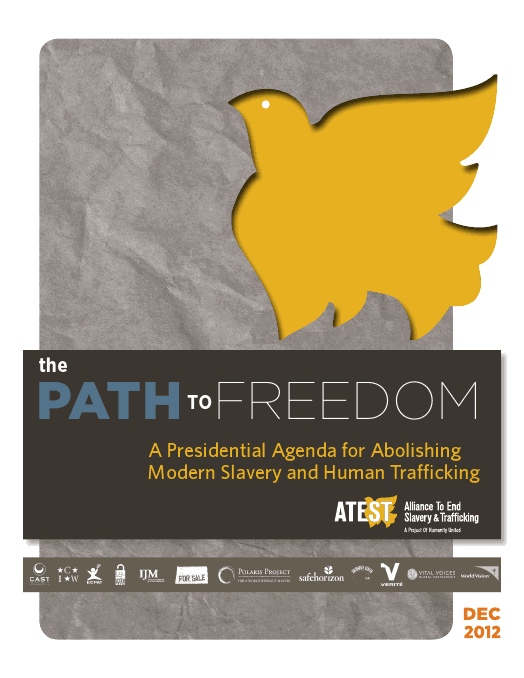
The organization created a road map for the administration by listing 84 detailed recommendations to help the President achieve his pledge. Titled The Path to Freedom: A Presidential Agenda for Abolishing Modern Slavery and Human Trafficking, the report, according to David Abramowitz, vice president for Policy & Government Relations, Humanity United and an ATEST Spokesperson, “is a step-by-step guide for Administration action that will increase protection for human trafficking victims, put more offenders behind bars and improve awareness and prevention efforts.”
Highlights of the recommendations include:
  • Begin immediately to work with Republicans and Democrats in Congress to reauthorize the lapsed Trafficking Victims Protection Act (TVPA), which provides critical resources and new tools in the fight against human trafficking and modern-day slavery;
  • Develop a National Action Plan based on a “whole of government approach” that coordinates all available resources and tools instead of providing piecemeal solutions;
  • Back up its commitment to fighting human trafficking and modern-day slavery with an FY14 budget request that fully funds critical initiatives; and
  • Partner with willing countries to create innovative, focused and comprehensive approaches to combat human trafficking, forced labor, and other forms of modern-day slavery around the world.
In addition to seeking bipartisan and multinational cooperation, the report’s authors also stress that the administration must also include the voices of survivors.
As survivors of this crime they are one of the best resources to understand how the U.S. government can ensure a victim-centered approach to addressing modern-day slavery and prevent this crime from occurring in the first place.
Too often, survivor voices remain absent from important discussions and decisions concerning promising practices, protocols for services, and other tools to combat modern-day slavery.
Survivors should be treated as stakeholders. Survivors are more than just a story; they need to be viewed as important participants in discussions on human trafficking.

Enhanced by Zemanta

Saturday, December 8, 2012

International Development - Fighting human trafficking: 5 lessons from the field

http://www.devex.com/en/news/fighting-human-trafficking-5-lessons-from-the/79899?source=ArticleHomepage_MostPopularNews_4&goback=%2Egde_4165508_member_193690185

Source: DEVEX,COM

Women-Trafficking.jpg
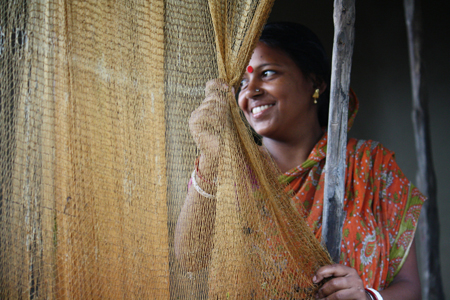
A woman from a fishing village in West Bengal in India. Her village is known for high levels 
of trafficking of women and girls. Photo by: Anindit Roy-Chowdhury / UN Women / CC BY-NC-ND


By Carol Michaels O'Laughlin on 05 December 2012

In the coming days, an important worldwide campaign against gender-based violence will come to an end. These “16 Days Against Gender Violence” began on Nov. 25, the International Day for the Elimination of Violence Against Women, and they will end Dec. 10 on Human Rights Day.

This campaign comes two months after U.S. President Barack Obama, in an address to Clinton Global Initiative, outlined new measures to tackle modern slavery in the United States and abroad. He called on the international community to step up efforts in assisting an estimated 20 million victims trafficked worldwide.

The attention to the issue and the new steps to eradicate human trafficking are timely and critical, as is the discussion on the lessons already learned about addressing the problem.

Trafficking in persons is a global phenomenon that is an affront to basic human rights across countries and cultures. Many forms of inequality are woven into what creates an enabling environment for trafficking, including income disparities, ethnicity, age, sexual orientation, and gender discrimination. Men, women and children are trafficked for forced labor, sexual exploitation, their organs, and petty crimes.

As a result, they suffer profound trauma that spreads to their families and communities. The situation of women and girls is often worsened by prevalent gender stereotypes and discrimination that makes them more vulnerable and prevents effective recovery.

For the past two decades, public and private organizations around the world have been fighting human trafficking. Their work has yielded important results and lessons for consideration by the international community.

1. Message mishaps

Some messages used around the world to counter human trafficking have failed to lower women’s vulnerabilities and may have worsened their situations. In Asia and Europe, past campaigns scared, rather than informed, women of the risks of trafficking. Posters that depicted traffickers kidnapping and beating women, and messages such as “Let’s protect our women” and “Do not trust anyone offering a job to a woman – he is a trafficker,” perpetuated the stereotype that women cannot migrate safely or find legitimate work, which results in higher seclusion of women looking for a way out.

Conversely, the following messages have shown to be effective in reducing stigma and engaging communities in dialogue and joint action: “Safe migration can lead you to a better future; check all the necessary papers yourself,” “What do you understand of the suffering of a survivor of human trafficking?” and “People who have survived trafficking are now fighting against it; are you with them?”

2. Focus on livelihoods

Economic instability is an important root cause of trafficking and many anti-trafficking initiatives have failed to address it, partly due to limited resources. Experience has shown that prevention or reintegration is not complete until a survivor or at-risk woman is economically self-sufficient. Skills training, educational support and business start-up assistance have empowered women to restore their self-confidence and pave the way to a better future for themselves and their families.

3. Alternatives to full-time shelters

Security and full-time care are critical for survivors’ recovery, but severe restrictions on the freedom of shelter residents can lead to increased feelings of isolation and despair. Various organizations have taken steps to offer different models of care suited to the circumstances of individual survivors, including drop-in centers offering psycho-social support, job skills training and legal aid. Transit centers, where survivors can stay for a few days, are currently being piloted in Asia to reduce dependence on home shelters and promote reintegration of survivors in communities of their choice.

4. Importance of family counseling

While reintegration standards have been improving over the past decades, one important aspect often remains unaddressed. It is common for families in certain regions to be complicit in the exploitation of their children. Despite this reality, it is not uncommon to see trafficking survivors being returned to the same vulnerable situation that led them to being trafficked in the first place – in many cases to an even more unstable situation, since family culpability and community rejection can be high for a survivor of trafficking. Initiatives to integrate family and community counseling into survivor case management are necessary to ensure that survivors return to supportive environments.

5. Qualified personnel

Another persistent challenge in assisting trafficking survivors in developing countries is the low qualification and competency of psychologists and social workers who frequently harbor biases against the women and girls in their care. In some cases, social workers have urged women to forget their experience and hide their past, leaving victims with unresolved feelings of shame and the fear that their past might be uncovered. Some organizations in South Asia have proposed marriage as a strategy for reintegration and spread the idea that to marry a victim of trafficking is an act of piety, condemning these women to live with men who do not respect them. Recognition of the problem and intensive training with all staff who work with survivors is needed to develop a decent, respectful and needs-based support system.

During these 16 Days Against Gender Violence, we thank the thousands of volunteers and professionals who are empowering communities to respect and protect the rights of every citizen and who are making a difference for generations to come.

This article is based on the paper Addressing inter-linkages between gender-based violence & trafficking in persons to prevent reinforcement of inequalities, published as part of Global Thematic Consultation on Addressing Inequalities.

Enhanced by Zemanta