Showing posts with label Council of Europe. Show all posts

Monday, April 15, 2013

Slavery: the case for compensation | Global Development Professionals Network | Guardian Professional


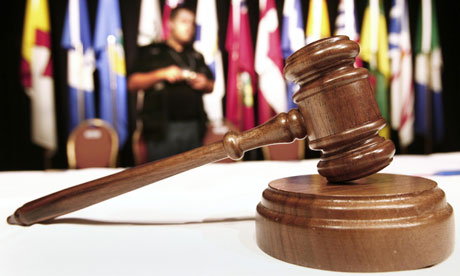
Gavel to be used during meeting between Native groups and First Ministers sits on table in Kelowna
Most European countries provide the right to compensation for trafficking victims from perpetrators and the state, but few receive any. Photograph: Andy Clark/Reuters
The Council of Europe's 2005 anti-trafficking convention gives people who have suffered the ultimate indignity of being sold and exploited as commodities the chance to stand up and demand justice for the unspeakable wrongs they have suffered.
TO CONTINUE, GO TO:

Enhanced by Zemanta

Wednesday, September 12, 2012

BBC News - Trafficked children in UK council care 'going missing'

http://www.bbc.co.uk/news/uk-19566617

Source: BBC New

11 September 2012


Some children trafficked into the UK are going missing from local authority care, a Council of Europe report says.
It says there are indications that increasing numbers of people are being brought into the UK for the purposes of sexual exploitation and forced labour.
The council raises particular concerns over a lack of secure and suitable accommodation for trafficked children who end up in local authority care.
It calls for better trained supervisors or foster carers for them.
The Council of Europe's Greta (Group of Experts on Action Against Trafficking in Human Beings) says reports suggest a "significant" number of trafficked children in local authority care go missing and some end up rejoining those who exploited them in the first place.
Its report says hundreds of people have been identified as victims of trafficking in the UK but only 56 people were convicted of human trafficking in 2009 and 29 the following year.
The common countries of origin were China, Vietnam, Romania, the Czech Republic, Slovakia, Albania, Nigeria, Uganda and India, the report says.
Children tended to be brought in for the purposes of sexual exploitation, domestic servitude, benefit fraud, cannabis farming and forced begging and stealing.
Greta acknowledges good work is going on around the UK but it found inconsistent approaches in different areas.
Intelligence gap
Greta also highlights what it describes as a significant intelligence gap on trafficking, saying the levels of trust and co-operation between victim support services and law enforcement agencies need to be improved.
The Council of Europe says on its website that it aims to "develop throughout Europe common and democratic principles based on the European Convention on Human Rights and other reference texts on the protection of individuals".
This is its first assessment of human trafficking in the UK since the anti-trafficking convention came into force in the UK in April 2009.
As well as improvements regarding care of trafficked children, Greta recommends a number of actions:
  • More needs to be done to separate the identification of trafficking victims from decisions on immigration or asylum and it points out that quick decisions on immigration status can prevent victims being recognised
  • Victims of human trafficking need assistance and support regardless of when the trafficking actually took place
  • Prosecutors across the UK need guidance to ensure trafficking is considered as a serious violation of human rights and victims of trafficking should not receive penalties for their involvement in illegal activities carried out under duress
  • The assisted voluntary return programmes should be reviewed to check whether they are appropriate for victims of trafficking.
Enhanced by Zemanta

Sunday, March 4, 2012

World's first sex trafficking opera to premiere in UK - News - Classical - The Independent

http://www.independent.co.uk/arts-entertainment/classical/news/worlds-first-sex-trafficking-opera-to-premiere-in-uk-7534762.html

Source: The Independent


Groundbreaking production about women forced into prostitution opens in Liverpool this week

EMILY DUGAN Author Biography

SUNDAY 04 MARCH 2012

As an art form, opera is more traditionally associated with overblown tales of romance, but this week the world's first opera about human trafficking will premiere in Britain.

Anya17 will open at the Liverpool Philharmonic Hall on Wednesday. It tells the story of a woman brought from Eastern Europe to work in the UK's sex industry. The show's official supporters include the United Nations, Anti-Slavery International and the Salvation Army. Special performances are already being mooted for the House of Lords and the Council of Europe in Strasbourg.

The drama is set in a brothel in an unnamed UK city and in an unspecified Eastern European country. The protagonist, Anya, is trafficked into Britain and forced into prostitution by a man pretending to be her boyfriend. The number 17 in the title comes from the practice of numbering girls on a "menu" in brothels. It is estimated that 800,000 women are trafficked into the EU every year. Nine out of 10 of these are forced to be sex workers in brothels.

The opera's librettist, Ben Kaye, who came up with the concept, said: "We're so used to hearing shocking news bulletins about subjects like this that we can become immune to it. Sometimes you need a different approach to engage people. I did a lot of research to make it accurate – going through stories and talking to case workers who worked with women who had gone through this."

The opera director Sir Jonathan Miller said the project showed no subject should be off-limits. "I think you can do whatever you like in opera. The Death of Klinghoffer was not something you'd expect in an opera, but it works. It's in the nature of any art form that it accommodates novelty. Genres that are thought to be closed turn out to be open-ended."

The cast, taken from the Royal Northern College of Music, went to meet survivors of sex trafficking at sheltered housing in London as part of their research. Andrea Tweedale, who plays Anya, said: "Most of the characters I play are in romantic stories about love, whereas this is very different. As an opera singer you never normally get the chance to raise awareness about serious issues. There are lines I never thought I'd sing: words like 'rump' and 'sodomised'."

The production is directed by the award-winning Caroline Clegg, with music by Adam Gorb.

Iqtadar Hasnain, a spokesman for Anti-Slavery International, said: "As far as we're aware, there has never been an opera on this subject. We hope that people will see it and realise that this is a form of slavery that is happening on their doorstep today."

Enhanced by Zemanta

Monday, December 20, 2010

APA - Azerbaijan hosts seminar on struggle against human trafficking - PHOTO

slideshow

  Slideshow
1/4


[ 15 Dec 2010 10:53 ]

Baku. Hafiz Heydarov - APA. Two-day seminar on struggle against human trafficking and its prevention has kicked off in Azerbaijan, APA reports.

Representatives of the Council of Europe, officials of the Interior Ministry’s Department on Struggle against Human Trafficking and Justice Ministry attend the seminar.

Delivering keynote speech at the event, Chief of the Department on Struggle against Human Trafficking of the Azerbaijani Interior Ministry Javad Shikhaliyev said that Azerbaijan had close cooperation with the Council of Europe in struggle against human trafficking. Shikhaliyev noted that nowadays, one of the issues disturbing the international world was compulsory labor.

“More than 30 countries have joined international convention prepared for the purpose of struggle against human trafficking. Azerbaijan is also among these countries”, said representative of the Council of Europe’s General Secretariat Danuta Wisniewska. Wisniewska added that Azerbaijan was used as a transit country in human trafficking.
Source: .apa.az
[TRAFFICKING MONITOR: Click on link below to view short video.]
http://en.apa.az/news.php?id=136420 

Enhanced by Zemanta

Tuesday, November 2, 2010

Watchdog to monitor action on trafficking - The Irish Times - Tue, Nov 02, 2010

Logo of the Council of EuropeImage via Wikipedia

The Irish Times - Tuesday, November 2, 2010

JAMIE SMYTH, Social Affairs Correspondent

EUROPE’S TOP human rights watchdog has begun monitoring the Government’s actions to tackle human trafficking with the entry into force yesterday of a convention to curb “modern-day slavery”.

Groups working with victims of trafficking welcomed the new supervisory mechanism, which they said they hope will focus attention on low conviction rates for traffickers and inadequate supports for victims in Ireland.

The Council of Europe convention on action against trafficking in human beings commits the Government to protecting the victims of trafficking and prosecuting traffickers.

The council will monitor all measures put in place to tackle trafficking and issue recommendations if it deems the State is not doing enough to tackle the trade.

Ireland is the 30th European state to ratify the council’s convention on human trafficking, which formally entered into force yesterday in the Republic.

The anti-human trafficking group within the Department of Justice says there were six prosecutions for human-trafficking-related offences last year.

In 2009, the Garda investigated 66 cases of potential and suspected human trafficking – 13 cases concluded with no evidence of trafficking found and 53 were still ongoing at the end of the year.

The Immigrant Council of Ireland and Ruhama, which works with women who have faced sexual violence, say they are concerned about the low number of prosecutions of traffickers under the Criminal Law (Human Trafficking) Act 2008.

“This is a source of concern and is an indication that the legislation is new and is difficult to work with,” said Nusha Yonkova, anti-trafficking co-ordinator at the immigrant council.

She said measures included in the Act to protect victims were also being underutilised.

“There are 1,000 women working in prostitution every day in Ireland, and 97 per cent of these are migrant women. Out of more than 60 investigations, just 16 recovery and reflection visas for victims have been issued,” she said.

Sarah Benson, Ruhama chief executive, said enacting legislation to criminalise human trafficking in 2008 was a very positive step. But she said the very few arrests and lack of convictions were a “serious concern”.

Minister for Justice Dermot Ahern welcomed the entry into force of the convention.

“The Council of Europe convention is a very important instrument in the international fight against human trafficking, and its coming into effect for Ireland today is yet another milestone in the Government’s fight against human trafficking,” he said.

“It is a further indication of the Government’s strong commitment to tackling this heinous crime and to protecting its victims.”

TRAFFICKING IN 2009 SIX CONVICTIONS

  • One person was prosecuted for three offences relating to a minor.
  • One person was convicted of an offence of attempting to traffic a child for purposes of sexual exploitation.
  • Three people were convicted in Romania as a result of cross-border co-operation.
Watchdog to monitor action on trafficking - The Irish Times - Tue, Nov 02, 2010

Source: Irish Times

Related articles
Enhanced by Zemanta

Monday, September 6, 2010

Britain's sex trade needs tackling | Denis MacShane | Comment is free | guardian.co.uk

FROM GUARDIAN.CO.UK

By opting out of an EU directive on sex slave trafficking, we continue to ignore the plight of vulnerable girls and women

A powerful three-part Channel 4 series on sex slave trafficking promised more than it delivered. Its timing was excellent: the three-hour film was shown in the week the Guardian revealed the government's decision to opt out of the new EU directive on sex slave trafficking. Twenty years ago a Tory government opted out of EU directives protecting workers. Today David Cameron and Nick Clegg are opting out of a directive aimed at protecting teenagers and young women from being trafficked into the UK's burgeoning brothel and massage parlour industry.

With luck the C4 documentary should alert public opinion to this depressing aspect of globalisation and the new patriarchalism which obliges young women to "have sex with 10 to 15 men a day against their will" as one detective constable told the film-makers. Shot and edited with consummate skill with a breathy linking commentary read by Helen Mirren in the style of Laurence Olivier declaiming the World at War script, the programme eschewed analysis in favour of showing police work in close-up detail. Two small west country forces co-operated fully with C4. The officers came over as decent, good men with female officers on the margin to help arrest women pimps and their victims.

But a huge amount of police time and work, including a trip to Thailand for Devon and Cornwall officers, results in a meagre haul. Minor Chinese and Thai pimps get prison sentences of between 12 and 18 months. At the same time there were court cases against Albanian and Slovakian pimps which resulted in longer prison sentences and details of the most brutal cruelty against trafficked women. There is no shortage of cases in all major cities, though it is not clear why the Devon and Cornwall or Gloucestershire chief constables agreed to co-operate with C4 rather than the Met where more dramatic examples of trafficking abound. But the documentary noted that the Home Office is winding down the Pentameter operations against trafficking. Mirren concluded: "You will find brothels and victims in every English town. Those individuals who use these brothels should think about what they are doing and stop using these services."

Thanks, Helen. Actually it is British men – not genderless "individuals" – who insist on a right to put money down and insert their penises into women's bodies. Serving this demand has led to massive increase in the supply of prostituted women. There is a sterile debate over numbers which C4 sensibly ignored. Getting the figures is impossible. The United Nations' International Labour Organisation says there are 2.45 million women trafficked into sex slavery worldwide. The Red Cross and other global outfits also insist that millions of women are traded. The idea Britain has only a few is laughable, despite a report in the Guardian by Nick Davies claiming that sex slave trafficking was hugely exaggerated. ACPO produced a report recently which talked of 4,000 trafficked women but British NGOs who work with the victims of sex slave trafficking criticised the methodology of ACPO's work and said the figure was much higher.

An organisation called the English Collective of Prostitutes, which has spokespersons but no details of membership or finances, is always available for Newsnight or the Guardian to pooh-pooh the problem of trafficking into or within Britain. Its solution is to legalise prostitution. Where this has been tried as in Nevada, the death and injury rate of prostituted women rises and students at universities in the US state believe it is impossible to rape a prostituted woman.

The C4 film avoided this debate or any effort to examine the ideology of male oppression that lies behind the extraordinary growth in sex trafficking. Detectives held up adverts in the Southampton Echo placed by one of the pimps in which "fresh" bodies were on offer for the delight of Southampton men. There was no challenge to the newspaper editors who are complicit in the sex slave industry by carrying adverts for sexual services.

After one raid, a detective talks to a punter and politely asks him to stay in touch. But there is no arrest even though a brave group of Labour women ministers and MPs changed the law to make it a crime to pay for sex with a victim who has been coerced in any way into working as a prostitute. Another detective described how a trafficked woman's "customer insisted on putting bits of metal into his condom causing her injury". So why wasn't the man arrested and charged? The C4 policemen donned armour and dramatically crashed their way into brothels. But no British male was arrested.

It is only by dealing with the demand side that any real progress will be made in reducing the inflow of trafficked women. The low-life, high-income foreign pimps arrested in the film have thousands ready to replace them because trafficking women is hugely profitable.

One of the last acts of Tony Blair's government was to sign and ratify the Council of Europe's convention on trafficking which I campaigned for in the Commons. The Home Office originally fought the convention, as Whitehall is today trying to derail the EU directive. Later under Gordon Brown the law was changed to make men open to naming and shaming if they paid for sex with a woman who had been trafficked or coerced into working in the sex trade. It is up to the police to apply the law and to editors to stop being accomplices of sex slavery by publishing the industry's adverts. It would be good if the liberal male media establishment could rethink their denigration of campaigners against sex slave trafficking.

The C4 documentary deserves loads of prizes. It was compelling television. But we need analysis, policy and police work to squeeze the demand side.

Britain's sex trade needs tackling | Denis MacShane | Comment is free | guardian.co.uk


Enhanced by Zemanta