
Photo: (Florence Luong)
By Courtney B. Wong
Since first seeing the images of child soldiers in Uganda, the widespread issue of human trafficking has been close to my heart. There are so many injustices in the world today, but the thought of men, women and children being enslaved is unbearable. I NEEDED to do something.
Last year, I quit my full-time job in sales at CBS to begin spreading awareness around human trafficking. This decision was not based on any expert knowledge or policy background. It was driven by my desire to do something against this injustice that so many people do not even know exists. I was shocked that even some of my own friends had not heard of human trafficking.
So what could I do? I decided to take a stand the best way I knew how: through my passion for music and my work with the New York City Urban Project. I wrote a song entitled “Taking a Stand” that captures the reality of this human trafficking atrocity as well as my struggle, as an “onlooker,” to fight apathy and respond to it. I’m going to create a video every month spotlighting an aspect of human trafficking that will help educate the public on the issue.
When I first started this project, I was armed with an old whiteboard, some dry erase markers, and a few nights to get creative. I had no previous knowledge of how to make a video so I decided to make a stop-motion video that would be both short and intriguing. I pulled a couple of all-nighters putting together close to 1,000 photos for a three-minute video, but so far the work has paid off.
The video, "Our Electronics from DR Congo Slavery," has sparked an explosion of tweets and shares, and was retweeted by actress Robin Wright (who’s in "The Girl with the Dragon Tattoo" and "Moneyball").
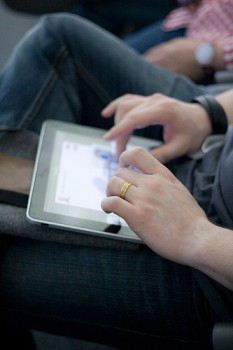
This video focuses on the connection between electronics such as cell phones and iPads and human trafficking and conflict in the Congo. Our gadgets connect us with conflict minerals -- tin, tantalum, tungsten, and gold -- that are sourced from mines in eastern Congo and used in the manufacture of our electronics products.
Why are they called “conflict” materials? These mines are controlled by armed groups who use rape, violence, and enslavement as a way to control local populations. The Enough Project estimates that armed groups take in some $185 million dollars annually trading these minerals, while the World Bank estimates that the miners themselves earn only $5 a day.
As consumers, we are fueling conflict and the use of human trafficking in Congolese mines in the form of debt bondage, child slavery, sexual slavery, and forced marriage when we purchase electronic devices sourced from conflict minerals. I am not saying you should not purchase the latest gadgets, but we should all do so responsibly. Greenpeace has posted a Guide to Greener Electronics, which ranks leaders and laggards in the consumer electronics industry on the use of conflict-free minerals. Check it out as you consider your next purchases.
So be aware of the electronics that you’re buying and make your voice heard! Go to theRaise Hope for Congo website to support conflict minerals legislation that will require companies to clean up their supply chain and no longer source minerals that are funding armed groups in the Congo. It is time to take a stand.
Courtney B. Wong is a singer/songwriter and worship leader who currently lives in New York City and works as a NYC Urban Project artist. Follow Courtney on Twitter (@CourtneyBWong)


 Steve Jobs has stood for a lot of things in his career — business innovation, creative marketing campaigns, an intense hatred of extraneous USB ports — but now he's taking perhaps the most controversial stand yet. He's offering a new kind of freedom on the