Trafficking Hotline Aims To Rescue Thousands Of Kids Who Disappear In South Asia:
(Reporting by Nita Bhalla. Editing by Katie Nguyen. Please credit the Thomson Reuters Foundation, the charitable arm of Thomson Reuters, that covers humanitarian news, women’s rights, trafficking, corruption and climate change. Visit news.trust.org)
Showing posts with label Child pornography. Show all posts
Showing posts with label Child pornography. Show all posts
Thursday, May 19, 2016


Monday, June 15, 2015
1HTC will assist in streamlining and coordinating Anti Trafficking efforts in the South Florida Region
"The commercial sexual exploitation of children (CSEC) in the South Florida Region exists on a large scale and in many forms."
"Stakeholders need to work with existing entities that will create a viable and functioning unit through 1HTC resource provision, technical assistance, education and networking."
Adriane Reesey, http://www.gofundme.com/1HTC-org
TRAFFICKING MONITOR: Please visit and like 1HTC: Thank you.
"Stakeholders need to work with existing entities that will create a viable and functioning unit through 1HTC resource provision, technical assistance, education and networking."
Adriane Reesey, http://www.gofundme.com/1HTC-org
TRAFFICKING MONITOR: Please visit and like 1HTC: Thank you.
Thursday, March 20, 2014
United Nations News Centre - Child trafficking, exploitation on the rise, warns UN expert
Source: United Nations News Centre
13 March 2014 – In an increasingly interconnected world, children are more at risk that ever of being sexually exploited or sold, a United Nations independent expert warned today, calling for decisive steps at the global level to stop crimes such as child prostitution and trafficking.

13 March 2014 – In an increasingly interconnected world, children are more at risk that ever of being sexually exploited or sold, a United Nations independent expert warned today, calling for decisive steps at the global level to stop crimes such as child prostitution and trafficking.
“Millions of girls and boys worldwide are victims of sexual exploitation, even though this issue in recent years has gained increased visibility,” said Najat Maalla M’jid, the Special Rapporteur on the sale of children, child prostitution and child pornography, as she presented her final report to the 25th session of the Human Rights Council, which opened last week and is to wrap on 28 March.
Continue here:
Monday, February 25, 2013
BBC - Travel - The darker side of tourism : Travel Tips
http://www.bbc.com/travel/blog/20130222-the-darker-side-of-tourism
Source: BBC

An estimated 1.2 million children are victims of trafficking each year, and the travel industry – which criminals often use to move and enslave their victims – has become increasingly involved in trying to do something about it. Travellers can play their part, too, by being aware of suspicious activity and supporting companies that have taken a stand against sex tourism and child exploitation.
To date, more than 1,000 travel and hospitality companies in 42 countries have signed The Code, a set of principles to combat child trafficking and abuse that was launched in 1998 by Ecpat (End Child Prostitution, Child Pornography and Trafficking of Children for Sexual Purposes) in Sweden. Travellers can find a list of companies that have signed on the website and they can use Ecpat letters and postcards to encourage other businesses to join too.
Patchareeboon Sakulpitakphon, a Bangkok-based project manager of The Code, said it is “a big step” for companies to sign on, as it requires them to establish an ethical policy on child trafficking and exploitation, train staff on the topic and put a clause in their contracts with suppliers.
“Travellers should understand that this sensitive crime is often ignored by tourism companies because they are simply ignorant or unaware, or because it conflicts with the ideal image of a dream vacation,” she said.
“Others are afraid to take action because they feel it's not their responsibility, or they are afraid of legal ramifications or retaliation from organised crime.”
In fact, Carol Smolenski, executive director of Ecpat USA, said it was slow-going when the organisation first tried to entice US companies to sign The Code in 2004. Just one company – Carlson, which owns the Radisson and Country Inns and Suites hotels – signed, and then there was a six-year stretch before any other US company joined them.
But since 2011, the initiative has gained momentum, with Delta Airlines, Wyndham Worldwide (which includes Wyndham hotels, Ramada, Days Inn and Howard Johnson), Hilton Worldwide and Sabre (owner of Travelocity) all signing on in the US.
“People who work at [hotels or airlines] see funky stuff all the time,” Smolenski said. “But unless they’re trained on what to do, they may not do anything.” Under The Code, front-desk personnel are trained to recognise signs of possible trafficking – such as a girl checking in with no baggage, paying in cash and quickly followed to her room by a man. The company should then have protocols in place to take the next steps.
Many businesses also help spread the word to travellers. For instance, Accor, the worldwide hotel group that includes the Novotel and Sofitel brands, puts up posters on child sex tourism in its hotels and hosts events to raise awareness in Thailand.
Beyond patronising businesses that support The Code, travellers should report suspicious activity. “Instinct kicks in,” Smolenski said, adding that people don’t need much training to know when something isn’t right. If a young girl is dressed up well beyond her years and appears to be in an odd situation, for instance, say something to your tour guide, hotel or travel company, or call the appropriate authorities. Emergency situations warrant a call to local law enforcement. Tips can also be passed onto police or other groups, such as local Ecpat offices or the National Human Trafficking Resource Center hotline in the US.
“It no longer accurate to say that trafficking is more likely to happen in one particular country because in reality, human trafficking occurs in every country,” said Sakulpitakphon, who conceded that there are certain hubs, such as Thailand, Cambodia and Vietnam. However Thailand is also one of the countries in which the travel industry has responded well to The Code. Others are Colombia, Costa Rica, the Netherlands and South Africa.
“It is everyone's responsibility to prevent child sexual exploitation,” Sakulpitakphon said.
Lori Robertson writes the Ethical Traveller column for BBC Travel. You can send ethical dilemmas to bbcethicaltravel@gmail.com.

Source: BBC
An estimated 1.2 million children are victims of trafficking each year. (Stephen Cairns/Getty)
An estimated 1.2 million children are victims of trafficking each year, and the travel industry – which criminals often use to move and enslave their victims – has become increasingly involved in trying to do something about it. Travellers can play their part, too, by being aware of suspicious activity and supporting companies that have taken a stand against sex tourism and child exploitation.
Patchareeboon Sakulpitakphon, a Bangkok-based project manager of The Code, said it is “a big step” for companies to sign on, as it requires them to establish an ethical policy on child trafficking and exploitation, train staff on the topic and put a clause in their contracts with suppliers.
“Travellers should understand that this sensitive crime is often ignored by tourism companies because they are simply ignorant or unaware, or because it conflicts with the ideal image of a dream vacation,” she said.
“Others are afraid to take action because they feel it's not their responsibility, or they are afraid of legal ramifications or retaliation from organised crime.”
In fact, Carol Smolenski, executive director of Ecpat USA, said it was slow-going when the organisation first tried to entice US companies to sign The Code in 2004. Just one company – Carlson, which owns the Radisson and Country Inns and Suites hotels – signed, and then there was a six-year stretch before any other US company joined them.
But since 2011, the initiative has gained momentum, with Delta Airlines, Wyndham Worldwide (which includes Wyndham hotels, Ramada, Days Inn and Howard Johnson), Hilton Worldwide and Sabre (owner of Travelocity) all signing on in the US.
“People who work at [hotels or airlines] see funky stuff all the time,” Smolenski said. “But unless they’re trained on what to do, they may not do anything.” Under The Code, front-desk personnel are trained to recognise signs of possible trafficking – such as a girl checking in with no baggage, paying in cash and quickly followed to her room by a man. The company should then have protocols in place to take the next steps.
Many businesses also help spread the word to travellers. For instance, Accor, the worldwide hotel group that includes the Novotel and Sofitel brands, puts up posters on child sex tourism in its hotels and hosts events to raise awareness in Thailand.
Beyond patronising businesses that support The Code, travellers should report suspicious activity. “Instinct kicks in,” Smolenski said, adding that people don’t need much training to know when something isn’t right. If a young girl is dressed up well beyond her years and appears to be in an odd situation, for instance, say something to your tour guide, hotel or travel company, or call the appropriate authorities. Emergency situations warrant a call to local law enforcement. Tips can also be passed onto police or other groups, such as local Ecpat offices or the National Human Trafficking Resource Center hotline in the US.
“It no longer accurate to say that trafficking is more likely to happen in one particular country because in reality, human trafficking occurs in every country,” said Sakulpitakphon, who conceded that there are certain hubs, such as Thailand, Cambodia and Vietnam. However Thailand is also one of the countries in which the travel industry has responded well to The Code. Others are Colombia, Costa Rica, the Netherlands and South Africa.
“It is everyone's responsibility to prevent child sexual exploitation,” Sakulpitakphon said.
Lori Robertson writes the Ethical Traveller column for BBC Travel. You can send ethical dilemmas to bbcethicaltravel@gmail.com.
Wednesday, August 24, 2011
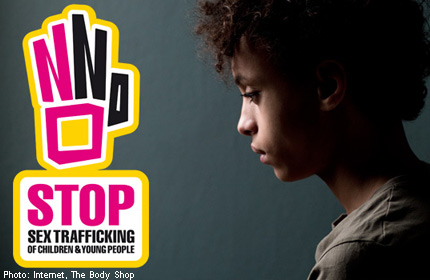
114,886 sign petition to UN against human trafficking


By Sophie Hong
A TOTAL of 114,886 signatures have been collected here for a petition by The Body Shop's international Stop Sex Trafficking Of Children And Young People movement.
The signatures will be presented to the United Nations (UN) Human Rights Council in Geneva on Sept 29, together with other signatures collected from over 65 countries, said Ms Josephine Chow, general manager of The Body Shop Singapore, during an event at The Arts House yesterday.
Held to celebrate the successful collection of signatures here, the event was attended by Body Shop staff members, campaign partners and other guests.
The movement is organised in partnership with the End Child Prostitution, Child Pornography and the Trafficking of Children for Sexual Purposes International, the National Committee for UN Women and the Humanitarian Organisation for Migration Economics (Home).
While only five sex-trafficking cases were reported in Singapore last year, Home president Bridget Tan pointed out that the actual figure could be much higher.
"Women who are exploited do not want to report their cases. They see no benefit in doing so and they just want to forget about the nightmare," she said.
Ms Pia Bruce, executive director of UN Women here, added there should be more comprehensive laws against trafficking.
Globally, The Body Shop has amassed close to seven million signatures for the movement.

Source: ASIAONE

Sunday, May 15, 2011
Facebook Partnership-Trafficking Org-Fights Internet Child Porn
 Image via CrunchBase
 Facebook And Stop Child Trafficking Now (SCTNow) Partner In The Fight Against Internet Child Pornography
Sherrie Clark 5/14/11
Facebook is taking the lead in targeting child sexual predators and the growing problem of child pornography on the internet. It has developed a strategic alliance with Stop Child Trafficking Now, a nonprofit organization who will use its expertise and technological savvy to police Facebook for any photos, videos and content that exploit children.
Through this proactive partnership, Facebook has once again demonstrated its ability to be a leader among its competitors, becoming the standard in how all social networking sites should respond to being utilized by child predators.
Facebook spokesman Frederick Wolens said, “Since last year, we have partnered with SCTNow to coordinate our resources and cast a wider safety net for those online.”
SCTNow operates on the basic economic principle of supply and demand, targeting the predators who drive up the demand for these children. This innovative organization utilizes highly trained and skilled Special Operative Teams that consist of former CIA operatives, Navy SEALS, and experts in counter-terrorism, all who track sexual offenders and accumulate valuable intelligence needed to bring child sex predators to justice.
To support the efforts of SCTNow, please join the SCTNow National Walk/Run Campaign this September by registering at www.SCTNow.org or email at info@SCTNow.org. For more information and for National
Media Interviews contact:
Sundy Goodnight
SCTNow National Director
212-333-7286
Follow SCTNow on Twitter @SCTNow Twitter marketing powered by M3NewMedia.
Facebook Partnership-Trafficking Org-Fights Internet Child Porn
Source: humantraffickinginfo.org

Tuesday, September 21, 2010
timesofmalta.com - Group claims Malta 'destination' for child trafficking
 Image via Wikipedia
Source: Times of Malta.com
Thursday, 16th September 2010 - 12:02CET
An international group against child prostitution and child pornography has claimed that Malta is a destination for women and children trafficked or sexual purposes.
In an unsigned report, ECPAT, the End Child Prostitution And Trafficking group said no reliable data was available on the extent of trafficking of children in sexual exploitation in Malta.
Similarly, Malta did not record a large number of children sexually exploited through prostitution. Most cases of sexual exploitation of children were related to the possession of child pornography.
"Malta is primarily a destination country for women and children trafficked for sexual purposes from Eastern European countries such as Ukraine, Russia and Romania," the organisation said.
"Young women recruited for prostitution from Eastern European countries are essentially ‘purchased’ by Maltese men, according to law enforcement agencies. Sometimes pimps intent on exploiting them for commercial sex act as intermediaries. These women can then often be ‘sold’ to other pimps or individuals who then continue the cycle; it is typical for trafficking victims to be ‘sold’ every three months under these practices.
"In many cases, these victims enter Malta legally on a tourist visa. In the case of victims of trafficking from Ukraine, various research points out that the majority of the victims are female and that trafficking occurs mainly for sexual exploitation."
The report made no reference to recent legislation to counter child pornography and prostitution.

Friday, September 17, 2010

Friday, August 13, 2010
Human trafficking and sexual exploitation of children – EU cracks down
Protecting the weakest
Justice and citizens rights - 29/03/2010
EU steps up fight against human trafficking and child sex predators.
The commission is calling for tougher laws against human trafficking and the sexual exploitation of children, saying Europe is losing the battle against these crimes.
Few reliable statistics exist on the number of people trafficked into or within Europe, but it is probably around several hundred thousand, mostly for prostitution and menial labour. Yet in 2006, the most recent year for which figures are available, prosecutors brought just 1 500 criminal trafficking cases to court in the whole of the EU. Only 3 000 victims received assistance.
Trafficking in humans is extremely profitable, and most traffickers are professional organised criminals. Most are based outside the EU but there are now growing networks inside too, especially since the bloc’s eastward expansion.
Existing laws would be updated, encouraging EU countries to go after nationals who commit crimes in other countries and to use more aggressive methods for investigating organised crime, like phone taps.
The draft rules also call for more consistency in how EU law is applied from one country to another and for more protection and assistance for victims. Independent national bodies would be set up to monitor implementation.
Concerning the sexual exploitation of children, the commission wants a combination of harsher penalties and more effective treatment for offenders.
The new laws would also restrict offenders from activities involving contact with children. About 20% of convicted child sex predators become repeat offenders.
Systems would be developed to block access to child porn sites.
Studies suggest between 10% and 20% of children in Europe will suffer some form of sexual abuse during their youth. Some kinds of abuse are on the rise, including websites devoted to child pornography.

Human trafficking and sexual exploitation of children – EU cracks down

Tuesday, June 15, 2010
Steve Jobs Declares Porn-Free iPhone and iPad | End Human Trafficking | Change.org
 Steve Jobs has stood for a lot of things in his career — business innovation, creative marketing campaigns, an intense hatred of extraneous USB ports — but now he's taking perhaps the most controversial stand yet. He's offering a new kind of freedom on the iPhone and iPad: "freedom from porn." While I'm sure the ironic "big brother" 1984 commercial references will follow and the adult industry/free speech/libertarian advocates will be flooding his inbox with complaints, I'd like to point out a group "freedom from porn" on the iPad will benefit: the thousands of children and human trafficking victims used in the production of pornography.
The mobile porn market — pornography that can slide into a pocket, purse, or briefcase — is growing by leaps and bounds. Even though the industry is less than seven years old, it's already generating millions, if not billions, of dollars in revenues. A lot of mobile porn is perfectly legal, made by consenting adults, for consenting adults. But some of it is made from trafficking victims, women who are forced to have sex in front of the cameras and pretend they're having a good time. Some of it is also made from children, like the teen girls who survived the earthquake in Haiti. And the problem is, it's really hard to tell which is which when you're shopping in the App Store.
When porn is mobile, the industry is much harder to regulate and exploitation is harder to prevent. Already, there have been several cases of child pornography showing up on cell phones. It's also harder for parents to monitor what their children are looking at when porn can fit in a pocket. And some of the porn that's out on the Internet and mobile devices these days isn't just naked ladies; it's hard-core, violent, and sometimes seriously demeaning to women. A thriving mobile porn industry also makes it easier for child traffickers to use pornography to groom children for the commercial sex trade and normalize violent and abusive sex. In order words, a pornified iPad isn't so great for pornography's unwilling victims.
Thursday, May 27, 2010
B.C. man pleads guilty to 14 sex tourism charges - CTV News
 Image via Wikipedia
Date: Saturday May. 22, 2010 6:32 AM ET
VANCOUVER — A Burnaby, B.C., man has pleaded guilty to sex tourism charges involving 14 underage girls in Cambodia and Colombia.
Kenneth Klassen appeared in B.C. Supreme Court in Vancouver on Friday and admitted to committing the crimes between December 1998 and March of 2002.
He also pleaded guilty to one count of importing child pornography and will be sentenced in July.
Klassen, a father of three, was originally facing 35 charges for the exploitation and sexual abuse of children in Cambodia, Colombia and the Philippines.
He was accused of abusing girls as young as nine and charged in 2007 after a two-and-a-half-year international investigation that netted videos showing a man having sex with young girls.
Klassen challenged Canada's child-sex tourism law in 2009, saying Canadian courts had no jurisdiction in other countries, but a B.C. Supreme Court judge ruled the law is internationally valid because many countries have similar legislation.
"In the absence of extraterritorial legislation, Canada would become a safer harbour for those who engage in the economic or sexual exploitation of children," Justice Austin Cullen wrote in his decision.
Canada's child-sex tourism laws were enacted in 1997 and bolstered five years later so the consent of the foreign country where allegations of sexual abuse took place was no longer needed in order to lay charges.
Vancouver hotel employee Donald Bakker was the first Canadian to be convicted under the law in 2005.
He got a 10-year sentence for 10 sexual assaults on girls between seven and 12 in Cambodia, where he videotaped the abuse.
In November of 2008, two Quebec aid workers pleaded guilty to sexually abusing teenage boys while working at an orphanage in Haiti.
Armand Huard was sentenced to three years in prison and Denis Rochefort was given two years.
B.C. man pleads guilty to 14 sex tourism charges - CTV News
![Reblog this post [with Zemanta]](http://img.zemanta.com/reblog_e.png?x-id=5f1e5983-4fc4-46d1-8d67-423c16d12614)
Sunday, May 16, 2010
Solving Youth Trafficking: Educating "Johns" Curbs Demand (Series Part 4) | Oakland Local
Published on Thursday, May 06, 2010
Last updated on 02:29PM, Thursday, May 6, 2010
Kelly Tyne runs the Johns' School in SF. "Criminalizing the supply side of prostitution is ineffective." Photo by Alison Yin.
by Sarah Terry-Cobo
This is Part 4 of an eight-part, four-day Oakland Local investigative series on youth sex trafficking.
"I admit it: I'm a john."
The image of a john, "someone looking to pay for sex," often evokes the idea of a man in a car, trolling a street at night in a gritty neighborhood. But what most people don't realize is that johns are often just another face in the crowd.
One evening in early February, after a San Francisco panel on human trafficking in the Koret auditorium of the city's main library, an unnamed man confessed his story, disclosing his past to people who likely were strangers...
PREVIOUSLY in this series | NEXT in this series
Complete series index | Take action!
As dozens of people filtered out of the auditorium, the man, who had shaggy salt-and-pepper hair and a bright yellow scarf, lingered at the back of the crowd.
"I admit it, I'm a john," he blurted out to the event organizer and MC.
He described his troubled childhood, living in group homes and being molested as a teenager. The molestation distorted his perspective on sexual relations, he said. Concerned this man might be looking for children to sleep with, the organizer found an FBI agent at the event and introduced him to the man in the yellow scarf.
SAGE School for Johns: Understanding the Demand
In San Francisco, the SAGE Project, or "Standing Against Global Exploitation," provides services to people trying to free themselves from commercial exploitation. It works with survivors of childhood sexual exploitation, and many employees identify as survivors of some type of exploitation. The group runs the First Offenders Prostitution Program, colloquially known as "the Johns' School," to help reduce exploitation.
"SAGE feels that if you make an effort to reduce demand, the need, or supply, will go down. Thereby sparing some individuals from being sucked into the matrix of hell that a life of prostitution looks like," said Kelly Tyne, director of men's services.
Tyne said SAGE employees acknowledge that criminalizing people who are involved in prostitution is counterproductive because it:
* Fails to promote public health
* Perpetuates exploitation
* Validates racism and socio-economic oppression
In particular, criminalization doesn't address what SAGE believes is at the root of the problem. Instead, the group focuses on reaching people who perpetrate the demand: johns, pimps and traffickers.
When Tyne talks about prostitution, he calls it exploitation. Sex is a commodity, and SAGE approaches the solution to sexual exploitation in economic terms. Simply put, if fewer people, "mostly men," purchase sex from exploited people, then fewer people, "mostly women," will sell sex.
Johns learn how they're part of the problem
The SAGE program allows first-time offenders who meet certain requirements to attend a daylong course at San Francisco's Hall of Justice and have their record wiped clean. Those arrested for soliciting sex from a minor are not eligible -- and upon conviction they are listed on the California sex offender registry.
Since SAGE launched the Johns' School in 1995, at least 12,000 individuals have attended the course. Attendees come from all walks of life -- there is no "typical profile" of a john, said Tyne. However, most attendees are men who tried to purchase sex from women.
A 2007 federally funded study showed that 95% of Johns' School graduates were not rearrested for prostitution in California.
"Yes. 95% of the individuals who attend the Johns' School are not rearrested in California for violating state prostitution laws." Tyne paused and emphasized, "It's a big deal."
Many SAGE employees are survivors of sexual exploitation, so they have a personal connection to the harm it inflicts, on individuals as well as communities.
Reducing demand: Not a typical solution
Elsewhere, much of the effort toward preventing the commercial sexual exploitation of children is a response to the crime.
Law enforcement agencies and several social service nonprofits offer basic services to victims, create tougher punishments for traffickers, and work toward regional collaboration among cities and counties. SAGE is the only local organization that directs its efforts to find what drives the demand for commercial sexually exploited people.
"The Johns' School is not about stopping prostitution in San Francisco. It's not," Tyne said with a shrug. "It's about reducing the demand for commercially sexually exploited individuals."
The role of SAGE, as Tyne puts it, is an educational focus on the demand: "Helping johns understand their role in terms of global systems of prostitution and exploitation, and putting money into services for directly affected prostituted individuals."
Many people begin the course feeling they were entrapped, Tyne says. But by the end of the day, they understand how their purchase of pornography is linked to child pornography rings flourishing on the other side of the globe.
Simply put, he said, individuals with power exploit those without it. Many of the clients SAGE works with do not "choose" a life of prostitution -- they are forced or coerced due to a lack of choices.
Representatives from SAGE say education is key to helping demonstrate that prostitution is not a victimless crime.
NEXT in this series: Part 5: Alameda County DA's Office: Crusade to Rescue Youth, Prosecute Pimps...
COMPLETE SERIES INDEX: Youth Trafficking in Oakland
This story was produced under a fellowship sponsored by the
G.W. Williams Center for Independent Journalism, a project of Tides
Center.
We also would like to thank Robert Rosenthal and California Watch for their support -- as well as our reporters Barbara Grady and Sarah Terry-Cobo, and photographer Alison Yin -- for their amazing work.
Support more independent quality reporting like this! Please donate to Oakland Local on Spot.us. We are seeking additional support for continued coverage.
About Sarah Terry-Cobo
Sarah Terry-Cobo's picture
Sarah is a freelance reporter and a 2009 graduate of the University of California, Berkeley Graduate School of Journalism and Latin American Studies programs. She specializes in science and environmental policy issues, but also has a keen interest in immigration and Latin American affairs. Her work has previously appeared in The Oakland Tribune, Forbes.com and GreenBiz.com. She is currently reporting and blogging for Carbon Watch, a joint venture of the Center for Investigative Reporting and Frontline/World. She researched and wrote the stories in Oakland Local's youth trafficking series with the support of a fellowship from the G.W. Williams Center for Independent Journalism.
♦♠♦♦♦
Solving Youth Trafficking: Educating "Johns" Curbs Demand (Series Part 4) | Oakland Local
![Reblog this post [with Zemanta]](http://img.zemanta.com/reblog_e.png?x-id=73c9ebae-9797-4518-80f1-26a88b723c48)
Last updated on 02:29PM, Thursday, May 6, 2010
Kelly Tyne runs the Johns' School in SF. "Criminalizing the supply side of prostitution is ineffective." Photo by Alison Yin.
by Sarah Terry-Cobo
This is Part 4 of an eight-part, four-day Oakland Local investigative series on youth sex trafficking.
"I admit it: I'm a john."
The image of a john, "someone looking to pay for sex," often evokes the idea of a man in a car, trolling a street at night in a gritty neighborhood. But what most people don't realize is that johns are often just another face in the crowd.
One evening in early February, after a San Francisco panel on human trafficking in the Koret auditorium of the city's main library, an unnamed man confessed his story, disclosing his past to people who likely were strangers...
PREVIOUSLY in this series | NEXT in this series
Complete series index | Take action!
As dozens of people filtered out of the auditorium, the man, who had shaggy salt-and-pepper hair and a bright yellow scarf, lingered at the back of the crowd.
"I admit it, I'm a john," he blurted out to the event organizer and MC.
He described his troubled childhood, living in group homes and being molested as a teenager. The molestation distorted his perspective on sexual relations, he said. Concerned this man might be looking for children to sleep with, the organizer found an FBI agent at the event and introduced him to the man in the yellow scarf.
SAGE School for Johns: Understanding the Demand
In San Francisco, the SAGE Project, or "Standing Against Global Exploitation," provides services to people trying to free themselves from commercial exploitation. It works with survivors of childhood sexual exploitation, and many employees identify as survivors of some type of exploitation. The group runs the First Offenders Prostitution Program, colloquially known as "the Johns' School," to help reduce exploitation.
"SAGE feels that if you make an effort to reduce demand, the need, or supply, will go down. Thereby sparing some individuals from being sucked into the matrix of hell that a life of prostitution looks like," said Kelly Tyne, director of men's services.
Tyne said SAGE employees acknowledge that criminalizing people who are involved in prostitution is counterproductive because it:
* Fails to promote public health
* Perpetuates exploitation
* Validates racism and socio-economic oppression
In particular, criminalization doesn't address what SAGE believes is at the root of the problem. Instead, the group focuses on reaching people who perpetrate the demand: johns, pimps and traffickers.
When Tyne talks about prostitution, he calls it exploitation. Sex is a commodity, and SAGE approaches the solution to sexual exploitation in economic terms. Simply put, if fewer people, "mostly men," purchase sex from exploited people, then fewer people, "mostly women," will sell sex.
Johns learn how they're part of the problem
The SAGE program allows first-time offenders who meet certain requirements to attend a daylong course at San Francisco's Hall of Justice and have their record wiped clean. Those arrested for soliciting sex from a minor are not eligible -- and upon conviction they are listed on the California sex offender registry.
Since SAGE launched the Johns' School in 1995, at least 12,000 individuals have attended the course. Attendees come from all walks of life -- there is no "typical profile" of a john, said Tyne. However, most attendees are men who tried to purchase sex from women.
A 2007 federally funded study showed that 95% of Johns' School graduates were not rearrested for prostitution in California.
"Yes. 95% of the individuals who attend the Johns' School are not rearrested in California for violating state prostitution laws." Tyne paused and emphasized, "It's a big deal."
Many SAGE employees are survivors of sexual exploitation, so they have a personal connection to the harm it inflicts, on individuals as well as communities.
Reducing demand: Not a typical solution
Elsewhere, much of the effort toward preventing the commercial sexual exploitation of children is a response to the crime.
Law enforcement agencies and several social service nonprofits offer basic services to victims, create tougher punishments for traffickers, and work toward regional collaboration among cities and counties. SAGE is the only local organization that directs its efforts to find what drives the demand for commercial sexually exploited people.
"The Johns' School is not about stopping prostitution in San Francisco. It's not," Tyne said with a shrug. "It's about reducing the demand for commercially sexually exploited individuals."
The role of SAGE, as Tyne puts it, is an educational focus on the demand: "Helping johns understand their role in terms of global systems of prostitution and exploitation, and putting money into services for directly affected prostituted individuals."
Many people begin the course feeling they were entrapped, Tyne says. But by the end of the day, they understand how their purchase of pornography is linked to child pornography rings flourishing on the other side of the globe.
Simply put, he said, individuals with power exploit those without it. Many of the clients SAGE works with do not "choose" a life of prostitution -- they are forced or coerced due to a lack of choices.
Representatives from SAGE say education is key to helping demonstrate that prostitution is not a victimless crime.
NEXT in this series: Part 5: Alameda County DA's Office: Crusade to Rescue Youth, Prosecute Pimps...
COMPLETE SERIES INDEX: Youth Trafficking in Oakland
This story was produced under a fellowship sponsored by the
G.W. Williams Center for Independent Journalism, a project of Tides
Center.
We also would like to thank Robert Rosenthal and California Watch for their support -- as well as our reporters Barbara Grady and Sarah Terry-Cobo, and photographer Alison Yin -- for their amazing work.
Support more independent quality reporting like this! Please donate to Oakland Local on Spot.us. We are seeking additional support for continued coverage.
About Sarah Terry-Cobo
Sarah Terry-Cobo's picture
Sarah is a freelance reporter and a 2009 graduate of the University of California, Berkeley Graduate School of Journalism and Latin American Studies programs. She specializes in science and environmental policy issues, but also has a keen interest in immigration and Latin American affairs. Her work has previously appeared in The Oakland Tribune, Forbes.com and GreenBiz.com. She is currently reporting and blogging for Carbon Watch, a joint venture of the Center for Investigative Reporting and Frontline/World. She researched and wrote the stories in Oakland Local's youth trafficking series with the support of a fellowship from the G.W. Williams Center for Independent Journalism.
♦♠♦♦♦
Solving Youth Trafficking: Educating "Johns" Curbs Demand (Series Part 4) | Oakland Local
Monday, May 3, 2010
The Human Trafficking Project: Child Trafficking
Monday, May 03, 2010
Introduction: Trafficking in children takes many different forms worldwide, from child soldiers to child sex tourism to forced child labor in brick factories to child camel jockeys to child sex slaves to child pornography to child domestic slaves to forced child begging. Ending child slavery and child exploitation will take committed, strategic effort based on understandings of the myriad forms of child trafficking and their interconnections.
Elise: Before the TVPA was ever enacted in the U.S., a case out of Texas showed the complexity that is often overlooked when we talk about children and trafficking. Given Kachepa, along with other boys from Zambia were brought to the U.S. under false pretenses offered to them by a Baptist minister claiming the young boys would come to the U.S. to perform in a boys choir and earn money for themselves and for a new school in Zambia. The reality the boys faced included forced performances, the withholding food and medical care if the boys resisted and the constant threat of deportation among other coercive and traumatic tactics used by Keith Grimes to keep the boys in their trafficking situation. A more detailed account of the case is given in The Slave Next Door by Kevin Bales and Ron Soodalter. Years after his trafficking situation ended, Given has taken to advocating on behalf of trafficking victims. He has appeared on national TV and print media delivering his message and his story, and has contributed to the development of state-level legislation.
Youngbee: Among the many different forms of child trafficking, a particularly terrible kind is child trafficking involving child pornography. In Japan, for instance, Jake Adelstein, a public relations representative in Polaris Project in Japan, describes child pornography as "evidence that a crime has been committed[;] that people can derive sexual pleasure from that or profit on that is horrifying." These children are not only sexually exploited but also their humiliation is likely to be publicized on the internet forever. What is worse is that the internet access makes this evil an average Joe's concern in the United States. In fact, a British internet watchdog says that over the past ten years, 51% of such illegal child pornography websites were hosted in the United States. Currently, in Japan, possession of child pornography is not illegal though distribution and production are criminalized. As Japanese government is sensitive to its reputation before the international world, perhaps, US citizens calling their state representatives would pressure the country to fix its legislative loophole further.
Meg: One child trafficking topic that seems to have received a lot of attention recently is trafficking and international adoptions. The issue came to the forefront after the Haiti disaster, when it became suspected that children disappearing from hospitals were being taken by traffickers and sold off as orphans. Learning about this form of trafficking was disheartening to me, because apparently even those trying to do something positive can inadvertently contribute to child exploitation and human trafficking. Although there does not appear to be much in the way of statistics on this issue yet, it is easy to see how traffickers could exploit situations such as the disaster in Haiti to make a profit off of vulnerable children, not only through international adoption, but for sex trafficking and other forms of trafficking as well. One interesting potential solution to the adoption problem is the idea of using DNA databases to reunify parents with missing children, which is something that has begun to be implemented in Haiti. If the Haiti situation prompts development of an international adoption DNA system that can be used to prevent future trafficking, this may be one positive result of a tragic disaster.
Jenn K.: According to the 2009 Domestic Minor Sex Trafficking report by Shared Hope International, over 100,000 US children are subjected to commercial sexual exploitation each year. The Child Exploitation and Obscenity Section of the United States Department of Justice reports that the average age for entering commercial sex in the US is 12-14. Despite progress in addressing this aspect of the United State's trafficking problem, such as programs targeting demand and increased attention to the issue, much remains to be done particularly in terms of services for victims and survivors. According to Gracehaven House, which will be opening a group home for child sex trafficking survivors in Ohio, there are only 39 shelter beds dedicated to minor sex trafficking victims in the US. Other organizations, such as Courtney's House in Washington DC, are also in the process of opening group homes for child victims. Both Gracehaven House and Courtney's House were founded by survivors of sex trafficking as minors, and plan to offer comprehensive services for survivors. Still, the shelter need greatly exceeds and is likely to continue to greatly exceed resources.
Posted by Buffalo Expat at 7:05 AM 0 comments Links to this post
Labels: Child Pornography, child slavery, Child Trafficking, CSEC, domestic minor trafficking, Haiti, United States, Zambia
The Human Trafficking Project
![Reblog this post [with Zemanta]](http://img.zemanta.com/reblog_e.png?x-id=56a44a64-8909-4fa4-9fee-175ed3773599)
Introduction: Trafficking in children takes many different forms worldwide, from child soldiers to child sex tourism to forced child labor in brick factories to child camel jockeys to child sex slaves to child pornography to child domestic slaves to forced child begging. Ending child slavery and child exploitation will take committed, strategic effort based on understandings of the myriad forms of child trafficking and their interconnections.
Elise: Before the TVPA was ever enacted in the U.S., a case out of Texas showed the complexity that is often overlooked when we talk about children and trafficking. Given Kachepa, along with other boys from Zambia were brought to the U.S. under false pretenses offered to them by a Baptist minister claiming the young boys would come to the U.S. to perform in a boys choir and earn money for themselves and for a new school in Zambia. The reality the boys faced included forced performances, the withholding food and medical care if the boys resisted and the constant threat of deportation among other coercive and traumatic tactics used by Keith Grimes to keep the boys in their trafficking situation. A more detailed account of the case is given in The Slave Next Door by Kevin Bales and Ron Soodalter. Years after his trafficking situation ended, Given has taken to advocating on behalf of trafficking victims. He has appeared on national TV and print media delivering his message and his story, and has contributed to the development of state-level legislation.
Youngbee: Among the many different forms of child trafficking, a particularly terrible kind is child trafficking involving child pornography. In Japan, for instance, Jake Adelstein, a public relations representative in Polaris Project in Japan, describes child pornography as "evidence that a crime has been committed[;] that people can derive sexual pleasure from that or profit on that is horrifying." These children are not only sexually exploited but also their humiliation is likely to be publicized on the internet forever. What is worse is that the internet access makes this evil an average Joe's concern in the United States. In fact, a British internet watchdog says that over the past ten years, 51% of such illegal child pornography websites were hosted in the United States. Currently, in Japan, possession of child pornography is not illegal though distribution and production are criminalized. As Japanese government is sensitive to its reputation before the international world, perhaps, US citizens calling their state representatives would pressure the country to fix its legislative loophole further.
Meg: One child trafficking topic that seems to have received a lot of attention recently is trafficking and international adoptions. The issue came to the forefront after the Haiti disaster, when it became suspected that children disappearing from hospitals were being taken by traffickers and sold off as orphans. Learning about this form of trafficking was disheartening to me, because apparently even those trying to do something positive can inadvertently contribute to child exploitation and human trafficking. Although there does not appear to be much in the way of statistics on this issue yet, it is easy to see how traffickers could exploit situations such as the disaster in Haiti to make a profit off of vulnerable children, not only through international adoption, but for sex trafficking and other forms of trafficking as well. One interesting potential solution to the adoption problem is the idea of using DNA databases to reunify parents with missing children, which is something that has begun to be implemented in Haiti. If the Haiti situation prompts development of an international adoption DNA system that can be used to prevent future trafficking, this may be one positive result of a tragic disaster.
Jenn K.: According to the 2009 Domestic Minor Sex Trafficking report by Shared Hope International, over 100,000 US children are subjected to commercial sexual exploitation each year. The Child Exploitation and Obscenity Section of the United States Department of Justice reports that the average age for entering commercial sex in the US is 12-14. Despite progress in addressing this aspect of the United State's trafficking problem, such as programs targeting demand and increased attention to the issue, much remains to be done particularly in terms of services for victims and survivors. According to Gracehaven House, which will be opening a group home for child sex trafficking survivors in Ohio, there are only 39 shelter beds dedicated to minor sex trafficking victims in the US. Other organizations, such as Courtney's House in Washington DC, are also in the process of opening group homes for child victims. Both Gracehaven House and Courtney's House were founded by survivors of sex trafficking as minors, and plan to offer comprehensive services for survivors. Still, the shelter need greatly exceeds and is likely to continue to greatly exceed resources.
Posted by Buffalo Expat at 7:05 AM 0 comments Links to this post
Labels: Child Pornography, child slavery, Child Trafficking, CSEC, domestic minor trafficking, Haiti, United States, Zambia
The Human Trafficking Project
Thursday, February 25, 2010
The Parthenon - West Virginia talks human trafficking
 Image via Wikipedia
Published: Tuesday, February 23, 2010
Updated: Tuesday, February 23, 2010
The First Wesleyan Church in Huntington hosted a community forum Saturday to address human trafficking nationally and within West Virginia.
The panel included Cristina Suarez-Ross, victim advocate of the CONTACT Rape Crisis Center, Lt. Donald Frye of the W.Va. State Police, Detective Rodney Pell of the Huntington Police Department, Rhonda Farley, director of Branches, Sherriff Thomas McComas, Social Service Supervisor Hope Smith of the Cabell County Department of Human Resources and Glen Robinson of the First Wesleyan Church.
The panel addressed human trafficking in our state and shared the situations that they had encountered.
Forum director and Special Agent of the FBI Joseph Ciccararelli recognized human trafficking on a national level.
“Human trafficking is a high priority in the FBI,” Ciccararelli said. “I don’t think it’s a huge problem here but we may have issues involved here with human trafficking that we are not aware of.”
Ciccararelli provided tips of how to identify a potential victim.
“Nationally, victim characteristics are usually undocumented citizens that are economically disadvantaged, have a lack of education and have a language barrier,” Ciccararelli said.
Terry Roberts, facilitator of the event, read a recent article written by Amanda Kloer on human trafficking in Ohio.
The Trafficking in Persons Study Commission found that 1800 people are trafficked in Ohio every year, according to the change.org article. This includes 800 immigrants who are exploited in commercial sex and factory work, as well as about 1000 American-born children who are forced into prostitution.
“Trafficking is in our backyard, and talking to people within our own city and state, there are situations that certainly need that definition,” Roberts said.
Lt. Donald Frye of the W.Va. State police said he could remember two situations in W.Va. in which persons tried to sell their children.
“This happens right here at home,” Frye said. “Within the last month at least 1,000 computers have lit up in W.Va. with child pornography. Child abuse and child pornography is a form of child trafficking,” Frye said.
Hope Smith and Rhonda Farley both shared their experiences with cases involving trafficking.
“Homeless children in Cabell County are increasing dramatically,” Smith said. “Some of these children don’t have anything and could easily be victims of a trafficker. We’ve also had teenage prostitution here in Huntington, some are runaways, and some are involved in drugs and in need of money.”
“We have a lot of kids on the streets, and we just really need to reach out and give,” Smith said.
“At Branches I’ve seen one to two cases a year that fit trafficking,” said Rhonda Farley, director of Branches. “I’ve seen a Milton woman sold for prostitution to earn money for her family.”
Farley also had a case where a trafficker kept a woman captive and abused in Barboursville.
“We usually find these victims by complaints in the community,” Ciccararelli said. “Also, the local law enforcement’s response to an incident or information received from non-governmental organizations, churches and community service providers.”
“Service providers and the faith-based community may be in the position to make everyone aware of these issues,” Ciccararelli said. “It’s good for the community and us to work together.”
The U.S. Department of State estimates between 600,000 and 800,000 people are trafficked worldwide. Eighty percent of those victims are female.
There are currently 212 pending investigations in the U.S., Ciccararelli said.
The panel encourages one to contact the National Human Trafficking Resource Center at 1.888.373.7888 or contact your local law enforcement with information about a victim of human trafficking.
Kimberly Bradley can be contacted at bradley82@marshall.edu.
The Parthenon - West Virginia talks human trafficking
![Reblog this post [with Zemanta]](http://img.zemanta.com/reblog_e.png?x-id=b36d4ed2-fe73-47c6-af08-eda29df42628)
Subscribe to:
Posts (Atom)


