Showing posts with label IPhone. Show all posts

Saturday, March 10, 2012

Justin Dillon: If Brands Want Trust, They Can't Have Slaves

http://www.huffingtonpost.com/justin-dillon/post_3109_b_1335282.html

SOURCE: HUFFINGTON POST

3/10/2012

Justin Dillon


A few years ago I was prepping to launch the website for my first film, Call+Response, which tackles the issue of human trafficking. As we were passing around ideas, one of our designers popped off with, "Hey, do you think Steve Jobs knows if there's slavery in his iPhone?" A wave of shrugs moved around the table. "Lets ask him, he's the only one who answers his emails." Another wave of shrugs.
So from his Macbook Pro, he penned the following letter, "Steve, does my iPhone use tantalum mined by slave labor? I'm sitting in a board room in San Francisco with a group of tech guys who believe you are aware of this issue and because of your public company restrictions, will not respond to this email -- prove them wrong". We all went back to work expecting that to be the end of it.
Being a musician, I took on the issue through the lens of music, establishing the idea that popular music is in fact a product of slavery. Our film proves that just about everything we use is tainted with slavery. It's in everything: Candy bars to baby wipes, action figures to smart phones. The challenge is that most slavery exists at the murky bottom of supply chains. My web team and I were trying to figure out a way to break the fourth wall of the film and insert this reality into people's everyday lives. Easy, right?
Six hours go by and an email pops up: "I have no idea. I'll look into it. -Steve ", along with the email signature "sent from my iPhone." No boiler plate CSR Report. No deflections. Just three vulnerable words: I don't know. These three words were followed up with four equally powerful words: I'll look into it. The coupling of those two statements just happened to match the narrative of my film. Call and Response. Tension and Release. Verse and Chorus. Oblivion and Action. Steve managed to package the very journey I was trying to take my viewers on in seven simple words.
We launched our next project, Slaveryfootprint.org, last fall on the 149th anniversary of the Emancipation Proclamation. This site asks "How Many Slaves Work For You?". Our team dug deep into the supply chains of over 400 different consumer products and determined the likely number of slaves it takes to make each of those products, including such items as laptops and smart phones. The only thing we didn't do was name and blame individual brands. We strategically chose to remain brand agnostic and received plenty of push back because of it. The desire to call out the worst offenders is completely understandable, but is it strategic? The reality that I cannot walk out of my home in the morning without wearing, eating, or communicating through something that was made by slaves is unacceptable. The tension lies in the fact that there is no quick solution. There's no switch to turn. There's no single law to pass. Naming and shaming a brand may feel good, but does anything really change?
Modern day slavery is a shadow economy where profits are mostly realized at the commodities level, not the brand level. It will never go away simply because of cathartic reactions. Human rights abuses have sustained against well-meaning catharsis for hundreds of years. It's going to require a paradigm shift in order to break a wildly profitable system like supply chain slavery. I'm wondering what it would look like to actually work WITH the brands who are brave enough to utter those three precious words: I don't know.
Apple's new CEO, Tim Cook, recently singled out forced labor in their latest sustainability report. He admitted they hadn't done enough and that they would do more. Cook, like his former boss, took what I consider to be a bold move. They made themselves publicly vulnerable. Instead of retracting and dodging, they engaged. You can say they did it because they had to, but the reality is they did it. On top of that they doubled down on their commitment by bringing in an outside auditor to "look into it" as Jobs put it.

At the end of the day, brands want our trust. The marketplace is full of shiny objects vying for our attention and money. Money is simply the manifestation of trust. Mutual trust requires vulnerability. We can kick the shins of the brands we love, or we can take the relationship to second base. If brands want my trust, I require two things: Vulnerability and commitment to look into it. I've made myself vulnerable. I took my Slavery Footprint and found out I have 49 slaves working for me. Brands, it's your move.
Enhanced by Zemanta

Monday, December 6, 2010

Could an iPhone app help in the fight against slave labour? | Global development | guardian.co.uk

One-legged potter, Josiah Wedgwood, fought slavery in the 1800s by creating medallions crafted with a revolutionary logo. Today, app developers are doing the same thing

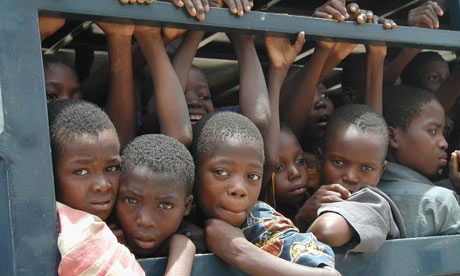
MDG: International Day for the Abolition of Slavery, Nigeria
Children in a police vehicle after being apprehended at the border on their way out of Nigeria to the Republic of Benin. Photograph: STR/AFP/Getty Images
As America braces for the 150th anniversary of the civil war, the California-based Not for Sale Campaign claims "there are more than 30 million slaves in the world today – more than at the height of the trans-Atlantic slave trade."

Yesterday, while the International Day for the Abolition of Slavery passed with little official fanfare, anti-slavery activists are busy tinkering with new media tools to catch the public's attention, using iPhones and "open-source activism" to try and reinvigorate the centuries-old humanitarian impulse to end slavery.

This November, the Not for Sale Campaign and the International Labour Rights Forum launched a new iPhone app, Free2Work, to help consumers reduce their "slavery footprint" by delivering product ratings as they shop.

The mobile phone application lets you browse and search for companies and products –from Lego to Levi's, and from food to footwear – each of which is awarded a grade from A to F.

An "A" grade is awarded to brands with sustainable and participatory systems to prevent forced labour, and a commitment to improve their industry as a whole. A "C" is the "standard" minimum passing grade, while an "F" goes to brands which are most at risk of using forced labour, as they do little or nothing to monitor their supply chain.

For those behind the Free2Work project, the hope is that the mobile phone application will help consumers deal with the complicated webs of supply-chains, outsourcing and subcontracting, and the plethora of monitoring, certification, and labelling programs that make it difficult for the average person to find an answer to the question: "Is my product slave-free?"

"The complexities of the global slave trade and limited insight into product supply chains make it difficult for the average consumer to grasp how he or she is connected to forced and child labour occurring within the global production cycle," says the Free2Work project.

The hope is that the mobile phone application will revolutionise how consumers make informed purchases by providing information when they need it most – while they shop.

"When companies know consumers have a tool to check their human rights and labour records at the point of purchase, they might just take those issues a lot more seriously," said Amanda Kloer an editor at Change.org, on her blog there.

Kloer has high hopes for how new media can invigorate contemporary anti-slavery campaigning, suggesting that Twitter can also be a useful tool.

"In 2010, we have a powerful weapon in the fight against slavery. Twitter. Yes, the 144-character social media tool might just do what all the legislation and international conventions have failed to — finally end slavery," she blogged.

But while the Free2Work app could attract much of the same criticism directed towards other campaigns for ethical consumerism, and while the suggestion that Twitter can end slavery is wide open for ridicule a la Malcolm Gladwell, historians and campaigners have often made the case that the British anti-slavery movement of the 18th and 19th centuries – which played no small part in the abolition of the slave trade – owed much of its success to its' activists innovative use of "new media."

In a 2004 essay in radical journal, Mother Jones, Adam Hochschild accredits many of the achievements of the early British anti-slavery movement – "the first great human rights campaign" – to its inventive communications strategies.

In one example, Hochschild recounts the story of famous, one-legged pottery entrepreneur, Josiah Wedgwood, who had hundreds of medallions crafted featuring a bas-relief of a chained, kneeling slave, encircled by the words: "Am I not a Man and a Brother?"

"The equivalent of the lapel buttons we wear for an electoral campaign, this was probably the first widespread use of a logo designed for a political cause. It was the 18th century's 'new media,'" he writes.

Along with the medallions, Hochschild lists consumer boycotts, petitions, political posters, newsletters, direct-mail fundraising letters, political book tours, and national campaigns with local committees among the countless innovative tactics pioneered by the activists, and used ever since.

The Not for Sale Campaign say the major obstacle in the fight against modern-day slavery is that the crime is largely hidden, and that slavery is not part of the current collective consciousness. All too often, the end of the trans-Atlantic slave trade is interpreted as the end of slavery.

And while alerts of the "re-emergence" of slavery and calls to "re-abolish" it give campaigns and media reports a sense of much-needed urgency, they run the risk of misreading history, which has seen slavery disappear more from our public discourse than from our economy.

The widespread use of forced, indentured, and slave labour in Europe's African colonies, for example, is well-documented. And in his 2010 message for the International Day for the Abolition of Slavery, UN secretary general Ban Ki Moon stresses that "the abolition of the trans-Atlantic slave trade in the 19th century did not eradicate the practice globally."

"Instead, it took on other forms, which persist to this day: serfdom, debt-bondage and forced and bonded labour; trafficking in women and children, domestic slavery and forced prostitution, including of children; sexual slavery, forced marriage and the sale of wives; child labour and child servitude, among others," he adds.

Indeed, a key challenge has been defining what constitutes slavery in the 20th century and providing estimates of its scope.

It would, of course, be hard to imagine an iPhone app ending modern-day slavery. But as Hochschild pointed out in his Mother Jones article, the 18th and 19th-century sugar boycotts caught people's imaginations by bringing to light the hidden ties of an otherwise largely obscure globalised economy.

The moral outrage that followed produced the first mass human rights campaign, and played a significant part in the end of the trans-Atlantic slave trade. Could the Free2Work app – and future new media innovations, still to come – do the same for us today?

What do you think?

Source: guardian.co.uk

Could an iPhone app help in the fight against slave labour? | Global development | guardian.co.uk
Enhanced by Zemanta

Sunday, December 5, 2010

Tech Gets Enlisted In The War Against Human Trafficking - Investors.com

The fight against human trafficking is using a few new weapons: texting, iPhone apps and smarter passports.

An estimated 12.3 million adults and children around the world are trafficked — compelled in a variety of ways to work against their will — the U.S. State Department says.

"It's basically modern-day slavery," said Mark Latonero, research director for the University of Southern California's Annenberg Center. "It's a pernicious and widespread global problem."
Demi Moore and Ashton Kutcher lent their celebrity clout to a November news conference at United Nations headquarters concerning the launch of the U...
Demi Moore and Ashton Kutcher lent their celebrity clout to a November news conference at United Nations headquarters concerning the launch of the U... View Enlarged Image
The term "trafficking" covers a wide area.
"It's not just forced prostitution, it's also forced labor — people working in slaverylike conditions on farms, fishing boats, in nail salons, whatever," Latonero said.

He's working on a project to make it easier to get help for trafficking victims via cell phone.

The Technology and Trafficking in Persons Research Initiative will allow concerned citizens, potential trafficking victims and possibly victims themselves to text information to a hotline. The project is led by the Annenberg Center.

Texts will be sorted by a computer and sent to appropriate agencies that could help, Latonero says.

The initiative focuses on the Mekong region in Southeast Asia: Thailand, Cambodia, Vietnam, Laos, southern China and Burma.

"This part of the world is a major source, transit and destination region for men, women and children forced into labor and prostitution," Latonero said.

Cell Phones Aplenty
The program could be in place by mid-2011 in Thailand, with government funding and philanthropic grants expected to cover the $500,000-plus launch costs.

Though residents of the region are extremely poor — which makes them vulnerable to trafficking — most have cell phones, Latonero says.

"That," he said, "is our opportunity."

Phones are used on another front in the fight against trafficking. An iPhone application for consumers concerned about whether forced or child labor was used to create their purchase became available last month.

The app, Free2Work, is a joint project of Not For Sale, a San Francisco anti-slavery nonprofit, and the International Labor Rights Forum, a nonprofit advocacy organization for workers. Juniper Networks (JNPR) funded the development of the application, which is free.

With the app, shoppers can access information about the labor practices of some 60 companies, including Nike (NKE), Hasbro (HAS), Hewlett-Packard (HPQ) and Apple (AAPL). It rates the companies' labor practices. Not For Sale compiles information from company Web sites and public databases to create its corporate ratings.

"It's when people are shopping that they really need that information," said Dave Batsone, president of Not For Sale.

Source: Investor.com

Tech Gets Enlisted In The War Against Human Trafficking - Investors.com
Enhanced by Zemanta

Tuesday, June 15, 2010

Steve Jobs Declares Porn-Free iPhone and iPad | End Human Trafficking | Change.org


Steve Jobs has stood for a lot of things in his career — business innovation, creative marketing campaigns, an intense hatred of extraneous USB ports — but now he's taking perhaps the most controversial stand yet. He's offering a new kind of freedom on the iPhone and iPad: "freedom from porn." While I'm sure the ironic "big brother" 1984 commercial references will follow and the adult industry/free speech/libertarian advocates will be flooding his inbox with complaints, I'd like to point out a group "freedom from porn" on the iPad will benefit: the thousands of children and human trafficking victims used in the production of pornography.

The mobile porn market — pornography that can slide into a pocket, purse, or briefcase — is growing by leaps and bounds. Even though the industry is less than seven years old, it's already generating millions, if not billions, of dollars in revenues. A lot of mobile porn is perfectly legal, made by consenting adults, for consenting adults. But some of it is made from trafficking victims, women who are forced to have sex in front of the cameras and pretend they're having a good time. Some of it is also made from children, like the teen girls who survived the earthquake in Haiti. And the problem is, it's really hard to tell which is which when you're shopping in the App Store.

When porn is mobile, the industry is much harder to regulate and exploitation is harder to prevent. Already, there have been several cases of child pornography showing up on cell phones. It's also harder for parents to monitor what their children are looking at when porn can fit in a pocket. And some of the porn that's out on the Internet and mobile devices these days isn't just naked ladies; it's hard-core, violent, and sometimes seriously demeaning to women. A thriving mobile porn industry also makes it easier for child traffickers to use pornography to groom children for the commercial sex trade and normalize violent and abusive sex. In order words, a pornified iPad isn't so great for pornography's unwilling victims.