http://www.hawaiireporter.com/laotian-workers-suffer-health-and-financial-problems-on-oahu-farms/123
Tuesday, December 6th, 2011

Laotian
national Khamfanh Keohavong gives a tour of where he lived and worked
on a Kahuku farm before he collapsed after using chemicals
BY MALIA ZIMMERMAN - Alay Tansili left his
family and home in
Vientiane,
Laos, in 2006 and moved to
Hawaii after
his wife encouraged him to seek a job in America. Like many
Laotians in
that impoverished country, Alay and his family believed America to be
the land of opportunity, a safe place to work and make enough money in a
year or two to pull the family out of poverty forever.
He never dreamed that just five years later at age 46 he'd
be confined to a bed in the hospital after suffering a
debilitating stroke, facing the possibility that he'd never walk again,
and in the middle of a tug of war with his employer and his attorney
over whether he should be forced to return home while he's unable to
care for himself.
Alay's story is shared by many Laotians now secretly working on farms
in Hawaii. For a steep price, a recruiter in Laos helped Alay arrange
his travel and prepared him for questions from American Embassy
officials. He did not realize he was coming to Hawaii on a B2 visitor
visa, not an H2A
work visa. His B2 visa expired quickly, leaving him
unable to work in the country legally and unable to pay back the
recruiter.

Alay's home on the Kahuku farm
But Hawaii is rife with farm owners looking for cheap labor,
and while there are many honest, diligent farmers, there are also many
unconcerned with workers´ immigration status. Alay says he secured a job
for $1,500 a month at a Kahuku farm where he picked beans and bananas
for as long as ten hours a day, seven days a week, for the next four
years. He slept in a tiny makeshift plywood shack with no plumbing or
electricity and no furniture except for his cot. The structure, which
has no windows or doors and no front wall, has no barrier to the rats,
chickens, peacocks, mosquitoes, spiders and centipedes that live there.
The hard farm labor exhausted Alay. He found it difficult to
sleep. Even worse were the many bad reactions he suffered after
mixing and spraying chemicals on the crops and burning the
chemical containers as he was directed.

After
handling hazardous chemicals without training or protection for as many
as three days a week for at least four years, he collapsed this week.
He was transported to Kahuku Hospital and then to Castle Medical Center
where he is now recovering from a stroke.
While Hawaii employers are obligated to pay for medical
insurance coverage for their workers, Alay's employer did not offer
this benefit. Now he is unable to qualify for the 24-hour care
he requires, which means he will have to face the reality that at
age 46, he may never walk again.
But Alay has one glimmer of hope - his friend Khamfanh Keohavong,
also from Laos, worked on the farm with Alay for four years before
quitting for similar reasons, and is now helping him.
Khamfanh said he collapsed several times after spraying the
same chemicals that hurt Alay. A doctor in Queens Medical Center said in
recent weeks the chemical exposure may have caused Khamfanh to develop
a brain tumor.

Hawaii Immigration Attorney Melissa Vincenty courtesy of HawaiiConversation.org
Melissa Vincenty, a local immigration attorney who represents several
dozen human trafficking victims in Hawaii originally from Thailand and
Laos, agreed to help Khamfanh, and now she is also representing Alay.
Vincenty said that after interviewing her new client, she discovered
that Alay's sister and mother were in Hawaii under the same conditions.
On Friday, Vincenty visited the farm in Kahuku where Alay said
he works so she could meet with the farm owner, Tony Law, and obtain
Alay's passport and personal effects.
Vincenty said Alay and Khamfanh have worked under
"terrible conditions" and they were sickened after spraying
chemicals several days a week over a period of years.
While Khamfanh experienced blackouts and numbness is his limbs, Alay
suffered from rashes, shortness of breath, headaches, fatigue, numbness
in his arms and legs and the loss of his sense of taste.
Alay had been afraid to leave the farm as Khamfanh did, because he
was under the impression that his situation is not as bad as what other
Laotian workers are experiencing in Hawaii.
Farm owner Tony Law, who was reached by phone Monday, refutes any connection to Alay other than being his "friend."

Chemicals on the kahuku farm are mixed and sprayed before the containers are burned
Law said Alay came by the farm from time to time as a friend to help
him. He denies his workers handle chemicals - Law says he personally
takes care of that.
Law also rebuffs the accusation he employs illegal workers even
though some of his own farm laborers say he's employed up to a dozen at
one time.
Law said he didn't have to provide medical care for Alay or
farm laborers because they float from farm to farm and are not
his employees.
Law also refutes the accusation that workers live or work in poor or dangerous conditions.
Law has been aggressively trying to get Alay to return
home immediately to Laos, even taking his passport to a travel agent
to secure a ticket.
But Alay, who has not yet been discharged from the hospital after his
stroke last week, told Vincenty and Khamfanh that he wants to remain in
Hawaii - at least until he is strong enough to travel on his own.
Even though doctors had already told Law that Alay could not be released, Law came to pick up Alay at the hospital this weekend.
Law brought two other men with him to the hospital and wheeled Alay
out of his room toward the elevator twice on Saturday morning.
Vincenty said the first time a nurse stopped Law, and the second time, Alay's friends who came to visit stopped Law and told him that Alay could not leave the hospital, much less Hawaii.
Law denies he was trying to sneak Alay off the grounds and said he
was only trying to give Alay a break from being in his small room.

Joanna Thakhamhor
But Joanna Thakhamhor has her suspicions. She was at the hospital on
Saturday with Khamfanh and her husband planning to visit Alay when they
ran into Law wheeling Alay down the hallway for the second time.
Vincenty said Alay's story is similar to many other Laotians she interviewed over the last few months.
"What we seem to have uncovered is part of a bigger problem that has
been going on for some time. These Laotians are stuck here until they
are sent home because they are not useful to the farm owners any more.
Many are in their fifties, sixties and seventies and suffer heart
attacks and strokes because of their working conditions, schedules and
lack of health care and nutrition. We need help to figure out how to
help them," Vincenty said.
Vincenty and others involved in interviews with Laotians are
just beginning to evaluate the extent of the recruiter fees they
paid, who they were paid to in Hawaii and Laos, and how the network that
brought the workers here operates.
"But we are going to get to the bottom of it," Vincenty promised.

Touane Tipphavanh
Alay and Khamfanh and others have been brave enough to tell their
story," Vincenty said, adding that those who came forward are getting
the help they need.
But for some, like Toune Tipphavanh, help will not come in time.

Toune Tipphavanh, a 51-year old Laotian farm laborer, became ill at work and died shortly afterward.
Toune, a 51-year old Laotian farm laborer working at a Kahuku farm
owned by Tony's brother, Thomas Law, became ill one day while at work
and died shortly afterward.
Hawaii Reporter's Jim Dooley attended a cremation ceremony held for her in early November.
Friends said Toune was not taken to a doctor for several years despite a known heart condition.
Her husband, who traveled here with her in 2006, returned home to bring their children the sad news.
Vincenty said these stories can have a better ending if people come forward.
"We highly urge people not to be afraid and to assist with this investigation," Vincenty said.


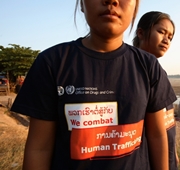
 In another case, Noi, (not her real name) a 16 year old girl from Meun District was persuaded by Ms. Seuy an older woman to work in Thailand. Ms. Suey told her parents that Noi would get good money. However when she arrived in Thailand, Noi was beaten, locked up and forced to work as a sex worker servicing 20 men a day. Noi was rescued in August 2012 and returned home where plans are being made to help rehabilitate her.
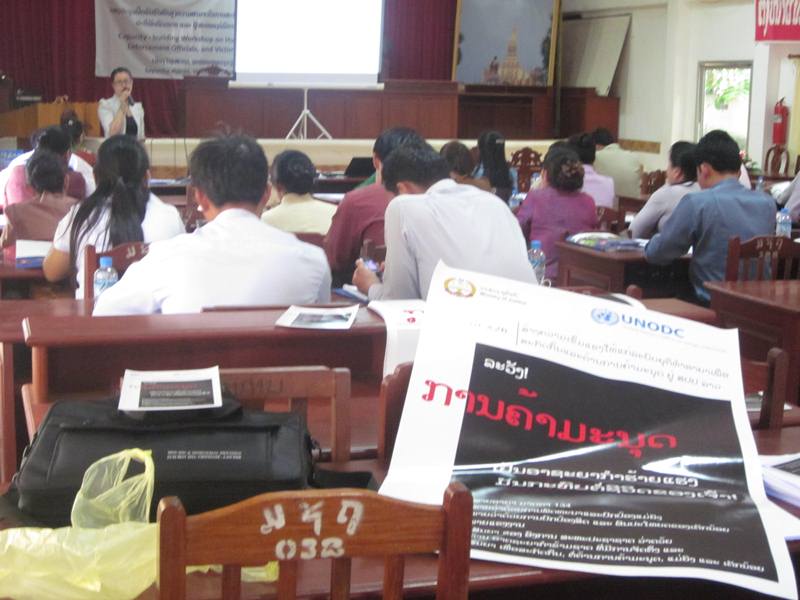 To deal with this problem a Core Training Group (CTG), consisting of a cross-cutting group of officials from the Lao legal sector, was established under a previous UNODC R76 Project. This trainer group forms an integral part of the new X26 Project "Strengthening Criminal Justice Responses to Human Trafficking in Lao PDR". The CTG provided awareness-raising and training workshops at provincial level to sensitise their counterparts in the legal and law enforcement institutions on the issue of human trafficking and how to respond with the cases they are facing in their work. The projects are funded by the Government of the United States of America.
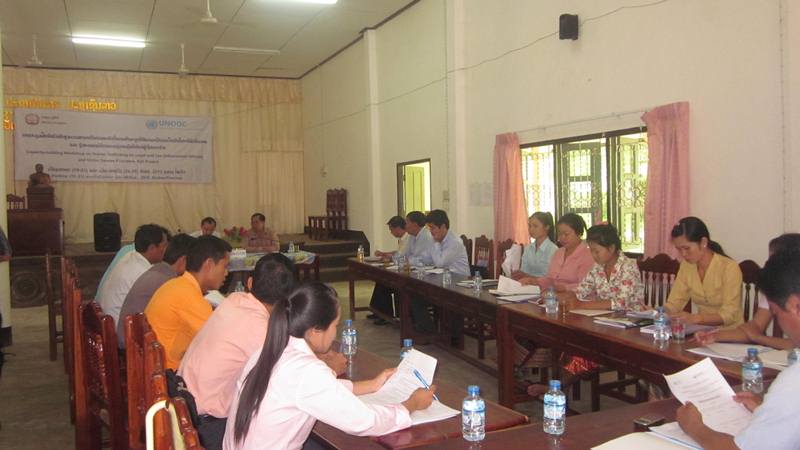 Workshops have taken place in Vientiane Capital for law enforcement officers from 7 districts on 14-16 August 2012; in


 Project Childhood was recently introduced in Lao PDR through a workshop in the capital Vientiane. The 80 participants to the "Workshop on Anti
 At the launch event, Ms. Margaret Akullo, the Project Coordinator for Project Childhood (Protection Pillar), emphasized that the Protection Pillar will significantly expand the intelligence base on the closed community of travelling sex offenders to more effectively prosecute suspects who seek to sexually abuse children. UNODC will provide assistance to the four countries in SE Asia to facilitate ratification and implementation of the relevant international legal instruments. INTERPOL will give operational criminal police support and advanced technological tools to strengthen international criminal police cooperation.
 Project Childhood countries were selected on the basis of a number of factors such as: the volume of reported arrests of alleged travelling child sex offenders; a perceived lack of institutional and legislative capacity to counter the crime, and the degree of participating Government willingness to engage with the international community to take effective action. Protection Pillar activities have already begun in Cambodia and Thailand and will extend to cover Lao PDR and Viet Nam in early 2012.
 A key workshop objective was to present findings from a UNODC legal review that examined current domestic legislative frameworks in Lao PDR as they apply to travelling child sex offenders. The report, an important Protection Pillar activity, determined whether Lao PDR law and legislative frameworks met international standards and obligations and addressed key issues such as child prostitution, sexual abuse of children, child pornography, child trafficking, child protection measures and International cooperation.


