Showing posts with label West Africa. Show all posts

Wednesday, August 28, 2013

Trafficked into labour, a young girl tries to regain what she's lost

SOURCE: UNGIFT.ORG

"Blessing's story is short, and it has many holes, because she simply doesn't remember much of her life - at least the part before she came to Lagos, West Africa's biggest metropolis.

"Years ago, she left her native Ghana with an aunt who was headed for neighbouring Nigeria. The aunt promised Blessing's parents that the girl would go to school and work to send them money. Like millions before them, they arrived in Lagos looking for opportunity."

CONTINUE READING:
http://www.ungift.org/knowledgehub/stories/August2013/trafficked-into-labour-a-young-girl-tries-to-regain-what-shes-lost.html
Enhanced by Zemanta

Monday, February 4, 2013

Eliminating human trafficking from the global business landscape

http://www.ohchr.org/EN/NewsEvents/Pages/Trafficking.aspx

Source: United Nations Human Rights


Businesses may unknowingly be associated with the crime of human trafficking when their suppliers, subcontractors, or partners supply materials or products that have been produced by trafficked persons. “In today’s globalized world, the risks of human trafficking in supply chains are significant throughout economic sectors and affect all States,” says Joy Ngozi Ezeilo, UN Special Rapporteur on trafficking in persons, in her report to the 67th session of the UN General Assembly.

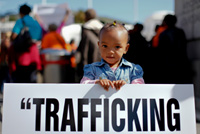
A South African child holds a poster during an anti-human trafficking protest © EPA/NIC BOTHMAGlobalization has made supply chains considerably complex, involving multiple suppliers in various locations around the world. In this environment, monitoring of the supply chain has inevitably become challenging.

The use of trafficked persons can be seen across the supply chain in various sectors. The economic sectors mostly connected to human trafficking include agriculture and horticulture, construction, garments and textiles, hospitality and catering, mining, logging and forestry, food processing and packaging, transportation, and domestic services. For example, global clothing companies have been accused of exploiting migrant workers in Asia, while chocolate and confectionary companies have been reported employing children who have been trafficked for forced labour under deplorable conditions in cocoa farms in West Africa.

On one occasion, an international tobacco company was linked to trafficking and forced labour through the tobacco farm owners who supply tobacco to the company’s subsidiary in Central Asia. Ezeilo observed that ”while the international company had no direct contractual relationship with the tobacco farm owners, it has nevertheless found it difficult to disassociate itself from the allegations in the light of the significant economic benefits that it ultimately derives from such conduct”.

Ezeilo says that States have an obligation under international human rights law to protect everyone within their jurisdiction against human rights abuses.

While states have in fact taken anti-trafficking measures, these are often not enforced. Ezeilo stresses the importance of effectively enforcing such measures, as well as other related national laws, such as labour and immigration laws, which are equally crucial in eliminating the risks of trafficking in persons in supply chains.
In her report, she notes the value of creative laws and mechanisms directed at businesses to better monitor their conduct, such as national certification or labelling systems, public listing of corporations known to have used slave labour, and laws requiring disclosure of information on corporate efforts to prevent human trafficking.
Businesses also have responsibilities to respect human rights and they are uniquely positioned to prevent or mitigate any risks of trafficking in their supply chains.

“Businesses cannot, and should not, shy away from the issue of human trafficking, not only because it amounts to human rights violations and is a criminal offence in most States, but also because it creates reputational and financial risks to their operations,” says Ezeilo. 

Ezeilo recommends that all global businesses commit themselves to the UN Guiding Principles on Business and Human Rights and become signatories to the UN Global Compact. Ezeilo also urges businesses to exercise due diligence and conduct a risk assessment for their entire production chain in order to eliminate risks of human trafficking in their operations.
29 January 2013elated articles
Enhanced by Zemanta

Saturday, May 5, 2012

Ferrero sets date to end cocoa slavery - The CNN Freedom Project: Ending Modern-Day Slavery - CNN.com Blogs

http://thecnnfreedomproject.blogs.cnn.com/2012/04/20/ferrero-sets-date-to-end-cocoa-slavery/
Source: CNN.com Blogs
April 20th, 2012
Chocolate maker Ferrero has pledged to eradicate slavery from farms where it sources its cocoa by 2020, as part of a growing movement by the multi-billion dollar industry to clean up its supply chains.
The Italian company, which produces Ferrero Rocher chocolates, Nutella spread and Kinder eggs, follows Nestle and Hershey as the third major chocolate manufacturer to announce new anti-slavery moves since September.
It says it will eradicate child labor and forced adult labor from cocoa plantations it uses by 2020, verified by “independent and credible” third parties. Also, it says it will publish a more detailed progress report this summer and promises improved communication to customers.
Up to 75% of the world’s cocoa beans are grown in small farms in West Africa. In the Ivory Coast alone, there are an estimated 200,000 children working the fields, many against their will, to create chocolate enjoyed around the world. Many of the children don’t even know what chocolate is.
In January, CNN highlighted the plight of the child labor in the Ivory Coast in a documentary, “Chocolate’s Child Slaves”, by correspondent David McKenzie.
statement from Ferrero said its new goals were made “in the light of the need for transparency in the cocoa sector.”
The industry’s regulation over cocoa farms is largely self-regulated. Critics say progress is too slow.
NGO Stop the Traffik, which worked with CNN on its documentary, welcomed Ferrero’s move as a “sweet deal” for children doing “back-breaking work”. 
“Ferrero is the first global chocolate company to explicitly state they will fulfill the promise the chocolate industry made collectively in 2001 to eliminate the trafficking of children in their supply chain. Together with Mars, who have promised 100% certified chocolate by 2020, Ferrero is the only other chocolate company to have made comprehensive commitments towards their entiry cocoa supply chain.
“This individual acceptance of responsibility, coupled with a commitment to report on progress each year, should be an example to the other major chocolate companies, such as Nestlé, Kraft/Cadbury, and Hershey’s, to follow suit.”
The London-based NGO called on Ferrero to put labels on wrappers of its products so customers would know they were untainted by slavery.
statement added: “2020 is still a long way away, and Stop the Traffik will be monitoring Ferrero’s progress.”
More than 10 years ago, two U.S. lawmakers took action to stop child labor in the industry. The Harkin-Engel Protocol, also known as the Cocoa Protocol, was signed into law on September 19, 2001.
But manufacturers raised concerns and a compromise was reached that required chocolate companies to voluntarily certify they were stopping the practice of child labor. The certification process would not involve labeling products "child-labor-free," as initially proposed.

Enhanced by Zemanta

Tuesday, February 14, 2012

Far from romantic - Fiji Times Online

Source: Fiji Times Online


Off The Wall With Padre James Bhagwan
Wednesday, February 15, 2012

Every week I receive an email from Dudley Church which has their weekly newsletter, the "Dudley Samachar" (samachar means news). It's handed out at the four churches in Dudley Circuit/Parish in Suva and emailed out to friends and former members.

Last Sunday's issue contained, among other things, articles from the Uniting Church of Australia magazine "Revive" on St. Valentine's Day.

One article which caught my attention and prompted a discussion with my children was titled, "A LOVE TO DIE FOR":

St. Valentine's Day, 14 February, isn't quite as big a deal in Australia as it is in the United States; nonetheless, many romantics like to mark the day with a small token of affection to the one they love. In 2011, Australians were estimated to have spent about $285million on Valentine's Day chocolate and confectionary. But is that heart-shaped box really giving the right message?

The reality of chocolate is far from romantic. Around 70 per cent of the world's production of cocoa comes from West Africa - Ghana, Nigeria, C"te d'Ivoire and Cameroon. Most of the chocolate sold in Australia will contain cocoa from West Africa, produced by children forced to work in slave-like conditions or have been trafficked.

The US Department of State estimates that more than 109,000 children in C"te d'Ivoire's cocoa industry work under "the worst forms of child labor", and that some 10,000 are victims of human trafficking or enslavement. Think about it. One of life's simple pleasures, one we share as an expression of love, comes to us courtesy of children who have been taken from their families and denied a childhood.

Children who understand what the beans they collect are used for, because they have never seen chocolate.

Naturally you can imagine the look on my two little one's faces after they read the article (they had to read it for themselves to make sure this wasn't one of Daddy's "made up stories").

Yesterday as many chocolates were given out and eaten on St. Valentine's Day (which was not a public holiday as one Fijian television channel's programming seemed to suggest) I wondered how many people thought about where their chocolate came from (beyond of course the giver or the shop at which it was bought).

A BBC Panorama investigation found that that there is no guarantee, despite safeguards, even with chocolate marketed as Fairtrade, that child labour - as defined by the International Labour Organisation (ILO) - has not been involved in the supply chain. Investigative journalist Paul Kenyon, posed as a cocoa dealer and in a village in Ghana, met 12-year-old Ouare Fatao Kwakou, who was sold to traffickers by his uncle and taken from neighbouring and impoverished Burkina Faso to work as a cocoa picker.

More than a year later, he had not been paid a penny for his work - the profits of his labour going instead to his new cocoa masters and to the uncle who sold him.

Fair Trade is a growing, international movement which ensures that producers in poor countries get a fair deal.

According to the BBC, the Fairtrade cocoa co-operative in Ghana which supplies Cadbury and Divine, suspended seven out of 33 of their cocoa farming communities in one of its 52 major growing districts in the country after they were found to be using the worst forms of child labour. Some suspensions were lifted when the cooperatives stopped using child labour

In the port city of San Pedro in Ivory Coast, Kenyon posed as a trader and sold on cocoa beans which had been produced by the worst forms of child labour. It is at this point where the traceability of the cocoa ends and it can be sold on to major chocolate makers worldwide who cannot say how it was sourced.

For more on child labour and chocolate read the BBC article at http://news.bbc.co.uk/panorama/hi/front_page/newsid_8583000/8583499.stm

For the last few years I have enjoyed the local chocolate made in Tailevu. However I have only been able to obtain a few precious bars during the Ministry of Primary Industries' Fiji Agricultural Show.

However those bars from Namau Village in Naloto, Tailevu, in their no frills foil wrapping are the closest I have come to in terms of guilt-free chocolate!

I have not had an opportunity to visit our local chocolatiers and am not sure when they will have the capacity to cater for the Fijian market.

I do however, know that it is their dream. For that dream to become a reality, many of us will seriously need to commit to supporting our local cottage industries.

Most of us do support our cottage industries, and not just because of the Buy Fiji Made campaign (although I'm sure it helps). We buy bubu's jam, bahaini's chutney, roti parcels, fried fish and cassava lunch packs, sasa-brooms, patchwork quilts and floormats made from cast-off rags because they are affordable.

We buy them because we are supporting the people (mainly our mothers and sisters) who make them as often the only source of income for the family. At the same time we are choosing our local products over the imports.

I am sure that one day, our Tailevuan chocolate will be promoted locally and regionally like the products from FRIEND Fiji or internationally demanded like those of Pure Fiji, both who combine support for locally made products with international standards.

Martin Luther King once remarked, "Before you've finished your breakfast this morning, you'll have relied on half the world". This may be true of western countries. It does not have to be the case in Fiji.

Maybe our sila can be made into corn flakes, our Labasa rice can become the bubbles that children love.

Who knows, maybe next year you will be able to give your Valentine Fiji chocolate. At least knowing where it came from and who made it won't leave a bitter taste in your mouth.

* Reverend James Bhagwan is currently a student of the Methodist Theological University's International Graduate School of Theology in Seoul, South Korea. Email: padrejames@gmail.com or visit http://thejournalofaspiritualwonderer.blogspot.com.


Enhanced by Zemanta

Friday, November 18, 2011

Hershey Hires Lobbyists to Avoid Labor Rights Scrutiny | Change.org News

http://news.change.org/stories/hershey-hires-lobbyists-to-avoid-labor-rights-scrutiny

by Tim Newman · 2011-09-22 04:35:00 -0700 


Amid growing scrutiny of Hershey's labor rights abuses, from its cocoa beans to its packing facility in Pennsylvania, the company has hired additional lobbyists to deflect attention from its exploitation of workers. Hershey recently hired the services of Bank Rome Government Relations to advocate for the company on "government affairs issues related to labor practices." Unfortunately for Hershey, no amount of money thrown to lobbyists will end its connection the abuse of student guestworkers or child, forced and trafficked labor in its cocoa supply chain -- only changing its policies will solve these problems.

Last month, it was revealed that student guestworkers who came to the US on J-1 visas found themselves working long hours in poor conditions for paltry wages in a Hershey packing facility in Pennsylvania. The students staged a walk out, organized massive protests in Hershey and took their message across the country, even receiving support from labor rights advocates around the world. Almost 70,000 Change.org readers have joined the campaign calling for justice for guestworkers and for living wage jobs for Pennsylvania residents. Meanwhile, Hershey has hidden behind multiple layers of subcontractors and remained silent about its connection to the exploitation of these students.

This week marked the ten year anniversary of a commitment Hershey signed to end abusive child labor, forced labor and trafficking in its cocoa supply chain in West Africa. A decade later, 1.8 million children continue to work on cocoa farms in Cote d'Ivoire and Ghana. Hershey has lag behind all other major chocolate companies in committing to source cocoa that has been independently certified to comply with international labor rights standards. That is why over 15,500 Change.org readers have joined the
International Labor Rights Forum in calling on Hershey to "raise the bar" for responsible cocoa sourcing.

Instead of directly addressing its connection to egregious labor rights violations in its global supply chain, Hershey has chosen to spend its resources on hiring lobbyists to quell increasing demands that the company do the right thing for workers. Blank Rome Government Relations has reported to the US Senate that it is now lobbying on behalf of Hershey on labor issues. According to the disclosure documents, Ashley Davis and Abigail Goldstein will be representing the company in meetings with legislators. Davis has worked closely with the George W. Bush Administration and served as a Special Assistant to Tom Ridge when he was Director of Homeland Security. Interestingly, Ridge is also a current member of Hershey's Board of Directors.

Of course, lobbying is nothing new to Hershey. The company also employs Ronald Graf as Vice President of Government Relations. Graf, with assistance from Eileen Harley, lobby for Hershey on a range of issues including labor standards in supply chains. Harley went directly from working in the House Rules Committee from 2001 to 2007 to lobbying for a food industry front group followed by the Grocery Manufacturers Association before she began lobbying for Hershey. The company has already spent over $300,000 for lobbying just on its two official employees in the first half of this year.

Hershey's increased spending and reliance on lobbying demonstrates clearly that we're starting to have an effect on the company. It clearly is starting to feel the backlash from its declining respect for workers throughout its supply chain. Now, we need to build the pressure on Hershey to channel its energy and resources to supporting the best kind of public relations: actually respect workers. The best way to improve its reputation for poor labor rights policies is to "raise the bar" for workers from bean to bar. Concerned consumers certainly won't be swayed by anything less.

You can increase the pressure on Hershey by signing both the petition to support student guestworkers and cocoa growing communities producing for Hershey. After you sign both petitions, ask your friends and family to join you and spread the word on Facebook and Twitter.
Photo credit: entheos
Tim Newman is a campaigns assistant at the International Labor Rights Forum. He also works on the Stop Firestone campaign.
Enhanced by Zemanta

Tuesday, October 11, 2011

Guinea-Mauritania: Worst forms of child labour still widespread

Source: IRIN News

200612262.jpg
Photo: Nicholas Reader/IRIN Child labour is common in Guinea (file photo)
DAKAR, 10 October 2011 (IRIN) - The law does not necessarily make much difference when it comes to child labour: In Guinea and Mauritania the worst forms of child labour persist despite it being banned by law, leading child protection experts to call for a better understanding of the dynamics behind it.

West Africa adviser for child protection at the UN Children's Fund (UNICEF) Joachim Theis told IRIN: "Until now there has been very little discourse which makes the links between strategies taken by parents to find a solution for each child in the context of informal employment, and the application of international norms."

Mauritania

In Mauritania the law prohibits putting children under 14 to work, and penalizes those who are guilty of exploiting minors. But in reality, according to a late September report the International Trade Unions Federation (ITUC) under-14s continue to be sent to work, including some in "slave-like" conditions.

While most of the children are girls working as domestics for families, boys are often forced to beg; or are sent to work in the construction industry, on buses as money-collectors, or in criminal gangs. They are also forced to beg by Koranic teachers who are supposedly giving them a religious education - as is the case with hundreds of thousands of children across West Africa. In rural areas, boys work in the fields or herd animals.

Domestics work on average 10-hour days, according to a 2009 study by UNICEF and the Ministry of Welfare for Children and the Family; while those working as beggars or in agriculture may work as many as 16 hours. Of 265 children interviewed, just under half said they were beaten by their bosses.

A long tradition of slavery complicates the situation. A law was passed in 2007 forbidding slavery but it is not rigorously enforced, according to Mamadou Niang, head of external relations at the General Confederation of Workers in Mauritania."The authorities are usually lax in these cases, and the administration often ignores them - in some cases they may dissuade the families of enslaved children from bringing a case forward," he said.

One fifth of the Mauritanian population is affected by slavery in one form or another, according to a 2009 study by NGO SOS Slavery.

Guinea

In Guinea, despite legislation banning work for under-16s, "children carry out dangerous work in farms, in mines and in fisheries." According to the ITUC, some children in artisanal mines work 15-hour-days, seven days a week, from age five.

Child trafficking is also a problem: Moving children across borders into forced begging and other activities is still prevalent, though it has declined in recent years.

ITUC calls on both governments to more rigorously impose child labour laws and penalize individuals and organizations that do not comply, while recognizing that capacity in ministries remains very low.

Grégoire Tonguino at the child protection and pre-school education department of Guinea's Ministry of Children and the Family, told IRIN: "Guinea is good at developing laws, but applying them still poses some problems." Few people other than child protection experts even know about child labour laws in Guinea, he added.

However, a gap in the law means that even with boosted capacity, it would be hard to crack down: the law does not cover children in the informal sector, where most domestics and agricultural helpers work.

Cultural reality

Child labour is commonplace in poor rural societies in West Africa, as it is a way of training children and assuring them jobs in the future. In Guinea, for example, "fostering" or giving a child to a family as an apprentice, is considered beneficial to the child.

Sending a child into work is part of a family's risk-spreading strategy to combat poverty, said Theis.

As Olivier Feneyrol, regional adviser for NGO Terre des Hommes in West Africa once put it to IRIN: "Children have been moving around the region for centuries and working just as long. That is the cultural reality here."

"The debate on this issue is contentious," says Mariama Penda Diallo, head of international relations, solidarity and humanitarian action at the Trade Union of Workers of Guinea (USTG), "because people say that it's better to place the child from an early age so they can learn how to work," she said.

Most poor urban families have no choice but to send their children to work, added Niang in Mauritania. "With the rural exodus, many families have settled in slums with their children. In the absence of public strategies to look after them, poor parents have no alternative but to send their children to work."

To make a difference to children's lives, authorities need to better understand the context they are working in, said Theis: "It is important to understand the decision-making process that families go through because policies are not necessarily based on real situations that can have concrete results."

For the ITUC the priorities are clear: it recommends investigating instances of children being forced into work to pay for their religious education; more prosecutions of those individuals who force children to work; turning the Mauritania anti-slavery law from theory into practice; and expanding Guinea's child labour law to include children involved in unpaid, temporary, contract work.

But given the reality, just as important, said Diallo is to improve conditions for the thousands of children who will inevitably end up working, and to find a way to help them also attend school.

Enhanced by Zemanta

Saturday, October 1, 2011

Letter: Human trafficking | CJOnline.com

Source: CJOnline.com

September 25, 2011 - 8:47pm

Few films have stunned me as much as “Not My Life,” a documentary about human trafficking shown recently by Washburn University and the Topeka Center for Peace and Justice.

The film explores the myriad ways criminals exploit other people, primarily children, for their own profit.

The scope and brutality of human trafficking, as well as ways in which I have unwittingly contributed to it, made me squirm more than once.

I was awake well into the night, trying to think of ways I could play some small part in combating it — such as learning more and writing letters to the editor, for starters.

The film spotlights some of the victims of human trafficking, including the fishing boys of Ghana, street beggars of Senegal and girls and women trapped in the brothels of Mumbai, India, and Phnom Penh, Cambodia.

The film even includes a segment on a Wichita teenager who was tricked and coerced into prostitution at truck stops in Oklahoma and Kansas.

Among the things I learned:

■Human trafficking is the world’s third largest crime industry, behind only drugs and guns, and it is the fastest growing criminal activity.

■About 80 percent of human trafficking is sex trafficking, the rest is labor.

■In some instances there is a direct relationship to the low price I pay for many of my favorite items and human trafficking.

After the film, Christine Ladner, a Kansas assistant attorney general, talked about some steps the state is taking to combat human trafficking, including recent legislation.

The program was one in a series sponsored by the Topeka Center for Peace and Justice and WU that focuses on the problem of human trafficking.

The next program will include the film, “The Dark Side of Chocolate,” a documentary that investigates the use of child labor in the cocoa fields of West Africa.

The film will be shown in mid October, when many of us will be purchasing chocolate to hand out to our neighborhood children for Halloween.

DUANE JOHNSON, TOPEKA

Enhanced by Zemanta

Thursday, February 17, 2011

Tyler Paper Censors Truth About Chocolate Industry Abuse | Change.org News

by Tim Newman · February 15, 2011
Valentine's Day is an opportunity for many people to learn more about how their chocolate is produced. That impulse is what motivated Leigh Vickery to write an article about the well-documented and continued use of forced, trafficked and child labor in the cocoa industry in West Africa. The article was published by Tyler Paper in Texas, but soon after it was posted, the management made the decision to remove Leigh's piece.

After censoring Leigh's article, the newspaper posted a new one by Business Editor Casey Murphy that sounds more like industry talking points than actual journalism. As evidence that labor rights are protected in the cocoa industry, Murphy quotes one company representative who states simply, "We're very comfortable with the vendors we get our chocolate from" without providing any actual evidence of suppliers' efforts to address labor rights violations. The company representative states that chocolate is "just a token of love." Unfortunately, every report on labor rights conditions in West Africa confirms that chocolate is actually linked to continued exploitation of workers.

For example, the U.S. Department of Labor cites cocoa from five different West African countries as tainted by child and forced labor. In fact, cocoa from the Ivory Coast and Nigeria is on a list from the U.S. Department of Labor (DOL) of products that government contractors must prove are not produced by forced or child labor due to the pervasive existence of these abuses in the region that produces the vast majority of the world's cocoa. Additional annual reports from both DOL and the State Department also highlight child labor and trafficking connected to the primary ingredient in chocolate.

The most extensive independent analysis of labor rights abuses on cocoa farms in West Africa and industry efforts to address the exploitation also contradicts Murphy's article. Tulane University's Payson Center for International Development reported in 2009 that one million children in the Ivory Coast and Ghana work in the cocoa industry and that the voluntary industry protocol cited by Murphy as evidence that the industry is dealing with this abuse has many critical aspects that have not been implemented in the ten years since the agreement was signed and that the efforts supported by companies do not sufficiently remediate forced labor and trafficking.

Unfortunately, the evidence is overwhelming that abuses continue and the efforts of the broader chocolate industry have not done enough. As Leigh's article notes, there are companies that are working more proactively to end these abuses and those companies should be acknowledged for their efforts. However, consumers have a right to know which companies are not stepping up to the plate to end such severe human rights violations.

While Tyler Paper decided to censor Leigh's article that highlighted the reality behind chocolate in favor of corporate propaganda, the International Labor Rights Forum worked with Leigh to make her article available on its blog. This might make a good temporary solution, but the bigger question is Tyler Paper's commitment to journalistic integrity. Additionally, Tyler Paper's actions fit in to a broader context where those in power have continuously attempted to silence those who expose abuse in the cocoa industry. In the Ivory Coast, journalist Guy-Andre Kieffer disappeared in 2004 while investigating corruption in the cocoa industry. This past summer, three Ivorian journalists ended up in jail after they published an article about a government probe into ongoing mismanagement and corruption in their country's cocoa industry.

The good news is that the three journalists jailed in the Ivory Coast in July 2010 were released, in part due to the international pressure from Change.org readers who took action. Those journalists ended up on our list of Human Trafficking Heroes of 2010. Let's use the collective strength we've exerted before to stand up for those who speak out against child labor and trafficking once again.

Contact Tyler Paper now to tell its management that we will not support their censorship of labor rights abuses in the cocoa industry.
Photo credit: GiantsFanatic
Tim Newman is a campaigns assistant at the International Labor Rights Forum. He also works on the Stop Firestone campaign.
Tyler Paper Censors Truth About Chocolate Industry Abuse | Change.org News
Enhanced by Zemanta

Wednesday, December 15, 2010

From servitude to safety in northern Ghana

An adolescent boy pulls in nets after detangling them from the tree stumps below the water. Many children drown during this task.

Touch A Life Foundation is changing the lives of children who were previously sold into slavery in the fishing industry on Lake Volta in northern Ghana. Touch A Life (TAL) has one home in Tema, named the Village of Love, that houses 24 rescued children and a second home, named the Village of Life, that is home to 44 children in Kete Krachi, which is less than five minutes from the dark and dangerous waters of Lake Volta.

At both locations, I met the 68 girls and boys who were rescued from the lake, and some from cocoa fields. It is amazing to see how children, all of whom were once traded for less than 20 American dollars in exchange for years of strenuous (and illegal) labor, can have the chance to pursue their dreams and live their lives fully.

TAL gives these children the love, safety, nourishment, education and family that they so desperately deserve and need. This is all immediately evident in the moment one arrives at the children's homes. Instantly, one is overwhelmed (and even physically knocked over) by hugs and smiles from these kids. I had the great fortune of spending a week with TAL, mainly in Kete Krachi, where I documented the medical exams conducted by nurse practitioner Brad Gautney, as well as the human trafficking on the lake. Being there and seeing these kids has changed my life forever.

This photo essay was selected by Photo Philanthropy as a finalist for their 2010 Activist Awards in the amateur category. To see all the award winners and finalists, go to www.PhotoPhilanthropy.org.

Source: sfgate.com
From servitude to safety in northern Ghana
Enhanced by Zemanta

Monday, December 13, 2010

Lawyer says N.J. human trafficking case involves culture norms not understood in America | NJ.com

Published: Wednesday, December 08, 2010, 1:30 PM     Updated: Wednesday, December 08, 2010, 1:30 PM
african-human-trafficking.jpgThe bedroom at 169 South Clinton Street where some of the victims, who were smuggled and forced to work in hair salons, lived.
ESSEX COUNTY —The lawyer for an African woman charged with smuggling young girls from Togo to New Jersey said her trial was about cultural norms that failed to translate in America. Twelve American jurors saw it as a clear-cut example of human trafficking, and she was sentenced to 27 years in prison.

Both sides focused on the cultural nuances of the case; the defense arguing the woman was a benevolent mother figure who helped young girls escape a life of poverty; the prosecution accusing her of using the threat of African voodoo curses to keep the girls subjugated.

The case highlighted a legal strategy that experts say immigrants' defense lawyers are using increasingly in the U.S.: the argument that a defendant's actions reflect his cultural upbringing, rather than criminal intent.

"We derive meaning from action, and that meaning is very culturally laden," said Susan Bryant, a law professor at the City University of New York who provides cross-cultural training to lawyers and judges. "If you look out the window and you see someone with an umbrella, you may assume it's raining. In China, it could just as easily mean the sun is out."

Bryant said demand for cross-cultural training among legal professionals has steadily increased over the past decade.

Bukie Adetula represented the Togolese immigrant, Akouavi Kpade Afolabi, who was convicted of human trafficking and visa fraud charges at her 2009 federal trial in Newark. Prosecutors alleged Afolabi brought at least 20 girls between the ages of 10 and 19 from West African nations on fraudulent visas to New Jersey, effectively enslaving them and forcing them to work in African hair braiding salons for no pay.

Adetula argued that what prosecutors called clear-cut signs of modern slavery were considered protective measures in African culture: restricting telephone access, holding the girls' passports, and forbidding them from going out of the house unaccompanied.

"America is supposed to be a country made up of so many different cultures, so, yes, make the laws, and enforce the laws," Adetula said. "Do not make different sets of laws for different people, but look to the interpretations of acts, before you say: 'Oh, it's an offensive act, it's against the law, it amounts to human slavery."

Adetula, a Nigerian native who has been practicing law in New Jersey for more than two decades, is one of many lawyers — often immigrants themselves — who bridge the divide between their clients' cultural or religious backgrounds and the American legal system.

Raymond Wong, a lawyer in New York City's Chinatown neighborhood who has a large Asian immigrant client base, said his challenge is often twofold: explaining a client's cultural customs to Americans, while persuading foreign-born clients who prefer resolving disputes through negotiation to use the U.S. court system.

"There's a serious a lack of legal professionals in China, so all the problems are resolved by friends, relatives, people that you know," Wong said. "To them, going to court is a scary thing, getting arrested by cops is a scary thing, confrontation with authorities is a scary thing."

Defense attorney Tony Serra gained national prominence for his use of cultural defenses in two separate California cases in the 1990s where American Indians were accused of fatally shooting law enforcement officers. Serra's cultural defense tactics included using expert witnesses on American Indian culture to argue the alleged perpetrators were victims of longstanding anti-Indian racial prejudice, historical tragedies, and a deeply rooted fear of authorities. Serra's defense in the 1990 retrial of Patrick "Hooty" Croy, a Siskiyou County Indian accused of killing a Yreka, Calif., policeman, proved persuasive enough for a San Francisco jury to free Croy after 11 years on San Quentin's death row.

Prosecutors at the time derided the strategy — as critics of "culture defenses" do today — arguing that historical accounts are irrelevant to modern-day criminal cases, and a person's cultural background is no excuse for lawbreaking.

"We don't want to water down our rule of law," said Kent Scheidegger, the legal director of the Criminal Justice Legal Foundation, who argues that cultural defenses, in most cases, shouldn't be considered mitigating factors.

"There are some cultures where fathers kill their daughters because they get involved with a man," Scheidegger said. "That would not be exonerating at all in my view — that's a crime and it should be punished as a crime — and punished the same as anyone else who commits that crime."

Lawyers like Adetula emphasize that factoring in someone's cultural upbringing can help juries and judges determine the degree of an offense or the severity of punishment; they say it is not meant to excuse criminal acts.

"There are aspects of American culture that may not be acceptable in other parts of the world also, and we hear stories of Americans hiking in other countries and they get arrested, or taking pictures at places where it's offensive in other countries, and getting arrested," Adetula said. "It's not a one-sided thing."

Source:  nj.com

Lawyer says N.J. human trafficking case involves culture norms not understood in America | NJ.com

Enhanced by Zemanta

Sunday, October 3, 2010

We've got to stamp out modern slavery | Felicity Lawrence | Comment is free | guardian.co.uk

Workers are powerless against the contractors used by multinationals who relocate to wherever production is cheapest

The re-emergence of slavery on ships off West Africa is profoundly shocking but it is not a surprise. Last week slavery its modern form came to light in cases of forced labour uncovered on trawlers fishing for the European market. In a haunting echo of the 18th century triangular trade, west African workers were found off the coast of Sierra Leone on board boats where they lived and worked in ships' holds with less than a metre of head height, sometimes for 18 hours a day for no pay, packed like sardines to sleep in spaces too small to stand up, with their documents taken from them and no means of escape.

It is no accident that globalisation has seen the reemergence of slavery. The human degradation off West Africa is replicated elsewhere. I first came across modern slavery when investigating the UK chicken supply chain in Thailand in 2002. UK retailers and manufacturers now source much of their cheap commodity chicken from Asian factories. On the subcontracted farms around Bangkok that supply the international poultry processing factories I found illegal Burmese migrants trapped in debt bondage and forced labour. Fifteen Burmese refugees, interviewed for me by the American Centre for International Labour Solidarity, described sleeping in one room on the floor working whatever hours their Thai boss required of them, without pay and without a day off for two months. They had been kept in order by violence and by the threat of deportation if they complained.

In Brazil, investigating the explosion in soya production in the Amazon region for my book Eat Your Heart Out, I heard of the slaves found on farms being cleared in the rainforest. A Dominican priest, Xavier Plassat, who campaigns to free them told me how he had just returned with government swat squads from a farm 60km off the road where 200 workers were being kept in slavery, labouring without pay, deprived of freedom of movement and controlled by debt bondage. They had no clean water and little food and were living 30 to a room. Plassat believed slavery and agribusiness were inextricably linked. Monoculture for export, the large-scale intensive farming dominated by transnational corporations (TNC), and favoured by trade rules and international financial institutions, had created the conditions for slavery by eliminating the traditional small scale farming that provided food for 60% of the Brazilian population. He is not alone. Kevin Bales, the great expert on modern slavery, has shown how driving peasant farmers off the land has created a new supply of dispossessed workers who can be pressed into this condition.

Expansionist agriculture and empires have always depended on slave labour, as Latin authors of the Roman empire complained centuries ago. Today, we live in an era when the dominant powers don't officially "do" empire, so economic control takes a new privatised form in the TNC. Modern slavery has evolved to match. The straightforward ownership of chattel slavery is gone, replaced instead by an outsourced, subcontracted kind of control over people, which can be terminated when they have served their purpose. The transnationals universally abhor any idea of slavery or forced labour and yet it is found in their supply chains. Slaves and exploited migrants, often driven into migration by the squeeze on family agriculture, are what make the economics of today's agribusiness work.

In a globalised world, footloose corporations have relocated to wherever labour and resources are cheapest. And then in order to compete, companies in the developed world have reimported the labour conditions of the least developed countries with the fewest protections back to Europe and the US. So even in rural England I have found examples of debt-bonded South African workers and Anti-Slavery International finds itself taking up the plight of Mexican farm workers suffering extreme exploitation in California.

It was in part revulsion among consumers of the products of slavery in the 19th century that led to the movement to abolish it.

The sugar trade of the 17th and 18th centuries unlocked the power of mass consumption in England. Slaves on the plantations of the Caribbean laboured to produce it, creating wealth that mostly returned to Britain, and for others to accumulate capital. They paid with their lives. But it was also the sugar trade that threw up one of the earliest examples of ethical shopping.

An early 19th century sugar bowl in London's Museum of Docklands is inscribed with the message: "East India Sugar not made by Slaves. By Six Families using East India instead of West India sugar, one less slave is required." Like so much ethical shopping it exposes its own limitations. Abolishing slavery in the 19th century required reform of a whole political and economic system.

How should we respond to news of slavery re-emerging today? Stamping it out needs as big an overhaul of prevailing power structures as previously. And yet, it was on small tokens of concern that a political movement against slavery was originally built. It's time we made our revulsion clear again.

We've got to stamp out modern slavery | Felicity Lawrence | Comment is free | guardian.co.uk

Source: guardian.co.uk


Enhanced by Zemanta