Burma angered as EU backs UN investigation into plight of Rohingya Muslims | The Independent:
Showing posts with label Myanmar. Show all posts
Showing posts with label Myanmar. Show all posts
Monday, May 8, 2017


Friday, July 15, 2016
Tuesday, July 5, 2016
Tuesday, March 29, 2016
Friday, March 25, 2016
Wednesday, October 21, 2015
Tuesday, July 21, 2015
Wednesday, June 3, 2015
Friday, April 24, 2015
Myanmar under pressure over human trafficking in Rakhine
A human rights group (Fortify Rights) lobbied the United States on April 22 to rank Myanmar among the worst human trafficking offenders in the world for “driving” ethnic minorities into the slave trade.
Read HERE
Myanmar under pressure over human trafficking in Rakhine:
Here is the URL to Fortify Rights' testimony
http://www.fortifyrights.org/downloads/FR_TIP_Testimony_April_2015.pdf


Thursday, March 6, 2014
A Reuters Exclusive: Trafficking abuse of Myanmar Rohingya spreads to Malaysia
Source: Reuters:
Trafficked Rohingyas are now held in northern Malaysia where they are tortured to extort ransom from their families.
Read the report by STUART GRUDGINGS
http://www.reuters.com/article/2014/03/06/us-malaysia-rohingya-idUSBREA2504U20140306

Trafficked Rohingyas are now held in northern Malaysia where they are tortured to extort ransom from their families.
Read the report by STUART GRUDGINGS
http://www.reuters.com/article/2014/03/06/us-malaysia-rohingya-idUSBREA2504U20140306


Thursday, January 2, 2014
Human Trafficking: Muslim Women Vulnerable in Myanmar | Engy Abdelkader
Source: Huffington Post
By Engy Abdelkader
U.S. Representative to Advisory Panel of Experts on Freedom of Religion or Belief at the OSCE
Amid continued communal strife in Myanmar, Muslim women and children are increasingly finding themselves in vulnerable situations that have yet to be adequately recognized and addressed. This post glimpses the related issue of human trafficking.
Continue here:
http://www.huffingtonpost.com/engy-abdelkader/human-trafficking-rohingya-women_b_4501815.html

By Engy Abdelkader
U.S. Representative to Advisory Panel of Experts on Freedom of Religion or Belief at the OSCE
Amid continued communal strife in Myanmar, Muslim women and children are increasingly finding themselves in vulnerable situations that have yet to be adequately recognized and addressed. This post glimpses the related issue of human trafficking.
Continue here:
http://www.huffingtonpost.com/engy-abdelkader/human-trafficking-rohingya-women_b_4501815.html
Thursday, December 5, 2013
SPECIAL REPORT-Thailand secretly dumps Myanmar refugees into trafficking rings
Source: Thomson Reuters Foundation
RANONG, Thailand, Dec 5 (Reuters) - One afternoon in October, in the watery no-man's land between
Thailand and Myanmar, Muhammad Ismail vanished.
Continue here:
http://www.trust.org/item/20131204234540-7ue31/?source=hpagehead

RANONG, Thailand, Dec 5 (Reuters) - One afternoon in October, in the watery no-man's land between
Thailand and Myanmar, Muhammad Ismail vanished.
Continue here:
http://www.trust.org/item/20131204234540-7ue31/?source=hpagehead
Thursday, September 19, 2013
Myanmar Pledges to Tackle Human Trafficking Through International Collaboration
Source: Radio Free Asia
Myanmar has vowed to step up its battle against human trafficking by doing more to check the problem at home and collaborating in preventive efforts with the U.S. and its Southeast Asian neighbors.
Home Affairs minister Ko Ko said the authorities would also emphasize efforts to address the rights of the victims of human trafficking, which has grown into a big problem in Myanmar’s cities in recent years.
Continue:
http://www.rfa.org/english/news/myanmar/trafficking-09172013150346.html

Myanmar has vowed to step up its battle against human trafficking by doing more to check the problem at home and collaborating in preventive efforts with the U.S. and its Southeast Asian neighbors.
Home Affairs minister Ko Ko said the authorities would also emphasize efforts to address the rights of the victims of human trafficking, which has grown into a big problem in Myanmar’s cities in recent years.
Continue:
http://www.rfa.org/english/news/myanmar/trafficking-09172013150346.html

Sunday, September 1, 2013
Nightmare island where traffickers imprison Burma's Rohingya - Channel 4 News
Source: Channel 4 News


Nightmare island where traffickers imprison Burma's Rohingya
John Sparks
Asia Correspondent
"Beaten, imprisoned and sold into slavery -
Channel 4 News reveals the fate of Burma's Muslim Rohingya refugees, who
flee conflict only to end up in the clutches of brutal human
traffickers."
Continue here:
Best Industrial Company Ltd., Myanmar Garment Factory, Protects Workers From Human Trafficking
By Iris C. Gonzales, Women's eNews
"Human trafficking happens when there are no decent jobs. We need to create decent jobs for them here in the country," said Khine Khine Nwe, managing director of Best Industrial Company Ltd., which produces jeans, shirts and other apparel for companies in Japan, and in the past to Europe and the United States."
Continue to read: http://www.huffingtonpost.com/2013/08/29/human-trafficking-myanmar_n_3836346.html

"Human trafficking happens when there are no decent jobs. We need to create decent jobs for them here in the country," said Khine Khine Nwe, managing director of Best Industrial Company Ltd., which produces jeans, shirts and other apparel for companies in Japan, and in the past to Europe and the United States."
Continue to read: http://www.huffingtonpost.com/2013/08/29/human-trafficking-myanmar_n_3836346.html
Friday, August 9, 2013
Thailand arrests suspected leader of human trafficking gang
Source: Thomson Reuters Foundation

Pairat Temphairojana reports that "Thai authorities have captured the suspected leader of a human trafficking gang, who confessed to selling some migrants from Myanmar into slavery on Thai fishing boats and possibly murdering as many as seven, a Thai official said on Friday."
Continue reading here:
Monday, January 7, 2013
Myanmar's brides to China top human trafficking list
http://www.mmtimes.com/index.php/national-news/3705-brides-to-china-top-govt-human-trafficking-list.html

SOURCE: THE MYANMAR TIMES
By Soe Sandar Oo | Monday, 07 January 2013
About 80 percent of human trafficking cases in Myanmar over the past five years involved women being smuggled into China for forced marriage, a Myanmar Police Force official said last week.
Of the remaining 20pc of cases, 10pc involved Thailand and 6pc Malaysia, the spokesperson from the Department of Transnational Crime said.
“Myanmar woman are in great demand because China practises its one-child policy. About 80pc of human trafficking in Myanmar are due to forced illegal marriage issue in China,” he said.
“Solving this problem will not only require the effort of the police force. It is partly related to poverty and also we need to improve education, particularly in the border areas.”
Between January 2006 and August 2011, 731 trafficking cases were reported, 585 of which involved China.
Of those cases, 1305 people were rescued, including 780 from China – or about 60pc of the total – along with 483 from Thailand, 16 from Indonesia and 15 from Malaysia.
Meanwhile, 85pc of victims were women and 65pc of traffickers were also women, the figures show.
The spokesperson said it remained difficult to rescue women who had been trafficked into China because they were spread across the country and they needed more cooperation from the Chinese authorities.
The Ministry of Home Affairs released the data in December at the launch of its latest five-year national plan of action to combat human trafficking, which covers the period between 2012 and 2016.
Women trafficked into other neighbouring countries are often forced to become sex workers, the official said. Men are likely to end up as labourers, he said, while children are trafficked to make money as beggars.
Most women are lured to China by the promise of a well-paying job.
Ma Moe Moe, 23, was sold to a Chinese man in Guangdong Province but escaped after three days in October 2012.
She was passed between four brokers before reaching Guangdong, she said, adding that she met many Myanmar forced brides while in China.
“I ran and escaped from the Chinese man who bought me from a broker to be his wife when he went to the toilet one day. They consider you to be a wife if you give birth to a son but will kill a female child and they’ll make you a forced labourer in the fields,” said the Shwe Pyi Thar township resident. “You will become a slave until you give birth to a son. I saw many Myanmar girls who are aged 20 to 25.
“I even found some who had been tortured. I was given a medical examination by a broker in China mostly to make sure I can give birth. All brokers are women.”
She said her personal experience was almost exactly the same as that portrayed on a half-hour film the government has been transmitting on TV since 1997 to improve awareness of human trafficking.
She said that while most people knew the risks they agree to go to China because they have no other way to earn money. She had been tricked by the offer of a K200,000-a-month job.
A retired general of the Department of Transnational Crime said that while a large number of women have been rescued from trafficking, support programs after they return are weak.
He said it takes the Department of Social Welfare from one to three years to visit women rescued from human trafficking.
“I was not satisfied with the resettlement system because we cannot help them visibly,” he said.
He said many suffer from psychological problems after being rescued.
“We have to try to improve their lives so they don’t try and go to China but especially look after them better after they are rescued,” he said


Monday, December 24, 2012
Duped women fight back as Burma gets to grips with human trafficking | Kate Hodal | Global development | guardian.co.uk
http://www.guardian.co.uk/global-development/2012/dec/24/women-burma-human-trafficking
Source: guardian.co.uk
NGO Walk Free is challenging firms including Apple and HSBC to tackle trafficking within Burma's emerging private sector
Kate Hodal in Rangoon
guardian.co.uk, Monday 24 December 2012 02.00 EST
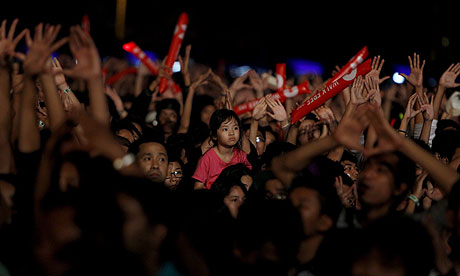
People watch US singer Jason Mraz perform at the MTV EXIT show, a free concert to raise awareness of human trafficking in Burma. Photograph: Nyein Chan Naing/EPA
The tiny drinks stall Chit Htet had been running for the past few years in Rangoon was doing so poorly that when the 35-year-old's sister-in-law promised her a job in Burma's southern province, Chit Htet didn't think twice.
But she had been duped. After taking food and drink offered to her by the sister-in-law, Chit Htet fell asleep – and woke up to discover she had been smuggled into Thailand, where, her sister-in-law said, she would now be working to "pay off her job-placement debts" in a pineapple factory. "I was given 300 baht [£6] every 15 days as salary but had to pay for my own water, electricity and rent, which meant that I could only afford to eat one egg a day – half at breakfast and half at dinner," says Chit Htet.
Working in the factory with thousands of others – at least 1,000 of whom she estimated to be Burmese nationals like herself, and many of whom she says had been trafficked by her own sister-in-law – Chit Htet plotted her escape. Guards patrolled the compound and workers were only allowed out in escorted minivans to the local market. But one day she found a Thai colleague's mobile lying around and made the call to police that freed her.
Burma has been fighting trafficking within its borders for the past eight years – it signed the 2004 UN Convention against Transnational Organised Crime and in 2007 established its own anti-trafficking taskforce – with more than 1,700 victims rescued to date. But rights groups say it still lacks the teeth to prosecute and prevent cases from reoccurring – meaning that repeat offenders like Chit Htet's sister-in-law often walk free.
However in a landmark agreement between the Burmese government and the Australian anti-trafficking NGO Walk Free in December, the Burmese government committed to working with local businesses to eradicate all trafficking within its private sector. This would mean that in Burma's nascent economy, businesses would be required to identify, eradicate and prevent forced labour in their operations and supply chains – preventing situations like Chit Htet's from occurring on Burmese soil.
"This chance to work with Walk Free is a great opportunity to persuade the domestic private sector to work with us on this initiative and, together, I am sure we will end human trafficking in Myanmar," Police Brigadier General Khin Maung Si told the Guardian.
Although slavery is illegal in every country in the world, the International Labour Organisation estimates that nearly 21 million people around the world can be considered modern-day slaves – defined as those working under threat of violence, abuse and harsh penalties – in a market generating roughly $32bn (£19.7bn) profit every year. More than half of those people are in Asia, and more than a quarter are women andchildren.
Burmese women are trafficked out of the country every year – the majority of whom are sold into forced marriages, prostitution or forced labour. According to the Burmese government's most recent plan of action, around 80% of Burma's trafficking victims end up in China, with the rest primarily going to Thailand, Malaysia and Singapore.
Burma's female workforce has been migrating for decades now, says Ma Mar of the Burmese charity FATE (Fight Against Trafficking and Exploitation of Women), seeking greater economic opportunities abroad to send money back home. "Before it was just women who were poor," she says. "Now it's women who are educated – lawyers, teachers, graduates – because their education has no value. They don't get a decent income to provide for their family but feel they are the ones responsible for providing food and [so they] take the risk of going to places like Saudi Arabia, China, Thailand."
Whether they go abroad or move within Burma, many end up particularly vulnerable to human traffickers because they don't know how to protect themselves, says Ohnmar Ei Ei Chaw, national project director of the UN's anti-trafficking unit in Burma. In many cases, this is because victims often fall prey to family members, like Chit Htet, or to neighbours working on behalf of agents.
Walk Free aims to change that by making businesses a safer place for employees. Founded by mining tycoon Andrew Forrest, the charity is calling on the world's largest companies to pledge zero tolerance of slavery. As one of the partners of MTV Exit (End Exploitation and Trafficking), the NGO organised a concert in Rangoon on 16 December in partnership with USAid, Ausaid, the Association of Southeast Asian Nations and the Burmese government to raise awareness about human trafficking. Videos reenacting trafficking situations were played on large-screen TVs, and speakers, including the US ambassador to Burma Derek Mitchell, asked the crowd to "promise never to trust anyone who promises you an offer that sounds too good to be true".
"Business has always been a key driver of social change, shaping modern life through innovation and new technology," Walk Free says. "If corporate giants – 25 of the world's top businesses whose net worth makes up $5 trillion – prioritise the abolition of modern slavery as their next major innovation, we could quickly deal a major blow to the slavery industry in this generation." Those targeted by the group include Google, Apple, Microsoft, HSBC and Coca-Cola.
While Walk Free and the Burmese government are still in the initial phases of the agreement, the NGO is calling on the experiences of victims like Chit Htet to help raise awareness about trafficking – by identifying where to place posters, billboards and hotlines in trafficking hotspots in Burma and surrounding countries.
"We [survivors] should be going to communities where there is trafficking and talking about our experiences," Chit Htet and a group of other survivors recently told Forrest. "So we can show them we are not different – we are just like them."
Some details have been changed to protect identity


Tuesday, July 31, 2012
'Drastic action' needed to halt trafficking | Bangkok Post: news
http://www.bangkokpost.com/news/local/304115/drastic-action-needed-to-halt-trafficking
Source: Bangkok Post
25/07/2012

Source: Bangkok Post
25/07/2012
Human trafficking in Thailand will trigger trade sanctions from the international community if drastic suppression and prevention measures are not taken, a regional meeting was told yesterday.
The US State Department placed Thailand on its Tier 2 Watch List in its 2012 Trafficking in Persons Report last month, which showed that human trafficking was a matter of grave concern, said Pol Lt Col Paisit Sangkhahapong, an expert at the Department of Special Investigation's anti-human trafficking centre.
The kingdom is a source, destination and transit country for human trafficking, while other countries in the Mekong region are only transit points, he told a meeting on measures to suppress and prevent trafficking in the region.
The meeting in Bangkok was attended by representatives from Cambodia, Laos, Myanmar, Vietnam, China, Malaysia and Thailand.
Pol Lt Col Paisit said Thailand would be at risk of facing trade sanctions unless drastic prevention and suppression measures were taken.
"Forced prostitution, human trafficking and labour exploitation in factories and fishing trawlers are serious problems in Thailand," he said.
"Many migrant workers from Cambodia and Myanmar are forced to work on fishing trawlers. Migrant workers are exploited in Thailand, while Thais are lured by human trafficking gangs into the flesh trade in Japan, Australia and Middle East countries."
Pundit Sriwilai, director of Laos' anti-human trafficking department, said trafficking was a transnational crime that all countries must combat jointly.
Laos has strictly enforced the criminal code and a law to protect women and children from human trafficking gangs.
Girls aged 15-18 are the main victims, he said.
DSI chief Tarit Pengdith, who presided over the meeting, said human trafficking was a major problem that needed to be urgently tackled before the launch of the Asean Economic Community in 2015.
Trafficking in women and children into the sex trade was the most serious problem in the Mekong region, followed by forced labour on fishing trawlers and the smuggling of children to become street beggars, he said.
Subscribe to:
Posts (Atom)
