Friday, January 10, 2014
An unflinching look at human trafficking
Not For Sale, a photojournalism exhibition intended to raise awareness of the plight of the human trafficking of girls in Thailand who are as young as six, has its vernissage on Friday evening at Shäika Café in Notre-Damede-Grâce.
CONTINUE HERE:
http://www.montrealgazette.com/entertainment/unflinching+look+human+trafficking/9150307/story.html
Wednesday, November 21, 2012
You are what you wear! The true story about the clothing industry and Human Trafficking
Source: Christian Today Australia
Who are you wearing right now?
A Press Service International volunteer Comment writer for Christian Today Australia
Don’t you mean what brand are you wearing? No, I actually mean who are you wearing? Are you wearing slave labour? Did a slave make your clothes? That slave has a name, like 12 year old Trang from Vietnam, who you will meet a bit later on.
Not for Sale Campaign (NFS) a modern day abolitionist movement has just released their consumer report on the Apparel Industry Trend. They “rank 300 apparel brands on their efforts to address child and forced labor in their supply chains. It provides a picture of the practices of industry leaders, and calls out brands that fuel modern slavery through their negligence.” You can find this report atwww.free2work.org.
It shines a real light into the apparel industry or rather a bit of a dark cloud on some companies that are doing much.
According to NFS, there is an estimated 27- 30 million slaves in the world today. According to the CNN freedom project they estimate that14.2 million were exploited in industries such as construction and agriculture. That item of clothing that was on sale discounted at 80% for $10.00 represents countless numbers of people who are still in bondage and forced to work as slaves in countries around the world so that we can have clothes.
How important is that label to you now?
The report reveals that slave labour is involved in whole production line of apparels not just in some aspects of production. Every area of the development from the crops to the sowing of clothes has slaves.
For instance, the second largest exporter of cotton to the world is Uzbekistan. They produce some the finest and most sought after cotton. The government their forces the schools to close and children as young as 10 to work in the fields to pick cotton up to 70 hours a week for little to no pay. The farmers are then required to sell their cotton to the government for artificially low prices which keep the farmers in poverty. The government continues to profit from this and the cotton finds its way into our clothing.
Unfortunately this is not a one of instance. A BBC report found that in Indian cotton fields “as many as half a million children may work in India’s cotton industry, making one third of the sector’s cotton seeders, pickers, ginners and other workers children.” That some of the girls are no more than 10 or 11 years old and are giving up education to work the fields. (www.soschildrensvillages.ca)
The cotton is picked and sent to factories around Asia where it is made into tread and weaved into patterns then eventually sown into clothes. In Vietnam, families are approached by human traffickers who promise that the children will have well-paying jobs and well looked after.
This is what was promised to 12 year Trang and his family. Trang told reporters "I felt so homesick, living in Saigon, who was taken by car from his small village of 35 households and brought to Saigon, where he worked cutting cloth and was regularly beaten.” He did not know how many hours a day he had to work as he was illiterate and could not tell time. Children like Trang are forced to work making clothes bound for the world market. They work in horrible conditions, receive little to know pay and have no chance for an education. (www.heraldsun.com.au)
How can we make a difference? “Buycott”!
We have the power to end human trafficking. All we need to do is begin to “buycott.” “A buycott is the opposite of a boycott; that is, an active campaign to buy the products or services of a particular company or country.” (en.wikipedia.org/wiki/Buycott)
Instead of not buying clothes which unless you live in the garden of Eden you can’t do, Let’s all band together and support companies that are valuing people over profit. Companies like Levi (which is not perfect) but they are stepping in the right direction. If all of us buycotted together and only bought clothes from a few retailers and let the other companies know why you are not shopping there any more, the other chains like Sketchers (who fares very poorly) would quickly hop on board too.
We have the power to change companies.
Before you go shopping next time and buy that discounted shirt, check out how that company rates. You can download an app from http://www.free2work.org/ and see how your clothes rate Just scan their barcode and if a company is a D or less, instead of encouraging their practice of slave labour email the company and tell them that you are switching brands because of lack of policies and effort in putting an end to human trafficking.
Next time you are the store, have a look at what you are buying. Be aware that the slave industry has never been larger in history of mankind.
Are you supporting companies that are trying to stop human trafficking or are you endorsing it by not saying or doing anything?
Genevieve Wilson is married with two children who served with YWAM for eight years in Brisbane and now serving in mission in Canada as a modern day abolitionist.
Genevieve Wilson's previous articles may be viewed atwww.pressserviceinternational.org/genevieve-wilson.html
Related articles
Saturday, July 14, 2012
Bay Area 8-Year Old Makes a (Lemonade) Stand to End Slavery
A few days ago, 8-year-old Vivienne Harr from Fairfax, California began her quest to raise $150,000 to help Not For Sale create new futures for survivors of slavery and exploitation. To do that, Vivienne will sit at her lemonade stand every day, rain or shine, and sell her “MAKE-A-STAND! Lemonade: The Sweet Taste of Freedom” until she raises the money. She is also raising funds online.“I am making a stand: a lemonade stand and a stand against slavery,” said Vivienne. “Lemonade is for sale. People are Not For Sale. There are kids just my age who don’t get to have summers or sell lemonade or enjoy the sunshine. They work all day with no hope. I want to give them hope. When you buy MAKE-A-STAND! Lemonade, you aren’t just buying a drink, you are making a statement. You are making a stand.”
The idea came on a family trip to Sonoma, Calif. where the Harrs discovered the work of Lisa Kristine, a journalist who photographs enslaved people around the world. One photo particularly moved Vivienne. It is of two children in Nepal carrying heavy rocks with leather straps across their heads. They are holding hands, as if to comfort one another.
“That was the tipping point for our family,” says her father Eric Harr, who is helping Vivienne use social media to spread the word. “You could feel the Earth crack underneath us. Vivienne looked us square in the eyes and said: ‘We’re doing something about this.’ It was so pure and powerful—from depths of this 8-year-old’s heart.”
Vivienne’s is no ordinary lemonade stand. She accepts credit cards from her iPhone. She streams the music of Adele and Katy Perry to entertain her customers. She serves her 100% organic, fair trade raspberry/mint-infused lemonade in eco-friendly cups with her logo. Some have called it: “Lemonade Stand 2.0.”
Vivienne has already attracted a worldwide following. Within a week, she had over 15,000 followers on Twitter, with bloggers covering her story. One-hundred percent of profits go to Not For Sale, a 501(c)(3) organization in Half Moon Bay, California, whose mission it is to help free the 30 million people enslaved around the world, roughly half of whom are children.
“Not For Sale believes everyone can make a difference in the movement to end slavery,” said Jessica Henry, Director of Communications for the organization. “Vivienne’s courageous endeavor is proof and inspiration for us all that everyone has the ability to make a stand.”
Given her ambitious goal of $150,000, Vivienne will likely be at her lemonade stand through the fall and winter months—when lemonade becomes…hot chocolate.
“Making a stand means doing what you think you can’t do. When I dreamed of doing this, I didn’t think of all the reasons why I can’t, I thought of all the reasons why I must.”
Vivienne is not just making a stand on human rights, she’s making a stand on ingredients in her lemonade: what they are and where they come from.
“Most drinks seem like compromises to me,” Vivienne said. “I am making a stand on ingredients. I only use organic, fair-trade (anti-slavery) ingredients.”
Vivienne’s long-term goal is to bottle her lemonade and sell it at specialty grocers like Good Earth, Mollie Stone’s and even Whole Foods with whom she has engaged on Twitter. With her MAKE-A-STAND! Lemonade, Vivienne wants to start a “movement” of people who make a stand in their own lives, “whether that’s for better health, a better environment, against slavery, against bullying, whatever,” she says. “Just make a stand.”
“Some people have asked me what a little 8-year old can do. I just say to them:
“Big things have small beginnings.”
We at NFS are so inspired by Vivienne and the stand that she is taking to fight slavery using her unique abilities. How can you make a stand against slavery? Join the conversation on Twitter by mentioning @nfs and @vivienneharr or on our Facebook Page.
Related articles
- Slavery Map (globalsistersgroup.wordpress.com)
Sunday, February 26, 2012
5,000 Global Churches Declare Freedom for the Captives – Not For Sale: End Human Trafficking and Slavery
FEBRUARY 25, 2012
On February 26th, freedom will ring from Bangkok to Managua, Austin to Sydney as thousands of churches around the world mobilize their congregations to take action towards “setting the captives free.” Through a day of collective fasting and prayer Freedom Sunday will rally religious devotees to join the global fight to end slavery in our lifetimes.
“Worship is the catalyst for action,” claims Rev. Kevin Austin, Director of the Abolitionist Faith Community, “It empowers the worshiper to move out beyond awareness to action.”
Currently 5000 faith communities from 100 different countries have registered for this day of hope-infused, prayer-filled, smart activism worship.
Freedom Sunday is uniting the faithful across national and denominational lines as Christian communities from disparate regions of the world unite for the common cause of justice. Many will Fast for Freedom throughout the Lenten season using the money saved in order to support NFS’s social ventures creating new futures for vulnerable, powerless, and exploited in our world.
“These religious devotees disdain lip service to the cause of justice, but act, give, and live in radical obedience to a better way,” says President and Co-founder David Batstone, “All over the world these faith-driven activists are saying, ‘not in my backyard.’”
This declaration resonates throughout the Onnuri Church in Seoul, South Korea. Faced with the reality of 1 million South Korean women enslaved in brothels in South Korea, the 60,000-member congregation (making Onnuri one of the largest churches in the world) hosted a spectacular Freedom Sunday last year. The event attracted an abundance of media attention, with Korea’s largest religious broadcasting network – CGNTV – bringing the sermon to two million viewers inside Korea as well as an additional 150 worldwide cable channels.
“Last year’s Freedom Sunday was electric for our congregation,” says Onnuri’s Pastor of English Ministries Eddie Byun, “I believe it was a reflection of a growing desire to see the Church rise up as relevant leaders in this movement for freedom.”
The event, imbued with action-based prayer, songs, and a sermon given by Batstone, moved the worshipers outward with a shared determination to use the transformative power of God’s love to fight the evil of modern-day slavery. In the span of one year, the Congregation has raised $35,000 to buy land for Not For Sale’s social venture in Thailand and that is creating new futures for survivors of trafficking.
Their incredible efforts inspired many more churches in South Korea to register for Freedom Sunday this year as worship becomes a formidable tool in the fight to abolish human trafficking. Byun will join Batstone in the Philippines, preaching to over 600 people in 35 churches around the country that people of faith a crucial role to play leading the movement to end forced labor in Asia and around the world.
Churches wishing to officially register for the exciting worship event can access a strong network of thousands of churches – The Underground Church Network (UCN) – through the NFS website. Using a “church-locator” – an interactive Google map – worshippers from diverse Christian denominations may find a participating Freedom Sunday church in their region. Through this portal churches can also share sermon notes, songs, bible studies, as well as fact sheets and other worship resources in order to enhance their congregation’s celebration of freedom.
Tomorrow, Freedom Sunday will sow the seeds of justice in thousands of churches across the globe.
“We are one community,” claims Austin, “working together despite differences, to stand against this global injustice.”

Related articles
- What's the role of faith in fighting slavery? - The CNN Freedom Project: Ending Modern-Day Slavery - CNN.com Blogs (trafficking-monitor.blogspot.com)
- The new Christian abolition movement - CNN Belief Blog - CNN.com Blogs (trafficking-monitor.blogspot.com)
- Why I Quit My Job at CBS To Stop Human Trafficking (trafficking-monitor.blogspot.com)
- New York City Bar Association - Human Trafficking and Modern Slavery - By Samuel W. Seymour | 44th Street Blog (trafficking-monitor.blogspot.com)
Saturday, June 18, 2011
Modern Slavery in America: Sad Echoes of Juneteenth
As African Americans celebrate the June 19 anniversary of the delayed emancipation of enslaved Africans in Texas, human bondage continues in our time -- and on our shores.
- By: The Root Staff | Posted: June 17, 2011 at 3:56 PM
This weekend throughout the South, African Americans will gather at festivals, picnics and other events to observe Juneteenth, a celebration commemorating the end of slavery in the United States. The term "Juneteenth" comes from the date June 19, 1865, when enslaved Africans in Galveston, Texas, found out that they were free a full 2½ years after the Emancipation Proclamation became official.
For 30 long months, the enslaved Texans continued to toil, unaware that technically they were free to stop and pursue their destinies. Their official status as free Americans meant nothing until Juneteenth came around.
Unfortunately, for millions of people around the world -- and thousands in the United States -- their official status as free people means nothing. That's because in various forms, the involuntary servitude of human beings -- slavery -- still exists.
The case of an Atlanta woman convicted on June 10 of enslaving two people who shared her Nigerian heritage shows how persistent the problem remains, even in the 21st century. Bidemi Bello was found guilty of luring women into bondage after offering them jobs as nannies and the opportunity to be educated in the U.S.
She brought them into the country on fake passports, and once they were here, she subjected them to beatings and inhumane conditions while forcing them to clean and provide child care at homes in upscale enclaves north of Atlanta. Unfortunately, this type of crime isn't an isolated incident.
A Global Impact
According to the United Nations, there are an estimated 27 million people enslaved around the world -- women, children and men who are brutally forced to work without pay under the threat of beatings, rape and murder if they try to escape. Although slavery is not legal anywhere, it's a booming criminal industry that is happening everywhere.
"For perpetrators of human trafficking, this is a business, so they've learned to be smart about it," Jill Morris, constituency director of the Not For Sale Campaign, told The Root. "Like any other organized crime, they've learned how to hide and form covert networks. They also have a lot of money and power, so in certain parts of the world they can buy off authorities."
Unlike the historic chattel system, modern-day slavery takes on various, subtler forms -- another factor that makes it difficult to detect and stop. The most widely practiced kind, especially prevalent in Southeast Asia, is debt bondage in which people must pay off loans with labor instead of currency. But with high interest rates and new debts incurred by food and shelter, many of these workers toil in bondage their entire lives and pass their "debt" on for several generations.
Sex trafficking involves women and children forced into prostitution. The human-trafficking industry generates an estimated $32 billion a year. Millions of other victims are lured, with false promises of good jobs, into forced labor, working for zero pay in hazardous conditions. Migrant workers are particularly vulnerable to this form of slavery, trafficked into a range of industries including mining, farming, textiles and domestic work.
Many Americans conceptualize modern-day slavery as a problem only in foreign countries. We recall images of young girls forced into brothels in Cambodia and Russia, or men mining for profitable metal in the Congo. But according to the U.S. State Department, between 14,500 and 17,000 people are trafficked in the United States each year.
Land of the Free?In the State Department's 2010 Trafficking in Persons Report, an annual assessment of human trafficking around the world, the United States was included for the first time. "This human rights abuse is universal, and no one should claim immunity from its reach or from the responsibility to confront it," Secretary of State Hillary Clinton wrote in a letter upon the release of the report, which describes the United States as a source of and destination for victims, who are either trafficked in from other countries or taken advantage of because of uncertain immigration status.
Young girls and women have been forced into prostitution in cities from Atlanta to Los Angeles, enslaved farmworkers have been found picking tomatoes in Florida, and men and women have been discovered in bondage as domestic workers in hotels and restaurants all over the country.
"A lot of times, victims are trafficked in from other countries, so they don't speak the language. They're in fear for their lives, their safety and their families back home," said Morris, adding that many forced laborers in restaurants and hotels are kept away from customers, where no one ever sees them. "It's super hidden. Because people don't know to look for it or ask certain questions, the perpetrators are able to get away with it."
Victims of sexual trafficking in the United States, however, also include American girls, with most victims under the age of 18. They are often coerced into prostitution by someone they know. "There are boyfriends, fathers and brothers forcing these young girls to prostitute themselves so they can make a profit. It's not typically a stranger kidnapping a girl off the street," said Morris.
The most vulnerable victims are people in poverty, and the issue crosses all racial barriers. Girls and women from middle-class communities, however, have also been forced into sexual slavery.
Fighting Back
One reason slavery persists in the United States is that the general public doesn't think it can happen here, so they turn a blind eye to the problem. Activist groups like Not for Sale educate citizens about the signs to look for in their communities, and what to do. They also work with local governments and police forces to raise awareness of the issue.
Those efforts are paying off. This year, 12 states -- including Georgia, Texas, Massachusetts, Arizona and Virginia -- passed strong anti-human-trafficking laws. "States are passing laws in all different areas of human trafficking, from dealing with sex trafficking to supply-chain transparency," Morris said.
On a global level, different countries are also starting to look into the issue. "More importantly, we've seen corporations think about their supply chain -- for example, where the cotton comes from for the blue jeans they make," said Morris. "That changes the demographic not only for the consumer but for the workers in factories and manufacturers as well. We're starting to see the entire global trafficking industry wake up."
Source: theroot.comRelated articles
- BBC News - Duncan Smith warns of threat from human trafficking (trafficking-monitor.blogspot.com)
- infoZine - Hotels, Airlines Work to Stop Human Trafficking - Kansas City, Missouri News (trafficking-monitor.blogspot.com)
- New Online Toolkit by Verité for Multinational Brands to Rid their Supply Chains of Labor Abuses (trafficking-monitor.blogspot.com)
- Nigerian Woman Convicted of Human Trafficking - Tucker, GA Patch (trafficking-monitor.blogspot.com)
- Report says modern day slavery exists in Northern Ireland (trafficking-monitor.blogspot.com)
- Public Private Partnerships To End Modern Slavery (trafficking-monitor.blogspot.com)
Monday, March 28, 2011
Human Trafficking as a Public Health Crisis Part 3: What One Person Can Accomplish | Health
I'm a writer at Justmeans in the Health category. I am also currently the Director of Biomedical Research and Development at Gallifrey Systems. I finished my PhD in experimental psychology in 1997 and have worked covering legislative initiatives, building statistical models and in technology development. I'm an expert in the areas of health behavior and health policy. I'm a huge proponent of c... Read More>>
What can one person accomplish? Dr. Paula Heron is a a postdoctoral fellow at the University of Kentucky. Born in Zimbabwe, she's lived most of her life in South Africa. Ten years ago, Ms. Heron came to the US to complete her Ph.D. in neuroscience and has remained here. She decided to combine her triathlon experience with a passionate stand against human trafficking. The following is a verbatim record of my interview with Dr. Heron. For her, it began with a movie...1.. What is Tri4Freedom and when did you start it?
2. What motivated you to take such an interest in human trafficking?
"Initially my own awareness about human trafficking stemmed from a movie about a young woman from an eastern European country who thought she was coming to the United States to pursue a dream job as a model but once she arrived she was forced into sex slavery. What struck me was the relative ease with which this travesty was committed by the trafficker and the finality of what had occurred from the victim's perspective. The excitement associated with arriving in a new country - something I can well relate to - is abruptly replaced with an indescribable fear. This I find terrifying and the realization that human slavery occurs within our communities and areas we deem safe to live, haunts me."3. How surprised are people to learn the extent of human trafficking, both in sheer numbers and global extent?
"I have found that the majority of people I speak to either have no idea what human trafficking is or they have heard of it but fail to recognize how prevalent it is in the United States. Most people see it as a third-world issue. People's responses have varied greatly when they hear that human trafficking occurs in their own cities. Some people prefer to continue ignoring the issue, while some are alarmed and take a genuine interest in what they can do to help the situation."4. It's literally an ancient crime. In terms of modern solutions, do you feel governments willfully ignore human trafficking or is it just so difficult to solve that it slips below the radar?
"Governments are certainly aware of the issue. Many states have anti- human trafficking laws; however law enforcement alone is not sufficient to combat the problem. The Not For Sale Campaign, a non-profit organization committed to the fight against human trafficking, maintains that abolishing slavery can only be achieved by creating a community task force. I think the fact that human trafficking occurs unnoticed to the general public has contributed to its escalation into the 32 billion dollar industry it is now. If people knew the extent of human trafficking it should prompt public outrage which would force governments into finding effective ways to combat it."5. How doe Tri4Freedom help the problem?
"As an individual deeply disturbed by the issue of human trafficking I created tri4freedom in an attempt to merge my passion for triathlon with my desire to see an end to human slavery. Firstly, Tri4freedom can raise substantial awareness about human trafficking within the triathlon community, including spectators of major races such as Ironman. Secondly, Tri4freedom aims to support The Not for Sale Campaign by raising funds and highlighting the efforts this organization is doing to combat the issue."
6. Why the link between triathlon and the cause?
"Triathlon by definition is comprised of three sports presenting a challenge that only the most dedicated and zealous individuals find appealing. Not surprisingly, demographics have indicated that the majority of triathletes are highly successful and educated professionals. For this reason I am hopeful that tri4freedom will spark enthusiasm from fellow triathletes who are entrepreneurs, lawyers, healthcare workers, teachers and community leaders. Collectively triathletes are in professional positions most likely to have an influential impact on finding effective solutions to combat human trafficking."
7. How much support are you receiving through the Tri4Freedom website? Domestically, internationally?"The support I have received so far has stemmed from letters I have written requesting sponsorship or from individuals that know me. The purpose of the website is to provide interested people with information and resources to help in the fight against slavery. As I promote my site more in the coming months I hope to achieve greater support from the general public and fellow triathletes."
8. Who are some of the "good actors" organizations that either partner w/Tri 4 Freedom or provide support in some way?"First and foremost the Not For Sale Campaign has demonstrated continuous support for Tri4freedom, which is raising funds for their Free2play initiative. In collaboration with this organization, we are working on promoting fair trade athletic apparel and increasing media awareness about Tri4freedom's contribution to their efforts in abolishing human slavery.
Local businesses have been very supportive. Most notably, Green's Toyota of Lexington has provided financial assistance to help promote the Tri4freedom event in June. This event would not have been possible without the support of SpindleTop Hall who kindly offered to host the event and help with local promotion. Ad-Venture Promotions, and In His Image Designs have also shown enthusiastic support for Tri4freedom. HFP racing has been very supportive in helping promote Tri4freedom at two of their race weekends this summer which will reach almost 1500 athletes. Newton Running has generously donated a free pair of their running shoes for me to wear during my 27 hour triathlon."9. What is this 27-hour event you are planning this summer?
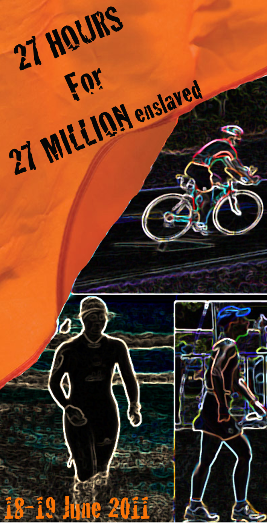
June 18th-19th I will do a solo triathlon lasting 27 hours, which I named "Free2tri" after Free2play, which is the sole recipient of all funds we raise. 27 hours has significance- 27 million people are currently enslaved around the world. The event will be hosted by Spindletop Hall and will begin at 6am starting with a 2.5 hour swim, followed by a bike ride until sunset and ending with an overnight run until 9am the following morning. In collaboration with Not For Sale and our sponsors, planning is underway to encourage public attendance and donation incentives. As the date approaches we will release updates on the website. The purpose of "Free2tri" is to showcase Tri4freedom in the hopes of gaining athlete support, to raise funds for the Not For Sale Campaign and most importantly to highlight the widespread travesty of human trafficking.10. How can individuals help draw attention to and combat the problem of human trafficking?Talk about it. Get angry. Acknowledge that human trafficking exists and accept the reality that an end to human trafficking is going to require a change in behavior. For example one way to help is by only purchasing fair trade products. This ensures that employee's lives are enhanced. The current reality is that fair trade is expensive because there is no overwhelming consumer demand to drive the price down. We need to demand that companies and their supply chains adhere to a slave-free workforce. The success of this approach has been demonstrated in the chocolate industry where a few companies have been pressured by the public to make their chocolate fair trade.
People could further this issue by being vigilant in identifying potential victims of human trafficking and contacting local authorities or dialing the National Human Trafficking hotline 1888-3737-888. There are numerous resources available on the web that describes human trafficking cases and how the public can help. I good place to start is http://www.notforsalecampaign.org and my site http://www.tri4freedom.comSource: justmeans.com
Human Trafficking as a Public Health Crisis Part 3: What One Person Can Accomplish | Health