Latest technology helps sex traffickers recruit, sell ...:
Showing posts with label Crime. Show all posts
Showing posts with label Crime. Show all posts
Saturday, May 6, 2017


Wednesday, April 15, 2015
Filmmakers explore sex trafficking abuses in 'Tricked' documentary
Filmmakers explore sex trafficking abuses in 'Tricked' documentary: "filmmakers Jane Wells and John Keith Wasson"
Monday, April 13, 2015
Utah Attorney General speaks on sex trafficking sting operation - The Herald Journal: Allaccess
In an appearance sponsored by the USU Government Relations Council and the USU Institute of Government & Politics, Reyes discussed his participation in an undercover child sex-trafficking sting in Colombia conducted last October.
Read More
Utah Attorney General speaks on sex trafficking sting operation - The Herald Journal: Allaccess:
Read More
Utah Attorney General speaks on sex trafficking sting operation - The Herald Journal: Allaccess:

Monday, July 28, 2014
Understanding the economics of human trafficking
Source: phys.org
Tackling human trafficking in Europe requires a more in-depth knowledge of its causes. Well aware of this knowledge gap, the European Commission is funding the FP7 project TRACE, a two-year initiative which kicked off in May 2014 and aims to better understand the perpetrator and the victims as well as investigating how the recruitment process takes place.
Read more at: http://phys.org/news/2014-07-economics-human-trafficking.html#jCp


Friday, June 27, 2014
Child sex trafficking a ‘serious problem’ | Sun.Star
Source: Sun.Star
CHILD sex trafficking remains a serious problem in the Philippines because it occurs in private residences and facilitated by taxi drivers who know of clandestine locations, the US Department of State said.
In its 2014 US Trafficking in Persons (TIP) Report released recently, the State Department also noted that Filipino children who fall victims to this illegal activity are getting younger and that more boys are being recruited.
Continue:


Sunday, November 10, 2013
Forced labour: it's about politics, not crime | Global Development Professionals Network | Guardian Professional
Source: Global Development Professionals Network | Guardian Professional
For many NGOs, governments and development agencies, there are two principal causes of forced labour: poverty, which makes people vulnerable to exploitation, and criminality, in the form of employers willing to exploit the poor.
Continue reading here:
http://www.theguardian.com/global-development-professionals-network/2013/nov/07/forced-labour-slavery-crime?CMP=

Monday, September 2, 2013
CNS STORY: Pope asks pontifical academies to help fight human trafficking
SOURCE: CATHOLIC NEWS SERVICE
http://www.catholicnews.com/data/stories/cns/1303624.htm
Aug-23-2013
By Cindy Wooden
Catholic News Service
VATICAN CITY (CNS) -- At the request of Pope Francis, scholars and researchers belonging to two pontifical academies and representatives of the World Federation of Catholic Medical Associations will begin focusing on the phenomenon of human trafficking and ways to fight it.
A working group from the pontifical academies of Sciences and Social Sciences and the federation will meet at the Vatican Nov. 2-3 for a preparatory workshop examining the size of the problem, its causes and steps that can be taken to prevent trafficking and to help victims, said Bishop Marcelo Sanchez Sorondo, chancellor of the academies.
No one can deny that "the trade in human persons constitutes a terrible crime against human dignity and is a serious violation of human rights," which is fueling increasingly complex international criminal networks, the bishop told Vatican Radio Aug. 22.
In a May speech, Pope Francis said human trafficking is "a despicable activity, a disgrace for our societies, which describe themselves as civilized." Refugees, displaced and stateless people are particularly vulnerable to "the plague of human trafficking, which increasingly involves children subjected to the worst forms of exploitation and even recruitment into armed conflicts," the pope said.
Bishop Sanchez said the international group of physicians, scientists, lawyers, economists and other scholars participating in the meeting will look at ways their disciplines can help the victims of trafficking and fight the phenomenon.
For instance, he said, scientists can start a DNA registry of children whose parents have reported them missing, and it can be used for comparisons when children are rescued from traffickers.
The social scientists, he said, will look at trafficking as one of the "pressing economic, social and political problems associated with the process of globalization."
The International Labor Organization has estimated that 20.9 million people are victims of forced labor globally; that number includes victims of human trafficking, Bishop Sanchez said. An estimated 2 million people -- mostly girls -- are trafficked each year for the sex trade.
"Some observers believe that within a few years human trafficking will surpass drug trafficking and weapons trafficking to become the most lucrative criminal activity in the world," the bishop said.
Tuesday, August 13, 2013
Training of Trainers to enhance police response in addressing child sexual exploitation in the Mekong
Source: UNODC
http://www.unodc.org/southeastasiaandpacific/en/2013/08/childhood-training/story.html
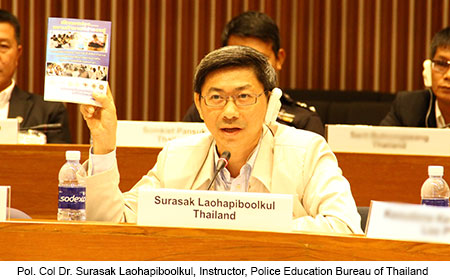
Bangkok (Thailand), 6 August 2013 - Although the sexual exploitation of children by travelling child-sex offenders remains prevalent in the Greater Mekong Sub-region (GMS) countries of Cambodia, Lao PDR, Thailand and Viet Nam, better collaboration between law enforcement officials across and within borders and stronger investigation and enforcement capacity is beginning to have a positive impact, say regional experts.
"In the analysis of chat logs, INTERPOL experts have said that child sex offenders are starting to say "stay out of Bangkok" and "stay out of Southeast Asia". The work police officers do everyday contributes to this," said Ms. Margaret Akullo, Project Coordinator, Project Childhood (Protection Pillar). "Police Officers have taken a stand, a stand that says we do not tolerate child sexual exploitation in our countries."
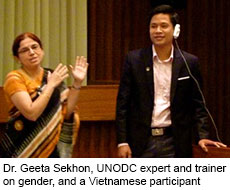 Ms. Akullo was speaking in Bangkok recently at a five-day training of trainers for police officers organized by Project Childhood (Protection Pillar), in partnership with UNODC, INTERPOL and World Vision.
Project Childhood is a $7.5 million Australian AID (AusAID) funded initiative to combat the sexual exploitation of children in the Greater Mekong sub-region countries of Cambodia, Lao PDR, Thailand, and Viet Nam. Building on Australia's long-term support for programs that better protect children and prevent their abuse, Project Childhood is being implemented in two complementary pillars- the Protection Pillar, a partnership between UNODC and INTERPOL, and the Prevention Pillar, implemented by World Vision.
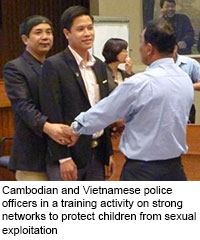
 Attended by officers from the four Project Childhood countries who work in crimes against children units, the workshop aimed to improve investigative skills and knowledge on child sexual exploitation cases. The training utilized the newly developed police-training curriculum,Investigating Sexual Exploitation of Children.
Despite the successes achieved by the GMS countries, participants noted that stopping the sexual exploitation of children by traveling sex offenders still required greater coordination and cooperation between GMS criminal justice agencies.
"The results of our collaborative efforts show that we need our friends from Cambodia, Lao PDR and Viet Nam," said Pol. Col Dr. Surasak Laohapiboolkul, Instructor, Police Education Bureau of Thailand. "This forum can be the beginning of a new era for protecting sexually abused children in our region - if we continue to work together."
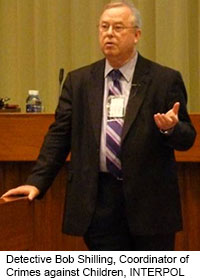
 Trainers for the five-day session included Dr. Geeta Sekhon (UNODC expert and trainer on gender), Warren Bulmer (Canada), Bob Shilling (INTERPOL) and Jane Walsh (Australian Federal Police), all of whom are specialists in the area of crimes against children. Facilitation of the training event was provided by the INTERPOL Coordinator, Annethe Ahlenius.
"Cooperation is essential to do this job properly. It does no good if we chase an offender out of one country and into another," said INTERPOL's Mr. Shilling. "The more we cooperate and put these perpetrators behind bars, the better off everyone will be."
 Mr. Jeremy Douglas, UNODC Regional Representative, Southeast Asia and the Pacific, highlighted the importance of a cooperative effort and the dissemination of training back to their countries.
"This is a significant milestone for Project Childhood (Protection Pillar)," said Mr. Douglas. "The training provides an excellent opportunity for officers to learn and share with other police colleagues, and to take what they learned from this event back with them and hold their own training sessions."
Curriculum topics included gender issues during police work, first response duties of frontline officers, analysis of evidence and images of child pornography, typologies of sex offenders, and cooperation in the investigation of these cases. Sexual exploitation of boys, a widely unrecognized crime, was also discussed by officers, who agreed that further work was required in this area.


http://www.unodc.org/southeastasiaandpacific/en/2013/08/childhood-training/story.html
Bangkok (Thailand), 6 August 2013 - Although the sexual exploitation of children by travelling child-sex offenders remains prevalent in the Greater Mekong Sub-region (GMS) countries of Cambodia, Lao PDR, Thailand and Viet Nam, better collaboration between law enforcement officials across and within borders and stronger investigation and enforcement capacity is beginning to have a positive impact, say regional experts.
"In the analysis of chat logs, INTERPOL experts have said that child sex offenders are starting to say "stay out of Bangkok" and "stay out of Southeast Asia". The work police officers do everyday contributes to this," said Ms. Margaret Akullo, Project Coordinator, Project Childhood (Protection Pillar). "Police Officers have taken a stand, a stand that says we do not tolerate child sexual exploitation in our countries."
Ms. Akullo was speaking in Bangkok recently at a five-day training of trainers for police officers organized by Project Childhood (Protection Pillar), in partnership with UNODC, INTERPOL and World Vision. Project Childhood is a $7.5 million Australian AID (AusAID) funded initiative to combat the sexual exploitation of children in the Greater Mekong sub-region countries of Cambodia, Lao PDR, Thailand, and Viet Nam. Building on Australia's long-term support for programs that better protect children and prevent their abuse, Project Childhood is being implemented in two complementary pillars- the Protection Pillar, a partnership between UNODC and INTERPOL, and the Prevention Pillar, implemented by World Vision.
Attended by officers from the four Project Childhood countries who work in crimes against children units, the workshop aimed to improve investigative skills and knowledge on child sexual exploitation cases. The training utilized the newly developed police-training curriculum,Investigating Sexual Exploitation of Children. Despite the successes achieved by the GMS countries, participants noted that stopping the sexual exploitation of children by traveling sex offenders still required greater coordination and cooperation between GMS criminal justice agencies.
"The results of our collaborative efforts show that we need our friends from Cambodia, Lao PDR and Viet Nam," said Pol. Col Dr. Surasak Laohapiboolkul, Instructor, Police Education Bureau of Thailand. "This forum can be the beginning of a new era for protecting sexually abused children in our region - if we continue to work together."
Trainers for the five-day session included Dr. Geeta Sekhon (UNODC expert and trainer on gender), Warren Bulmer (Canada), Bob Shilling (INTERPOL) and Jane Walsh (Australian Federal Police), all of whom are specialists in the area of crimes against children. Facilitation of the training event was provided by the INTERPOL Coordinator, Annethe Ahlenius. "Cooperation is essential to do this job properly. It does no good if we chase an offender out of one country and into another," said INTERPOL's Mr. Shilling. "The more we cooperate and put these perpetrators behind bars, the better off everyone will be."
Mr. Jeremy Douglas, UNODC Regional Representative, Southeast Asia and the Pacific, highlighted the importance of a cooperative effort and the dissemination of training back to their countries. "This is a significant milestone for Project Childhood (Protection Pillar)," said Mr. Douglas. "The training provides an excellent opportunity for officers to learn and share with other police colleagues, and to take what they learned from this event back with them and hold their own training sessions."
Curriculum topics included gender issues during police work, first response duties of frontline officers, analysis of evidence and images of child pornography, typologies of sex offenders, and cooperation in the investigation of these cases. Sexual exploitation of boys, a widely unrecognized crime, was also discussed by officers, who agreed that further work was required in this area.
Thursday, July 18, 2013
Truckers Against Trafficking: AG enlists road warriors to battle illegal sex trade
Truckers Against Trafficking: AG enlists road warriors to battle illegal sex trade

Dylan Woolf Harris/Elko Daily Free Press
Nevada Attorney General Catherine Cortez Masto, left, listens as Paul Enos,
chief executive officer of the Nevada Trucking Association explains the
Truckers Against Trafficking campaign Wednesday at Western States
Propane for a forum against human trafficking.
7 hours ago •
ELKO — Joining police and prosecutors, a new group of Nevadans is stepping up the fight against sex trafficking: truckers.
The Nevada Trucking Association is asking its members to be the “eyes and ears of the road” in hopes of saving someone from captivity.
Truck drivers travel main freeways that connect commerce from city to city. Those same roads are traveled by criminals in illegal trades: trafficking drugs, weapons or humans held against their will.
Truck drivers are also propositioned directly; truck stops are known to be frequented by prostitutes, said Paul Enos, Nevada Trucking Association chief executive officer.
“A lot of our drivers thought that those people who were knocking on the door to their cabs were in a voluntary situation,” Enos said. “What came to our attention is that a lot of those people who are working the truck stops or working big events, they’re being forced into sex trafficking.
“Because our drivers are in their cabs, on the highways, out in the truck stops, they have the ability to see a lot of these things, so we felt it was incumbent on us to educate our members so they could educate their drivers on the signs of what to look for if they think somebody is being held against their will and being sex trafficked,” he said.
The Nevada Trucking Association is asking members to show a video during safety training or orientation that outlines the problem of sex trafficking and how they can help stop it.
Enos said the campaign might also give a truck driver pause before he decides to have sex with a prostitute.
In a forum hosted by local business Western States Propane, General Attorney Catherine Cortez Masto commended the association for its “Truckers Against Trafficking” campaign.
Masto, who stopped in Elko to participate in the forum and later spoke at the Soroptimist lunch on the topic of sex trafficking, sponsored a bill that passed the 2013 legislative session aimed at combating human trafficking.
The bill establishes sex trafficking as a criminal offense, makes victims eligible for assistance and allows victims to sue their traffickers.
Pandering — commonly referred to as pimping — is already illegal, as is prostitution outside of licensed brothels. Sex trafficking is more organized, Masto said, with force as an element of the crime.
“Our first step is the training that’s necessary,” she said. Her office is organizing a law enforcement and prosecution training.
Deputy District Attorney Tyler Ingram said young victims are unlike victims or witnesses in other cases. He said expert training would be beneficial in the event that a sex trafficking case makes it to a jury trial.
Training will also help law officers identify victims of a crime often “hidden in plain sight,” according to the attorney general’s office.
Signs that someone is a victim of sex trafficking include seemingly scripted or rehearsed responses in social interaction, lack of official identification, living at place of employment, or being forced to be quiet or kept separate from other people.
“I didn’t know that we had a problem with those issues,” Julie Kraus said after the forum. “I think it’s great that the attorney general is taking the time to educate the public so we can help stop it.”
Kraus owns Western States Propane with her husband Mike.
Police Chief Don Zumwalt said although the City of Elko doesn’t have a truck stop where prostitutes approach truckers, that doesn’t mean illegal prostitution isn’t an issue.
“We’ve talked a lot about human trafficking in our legal prostitution area,” he said.
In the past, he said, city councilmen expressed concern after a brothel worker came before the council. Because she didn’t speak English, the prostitute could not communicate her age or whether she was willfully employed as a prostitute.
A national human trafficking resource center hotline can be called toll-free to report suspected trafficking at 1-888-373-7888.
More information can be found on the attorney general’s website at ag.nv.gov.


Wednesday, March 20, 2013
Editorial: Another way to stop human trafficking
http://www.smdailyjournal.com/article_preview.php?id=1765150&title=Editorial:%20Another%20way%20to%20stop%20human%20trafficking
Source: The Daily Journal

Source: The Daily Journal
| March 20, 2013, 05:00 AM Editorial |
The rationale behind collecting such data is that it will help police in their duties should a problem arise. And more and more such problems seem to be related to human trafficking. Since 2005, the South San Francisco Police Department has investigated more than 160 cases of human trafficking involving 182 escorts and/or pimps. Just last month, two people were arrested in the city for allegedly prostituting four females, including one underage girl, at one of the city’s 27 hotels, motels or inns. Those hotels are in close proximity to San Francisco International Airport, and South San Francisco police conducted training recently to help clerks identify possible cases of human trafficking or prostitution. It was that training that helped the clerk identify the odd behavior in the February incident that led to the arrest. Another recent case involved a Windsor man who allegedly set up a sex date with minors at a South San Francisco inn. He was arrested after arranging a meeting with undercover officers who posed as the father of the minors. This case is unrelated, and is evidence of the need for a multi-pronged approach for a variety of crimes that find their way to areas of convenience such as by international airports. Training clerks is a step in the right direction in ensuring they know what to watch for when it comes to such crimes. Requiring basic information is another step in the right direction. These incremental steps amount to larger awareness of how criminals use local hotels for nefarious reasons. Without imposing on the privacy of hotel guests, clerks can use the training police provided to them to keep a watchful eye on suspicious behavior. And the city has taken the proper step in ensuring those clerks are collecting the proper information that will assist them in investigating a number of crimes, but specifically those that involve human trafficking. Human trafficking has received more attention lately, in part because of Proposition 35, which expanded its definition, imposed new fines and changed how evidence can be used against victims. It also required additional law enforcement training. However, it has also received more attention because it is growing and more needs to be done to stop it. While this South San Francisco ordinance is not the cure-all, it is one more tool police can use to stop this crime from taking place in our area and to capture those who exploit people for their own profit. It is also a good example of the business community working with law enforcement to stop illicit behavior. |


Monday, March 11, 2013
Modern slavery: it happens here » Spectator Blogs
http://blogs.spectator.co.uk/coffeehouse/2013/03/modern-slavery-it-happens-here/?utm_source=rss&utm_medium=rss&utm_campaign=modern-slavery-it-happens-here
Source: Spectator Blogs
11 March 2013 10:01


Source: Spectator Blogs
11 March 2013 10:01
Slowly but surely, British court cases are revealing a once great
nation of abolitionists to be a shadow of its former self. We
often celebrate the nineteenth century anti-slavery movement
and its precious victory. We hail their achievement and honour
our Parliament’s noblest hour.
nation of abolitionists to be a shadow of its former self. We
often celebrate the nineteenth century anti-slavery movement
and its precious victory. We hail their achievement and honour
our Parliament’s noblest hour.
But like weeds in a neglected garden, slavery has returned. Its
roots remained intact – inherent in humanity’s darkest
weaknesses. Today, it is aggressive and hidden. It lives in
the shadows of Britain’s cities, towns and villages. And as
this morning’s Centre for Social Justice report reveals, too
often it thrives uncontested.
roots remained intact – inherent in humanity’s darkest
weaknesses. Today, it is aggressive and hidden. It lives in
the shadows of Britain’s cities, towns and villages. And as
this morning’s Centre for Social Justice report reveals, too
often it thrives uncontested.
In the hands of international bureaucrats the problem has
become better known as ‘human trafficking’. But just like
‘collateral damage’, these words mask the terror, injustice
and nature of abuse inflicted on those who are its victims.
become better known as ‘human trafficking’. But just like
‘collateral damage’, these words mask the terror, injustice
and nature of abuse inflicted on those who are its victims.
Across and within UK borders, vile child and sexual
exploitation, forced labour and domestic servitude
trap people in terrible torture. Enslaved in cauldrons
of abuse, many are threatened with rape, death or brutal
attacks on their families back home at the slightest hint
of rebellion. There are growing numbers of British-born
victims too. School girls moved around the UK at weekends
– raped numerous times a night – and back in the
classroom on Monday. This is a modern day underworld.
Behind closed doors, these victims are voiceless and
petrified. Most, of course, are not free to walk away.
And those who can often don’t, fearing immediate
arrest or deportation. And those who do escape receive
inadequate support.
petrified. Most, of course, are not free to walk away.
And those who can often don’t, fearing immediate
arrest or deportation. And those who do escape receive
inadequate support.
We are losing the battle. Ministers and officials are
clueless about the scale of this exploitation, largely
because the national identification system is not
trusted by those who are supposed to use it. Police
officers, social workers, health professionals and
prison governors regularly fail to recognise slavery
victims when they come face-to-face with them.
Police officers arresting a female victim who had
escaped from a brothel because she didn’t have a
passport is one such example of this.
And when someone does manage to pick the right
fight against the criminals rather than the victims,
our messy legislative framework stops them in their
tracks.
fight against the criminals rather than the victims,
our messy legislative framework stops them in their
tracks.
It is the blind leading the blind. This breeds political
complacency and cosiness. Many in authority
defend the status quo and argue all is well. But
palpably it is not. And it is irresponsible to pretend
otherwise.
complacency and cosiness. Many in authority
defend the status quo and argue all is well. But
palpably it is not. And it is irresponsible to pretend
otherwise.
William Wilberforce once famously stood up in
the House of Commons and said: ‘You may choose
to look the other way, but you can never say again
that you did not know.’ How pertinent those
words remain in 2013. So who is prepared to stand
up and say the same today?
the House of Commons and said: ‘You may choose
to look the other way, but you can never say again
that you did not know.’ How pertinent those
words remain in 2013. So who is prepared to stand
up and say the same today?
Christian Guy is Managing Director of the Centre
for Social Justice.
for Social Justice.

Tuesday, August 14, 2012
Teen's brothel escape triggers Mexico clampdown
Teen's brothel escape triggers Mexico clampdown:
By Rafael Romo, CNN - They were only 14 years old, cousins from a small town in central Mexico, when a fun trip to the local fair turned into a nightmare of drugs and forced prostitution.
As Maria and Lupe - CNN has changed their names to protect their identities - were waiting by the highway for their early evening bus home, they say a semi-tractor trailer stopped right in front of them and two men got out.
There were no conversations. It all happened very quickly, the cousins say. "They were two men who were wearing black masks like hoodies. We couldn't see their faces," Maria said.
Lupe says she didn't even have time to react. "I only felt that they put something on my nose and that's all I remember. The last thing I remember is yelling for help," Lupe said.
Drugged and drifting in and out of consciousness, they lost track of time. They only know they woke up in a dark room where they were kept for several days. There was no food or water and the cousins were cold. But it was only the start of their ordeal.
Several days later, Maria says, a woman showed up. She let them both know that, from now on, they were going to "work for her," the cousins said. At that moment they had no idea what the stranger was talking about.
Lupe was taken out of the room and Maria was left alone with the woman. A man then entered the room and started beating her savagely. She says he raped her; and then both the man and the woman threatened her life and told her to cooperate.
That night Maria says she was forced to have sex with 23 men. "When they left, I stayed there, lying on the floor, bleeding. My entire body ached. The woman told me to get up, that it hadn't been that bad," Maria said.
It was the beginning of several months the cousins describe as torture. They were sold to a pimp who forced them to have sex with multiple men every night. Their hair was dyed. They were forced to wear skimpy outfits. They would get beaten up if they weren't "friendly" with clients.
Meanwhile, in their hometown, their families were desperately looking for them. At first, they thought the girls had got lost and searched around the town. Then they started looking in wooded areas around the town, afraid they might have been killed or fallen off a cliff.
Lupe's father, a laborer, recalls how desperate his family was to find the girls. The family organized search parties. They posted flyers everywhere they could and reached out to hospitals, jails and other places. At one point, someone suggested searching in bars along highways.
Francisco - CNN has changed his name as well - and a brother went to many different bars in Morelos state, neighboring Mexico City.
Francisco says he was disgusted by what he saw: underage girls who should be in school working as prostitutes. "We would see young girls. There are many in the state of Morelos. Some of them were wearing masks. Others had their hair dyed and wore suggestive clothing," Francisco said.
At one of the bars Maria was taken to, she says she was forced to work from 3 p.m. to 6 a.m. only to get up again at noon to prepare for another 18-hour shift. "I felt so dirty, that every time I took a shower and every time they put makeup on me I felt like an old lady. I felt as if I didn't have a family," Maria said.
Forced to use drugs and drink alcohol, Maria says she thought her life would soon end. She was horrified when she saw a very young girl brought into the house where she and others were being kept. She asked the girl how old she was. The answer: eight years old.
Maria says she attempted to escape once. She ran away and asked some police officers on the street for help. What she didn't know was that the officers were on the payroll of the pimp and took her right back into the brothel where she got another savage beating.
Maria and Lupe were kidnapped on January 27, 2010. Almost three months later, when Maria says she had lost all hope, she finally saw the light - literally.
Maria says she'll never forget the date: April 14. She woke up to see a ray of light in the room coming from behind an armoire. When she pushed the armoire out of the way, she found an unlocked door.
Maria says she ran as fast as she could. Several hours later, she ran into a young man who appeared genuinely concerned about her. A group of young Christian men fed her, gave her a room to stay the night and bought her a bus ticket home.
After Maria reached home, the girls' families went to the police who raided the brothel. Ten people were arrested and six underage girls rescued, including Lupe. The eight-year-old was not among them.
Lead prosecutor Victor Carranca, the state attorney in Puebla State, says this case allowed authorities to learn about the underworld of human trafficking and the vast networks that kidnap underage girls for forced prostitution.
"The State's Attorney's office focused on targeting sources of financing for these criminal groups. We eventually closed down 600 establishments," Carranca said. "Many of these places were not only illegal brothels, but meeting points where criminal gangs planned their crimes and illegal activities."
The cousins are now getting financial, legal and psychological help from Camino a Casa, an anti-trafficking organization that focuses on assisting victims. The foundation was started in 2005 by Rosi Orozco, a Mexican lawmaker who has launched a crusade against human trafficking.
"There are some people that think they can buy another human being," Orozco says. The Mexican Congressman authored an anti-trafficking bill that was signed into law in June.
The new law makes human trafficking a federal crime, punishable by up to 40 years in prison. And it targets not only those involved in sex trafficking, but also other forms of modern slavery, including forced labor and child pornography.
Orozco is also targeting those who pay to have sex with underage girls. "We all can change if we stop saying 'johns' - they're not johns! The clients are criminals," Orozco said. She estimates tens of thousands of underage girls are sexually exploited every year in Mexico.
With the help of the Camino a Casa foundation, both Maria and Lupe are learning new skills that will help them have a brighter future. They're back with their families. Maria says her mother still cries when she thinks about what her daughter went through.
As part of her therapy, she talks to small groups of people about her ordeal. "I want people to know what they did to me. I'm no longer angry or want to get revenge. That's what I want to say. Vengeance is not good. I have already forgiven those people and I'm happy again," Maria says.
A long and painful road to recovery is ahead, but finally being home, Maria and Lupe say, allows them to dream again of a better future.
Tuesday, June 19, 2012
Rescuing child sex slaves in Minn.
Rescuing child sex slaves in Minn.: Minnesota kicks off a new initiative to rescue child sex slaves. CNN's Deborah Feyerick reports.

Friday, December 16, 2011
COL Report: Marijuana not harmless for child slaves who produce it. - International - Catholic Online
http://www.catholic.org/international/international_story.php?id=44079
12/16/2011
Catholic Online (www.catholic.org)
The cannabis trade in the UK is neither hip nor harmless.
Human trafficking and slavery takes place in every country of the world. The latest shocking example involves Vietnamese children trafficked into the UK and held as slaves to work in basement cannabis farms -- sometimes in the very heart of London itself. Even more shocking is that some of these children are actually being prosecuted as criminals by British authorities.

Even if you believe it's harmless to consume, it's anything but for the child slaves who produce it.
LONDON, ENGLAND (Catholic Online) - An estimated 90
percent of the cannabis consumed in England is being produced
domestically with nearly all of it grown and traded by Vietnamese
criminal gangs.
Teenage children are taken into bondage in Vietnam. The most common reason involves family debt. Vietnam is one of the poorest countries of Southeast Asia and is heavily dependent on exported labor and remittances from overseas workers. Some of those children are sold to repay family debt, others are simply tricked by the false promise of a better life overseas. Sadly, once on their way to their promised land, victims find themselves ensnared in the sinister underworld of human trafficking where they are employed as slave laborers or prostitutes.
Not all of the victims are kidnapped, rather many of them are use looking to leave Vietnam and travel overseas to find work. But when these kids run afoul of human traffickers, they commonly find themselves and their families being assessed as much as $20,000 to be smuggled into Europe. That sum is so great that it is nearly impossible for the victims to pay it off. Few victims, if any, are made aware of the sum until they are in the clutches of the traffickers and it is too late to do anything about it.
As a matter of course, traffickers intimidate the children by threatening to harm their families back in Vietnam. This intimidation means that the children often cooperate with their slavers, even when discovered by authorities. When questioned, they often lie to protect their captors or simply remain silent.
Once these children arrive in England, they are put to work in houses and basements that are frequently guided and set up for the sole purpose of mass producing cannabis. Windows are blacked out, and heat lamps are used to help grow the plants. The child slaves may toil under these harsh conditions for years.
On occasion, police manage to bust these operations taking into custody traffickers and children alike. However, many of the children who have been recovered by authorities have refused to speak up and cooperate, out of fear of retaliation. Therefore, instead of being treated as the victims they are, they are often prosecuted as criminals.
And for the recovered children whom authorities plan to save, their plight hasn't ended either. Authorities report that many of these children are under extreme pressure to abscond from care and return to their captors.
Debt bondage is a common form of modern-day slavery. It capitalizes on the desire of many people, particularly the young, to escape extreme poverty and to seek better opportunities for themselves. But these optimistic youths from around the world are often prime targets for human traffickers who promise to help, but ultimately do deliberate and egregious harm in the name of greed.
Authorities explain that the Vietnamese human trafficking organizations are particularly well organized, a trait which is helping them to corner the black market on cannabis in the UK. The fact that these children are desperate to stay in Europe only complicates the problem.
Still, British authorities should reevaluate how these children are treated if they want to address the problem. Instead of treating the children as criminals, they must recognize them as victims of both circumstance and crime. Once this is acknowledged, then the path forward lies in coordinating with Vietnamese officials to protect families back home and to provide rescue and opportunity for the children in England.
Of course, much of this evil would not be happening if not for the popularity of the drug on the streets. A point that must be appreciated if these children are to be saved.

12/16/2011
Catholic Online (www.catholic.org)
The cannabis trade in the UK is neither hip nor harmless.
Human trafficking and slavery takes place in every country of the world. The latest shocking example involves Vietnamese children trafficked into the UK and held as slaves to work in basement cannabis farms -- sometimes in the very heart of London itself. Even more shocking is that some of these children are actually being prosecuted as criminals by British authorities.
Even if you believe it's harmless to consume, it's anything but for the child slaves who produce it.
Teenage children are taken into bondage in Vietnam. The most common reason involves family debt. Vietnam is one of the poorest countries of Southeast Asia and is heavily dependent on exported labor and remittances from overseas workers. Some of those children are sold to repay family debt, others are simply tricked by the false promise of a better life overseas. Sadly, once on their way to their promised land, victims find themselves ensnared in the sinister underworld of human trafficking where they are employed as slave laborers or prostitutes.
Not all of the victims are kidnapped, rather many of them are use looking to leave Vietnam and travel overseas to find work. But when these kids run afoul of human traffickers, they commonly find themselves and their families being assessed as much as $20,000 to be smuggled into Europe. That sum is so great that it is nearly impossible for the victims to pay it off. Few victims, if any, are made aware of the sum until they are in the clutches of the traffickers and it is too late to do anything about it.
As a matter of course, traffickers intimidate the children by threatening to harm their families back in Vietnam. This intimidation means that the children often cooperate with their slavers, even when discovered by authorities. When questioned, they often lie to protect their captors or simply remain silent.
Once these children arrive in England, they are put to work in houses and basements that are frequently guided and set up for the sole purpose of mass producing cannabis. Windows are blacked out, and heat lamps are used to help grow the plants. The child slaves may toil under these harsh conditions for years.
On occasion, police manage to bust these operations taking into custody traffickers and children alike. However, many of the children who have been recovered by authorities have refused to speak up and cooperate, out of fear of retaliation. Therefore, instead of being treated as the victims they are, they are often prosecuted as criminals.
And for the recovered children whom authorities plan to save, their plight hasn't ended either. Authorities report that many of these children are under extreme pressure to abscond from care and return to their captors.
Debt bondage is a common form of modern-day slavery. It capitalizes on the desire of many people, particularly the young, to escape extreme poverty and to seek better opportunities for themselves. But these optimistic youths from around the world are often prime targets for human traffickers who promise to help, but ultimately do deliberate and egregious harm in the name of greed.
Authorities explain that the Vietnamese human trafficking organizations are particularly well organized, a trait which is helping them to corner the black market on cannabis in the UK. The fact that these children are desperate to stay in Europe only complicates the problem.
Still, British authorities should reevaluate how these children are treated if they want to address the problem. Instead of treating the children as criminals, they must recognize them as victims of both circumstance and crime. Once this is acknowledged, then the path forward lies in coordinating with Vietnamese officials to protect families back home and to provide rescue and opportunity for the children in England.
Of course, much of this evil would not be happening if not for the popularity of the drug on the streets. A point that must be appreciated if these children are to be saved.
Thursday, October 13, 2011
TRANSNATIONAL ORGANIZED CRIME IN THE FISHING INDUSTRY Focus on: Trafficking in Persons, Smuggling of Migrants, Illicit Drugs Trafficking
URL: http://www.unodc.org/documents/human-trafficking/Issue_Paper_-_TOC_in_the_Fishing_Industry.pdf
Source: UNODC
April 2011
Executive summary
The study posed the questions whether there is transnational organized crime and
other criminal activity in the fishing industry and, if so, what the vulnerabilities of the fishing
industry are to transnational organized crime or other criminal activity. The research took
the form of a six-month desk review of available literature, supplemented by ad hoc
consultations and a two-day expert consultation held in Vienna, Austria.
Importantly the study did not set out to tarnish the fishing industry. Rather, the
study sought to determine whether criminal activities take place within the fishing industry
to the detriment of law-abiding fishers, the legitimate fishing industry, local fishing
communities, and the general public alike.
The study considered the involvement of the fishing industry or the use of fishing
vessels in trafficking in persons (Chapter 2); smuggling of migrants (Chapter 3); illicit traffic
in drugs (Chapter 4); and other forms of crime such as marine living resource crime,
corruption, and piracy and other security related crimes (Chapter 5).
The perhaps most disturbing finding of the study was the severity of the
abuse of fishers trafficked for the purpose of forced labour on board fishing
vessels. These practices can only be described as cruel and inhumane treatment in the
extreme. Fishers are held as de facto prisoners of the sea, and the study documents several
instances of reported deaths, severe physical and sexual abuse, coercion and general
disregard for the safety and working conditions of fishers. A particularly disturbing
facet of this form of exploitation is the frequency of trafficking in children in the
fishing industry.
The study moreover found several reported instances where human
trafficking in persons on board fishing vessels were linked to marine living
resource crimes. Marine living resource crime is defined for the purpose of the study as
criminal conduct that may cause harm to the marine living environment, typically offences
established on the basis of contraventions of marine living resource management and
conservation regulations. The study found that transnational organized criminal
groups are engaged in marine living resource crimes in relation to high value,
low volume species such as abalone. This criminal activity is moreover linked to illicit
traffic in drugs, particularly ATS and ATS precursors, as a barter arrangement for marine
living resources. The study also found that some transnational fishing operators
are engaged in marine living resource crime. These fishing operations are highly
sophisticated with complex incorporation and vessel registration strategies, as well as a high
degree of logistical coordination of vessel support services at sea and the laundering of
illegally caught fish on to the market, often through the use of at-sea transhipments and
fraudulent catch documentation. Investigation and prosecution of the criminal activities of
these transnational fishing operators has proved to be challenging. There are moreover
indications that the fishing licensing and control system is vulnerable to
corruption, as is the practice of awarding foreign fleets access rights to fishing
grounds in developing States and possibly also the system of allowing foreign
corporate entities the right to operate commercial ship register of flag States
that are unable or unwilling to enforce their criminal jurisdiction.
The role of fishing vessels in criminal activities was considered throughout the study.
The study found that fishing vessels are used for the purpose of smuggling of
migrants, illicit traffic in drugs (primarily cocaine), illicit traffic in weapons,
and acts of terrorism. Fishing vessels are used as mother ships, i.e. vessels that serve as
base stations from which criminal activities take place, as supply vessels for other vessels
engaged in criminal activities, or simply as cover for clandestine activities at sea and in port.
The study moreover considered the role of fishers in transnational organized crime
at sea and other forms of criminal activities. The study found that although fishers are
often recruited by organized criminal groups due to their skills and knowledge
of the sea, they seldom seem to be regarded as the masterminds behind
organized criminal activities involving the fishing industry or fishing vessels. It
is therefore unfortunate that fishers, rather than more centrally placed persons in the
criminal networks, are likely to be targeted when criminal activities involving fishing vessels
or the fishing industry are investigated and prosecuted, particularly in light of the possibility
that some of these fishers may be victims of human trafficking.
The study identified a number of vulnerabilities of the fishing industry to
transnational organized crime and other forms of criminal activities. The main
vulnerabilities identified are as follows:
1. The global reach of fishing vessels, easy access to surplus fishing vessels due to
fishing quota restrictions, the legitimate presence of fishing vessels at sea, and the
distribution network for fish and fish products create opportunity and legitimate
cover for criminal activities.
2. There is a general lack of governance and rule of law in the fishing industry, in
particular there is
a) a lack of at-sea surveillance of vessel movements and transhipments. Compared
to merchant vessels there is no comprehensive and transparent system of fishing
vessel tracking or monitoring of their interaction with other vessels at sea;
b) a lack of transparency of the identity of the beneficial ownership of fishing
vessels and a lack of international records of fishing vessels’ identity and history;
c) a lack of ability or willingness of some flag States to enforce their criminal law
jurisdiction; and
d) a lack of international endorsement of existing international regulation of the
safety of fishing vessels and working conditions of fishers at sea to bring these
instruments into force and ensure compliance in port in the same manner as
Port State Control (PSC) of merchant vessels.
3. Quota restrictions and declining fish stocks in many regions of the world have led to
destitute fishers and fishing communities deprived of livelihoods and an important
food source. The socio-economic conditions brought about by overfishing may make
fishers and fishing communities vulnerable to recruitment into criminal activities.
4. Social acceptance may facilitate some forms of criminal activities in the fishing
industry, such as trafficking of children or marine living resource crimes.
Friday, September 16, 2011
Immigration Officials Come To SF To Talk Human Trafficking: News: SFAppeal
Source: Bay City News 
 Federal immigration officials are crisscrossing the country this month to spread the word about resources available to foreign victims of trafficking, violent crimes and domestic violence.
United States Citizenship and Immigration Services officials held a press conference at USCIS' San Francisco office Tuesday to discuss two visas available to such victims and to urge the public to be aware of potential human trafficking victims in their communities.
Immigration officials define human trafficking as a form of modern-day slavery in which victims are transported and forced into prostitution, hard labor or domestic servitude.
Unlike smuggling, which is "an arms-length transaction...with trafficking, you become an ongoing economic asset," USCIS Public Affairs Officer Sharon Runnery said Tuesday.
Often, traffickers prey on impoverished women and children, luring them into a life of slavery with promises of paid work in the U.S., federal officials said.
Once ensnared, many victims do not know how to escape, said Lynn Boudreau, assistant center director at USCIS' Vermont Service Center.
The federal agency is partnering with community groups, law enforcement and immigration officials in the Bay Area and nationwide to reach out to potential trafficking and violence victims and educate them about their options.
Foreign trafficking and crime victims can apply for a T or U Visa, created under the Victims of Trafficking and Violence Protection Act of 2000, USCIS officials said.
The T visa is geared specifically toward victims of trafficking, while the U visa is meant to aid victims of violent crime or domestic violence, Boudreau said. Both visas provide victims with immigration protection, allowing them to remain in the U.S. for three years.
During that time, T or U visa holders may apply for permanent resident status, she said.
To qualify for the T visas, applicants must show that they have helped law enforcement arrest and prosecute their trafficker and that they would suffer severe hardship if forced to leave the country.
U visas are available to victims who have suffered physical or mental abuse that occurred as a result of having been a victim of criminal activity. Applicants must show they are willing to assist in the investigation and prosecution of that criminal activity, federal officials said.
Boudreau said the government issued all 10,000 available U visas last Fiscal Year, while issuing only about 800 of 5,000 available T visas last year, perhaps because the U visa application is less complicated to complete.
Yet officials said today that those numbers are up from previous years, largely due to USCIS' ongoing collaboration with police and community-based groups who reach out to victims in their communities.
Susan Bowyer, an attorney for the Immigration Center for Women and Children in San Francisco, said she has seen the visa process work for local trafficking victims who have fled their traffickers and found jobs and stability in the U.S.
"There are so many people who have gone from abject hopelessness and desperation to unlimited possibilities," she said today.
To report a potential trafficking victim in your community, USCIS urges the public to call a non-governmental, confidential help line at 1-888-373-7888.
"It's just about being vigilant," Boudreau said. "If something doesn't seem right, this is the number to call."
Laura Dixon, Bay City News
Related articlesSunday, May 22, 2011
UN.GIFT Join the Fight Againt Human Trafficking
UN.GIFT
Take the e-learning Course
Overview
Get a better understanding of human trafficking and its challenges through our e-learning course. Designed to serve as an interactive, web-based resource, the e-learning tool will help identify the potential risks of human trafficking in a business and point out actions that can be taken to address them.
Development team
The e-learning course was created by UN.GIFT and the EHTN! Campaign, with the support of private partners. The tool is technically developed and sponsored by Microsoft.
A Work in Progress
The e-learning tool is under development with new modules being added to address specific economic sectors, industries and professions. These modules as well as those that are already available can be customised to meet the specific needs of a company or business association.
What is Human Trafficking?
It is the third largest criminal activity worldwide, after arms and drugs, affecting all sectors of society. According to the International Labour Organisation... Read more>
How does it impact business?
There are three main ways through which a business can become involved in human trafficking... Read more>
What can a business do?
There are many ways a business can responsibly address human trafficking within its own operations and supply chains... Read more>
Overview
Get a better understanding of human trafficking and its challenges through our e-learning course. Designed to serve as an interactive, web-based resource... Read more>

Subscribe to:
Posts (Atom)
