Utah Attorney General’s Office to Host Human Trafficking Survivor & Healthcare Provider Focus Groups | Business Wire:
Showing posts with label Sexual abuse. Show all posts
Showing posts with label Sexual abuse. Show all posts
Monday, January 11, 2016


Tuesday, November 24, 2015
Sunday, May 4, 2014
US laws to stop jailing child sex-trafficking victims expand but funding to help victims falls short
Source: Thompson Reuters Foundation
WASHINGTON (Thomson Reuters Foundation)--Over the past five years, 12 states in America have passed laws to stop treating young girls and boys arrested for prostitution as criminals but as victims of commercial sexual exploitation and trafficking, a shift that is starting to bring the United States into line with human rights’ norms in Europe.
Continue here
http://www.trust.org/item/20140502212531-qm3l8/

WASHINGTON (Thomson Reuters Foundation)--Over the past five years, 12 states in America have passed laws to stop treating young girls and boys arrested for prostitution as criminals but as victims of commercial sexual exploitation and trafficking, a shift that is starting to bring the United States into line with human rights’ norms in Europe.
Continue here
http://www.trust.org/item/20140502212531-qm3l8/


Monday, April 28, 2014
Forum: Trafficked children need help, not more trauma
Source: New England Register
Barbara J. Guthrie, Independence Foundation Professor of Nursing, Yale School of Nursing
Connecticut is incarcerating a 16-year-old accused of no crime in an adult prison. This child is a survivor of commercial sex trafficking, one of many horrific experiences she has endured in her short life. Rather than helping her recover from these traumas, the state is reinforcing them through placement in a highly unsafe environment.
Read more:
http://www.nhregister.com/opinion/20140426/forum-trafficked-children-need-help-not-more-trauma

Barbara J. Guthrie, Independence Foundation Professor of Nursing, Yale School of Nursing
Connecticut is incarcerating a 16-year-old accused of no crime in an adult prison. This child is a survivor of commercial sex trafficking, one of many horrific experiences she has endured in her short life. Rather than helping her recover from these traumas, the state is reinforcing them through placement in a highly unsafe environment.
Read more:
http://www.nhregister.com/opinion/20140426/forum-trafficked-children-need-help-not-more-trauma
Friday, March 21, 2014
Canada's Inuit face human trafficking fears - Features - Al Jazeera English
Source: Al Jazeera English
Inuit families sell their babies online, pimp out their daughters and turn a blind eye to human trafficking.

Inuit families sell their babies online, pimp out their daughters and turn a blind eye to human trafficking.
These are some of the claims made by Canadian consultant Helen Roos in a 159-page report released in November 2013, that presents anecdotal evidence of sexual abuse and human trafficking in Canada's remote arctic regions. The report stirred public debate last month, when it was picked up by media across the world's second largest country.
Continue:
Tuesday, August 13, 2013
Training of Trainers to enhance police response in addressing child sexual exploitation in the Mekong
Source: UNODC
http://www.unodc.org/southeastasiaandpacific/en/2013/08/childhood-training/story.html

Bangkok (Thailand), 6 August 2013 - Although the sexual exploitation of children by travelling child-sex offenders remains prevalent in the Greater Mekong Sub-region (GMS) countries of Cambodia, Lao PDR, Thailand and Viet Nam, better collaboration between law enforcement officials across and within borders and stronger investigation and enforcement capacity is beginning to have a positive impact, say regional experts.
"In the analysis of chat logs, INTERPOL experts have said that child sex offenders are starting to say "stay out of Bangkok" and "stay out of Southeast Asia". The work police officers do everyday contributes to this," said Ms. Margaret Akullo, Project Coordinator, Project Childhood (Protection Pillar). "Police Officers have taken a stand, a stand that says we do not tolerate child sexual exploitation in our countries."
 Ms. Akullo was speaking in Bangkok recently at a five-day training of trainers for police officers organized by Project Childhood (Protection Pillar), in partnership with UNODC, INTERPOL and World Vision.
Project Childhood is a $7.5 million Australian AID (AusAID) funded initiative to combat the sexual exploitation of children in the Greater Mekong sub-region countries of Cambodia, Lao PDR, Thailand, and Viet Nam. Building on Australia's long-term support for programs that better protect children and prevent their abuse, Project Childhood is being implemented in two complementary pillars- the Protection Pillar, a partnership between UNODC and INTERPOL, and the Prevention Pillar, implemented by World Vision.
 Attended by officers from the four Project Childhood countries who work in crimes against children units, the workshop aimed to improve investigative skills and knowledge on child sexual exploitation cases. The training utilized the newly developed police-training curriculum,Investigating Sexual Exploitation of Children.
Despite the successes achieved by the GMS countries, participants noted that stopping the sexual exploitation of children by traveling sex offenders still required greater coordination and cooperation between GMS criminal justice agencies.
"The results of our collaborative efforts show that we need our friends from Cambodia, Lao PDR and Viet Nam," said Pol. Col Dr. Surasak Laohapiboolkul, Instructor, Police Education Bureau of Thailand. "This forum can be the beginning of a new era for protecting sexually abused children in our region - if we continue to work together."
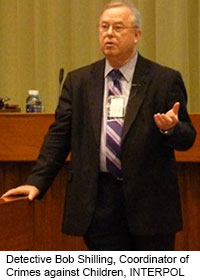
 Trainers for the five-day session included Dr. Geeta Sekhon (UNODC expert and trainer on gender), Warren Bulmer (Canada), Bob Shilling (INTERPOL) and Jane Walsh (Australian Federal Police), all of whom are specialists in the area of crimes against children. Facilitation of the training event was provided by the INTERPOL Coordinator, Annethe Ahlenius.
"Cooperation is essential to do this job properly. It does no good if we chase an offender out of one country and into another," said INTERPOL's Mr. Shilling. "The more we cooperate and put these perpetrators behind bars, the better off everyone will be."
 Mr. Jeremy Douglas, UNODC Regional Representative, Southeast Asia and the Pacific, highlighted the importance of a cooperative effort and the dissemination of training back to their countries.
"This is a significant milestone for Project Childhood (Protection Pillar)," said Mr. Douglas. "The training provides an excellent opportunity for officers to learn and share with other police colleagues, and to take what they learned from this event back with them and hold their own training sessions."
Curriculum topics included gender issues during police work, first response duties of frontline officers, analysis of evidence and images of child pornography, typologies of sex offenders, and cooperation in the investigation of these cases. Sexual exploitation of boys, a widely unrecognized crime, was also discussed by officers, who agreed that further work was required in this area.


http://www.unodc.org/southeastasiaandpacific/en/2013/08/childhood-training/story.html
Bangkok (Thailand), 6 August 2013 - Although the sexual exploitation of children by travelling child-sex offenders remains prevalent in the Greater Mekong Sub-region (GMS) countries of Cambodia, Lao PDR, Thailand and Viet Nam, better collaboration between law enforcement officials across and within borders and stronger investigation and enforcement capacity is beginning to have a positive impact, say regional experts.
"In the analysis of chat logs, INTERPOL experts have said that child sex offenders are starting to say "stay out of Bangkok" and "stay out of Southeast Asia". The work police officers do everyday contributes to this," said Ms. Margaret Akullo, Project Coordinator, Project Childhood (Protection Pillar). "Police Officers have taken a stand, a stand that says we do not tolerate child sexual exploitation in our countries."
Ms. Akullo was speaking in Bangkok recently at a five-day training of trainers for police officers organized by Project Childhood (Protection Pillar), in partnership with UNODC, INTERPOL and World Vision. Project Childhood is a $7.5 million Australian AID (AusAID) funded initiative to combat the sexual exploitation of children in the Greater Mekong sub-region countries of Cambodia, Lao PDR, Thailand, and Viet Nam. Building on Australia's long-term support for programs that better protect children and prevent their abuse, Project Childhood is being implemented in two complementary pillars- the Protection Pillar, a partnership between UNODC and INTERPOL, and the Prevention Pillar, implemented by World Vision.
Attended by officers from the four Project Childhood countries who work in crimes against children units, the workshop aimed to improve investigative skills and knowledge on child sexual exploitation cases. The training utilized the newly developed police-training curriculum,Investigating Sexual Exploitation of Children. Despite the successes achieved by the GMS countries, participants noted that stopping the sexual exploitation of children by traveling sex offenders still required greater coordination and cooperation between GMS criminal justice agencies.
"The results of our collaborative efforts show that we need our friends from Cambodia, Lao PDR and Viet Nam," said Pol. Col Dr. Surasak Laohapiboolkul, Instructor, Police Education Bureau of Thailand. "This forum can be the beginning of a new era for protecting sexually abused children in our region - if we continue to work together."
Trainers for the five-day session included Dr. Geeta Sekhon (UNODC expert and trainer on gender), Warren Bulmer (Canada), Bob Shilling (INTERPOL) and Jane Walsh (Australian Federal Police), all of whom are specialists in the area of crimes against children. Facilitation of the training event was provided by the INTERPOL Coordinator, Annethe Ahlenius. "Cooperation is essential to do this job properly. It does no good if we chase an offender out of one country and into another," said INTERPOL's Mr. Shilling. "The more we cooperate and put these perpetrators behind bars, the better off everyone will be."
Mr. Jeremy Douglas, UNODC Regional Representative, Southeast Asia and the Pacific, highlighted the importance of a cooperative effort and the dissemination of training back to their countries. "This is a significant milestone for Project Childhood (Protection Pillar)," said Mr. Douglas. "The training provides an excellent opportunity for officers to learn and share with other police colleagues, and to take what they learned from this event back with them and hold their own training sessions."
Curriculum topics included gender issues during police work, first response duties of frontline officers, analysis of evidence and images of child pornography, typologies of sex offenders, and cooperation in the investigation of these cases. Sexual exploitation of boys, a widely unrecognized crime, was also discussed by officers, who agreed that further work was required in this area.
Wednesday, August 8, 2012
Child sex traffic brothers guilty
Child sex traffic brothers guilty: Two brothers from Telford are convicted of a series of sexual offences against young girls.

Thursday, June 14, 2012
Witnessing advocacy: transforming ideas into laws
Witnessing advocacy: transforming ideas into laws:
Truck stops and rest areas have become hotspots for human trafficking. Traffickers use freeways to transport victims from place to place. Stops along those routes often play host to sex trafficking, offering a steady stream of anonymous customers. From December of 2007 through August of 2011, the National Human Trafficking Resource Center (NHTRC) hotline received 141 hotline calls nationwide regarding truck stops. 95% of these cases involved sex trafficking, 61% of the victims being minors. In response, Polaris Project, in collaboration with Maryland Delegates Tom Hucker and Dana Stein, introduced HB 607 and HB 860. HB 607 the “Hotline Posting Bill,” would require owners of privately owned truck stops and bus stations as well as the 10 state- operated highway rest areas to post signs with the NHTRC hotline number in their restrooms. This number helps to protect minors from being exploited by people like Shelby Lewis, a Maryland pimp recently sentenced to twenty years in prison, and help them learn how to access to the services they need. HB 860 clarifies the definition of sexual abuse to explicitly state that allowing or encouraging a child to engage in prostitution or human trafficking is considered a form of sexual abuse.
In order to bring attention to this horrible crime and to get these crucial bills passed, we worked with partner organizations to engage our grassroots network and lobby state legislators. We participated in Shared Hope’s Maryland Lobby Day on February 15, 2012; we submitted written testimony in support of the bills; and eventually testified before the Maryland House Judiciary Committee and the House Economic Matters Committee. Getting the chance to stand up for something that we believe in was exhilarating and empowering.
Both of these bills ultimately passed through State Congress. A few weeks ago, we returned to Annapolis to attend the Governor’s bill signing ceremony for HB 860; and the signing ceremony for HB 607 was held on May 22. It is amazing to think that what was just an idea a few short months ago is now an actual state law which will helps protect victims of trafficking. For us, witnessing how hard work and dedicated advocates can implement lasting change and extend a lifeline to victims was a tremendously rewarding experience.


Truck stops and rest areas have become hotspots for human trafficking. Traffickers use freeways to transport victims from place to place. Stops along those routes often play host to sex trafficking, offering a steady stream of anonymous customers. From December of 2007 through August of 2011, the National Human Trafficking Resource Center (NHTRC) hotline received 141 hotline calls nationwide regarding truck stops. 95% of these cases involved sex trafficking, 61% of the victims being minors. In response, Polaris Project, in collaboration with Maryland Delegates Tom Hucker and Dana Stein, introduced HB 607 and HB 860. HB 607 the “Hotline Posting Bill,” would require owners of privately owned truck stops and bus stations as well as the 10 state- operated highway rest areas to post signs with the NHTRC hotline number in their restrooms. This number helps to protect minors from being exploited by people like Shelby Lewis, a Maryland pimp recently sentenced to twenty years in prison, and help them learn how to access to the services they need. HB 860 clarifies the definition of sexual abuse to explicitly state that allowing or encouraging a child to engage in prostitution or human trafficking is considered a form of sexual abuse.
In order to bring attention to this horrible crime and to get these crucial bills passed, we worked with partner organizations to engage our grassroots network and lobby state legislators. We participated in Shared Hope’s Maryland Lobby Day on February 15, 2012; we submitted written testimony in support of the bills; and eventually testified before the Maryland House Judiciary Committee and the House Economic Matters Committee. Getting the chance to stand up for something that we believe in was exhilarating and empowering.
Both of these bills ultimately passed through State Congress. A few weeks ago, we returned to Annapolis to attend the Governor’s bill signing ceremony for HB 860; and the signing ceremony for HB 607 was held on May 22. It is amazing to think that what was just an idea a few short months ago is now an actual state law which will helps protect victims of trafficking. For us, witnessing how hard work and dedicated advocates can implement lasting change and extend a lifeline to victims was a tremendously rewarding experience.


Sunday, May 15, 2011
Facebook Partnership-Trafficking Org-Fights Internet Child Porn
 Image via CrunchBase
 Facebook And Stop Child Trafficking Now (SCTNow) Partner In The Fight Against Internet Child Pornography
Sherrie Clark 5/14/11
Facebook is taking the lead in targeting child sexual predators and the growing problem of child pornography on the internet. It has developed a strategic alliance with Stop Child Trafficking Now, a nonprofit organization who will use its expertise and technological savvy to police Facebook for any photos, videos and content that exploit children.
Through this proactive partnership, Facebook has once again demonstrated its ability to be a leader among its competitors, becoming the standard in how all social networking sites should respond to being utilized by child predators.
Facebook spokesman Frederick Wolens said, “Since last year, we have partnered with SCTNow to coordinate our resources and cast a wider safety net for those online.”
SCTNow operates on the basic economic principle of supply and demand, targeting the predators who drive up the demand for these children. This innovative organization utilizes highly trained and skilled Special Operative Teams that consist of former CIA operatives, Navy SEALS, and experts in counter-terrorism, all who track sexual offenders and accumulate valuable intelligence needed to bring child sex predators to justice.
To support the efforts of SCTNow, please join the SCTNow National Walk/Run Campaign this September by registering at www.SCTNow.org or email at info@SCTNow.org. For more information and for National
Media Interviews contact:
Sundy Goodnight
SCTNow National Director
212-333-7286
Follow SCTNow on Twitter @SCTNow Twitter marketing powered by M3NewMedia.
Facebook Partnership-Trafficking Org-Fights Internet Child Porn
Source: humantraffickinginfo.org

Thursday, August 19, 2010
Who Protects the Child from Trafficking? | Feature Article 2010-08-19
 Image via Wikipedia
FROM GHANA WEB
Feature Article of Thursday, 19 August 2010
Columnist: Kpebesaan, Delle
The effects of Child Trafficking and child labour are more devastating than a double-edged sword. Ghana seems to provide a conducive socio-economic environment that nurses and nurtures this phenomenon beyond the control of the stakeholders involved in remedying the problem. The ‘child grasping’ ferries and canoes on our water bodies (ever ready to have on board children for any reason) and the vehicles that ply between the inland boarders and the coast contribute to this problem that affects our future leaders. Trafficking is not the same as migration or traveling. Within Ghana, persons are not inhibited from migrating for any reason. Children sometimes travel to visit their relations, or migrate to live with relatives outside their hometowns. A responsible parent or guardian would ensure that his or her child travels within the company of a grown up. This is allowed by culture and law. When the same child is transported from one place to another by another person – be the person a relative, parent, friend or stranger – and the child ends up being exploited or abused, migration then turns into trafficking which is an offense under Act 694. In the guise of migration, some children have been transported to various destinations where they have been put to work and deprived of education, good care and sound growth and development. This act will eventually tell on the quality of human resource of the family, community and the nation as a whole in future. It is this effect that makes this act human trafficking – an offense against the state and an illegality.
Most of these boys and girls who are trafficked or transported to various parts of the Volta Lake are abused in several ways and used in various forms of what can be termed as worst forms of child labour. Other children that are found on a number of small-scale mining sites located at different places in the country do sit on deadly time bombs - this is evidenced by the recent disaster at Dunkwa-on-Offin where a mining pit caved in on some people including boys and girls whose bodies are yet to be discovered. Other children are trafficked into domestic servitude, commercial sexual exploitation, stone quarry and other areas. The case of the children, mostly girls, who migrate or are trafficked from the North to the South of the country has even gained international repute, contributing to the development of the latest word added to the BBC English Dictionary Edition - ‘kayaye’ – which is now a standard word originating from Ghana. It is noteworthy that other such Ghanaian words that have been accepted as standard words worldwide are “kwashiorkor” and “beriberi”, both being diseases of malnourishment of children.
Child trafficking has been a serious concern to the government, the media and several civil society organizations today. Some individuals and groups use clandestine means to promote and perpetuate this obnoxious trade, especially on the Volta Lake, out of greed. Unfortunately, the phenomenon still appears as “normal”, “acceptable” and “traditional” to many people in this country. The recent pronouncement by people in authority on the transportation of over 200 children from Ada to Yeji purportedly to assist their parents should be given close scrutiny. It is quite incredulous that over 200 children could just wake up one morning and, without any consultation among themselves or with any person in authority, set off to a common destination to “help” their parents to mobilize money to pay their fees (even though education at the basic level is free). This leads to conjecturing that there was something more to this incident than what is being said; and this points strongly at the possibility of this being a case of child trafficking.
A few questions arise from this incident. If children commonly travel to Yeji to help their parents, how many of such children return to where they came from after the holidays? Do the activities of these children in Yeji and other destinations constitute child labour as defined in Section 91 of the Children’s Act of 1998? Does anyone monitor the activities of these migrant children? How many of them are physically and sexually abused? How many of them get injured or die in the process of “helping” their parents/guardians due to the hazardous nature of the work they are engaged in? Do we have an idea whether any of these children end up becoming modern-day slaves, never returning to their real homes and real parents, cry most times, get abused and maltreated their entire lives?
Children traveling to visit their parents and family is normal, but if these children are on their way to be subject to hazardous activities which has the potential of negatively affecting their education, growth and total development, this would be in conflicts with our laws and is unacceptable.
Several efforts are being made by the government, the Anti-Human Trafficking Unit of the Ghana Police Service and several non-governmental organizations such as the Ghana Anti-Human Trafficking and Child Protection Coalition to stem the tide of human trafficking in the country. The Coalition, which met its entire members to critically discuss this issue, is committed to working with various stakeholders, especially the government, and indicates its preparedness to support the protection of children in Ghana. The coalition believes that children have rights and must be allowed to enjoy those rights in full without any hindrances. Through the responsible exercise of their rights, we can effectively groom the human resource of our nation, for the children of today to become the real leaders of the future.
The concept of children helping their parents or guardians after school, during weekends and during vacation has been the Ghanaian custom for many years. It is acceptable as a means of grooming children into responsible adulthood. However, transporting as many as nearly 300 children between 5 to 17 years of age to be involved in fishing in Yeji under the pretence of helping their parents is quite suspicious and may not be in the best interest of the child.
The Coalition believes that child trafficking and worst forms of child labor must be the concern of all – everyone one must contribute to finding a lasting solution to this problem. One key area that needs immense focus is monitoring of movement of all persons within and into the country. Migration does not need to be restricted. However, it is very important that every community understand the dangers and dimensions of trafficking in persons, worst forms of child labour, lack of education and adequate care for children, and the future that these present to the community and the nation. Our own parliament enacted the Children’s Act, the Human Trafficking Act and other laws that prohibit child labour and human trafficking. It is, therefore, our collective responsibility to study the processes of human trafficking, worst forms of child labour, and modern-day slavery and work towards sustainable solution. We need public education on these acts and on-going activities in respect of these laws. The Ghana Anti-Human Trafficking and Child Protection Coalition calls on all persons to stand up to protect children from trafficking, abuse, exploitation and modern-day slavery, and thereby uphold and defend the good name of Ghana.
Ghana Anti-Human Trafficking and Child Protection Coalition
Contact Person Delle Kpebesaan
kpebesaan_delle@hotmail.com

Friday, August 13, 2010
Human trafficking and sexual exploitation of children – EU cracks down
Protecting the weakest
Justice and citizens rights - 29/03/2010
EU steps up fight against human trafficking and child sex predators.
The commission is calling for tougher laws against human trafficking and the sexual exploitation of children, saying Europe is losing the battle against these crimes.
Few reliable statistics exist on the number of people trafficked into or within Europe, but it is probably around several hundred thousand, mostly for prostitution and menial labour. Yet in 2006, the most recent year for which figures are available, prosecutors brought just 1 500 criminal trafficking cases to court in the whole of the EU. Only 3 000 victims received assistance.
Trafficking in humans is extremely profitable, and most traffickers are professional organised criminals. Most are based outside the EU but there are now growing networks inside too, especially since the bloc’s eastward expansion.
Existing laws would be updated, encouraging EU countries to go after nationals who commit crimes in other countries and to use more aggressive methods for investigating organised crime, like phone taps.
The draft rules also call for more consistency in how EU law is applied from one country to another and for more protection and assistance for victims. Independent national bodies would be set up to monitor implementation.
Concerning the sexual exploitation of children, the commission wants a combination of harsher penalties and more effective treatment for offenders.
The new laws would also restrict offenders from activities involving contact with children. About 20% of convicted child sex predators become repeat offenders.
Systems would be developed to block access to child porn sites.
Studies suggest between 10% and 20% of children in Europe will suffer some form of sexual abuse during their youth. Some kinds of abuse are on the rise, including websites devoted to child pornography.

Human trafficking and sexual exploitation of children – EU cracks down

Thursday, July 15, 2010
Op-Ed Columnist - Seduction, Slavery and Sex - NYTimes.com
Op-Ed Columnist
Published: July 14, 2010
Against all odds, this year’s publishing sensation is a trio of thrillers by a dead Swede relating tangentially to human trafficking and sexual abuse.
Nicholas D. Kristof
On the Ground
“The Girl With the Dragon Tattoo” series tops the best-seller lists. More than 150 years ago, “Uncle Tom’s Cabin” helped lay the groundwork for the end of slavery. Let’s hope that these novels help build pressure on trafficking as a modern echo of slavery.
Human trafficking tends to get ignored because it is an indelicate, sordid topic, with troubled victims who don’t make great poster children for family values. Indeed, many of the victims are rebellious teenage girls — often runaways — who have been in trouble with their parents and the law, and at times they think they love their pimps.
Because trafficking gets ignored, it rarely is a top priority for law enforcement officials — so it seems to be growing. Various reports and studies, none of them particularly reliable, suggest that between 100,000 and 600,000 children may be involved in prostitution in the United States, with the numbers increasing.
Just last month, police freed a 12-year-old girl who they said had been imprisoned in a Knights Inn hotel in Laurel, Md. The police charged a 42-year-old man, Derwin Smith, with human trafficking and false imprisonment in connection with the case.
The Anne Arundel County Police Department said that Mr. Smith met the girl in a seedy area, had sex with her and then transported her back and forth from Washington, D.C., to Atlantic City, N.J., while prostituting her.
“The juvenile advised that all of the money made was collected and kept by the suspect,” the police department said in a statement. “At one point, the victim conveyed to the suspect that she wanted to return home, but he held her against her will.”
Just two days later, the same police force freed three other young women from a Garden Inn about a block away. They were 16, 19 and 23, and police officials accused a 23-year-old man, Gabriel Dreke-Hernandez, of pimping them.
Police said that Mr. Dreke-Hernandez had kidnapped the 19-year-old from a party and had taken her to a hotel room. “Once at the hotel,” the police statement said, Mr. Dreke-Hernandez allegedly “grabbed her around the throat and began to choke her. Hernandez then pushed her head against the wall several times before placing a knife to her throat and demanding that she follow his commands.
“The female further advised that all of the money made was collected and kept by the suspect. At one point, she indicated that she would not prostitute any longer and the suspect subsequently pulled her into the bathroom and threatened her again with a knife.”
Police officials did not release details about the 16-year-old and 23-year-old, though they said customers for the teenager had been sought on the Internet.
There’s a misperception in America that “sex trafficking” is mostly about foreigners smuggled into the U.S. That exists. But I’ve concluded that the biggest problem and worst abuses involve not foreign women but home-grown runaway kids.
In a typical case, a rebellious 13-year-old girl runs away from a home where her mother’s boyfriend is hitting on her. She is angry and doesn’t trust the police. She goes to the bus station in hopes of getting out of town — and the only person on the lookout for girls like her is a pimp, who buys her a meal, offers her a place to stay and tells her he loves her.
The next thing she knows, she’s having sex with four men a night and all the money is going to her “boyfriend.” If she voices reservations, he puts a gun in her mouth and threatens to blow her head off.
Her customers, often recruited on the Internet, may have no inkling that her actions are not completely voluntary. Some mix of fear, love, hopelessness and shattered self-esteem keep her from trying to run away.
No strategy has worked particularly well against human trafficking, and commercial sex may well exist 1,000 years from now. But a starting point is for law enforcement to go after pimps rather than the girls. That’s the only way to break the business model of forced prostitution.
Sweden offers us not only the summer’s top beach paperbacks, but also a useful strategy for dealing with trafficking. The Swedish model, adopted in 1999, is to prosecute the men who purchase sex, while treating the women who sell it as victims who merit social services.
Prosecution of johns has reduced demand for prostitution in Sweden, which in turn reduces market prices. That reduces the incentives for trafficking into Sweden, and the number of prostitutes seems to have declined there. A growing number of countries are concluding that the Swedish model works better than any other, and it would be wise for American states to experiment with it as well. It’s not a panacea, but cracking down on demand seems a useful way to chip away at 21st-century slavery.
I invite you to visit my blog, On the Ground. Please also join me on Facebook, watch my YouTube videos and follow me on Twitter.
A version of this op-ed appeared in print on July 15, 2010, on page A31 of the New York edition.
http://www.nytimes.com/2010/07/15/opinion/15kristof.html?_r=2
Published: July 14, 2010
Against all odds, this year’s publishing sensation is a trio of thrillers by a dead Swede relating tangentially to human trafficking and sexual abuse.
Nicholas D. Kristof
On the Ground
“The Girl With the Dragon Tattoo” series tops the best-seller lists. More than 150 years ago, “Uncle Tom’s Cabin” helped lay the groundwork for the end of slavery. Let’s hope that these novels help build pressure on trafficking as a modern echo of slavery.
Human trafficking tends to get ignored because it is an indelicate, sordid topic, with troubled victims who don’t make great poster children for family values. Indeed, many of the victims are rebellious teenage girls — often runaways — who have been in trouble with their parents and the law, and at times they think they love their pimps.
Because trafficking gets ignored, it rarely is a top priority for law enforcement officials — so it seems to be growing. Various reports and studies, none of them particularly reliable, suggest that between 100,000 and 600,000 children may be involved in prostitution in the United States, with the numbers increasing.
Just last month, police freed a 12-year-old girl who they said had been imprisoned in a Knights Inn hotel in Laurel, Md. The police charged a 42-year-old man, Derwin Smith, with human trafficking and false imprisonment in connection with the case.
The Anne Arundel County Police Department said that Mr. Smith met the girl in a seedy area, had sex with her and then transported her back and forth from Washington, D.C., to Atlantic City, N.J., while prostituting her.
“The juvenile advised that all of the money made was collected and kept by the suspect,” the police department said in a statement. “At one point, the victim conveyed to the suspect that she wanted to return home, but he held her against her will.”
Just two days later, the same police force freed three other young women from a Garden Inn about a block away. They were 16, 19 and 23, and police officials accused a 23-year-old man, Gabriel Dreke-Hernandez, of pimping them.
Police said that Mr. Dreke-Hernandez had kidnapped the 19-year-old from a party and had taken her to a hotel room. “Once at the hotel,” the police statement said, Mr. Dreke-Hernandez allegedly “grabbed her around the throat and began to choke her. Hernandez then pushed her head against the wall several times before placing a knife to her throat and demanding that she follow his commands.
“The female further advised that all of the money made was collected and kept by the suspect. At one point, she indicated that she would not prostitute any longer and the suspect subsequently pulled her into the bathroom and threatened her again with a knife.”
Police officials did not release details about the 16-year-old and 23-year-old, though they said customers for the teenager had been sought on the Internet.
There’s a misperception in America that “sex trafficking” is mostly about foreigners smuggled into the U.S. That exists. But I’ve concluded that the biggest problem and worst abuses involve not foreign women but home-grown runaway kids.
In a typical case, a rebellious 13-year-old girl runs away from a home where her mother’s boyfriend is hitting on her. She is angry and doesn’t trust the police. She goes to the bus station in hopes of getting out of town — and the only person on the lookout for girls like her is a pimp, who buys her a meal, offers her a place to stay and tells her he loves her.
The next thing she knows, she’s having sex with four men a night and all the money is going to her “boyfriend.” If she voices reservations, he puts a gun in her mouth and threatens to blow her head off.
Her customers, often recruited on the Internet, may have no inkling that her actions are not completely voluntary. Some mix of fear, love, hopelessness and shattered self-esteem keep her from trying to run away.
No strategy has worked particularly well against human trafficking, and commercial sex may well exist 1,000 years from now. But a starting point is for law enforcement to go after pimps rather than the girls. That’s the only way to break the business model of forced prostitution.
Sweden offers us not only the summer’s top beach paperbacks, but also a useful strategy for dealing with trafficking. The Swedish model, adopted in 1999, is to prosecute the men who purchase sex, while treating the women who sell it as victims who merit social services.
Prosecution of johns has reduced demand for prostitution in Sweden, which in turn reduces market prices. That reduces the incentives for trafficking into Sweden, and the number of prostitutes seems to have declined there. A growing number of countries are concluding that the Swedish model works better than any other, and it would be wise for American states to experiment with it as well. It’s not a panacea, but cracking down on demand seems a useful way to chip away at 21st-century slavery.
I invite you to visit my blog, On the Ground. Please also join me on Facebook, watch my YouTube videos and follow me on Twitter.
A version of this op-ed appeared in print on July 15, 2010, on page A31 of the New York edition.
http://www.nytimes.com/2010/07/15/opinion/15kristof.html?_r=2
Thursday, May 27, 2010
Rise in sex crimes involving children sparks concern | MailTribune.com
May 26, 2010
By Sanne Specht
Mail Tribune
A recent nationwide sting by federal, state and local law enforcement agencies that placed Portland second in the nation for the number of rescued child prostitutes has local officials concerned about the ramifications for Jackson County.
"We are seeing more adults traveling to Southern Oregon to have sex with kids who they've met online," said Sgt. Josh Moulin, commander of the Southern Oregon High-Tech Crimes Task Force, adding he's seen ads on Craigslist from teens offering themselves for sale.
Did you know?
According to recent Federal Bureau of Investigation statistics, between 100,000 and 300,000 children are prostituted annually. These children service between four to 10 customers a day, which equals 1,460 to 3,600 transactions per child per year, said Marlene Mish, executive director of the Children's Advocacy Center.
The FBI has determined 90 percent of runaways living on the street were victims of sexual, physical or emotional abuse or neglect, Mish said.
Ways to help: Become a volunteer or donate to the Mazlow Project, located at 209 W. Main St., 541-608-6868. To become a volunteer or donate to the CAC, call 541-734-5437.
Runaways trading sex for survival, parents trading their children for drugs or money, older adults preying upon curious kids on the Internet — all these scenarios can end up as a death sentence for a child, said Marlene Mish, executive director of the Children's Advocacy Center.
"Child sex trafficking is the most hidden form of child abuse in our country today," Mish said.
According to the Federal Bureau of Investigation, 100,000 to 300,000 children are prostituted annually. They service between four to 10 customers a day, 1,460 to 3,600 transactions per child per year.
"To call it child prostitution is a very euphemistic way of getting around the brutality," Mish said. "These children are raped, beaten and enslaved."
The problem of prostituted children is growing because of funding cuts to mental health services, a lack of residential care programs for youths and a child welfare system that is unable to stop runaways, local officials said.
Most of the estimated 1.6 million children nationwide who flee or are kicked out of their homes each year will return within a week. But nearly a third of those who remain runaways will trade sex for food, drugs or a place to stay, according to studies cited in a story published in the New York Times last fall.
Nicole Clark, 17, of Ashland spoke of her experiences as a teen runaway in the article. Clark ran away from a Medford group home at age 14. Living on the street and desperate, she eventually accepted a young man's offer of a place to stay. He became her boyfriend, and then her pimp. He threatened to kick her out of the apartment if she did not have sex with several of his friends in exchange for money. Clark's downward spiral continued for 14 months until she escaped from another pimp who kept her locked in his garage apartment for months, she said.
Mary Ferrell, director of the Maslow Project, a Medford outreach center for homeless youths, said word on the street is that "survival sex" incidents are on the rise.
"It's just so scary," Ferrell said. "Their lives are literally at risk. The girls are just convinced they are going to die."
Teens are reluctant to discuss their experiences. "Prostitution is not the kind of thing that kids are going to willingly self-disclose," she said.
Ferrell is hearing more reports of graffiti on public buildings signaling sex trafficking and prostitution, she said.
Ferrell said she worries about unaccompanied kids who are seen at her center once or twice, and then never show up again.
"We don't know what happens to these kids," she said.
The common assumption that children of inner cities are the ones most often lured into prostitution is a fallacy. Studies show rural children are most at risk. The No. 1 state for recruiting children is Minnesota, Mish said.
"This is big money worldwide and it's attracting people who are making a science out of it," Mish said. "They are going to smaller towns where kids are less sophisticated and more willing to buy a line. That's why it's significant to us."
Deputy District Attorney David Hoppe said Jackson County has had a case "where a mother had her daughter perform sex acts for money." But getting teen prostitution victims to come forward is very difficult, he said.
"Trafficking is a horrible problem in our world," he said.
Human trafficking is a specific charge created in 2006. There have been no trafficking cases filed in Jackson County. But there have been hundreds of cases involving sex offenses committed by adults against minors. These felony charges can carry Measure 11 consequences, said Hoppe.
"Compelling prostitution is a Measure 11 crime and carries a minimum 70-month sentence," he said.
The Southern Oregon High-Tech Crimes Task Force has seen a 29 percent increase in cases involving child pornography and child sexual exploitation over the past year, said Moulin.
In addition to an increase in adult-generated child pornography, children are self-exploiting by "sexting." Teens and pre-teens are posting sexually explicit photos of themselves to social networking venues, and to strangers they have met online, he said.
The Internet is a highly effective tool for predators seeking to seduce children, Mish said.
"If a stranger knocked on your door and asked if he could take your daughter into the bedroom behind closed doors for a few hours, you'd say 'no,'" Mish said. "But we do that with our children when we allow them unsupervised access to the Internet."
Once teens turn 18, they are considered legal adults and face criminal charges if arrested for prostitution. If convicted, the teen gets a sex crimes record and jail time. The adult "john" often gets only a fine. The pimp usually goes free, she said.
"They are victimized and re-victimized," Mish said. "We must stop children who are engaged in criminal behavior without criminalizing the child."
The FBI has determined 90 percent of runaways living on the street were victims of sexual, physical or emotional abuse or neglect, Mish said.
"The solution is very simple. To reduce the number of kids on our streets, we need to stop sex abuse in the home," Mish said.
Reach reporter Sanne Specht at 541-776-4497 or e-mail sspecht@mailtribune.com.
Rise in sex crimes involving children sparks concern | MailTribune.com
![Reblog this post [with Zemanta]](http://img.zemanta.com/reblog_e.png?x-id=cc7456c0-c8d4-481f-95c8-168046ddffc1)
By Sanne Specht
Mail Tribune
A recent nationwide sting by federal, state and local law enforcement agencies that placed Portland second in the nation for the number of rescued child prostitutes has local officials concerned about the ramifications for Jackson County.
"We are seeing more adults traveling to Southern Oregon to have sex with kids who they've met online," said Sgt. Josh Moulin, commander of the Southern Oregon High-Tech Crimes Task Force, adding he's seen ads on Craigslist from teens offering themselves for sale.
Did you know?
According to recent Federal Bureau of Investigation statistics, between 100,000 and 300,000 children are prostituted annually. These children service between four to 10 customers a day, which equals 1,460 to 3,600 transactions per child per year, said Marlene Mish, executive director of the Children's Advocacy Center.
The FBI has determined 90 percent of runaways living on the street were victims of sexual, physical or emotional abuse or neglect, Mish said.
Ways to help: Become a volunteer or donate to the Mazlow Project, located at 209 W. Main St., 541-608-6868. To become a volunteer or donate to the CAC, call 541-734-5437.
Runaways trading sex for survival, parents trading their children for drugs or money, older adults preying upon curious kids on the Internet — all these scenarios can end up as a death sentence for a child, said Marlene Mish, executive director of the Children's Advocacy Center.
"Child sex trafficking is the most hidden form of child abuse in our country today," Mish said.
According to the Federal Bureau of Investigation, 100,000 to 300,000 children are prostituted annually. They service between four to 10 customers a day, 1,460 to 3,600 transactions per child per year.
"To call it child prostitution is a very euphemistic way of getting around the brutality," Mish said. "These children are raped, beaten and enslaved."
The problem of prostituted children is growing because of funding cuts to mental health services, a lack of residential care programs for youths and a child welfare system that is unable to stop runaways, local officials said.
Most of the estimated 1.6 million children nationwide who flee or are kicked out of their homes each year will return within a week. But nearly a third of those who remain runaways will trade sex for food, drugs or a place to stay, according to studies cited in a story published in the New York Times last fall.
Nicole Clark, 17, of Ashland spoke of her experiences as a teen runaway in the article. Clark ran away from a Medford group home at age 14. Living on the street and desperate, she eventually accepted a young man's offer of a place to stay. He became her boyfriend, and then her pimp. He threatened to kick her out of the apartment if she did not have sex with several of his friends in exchange for money. Clark's downward spiral continued for 14 months until she escaped from another pimp who kept her locked in his garage apartment for months, she said.
Mary Ferrell, director of the Maslow Project, a Medford outreach center for homeless youths, said word on the street is that "survival sex" incidents are on the rise.
"It's just so scary," Ferrell said. "Their lives are literally at risk. The girls are just convinced they are going to die."
Teens are reluctant to discuss their experiences. "Prostitution is not the kind of thing that kids are going to willingly self-disclose," she said.
Ferrell is hearing more reports of graffiti on public buildings signaling sex trafficking and prostitution, she said.
Ferrell said she worries about unaccompanied kids who are seen at her center once or twice, and then never show up again.
"We don't know what happens to these kids," she said.
The common assumption that children of inner cities are the ones most often lured into prostitution is a fallacy. Studies show rural children are most at risk. The No. 1 state for recruiting children is Minnesota, Mish said.
"This is big money worldwide and it's attracting people who are making a science out of it," Mish said. "They are going to smaller towns where kids are less sophisticated and more willing to buy a line. That's why it's significant to us."
Deputy District Attorney David Hoppe said Jackson County has had a case "where a mother had her daughter perform sex acts for money." But getting teen prostitution victims to come forward is very difficult, he said.
"Trafficking is a horrible problem in our world," he said.
Human trafficking is a specific charge created in 2006. There have been no trafficking cases filed in Jackson County. But there have been hundreds of cases involving sex offenses committed by adults against minors. These felony charges can carry Measure 11 consequences, said Hoppe.
"Compelling prostitution is a Measure 11 crime and carries a minimum 70-month sentence," he said.
The Southern Oregon High-Tech Crimes Task Force has seen a 29 percent increase in cases involving child pornography and child sexual exploitation over the past year, said Moulin.
In addition to an increase in adult-generated child pornography, children are self-exploiting by "sexting." Teens and pre-teens are posting sexually explicit photos of themselves to social networking venues, and to strangers they have met online, he said.
The Internet is a highly effective tool for predators seeking to seduce children, Mish said.
"If a stranger knocked on your door and asked if he could take your daughter into the bedroom behind closed doors for a few hours, you'd say 'no,'" Mish said. "But we do that with our children when we allow them unsupervised access to the Internet."
Once teens turn 18, they are considered legal adults and face criminal charges if arrested for prostitution. If convicted, the teen gets a sex crimes record and jail time. The adult "john" often gets only a fine. The pimp usually goes free, she said.
"They are victimized and re-victimized," Mish said. "We must stop children who are engaged in criminal behavior without criminalizing the child."
The FBI has determined 90 percent of runaways living on the street were victims of sexual, physical or emotional abuse or neglect, Mish said.
"The solution is very simple. To reduce the number of kids on our streets, we need to stop sex abuse in the home," Mish said.
Reach reporter Sanne Specht at 541-776-4497 or e-mail sspecht@mailtribune.com.
Rise in sex crimes involving children sparks concern | MailTribune.com
B.C. man pleads guilty to 14 sex tourism charges - CTV News
 Image via Wikipedia
Date: Saturday May. 22, 2010 6:32 AM ET
VANCOUVER — A Burnaby, B.C., man has pleaded guilty to sex tourism charges involving 14 underage girls in Cambodia and Colombia.
Kenneth Klassen appeared in B.C. Supreme Court in Vancouver on Friday and admitted to committing the crimes between December 1998 and March of 2002.
He also pleaded guilty to one count of importing child pornography and will be sentenced in July.
Klassen, a father of three, was originally facing 35 charges for the exploitation and sexual abuse of children in Cambodia, Colombia and the Philippines.
He was accused of abusing girls as young as nine and charged in 2007 after a two-and-a-half-year international investigation that netted videos showing a man having sex with young girls.
Klassen challenged Canada's child-sex tourism law in 2009, saying Canadian courts had no jurisdiction in other countries, but a B.C. Supreme Court judge ruled the law is internationally valid because many countries have similar legislation.
"In the absence of extraterritorial legislation, Canada would become a safer harbour for those who engage in the economic or sexual exploitation of children," Justice Austin Cullen wrote in his decision.
Canada's child-sex tourism laws were enacted in 1997 and bolstered five years later so the consent of the foreign country where allegations of sexual abuse took place was no longer needed in order to lay charges.
Vancouver hotel employee Donald Bakker was the first Canadian to be convicted under the law in 2005.
He got a 10-year sentence for 10 sexual assaults on girls between seven and 12 in Cambodia, where he videotaped the abuse.
In November of 2008, two Quebec aid workers pleaded guilty to sexually abusing teenage boys while working at an orphanage in Haiti.
Armand Huard was sentenced to three years in prison and Denis Rochefort was given two years.
B.C. man pleads guilty to 14 sex tourism charges - CTV News
![Reblog this post [with Zemanta]](http://img.zemanta.com/reblog_e.png?x-id=5f1e5983-4fc4-46d1-8d67-423c16d12614)
Saturday, May 15, 2010
Victims of Youth Trafficking in Oakland (Series Part 2) | Oakland Local
Published on Wednesday, May 05, 2010
Last updated on 07:08AM, Wednesday, May 12, 2010
Oakland police officers arrest young women from Pomona on suspicion of solicitation. Photo by Alison Yin.
This is Part 2 of an eight-part, four-day Oakland Local investigative series on youth sex trafficking. Continued from Part 1.
Who is this "commodity" being traded on the street? Statistically she is a 13-year-old girl who has run away from an abusive parent, guardian or foster home. Too young to fend for herself as a runaway, she ends up under the control of a pimp who promises to take care of her. Then the trafficker turns on her and, either by emotional manipulation or physical threat, gets the girl to work the streets to bring in money.
"These are children who have never known love, so they look for love in all the wrong places," said Alameda County Deputy District Attorney Sharmin Eshraghi Bock, who has directed 148 cases against people alleged to have sold teenagers and children for sex. "All the pimp has to say is, 'Baby I love you and some day I want to have a family with you but today I'm short of cash. Can you help me make the rent?'" Bock continued.
PREVIOUSLY in this series | NEXT in this series
Complete series index | Take action!
In other situations, girls are kidnapped off sidewalks by traffickers who then threaten them into cooperation. That's what happened in the case of Vincent Turner, tried and convicted April 2 in Superior Court in Alameda County on seven felony counts including kidnapping, rape and trafficking. Prosecutors said Turner kidnapped a 15-year-old and a 16-year-old off the street in Oakland, brought them to Stockton and told them they had to work as prostitutes to raise money to win their release. Turner will be sentenced in June and faces 15 years to life.
National and local statistics say 80% of minors trafficked for commercial sex are runaways and most experienced sexual or physical abuse as young children. A 2008 study of 149 Bay Area kids receiving services after the trauma of commercial sexual abuse found:
* 82% ran away from home
* 70% were abused as young children
* 61% were raped before they were adolescents
* 55% ran away from a foster care or group home
(This study was conducted by the Sexually Exploited Minors Support Network, Safe Place Alternative program, in Alameda County.)
"A common trait is previous abuse. A lot of our children are sexual abuse victims, and children who have not had adults around to do basic things like enroll them in school," said Nola Brantley, director of MISSSEY, the largest organization serving commercially sexually exploited youth in Alameda County and the person who oversaw the survey. (MISSSEY stands for Motivating, Inspiring, Supporting and Serving Sexually Exploited Youth.)
"A lot of the girls were exchanged for drugs. Like their mother is a drug addict and she allows someone to have sex with her child in exchange for drugs. We get that all the time," she said, her voice rising.
Or they are kids living in poverty. "We have a girl coming in she has no food, she has no clothes. If she goes back home there is nothing in the refrigerator. We're not just providing her talk, you feel me? We're providing her socks, and underwear, and food and diapers for her baby," Brantley said.
In the United States, the average age of entry into prostitution is 13, noted Kelly Tyne of nonprofit advocacy agency the Stand Against Global Exploitation Project. This number is widely acknowledged by advocates and law enforcement.
"Those are children," he said of that age. "There is no such thing as a child prostitute. There are children who are raped. There are children who suffer molestation. There are children who survive sexual violence. But there is no such thing as a child prostitute," said Tyne, himself a survivor of a childhood of commercial sexual exploitation.
Not just poor kids
Some kids are from wealthy but abusive homes. One 16-year-old girl said she ran away from two abusive parents. Unable to figure out how to support herself on the streets, she took up with a pimp who offered her food and shelter but then abused her and forced her to sell herself. Counselors from Bay Area Women Against Rape (BAWAR) talked with her and discovered her pimp had burned her with cigarettes and broken her nose.
"These kids run away from being beaten by a parent or someone the parent knows and the streets become their family. Then they are abused again," said Patrick Mims, the BAWAR social worker who helped her.
The National Runaway Switchboard reports that 80% of girls who run away from home are fleeing physical or sexual abuse.
What it's like to be a sexually exploited teen
Saundra Domingue was prostituted in Oakland for many years starting at age 17, but now is a counselor with the Stand Against Gobal Exploitation Project, a San Francisco nonprofit for survivors of commercial sexual exploitation. She said her first pimp "painted this beautiful picture, this glamorous picture, that if I engaged in prostitution, I would have money in my pocket, I would have a roof over my head, I would have food and clothes, very beautiful clothes." Domingue's trafficker was a woman and among the first people she met after running away from home. "So I, not having any other means of supporting myself, adhered to this woman's wishes."
Unfortunately there are plenty of kids who need love and support in Oakland and the Bay. The Alameda County Social Services Agency receives 1,600 reports of child abuse or neglect each month. In those reports are many of the children who will become victims of commercial sexual exploitation.
This story was produced under a fellowship sponsored by the
G.W. Williams Center for Independent Journalism, a project of Tides Center.
We also would like to thank Robert Rosenthal and California Watch for their support -- as well as our reporters Barbara Grady and Sarah Terry-Cobo, and photographer Alison Yin -- for their amazing work.
Support more independent quality reporting like this! Please donate to Oakland Local on Spot.us. We are seeking additional support for continued coverage.
About Barbara Grady
Barbara Grady's picture
Barbara Grady, a freelance reporter, researched and wrote this story with the support of a fellowship from the G.W. Williams Center for Independent Journalism. Before her current stint of writing about social issues for various news and non-profit organizations, Barbara was on staff at the Oakland Tribune and, earlier, at Reuters News Agency. She received a national Society of Professional Journalists 'excellence in journalism' award for a series published in 2008.
Victims of Youth Trafficking in Oakland (Series Part 2) | Oakland Local
![Reblog this post [with Zemanta]](http://img.zemanta.com/reblog_e.png?x-id=0164f468-ea6c-4d63-be92-eb1173fa2661)
Last updated on 07:08AM, Wednesday, May 12, 2010
Oakland police officers arrest young women from Pomona on suspicion of solicitation. Photo by Alison Yin.
This is Part 2 of an eight-part, four-day Oakland Local investigative series on youth sex trafficking. Continued from Part 1.
Who is this "commodity" being traded on the street? Statistically she is a 13-year-old girl who has run away from an abusive parent, guardian or foster home. Too young to fend for herself as a runaway, she ends up under the control of a pimp who promises to take care of her. Then the trafficker turns on her and, either by emotional manipulation or physical threat, gets the girl to work the streets to bring in money.
"These are children who have never known love, so they look for love in all the wrong places," said Alameda County Deputy District Attorney Sharmin Eshraghi Bock, who has directed 148 cases against people alleged to have sold teenagers and children for sex. "All the pimp has to say is, 'Baby I love you and some day I want to have a family with you but today I'm short of cash. Can you help me make the rent?'" Bock continued.
PREVIOUSLY in this series | NEXT in this series
Complete series index | Take action!
In other situations, girls are kidnapped off sidewalks by traffickers who then threaten them into cooperation. That's what happened in the case of Vincent Turner, tried and convicted April 2 in Superior Court in Alameda County on seven felony counts including kidnapping, rape and trafficking. Prosecutors said Turner kidnapped a 15-year-old and a 16-year-old off the street in Oakland, brought them to Stockton and told them they had to work as prostitutes to raise money to win their release. Turner will be sentenced in June and faces 15 years to life.
National and local statistics say 80% of minors trafficked for commercial sex are runaways and most experienced sexual or physical abuse as young children. A 2008 study of 149 Bay Area kids receiving services after the trauma of commercial sexual abuse found:
* 82% ran away from home
* 70% were abused as young children
* 61% were raped before they were adolescents
* 55% ran away from a foster care or group home
(This study was conducted by the Sexually Exploited Minors Support Network, Safe Place Alternative program, in Alameda County.)
"A common trait is previous abuse. A lot of our children are sexual abuse victims, and children who have not had adults around to do basic things like enroll them in school," said Nola Brantley, director of MISSSEY, the largest organization serving commercially sexually exploited youth in Alameda County and the person who oversaw the survey. (MISSSEY stands for Motivating, Inspiring, Supporting and Serving Sexually Exploited Youth.)
"A lot of the girls were exchanged for drugs. Like their mother is a drug addict and she allows someone to have sex with her child in exchange for drugs. We get that all the time," she said, her voice rising.
Or they are kids living in poverty. "We have a girl coming in she has no food, she has no clothes. If she goes back home there is nothing in the refrigerator. We're not just providing her talk, you feel me? We're providing her socks, and underwear, and food and diapers for her baby," Brantley said.
In the United States, the average age of entry into prostitution is 13, noted Kelly Tyne of nonprofit advocacy agency the Stand Against Global Exploitation Project. This number is widely acknowledged by advocates and law enforcement.
"Those are children," he said of that age. "There is no such thing as a child prostitute. There are children who are raped. There are children who suffer molestation. There are children who survive sexual violence. But there is no such thing as a child prostitute," said Tyne, himself a survivor of a childhood of commercial sexual exploitation.
Not just poor kids
Some kids are from wealthy but abusive homes. One 16-year-old girl said she ran away from two abusive parents. Unable to figure out how to support herself on the streets, she took up with a pimp who offered her food and shelter but then abused her and forced her to sell herself. Counselors from Bay Area Women Against Rape (BAWAR) talked with her and discovered her pimp had burned her with cigarettes and broken her nose.
"These kids run away from being beaten by a parent or someone the parent knows and the streets become their family. Then they are abused again," said Patrick Mims, the BAWAR social worker who helped her.
The National Runaway Switchboard reports that 80% of girls who run away from home are fleeing physical or sexual abuse.
What it's like to be a sexually exploited teen
Saundra Domingue was prostituted in Oakland for many years starting at age 17, but now is a counselor with the Stand Against Gobal Exploitation Project, a San Francisco nonprofit for survivors of commercial sexual exploitation. She said her first pimp "painted this beautiful picture, this glamorous picture, that if I engaged in prostitution, I would have money in my pocket, I would have a roof over my head, I would have food and clothes, very beautiful clothes." Domingue's trafficker was a woman and among the first people she met after running away from home. "So I, not having any other means of supporting myself, adhered to this woman's wishes."
Unfortunately there are plenty of kids who need love and support in Oakland and the Bay. The Alameda County Social Services Agency receives 1,600 reports of child abuse or neglect each month. In those reports are many of the children who will become victims of commercial sexual exploitation.
This story was produced under a fellowship sponsored by the
G.W. Williams Center for Independent Journalism, a project of Tides Center.
We also would like to thank Robert Rosenthal and California Watch for their support -- as well as our reporters Barbara Grady and Sarah Terry-Cobo, and photographer Alison Yin -- for their amazing work.
Support more independent quality reporting like this! Please donate to Oakland Local on Spot.us. We are seeking additional support for continued coverage.
About Barbara Grady
Barbara Grady's picture
Barbara Grady, a freelance reporter, researched and wrote this story with the support of a fellowship from the G.W. Williams Center for Independent Journalism. Before her current stint of writing about social issues for various news and non-profit organizations, Barbara was on staff at the Oakland Tribune and, earlier, at Reuters News Agency. She received a national Society of Professional Journalists 'excellence in journalism' award for a series published in 2008.
Victims of Youth Trafficking in Oakland (Series Part 2) | Oakland Local
Wednesday, March 31, 2010
Marian Wright Edelman: Haiti's Restavèk Children: The Child Servitude Crisis
 Image via Wikipedia
The recent earthquake in Haiti gave the rest of the world a glimpse of a form of child suffering that often goes unseen. When a group of American missionaries were accused of child trafficking, many people were confused by the story that unfolded. How could parents have been desperate enough to agree to simply give their children away to strangers? Sadly, this wasn't just an isolated event that only happened because of the earthquake. Thousands of poor Haitian parents send their children away to live with strangers every year, desperately entrusting them to people who tell the parents they will help provide their children with a better life. But not all of these children are transferred to well-meaning caregivers who plan to give them an education or help them find adoptive families. Instead, many poor Haitian children end up trapped in child servitude.
Many Americans watching media coverage of the earthquake were moved by the poverty in Port-au-Prince, but the images from Haiti's capital actually overlooked a devastating reality: the level of poverty in the nation's rural areas is even worse. Almost half of Haiti's population is under age 18, so children are hit very hard by the country's deep poverty, and rural children and families are especially vulnerable. The American organization Beyond Borders has been working to serve the needs of the poor in Haiti for almost 20 years, and the child servitude crisis, which they call a "brutal form of modern slavery," preys on rural families and is one of their main concerns.
As Beyond Borders explains, "Even before the quake, roughly one in ten [about 300,000] Haitian children,
mostly girls, were living apart from their parents in unpaid domestic servitude -- working endlessly, without the opportunity to attend school or play. Some were orphans, but many more were sent by their parents in poor rural communities to live with urban families who falsely promised to feed, clothe, and educate them.
Desperate and destitute, these parents thought they were giving their children a brighter future. Instead, those boys and girls endured -- and continue to endure -- unimaginable humiliation and physical, psychological, and sexual abuse. Because the Haitian government has had no system in place for protecting or even registering these children who live apart from their parents, they have been absolutely defenseless."
The name for these children in Haiti is restavèk, a Creole word that comes from the French reste avec, "stay with," but has evolved to become a general slur meaning worthless. Some of these restavèk children may have been among the traumatized boys and girls we saw on our television screens after the earthquake -- now more alone and afraid than ever. What can be done to help them? Beyond Borders is one of the organizations fighting for them on several fronts.
First, they try to stop and reverse the flow of children into servitude. One key step is conducting campaigns to educate rural parents about the real risks of sending their children away. Another is making education available for rural children. Beyond Borders notes that, right now, fewer than half of Haiti's rural children attend school, most of those who do never finish elementary school, and fewer than four in 100 graduate from high school. But many parents wouldn't consider sending their children away if an education were available to them at home, so Beyond Borders is working to improve the quality of rural schools and provide scholarships for rural children. They are also investing in rural development overall, providing hope for families who live in these areas.
For children who are already caught up in the child servitude system, Beyond Borders is raising awareness of children's rights and developing a grassroots movement to demand that government, civic leaders and citizens do more to protect children from exploitation, abuse, and neglect. They are helping train Haitian police to enforce existing laws protecting children, and training adult survivors of child servitude to become the core of a new abolitionist movement speaking out against the practice. In the wake of the earthquake, there was an outpouring of international compassion for Haiti's children and a new urgency focused on creating a system to ensure children in need were properly documented and safely cared for until they could be reunited with family members or safe caregivers. Beyond Borders is now working with the government, UNICEF, Save the Children, and others to seize this moment of care and concern and fight for the same protections for all of the country's vulnerable children. I am so grateful to Beyond Borders and all those like them committed to keeping children safe, ensuring each one a childhood, and making sure no child believes he or she is worthless.
Marian Wright Edelman: Haiti's Restavèk Children: The Child Servitude Crisis
![Reblog this post [with Zemanta]](http://img.zemanta.com/reblog_e.png?x-id=c04cafc9-8238-4970-812a-124a6b99aea4)
Thursday, March 11, 2010
Charge: Runaway pimped for jewelry, rims for Cadillac
Wednesday, March 10, 2010
Last updated 6:19 p.m. PT
Oregon man charged with pimping 15-year-old girl
By LEVI PULKKINEN
SEATTLEPI.COM STAFF
An accused pimp is behind bars following allegations that he brought a 15-year-old runaway to Kent to work as a prostitute.
Charged with pimping a child, Oregon resident Zackery M. Driver was arrested after Kent police spotted the girl walking on Pacific Highway South on March 2.
According to charging documents, officers contacted the girl in an area of high prostitution wearing a short skirt and heels. She was later arrested at a nearby hotel.
Speaking with investigators, the girl initially denied that Driver was her pimp before admitting that he'd been profiting from her prostitution, a Kent detective said in court documents.
"It was evident she was emotionally attached to Driver," the detective told the court, describing the tearful girl. "(She) stated that she didn't understand how Driver had 'gotten in her head.'"
The girl told officers she'd met Driver in Portland after running away from home. She'd begun prostituting for his benefit in January, allowing him to post advertisements of her online and walking the streets of Portland. She estimated she'd given Driver at least $10,000 made from prostitution.
With that money, Driver bought 20-inch rims for his Cadillac, and installed a DVD player in the vehicle, the girl told police. He also bought expensive jewelry for himself, giving the girl only enough money for the basic necessities.
The girl said Driver refused to take her to the hospital when, on Valentine's Day, she developed a life-threatening infection.
"Instead he went on a date with another girl," the Kent detective told the court. "(She) was dropped off at the hospital and spent the day alone in her hospital bed.
"She cried when she told the story."
Driver and the girl arrived in Seattle on March 1, having taken a bus from Portland. The girl was arrested the following day.
On Friday, Driver was booked into the Norm Maleng Regional Justice Center, where he remains. He has been charged with commercial sexual abuse of a minor, a felony.
Levi Pulkkinen can be reached at 206-448-8348 or levipulkkinen@seattlepi.com.
Charge: Runaway pimped for jewelry, rims for Cadillac
![Reblog this post [with Zemanta]](http://img.zemanta.com/reblog_e.png?x-id=5d6e8299-5d51-447b-ada5-72069e0ed1b9)
Last updated 6:19 p.m. PT
Oregon man charged with pimping 15-year-old girl
By LEVI PULKKINEN
SEATTLEPI.COM STAFF
An accused pimp is behind bars following allegations that he brought a 15-year-old runaway to Kent to work as a prostitute.
Charged with pimping a child, Oregon resident Zackery M. Driver was arrested after Kent police spotted the girl walking on Pacific Highway South on March 2.
According to charging documents, officers contacted the girl in an area of high prostitution wearing a short skirt and heels. She was later arrested at a nearby hotel.
Speaking with investigators, the girl initially denied that Driver was her pimp before admitting that he'd been profiting from her prostitution, a Kent detective said in court documents.
"It was evident she was emotionally attached to Driver," the detective told the court, describing the tearful girl. "(She) stated that she didn't understand how Driver had 'gotten in her head.'"
The girl told officers she'd met Driver in Portland after running away from home. She'd begun prostituting for his benefit in January, allowing him to post advertisements of her online and walking the streets of Portland. She estimated she'd given Driver at least $10,000 made from prostitution.
With that money, Driver bought 20-inch rims for his Cadillac, and installed a DVD player in the vehicle, the girl told police. He also bought expensive jewelry for himself, giving the girl only enough money for the basic necessities.
The girl said Driver refused to take her to the hospital when, on Valentine's Day, she developed a life-threatening infection.
"Instead he went on a date with another girl," the Kent detective told the court. "(She) was dropped off at the hospital and spent the day alone in her hospital bed.
"She cried when she told the story."
Driver and the girl arrived in Seattle on March 1, having taken a bus from Portland. The girl was arrested the following day.
On Friday, Driver was booked into the Norm Maleng Regional Justice Center, where he remains. He has been charged with commercial sexual abuse of a minor, a felony.
Levi Pulkkinen can be reached at 206-448-8348 or levipulkkinen@seattlepi.com.
Charge: Runaway pimped for jewelry, rims for Cadillac
Subscribe to:
Posts (Atom)


