Showing posts with label Fishing. Show all posts

Monday, January 27, 2014

BBC News - Forced to fish: Slavery on Thailand's trawlers

Source: BBC News 


Thailand is the third largest exporter of seafood in the world, supplying supermarkets in Europe and America, but it's accused of crewing fishing boats with Burmese and Cambodian men who've been sold and forced to work as slaves.

Read more: 
http://www.bbc.co.uk/news/magazine-25814718?goback=%2Egde_4238690_member_5832449860028108803#%21
Enhanced by Zemanta

Thursday, July 19, 2012

Malawi children falling victim to human traffickers | Global development | guardian.co.uk

http://www.guardian.co.uk/global-development/2012/jul/16/malawi-children-victim-human-traffickers#start-of-comments

Source: guardian.co.uk

Children from Malawi are being trafficked into neighbouring Tanzania to work as forced labour or in the sex trade


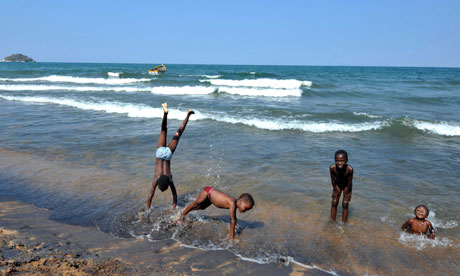
MDG : Malawi children and human trafficking : Children play along the Saga beach, at Lake Malawi
Children play on Saga beach, Lake Malawi. Children have been lured across the border into Tanzania by traffickers. Photograph: Alexander Joe/AFP/Getty Images
Walusungu Msondo was first approached by traffickers while he was fishing at Lake Malawi. "The foreigners were being directed by two local people who could show them where they could find young fishermen. When they found me and my colleagues at the lake, they coaxed us with some money and told us that they had well-paying jobs for us inTanzania," says 10-year-old Walusungu.
The boy and his friends thought their poverty-stricken lives were about to change for the better, but instead it was the beginning of a nightmare. Walusungu lives in Ngala, in Karonga district, on Malawi's border with Tanzania, from where the men had travelled in search of vulnerable children. They said the children would earn good money if they came to fish at Lake Rukwa and Lake Tanganyika, both in Tanzania.
The men explained the arrangements for the trip, but when they instructed the youngsters not to tell their parents, some of Walusungu's friends changed their minds. He decided to go because he thought he could earn good money. They were joined by others who had been recruited by traffickers operating in the Chilumba area, about 35km south of Ngala.
They were ferried across the Songwe river into Tanzania, and taken to Lake Lukwa, which is surrounded by thick forest. It was here that Walusungu realised he had been lied to. There were many other children, some speaking different languages, and the traffickers told Walusungu he had to work nine hours a day catching fish. He was promised only $88 for around 12 months' work. He asked to leave but the traffickers would not allow it. Fishing on the lake can be dangerous, and Msondo says he saw children being eaten by crocodiles, including one of his friends.
Last year the US state department published a report that named Malawi as a source country for men, women and children to be trafficked for forced labour and sex. The authors said the Malawi government does not fully comply with the minimum standards for the elimination of trafficking, but was making significant efforts to do so. In October 2009, the UK's Department for International Development (DfID) allocated around £388,000 to an anti-trafficking project to protect children at risk in Malawi that runs until September 2012. Yet there are fears the problem is escalating.
Local community leaders say some Malawians are collaborating with Tanzanian traffickers and luring young children over the border. Mwirang'ombe, a community leader in Ngala, says he was "deeply shocked". "We have already lost a young man who was caught by a crocodile at Lake Lukwa," he says, adding that he had reported the crime to the government but nothing had been done. "[The] government must do something because human trafficking is illegal."
His views are backed by Habiba Osman, one of the country's top human rights lawyers, who works with the Ecumenical Council of Malawi. She says a lack of a legislation on human trafficking is contributing to the increased prevalence of the crime. "We don't have a human trafficking law in place, so this makes it difficult for the government to actively trace such cases … it's high time we put pressure on our lawmakers to put a human trafficking law in place so that we can address this," she says.
Osman says many children from Malawi are also taken to other neighbouring countries, such as Zambia, Mozambique and South Africa, where they are forced into the sex trade and/or domestic slavery.
Chief Wasambo of the Chilumba police says he knows unemployed young people are being coaxed over the border by Tanzanians. "Most youths are going there due to lack of activities [here] to earn them a living," he says. "The provision of business loans and creation of temporary jobs can positively contribute towards the fight against human trafficking here."
However, Haston Jaji, from the ministry of gender and welfare at Karonga district welfare office, says that although there have been confirmed reports of human trafficking, the number of cases had reduced due to government awareness campaigns.
The campaigns came too late for Chaston Mwafuliwa and Emot Msuku from Karonga district, who ended up fishing at Lake Rukwa along with Walusungu. They too saw people being killed by wild animals and crocodiles, and say others died of cholera due to poor sanitation. They say people had no access to clean water and there was little food.
"There were a lot of problems we were going through at the lake, apart from being financially exploited," says Emot. "Hunger was a big problem. We were sleeping in trees for fear of being caught by wild animals – they were plenty of them."
The boys, including Walusungu, were stranded there for 10 months, and the traffickers refused to pay them. Finally, one of the men drove them to the Songwe border, where he abandoned them. They made it back into Malawi, but Emot says many Malawian children are still in Tanzania.
"I can't go back to school," says Walusungu, "because this [fishing] is my bread and butter, though I am aware that my education is a milestone to a very successful life."
• This article was amended on 18 July 2012. The original said DfID allocated £18,000 to an anti-trafficking project but the scheme ended in March 2010. DfID have confirmed that the information on their website is incorrect.
• Henry Mhango is a correspondent for the International Network of Street Papers

Enhanced by Zemanta

Saturday, March 3, 2012

Little being done to counter rampant trafficking of Burmese into fishing industry - The Nation

Little being done to counter rampant trafficking of Burmese into fishing industry - The Nation

SAMUT SAKHON

Pravit Rojanaphruk
The Nation
Samut Sakhon

SAMUT SAKOHN: -- Labour exploitation, human trafficking and bondage of migrant workers from Burma continues in Samut Sakhon's shrimp-processing factories and onboard trawlers despite the passing of an anti-human-trafficking law nearly four years ago, said Sompong Srakaew, founder and director of Labour Rights Promotion Network Foundation (LPN).

Exactly how many workers are trapped in bondage inside shrimp factories or lured and forced to work on deep-sea fishing trawlers is unknown. But, Sompong, who worked in this area for eight years, estimates about 30 per cent of the 400,000-plus Burmese workers in the province are exploited beyond Thai laws.

Bosses confiscate work permits, temporary passports and identity cards so that Burmese in fish-processing factories cannot seek employment elsewhere. Worse still, some are held in small factories and not allowed to leave the compound and forced to work like slaves.

Young migrant men are also being trafficked into forced labour aboard deep-sea fishing boats via false documentation with the aid of corrupt Thai officials and police.

"It's hard to pin down the figures by making an estimate," Sompong said. "But they are definitely there and they end up as virtually slave labour."

In November 2009, two employers at Anoma shrimp-processing factory were charged with forcing 73 foreign workers including 25 children to be "slaves", working from 2am until 8pm every day. This was among other abuses that according to the local police inquiry report included "keeping them in slave-like conditions… confining of people [including] women and children by means of threat or use of force to achieve their consent to allow him/herself or others to exploit them…"

While the two employers were eventually sentenced to eight and five years, they are now out on bail fighting their conviction in the Appeal Court while many workers cannot afford to spend time to follow the case.

Even Thai men have been forced to work on fishing trawlers. The Mirror Foundation's Anti-Human Trafficking Centre published a report last year that said there had been 83 recorded cases of Thais aged between 14 to 55 tricked or abducted to work on fishing boats in Thai waters and beyond.

Sompong believes the Thai government isn't doing enough to warn Thai and migrant workers of the danger of these industries. He said even signs warning job-seekers at busy transport hubs like Mor Chit Bus Terminal put up by Mirror Foundation have been removed.

"Thais want to tell ourselves that no human trafficking exists. If they admit it, they fear it will be bad for tourism."

Sompong said the government should run a vigorous and visible campaign to warn job-seekers, both Thai and foreign, about the danger of human trafficking and forced labour at transport hubs such as bus and train terminals and also petrol stations. He said unlike the very visible anti-drug billboards, no such campaign has been run in Thailand to date.

Once people are inside factories or on-board ships, very little can be done to help them. Those on boats face a life-threatening work environment, while those detained inside prison-like factories cannot seek help. "Some are detained and cannot come out to call for help."

But Sompong said formal recognition of job-brokers by the government may help reduce the number of people duped into virtual bondage, as only half of the estimated 100 to 200 job-brokers were reliable and trustworthy.

Burma also needed to do more, he said. For the eight years he has been trying to protect migrant workers from Burma, the Burmese Embassy in Bangkok had never sent anyone to speak to him or ask for his advice or collaborate on any project.

"They have never sent anyone here," he said.

Sompong said he took a group of Chulalongkorn University graduates to some factories in Samut Sakhon two weeks ago. But they only saw high walls and fences that looked like prisons from the outside. And no one could enter.


-- The Nation 2012-02-28
Enhanced by Zemanta

Thursday, September 30, 2010

Modern-day slavery: horrific conditions on board ships catching fish for Europe | Law | The Guardian

Exclusive: Crews marooned at sea off Africa found in squalor, with cardboard bunks, 18-hour shifts, and payment in fish

The ships are crewed by untrained, illiterate workers housed in dismally unsafe and unhygienic living conditions Link to this video

When environmental campaigners began tracking a hi-tech South Korean trawler off the coast of West Africa, they were looking for proof of illegal fishing of dwindling African stocks. What they uncovered was an altogether different kind of travesty: human degradation so extreme it echoed the slavery they thought had been abolished more than a century ago.

"It was horrendous," said Duncan Copeland, a senior campaigner at the Environmental Justice Foundation, who boarded the South Korean-flagged trawler at the end of 2008 with naval forces from Sierra Leone.

"The men were working in the fish hold with no air or ventilation in temperatures of 40-45 degrees. It was rusty, greasy, hot and sweaty. There were cockroaches everywhere in the galleys and their food was in disgusting boxes. All they had for washing was a pump bringing up salt water. They stank. It was heartbreaking."

As their investigation continued, the EJF found vessel after vessel, some up to 40 years old, rusted and in terrible repair, engaged in pirate fishing – an illegal trade that damages already fragile marine stocks and exploits human labour in shocking conditions.

The 36 crew members on the boat boarded by Copeland came from China, Vietnam, Indonesia and Sierra Leone. Eight men shared a tiny windowless area of the fish hold with four cardboard "bunks" resting on planks. Four worked in the hold sorting and packing fish for the European market while four slept, and they would alternate, literally rolling out to allow the next to roll in.

The Sierra Leonean crew members said they were not paid with money but in boxes of "trash" fish – the bycatch rejected by the European market – which they would be given to sell locally. If anyone complained, the captain would abandon them on the nearest beach, they said.

"The conditions aren't good, but we can't do anything about it," a worker on another South Korean-registered ship told investigators. "We live with it, because it is hard to find work. If someone offers you a salary of $200 to support your family it's not good, but we have to live with it."

In May, about 150 Senegalese men were found labouring in a ship off Sierra Leone; working up to 18 hours through the day and into the night, eating and sleeping in spaces less than a metre high. The vessel carried a licence number for importing fish to the EU, showing it had passed apparently strict hygiene standards.

EJF also found several apparently redundant trawlers out at sea still with crew on board, some of whom had been there more than a year with no radio or safety equipment.

"I was sent here by the company," said one fisherman on a trawler off the coast of Guinea. "The company sends a boat with supplies to bring me food like fish and shrimps. Nobody wants to come here."

The fishermen's tales reveal the human toll of pirate fishing, a business thought to produce a catch of at least 11m tonnes of fish a year worth more than $10bn (£6.3bn).

Pirate fishing ship quarters Living quarters inside one of the pirate fishing ships. Photograph: EJF

Vessels often stay at sea for months on end, with reefers coming alongside every couple of weeks to unload the catch and resupply them. As they operate in remote waters, they can avoid detection for long periods. The crew are effectively imprisoned, most cannot swim and many of those interviewed by EJF meet the UN definition of forced labour. Reports of violence, withholding of pay and retention of documents are common, said Copeland.

The investigators found a crew of 200 Senegalese operating off Sierra Leone in 2006. The men were living in a makeshift structure built on the stern of the ship, divided into four levels with barely a metre of headroom and cardboard packing boxes crammed together to serve as mattresses.

The ship did not appear on the official list of vessels licenced to fish in Sierra Leone at the time of sighting. Records show that it has visited Las Palmas in the Canary Islands, which is the largest landing point for west African fish into Europe and has been criticised by senior EU officials for its lax inspection regime.

But the investigators' original interest in fish stocks also produced worrying evidence.

Several of the vessels boarded by EJF are bottom trawlers, licensed to import to the EU, catching high value fish such as shrimp, lobster and tuna. Bottom trawlers drag heavy chains across the sea bed, scraping up everything in their path including coral. In one case, the boat had been dumping more than 70% of its catch overboard, including sharks – once the fins had been removed for the Asian market.

The vessel's owner had been putting its Senegalese crew out to sea in small boats to bring in tuna and shark to sell as caught by "hook and line, having first identified fishing targets with global positioning software. Many of the Senegalese were fishermen unable to sustain a livelihood in their own waters because stocks have been decimated by overfishing by hi-tech trawlers.

The EJF believes most illegal fishing is carried out by ships flying flags of convenience. Under international maritime law, the country where a ship is registered is responsible for its activities. Some countries allow vessels of other nationalities to register with them for a few hundred dollars and are known to ignore offences.

Pirate vessels can re-flag several times a season and frequently change their name. They are often backed by shell companies, which makes their real owners hard to trace and law enforcement extremely difficult. The maximum fine for illegal fishing is around $100,000, which is typically less than two weeks' profit from the trade, according to EJF.

The South Korean captain, first mate and engineer of one of the ships were arrested by the Sierra Leone navy and fined $30,000 plus their catch for fishing in the country's inshore exclusion zone. The same ship was however spotted in August, fishing again off the coast of Sierra Leone and Liberia according to EJF.

All at Sea, the Abuse of Human Rights aboard Illegal Fishing Vessels, EJF. www.ejfoundation.org

Does illegal fish make it to UK?

Deciding whether the fish on your plate is from an illegal catch from west African waters remains difficult, but it should be getting easier after a crackdown in recent months by the British and European authorities.

Under an EU regulation brought in this year, it is forbidden to import fish into the member states unless it has been certified as legal by the flag state of the vessel. That means if a ship sails under a Spanish flag, Spain has to certify the catch as legal. Campaigners believe the problem remains that some countries, including South Korea and China, are not effectively policing fishing vessels using their flags.

Investigators believe pirate fish are "laundered" – packed in boxes with the stamp of a licensed fishing boat. During checks in 2006 and 2007 the Environmental Justice Foundation found west Africa-caught denton, commonly sold in the UK as snapper or sea bream, in London fish markets. Some boxes of frozen denton carried the logo of a Chinese company that operates many of the illegal fishing vessels the EJF had observed operating in Guinea. The problem of pirate fish reaching the plate is thought to be greater for consumers in southern Europe, which consumes the bulk of west African fish, shrimp, prawn and lobster.

SOURCE: guardian.uk.com

Modern-day slavery: horrific conditions on board ships catching fish for Europe | Law | The Guardian
Related articles by Zemanta
Enhanced by Zemanta

Wednesday, September 8, 2010

Masters of the Sea

FROM THE IRRAWADDY

By KYAW THEIN KHA


Wednesday, September 08, 2010


Burmese migrant laborers sort fish at a market in Phuket, an island in Thailand better known for its upscale resorts. (Photo: AFP)

Thailand is one of the world’s major fish-exporting countries, but it is Burmese fishermen who keep the industry alive

Aung Than is no ordinary fisherman. At 33, he is already a veteran of the seas. His years of hard work and commitment to his job have earned him the position of “yay shuu,” or master, of the Thai-owned vessel on which he and his fellow Burmese crew members make their living in the Andaman Sea.

As the most experienced and highly qualified member of his ship’s crew, he earns 10,000 baht (US $310) a month—about three times the basic salary of a Burmese fisherman working in Thailand, and 10 times what he would make in his native Burma.

Thailand’s fishing industry is kept afloat by a massive influx of migrant labor from neighboring Burma. Both on the ships and in the fish-processing plants, Burmese make up the majority of workers, doing jobs shunned by Thais. Fishermen are in especially high demand, working long hours for low wages, often risking life and limb to keep consumers around the world supplied with seafood.

Not surprisingly, human trafficking is rife in this industry, and reports of horrific abuses are common. But not all Burmese who find themselves aboard a Thai fishing vessel consider themselves victims of exploitation.

Aung Than (not his real name) has worked as a fisherman in Thailand for 10 years. He says he sends money back to his mother and sister in Burma and hopes to save enough to buy his own boat so he can return home someday and work for himself.

He now lives in the village of Ngan Yong, in Phang Nga Province’s Khuraburi District. The village is home to an estimated 5,000 migrant workers from Burma—most of them members of the Mon and Dawei ethnic groups. Aung Than is originally from Tavoy, or Dawei, the capital of Burma’s Tenasserim Division.

According to Thailand’s National Statistics Organization, there are around 7,600 registered Burmese migrants working on the country’s 4,000 legally operating fishing vessels. But these figures do not take into account the large number of unlicensed fishing boats in Thai waters, or the thousands of Burmese migrants employed without proper documentation.

With so much competition, it’s not easy to become a master fisherman.

“You must work very hard and show total commitment,” said Aung Than. “If you make an impression on your boss and earn his trust, he will promote you to yay shuu.”

It took six years of “proving himself” as an ordinary crew member before Aung Than was finally deemed worthy of earning $10 a day. And now that he has reached the pinnacle of his profession, he is expected to earn every baht that he is paid—supervising his crew, making sure they’re mending their nets properly when they’re on shore and using them to maximum effect when they’re at sea.

A yay shuu must know the sea as well as the most seasoned sailor. He is completely responsible for the safety of his crew and—more importantly from his employer’s perspective—the condition of his ship, which he must be able to operate in all kinds of weather.

Aung Than recalled one night when high winds created huge waves that lashed his boat. Some of his crew could not swim and many feared for their lives.

“But my own greatest fear was that our boat would be capsized by a wave and sink to the bottom of the sea,” he said.

“It is very dangerous work,” he added. “Many fishermen have lost their lives trying to make a living this way.”

In addition to their basic salaries, many fisherman receive bonuses based on the value of their catch. These are usually paid out once a month or once every six months, depending on the size and type of boat.

“I get paid 3,000 baht a month, but in a good month, I can earn double that,” said Kyaw Linn, one of the regular crew members on Aung Than’s boat. He said he had no idea how his bonus was calculated and had no choice but to accept whatever amount his Thai employer said he was owed.

Kyaw Linn’s job is to go out in a small boat equipped with a bright light in search of fish for the main boat to catch. The fish are attracted to the light, and when enough of them start to appear, Kyaw Linn contacts the main boat. Aung Than then decides if it’s worthwhile putting down their nets.

“We don’t fish for a few nights before and after the full moon,” he said. “The fish don’t follow our boat because all they can see is the moonlight shining in the water.”

In some ways, these Burmese fisherman are like the fish they catch, always looking for a brighter future. Most say they want to return home someday, but they know that their prospects for earning a living there are bleak.

“I’ll go back to Burma when I can make the same amount of money there as I can earn in Thailand,” said Aung Than.

“But that’s not possible yet, so I must think of the sea and our fishing boat in Thailand as my home.”

Masters of the Sea
Enhanced by Zemanta

Monday, August 2, 2010

Burmese 'Trafficked' To Thailand

2009-11-04

Burmese migrant workers fall prey to traffickers with the promise of work in Thailand.

AFP

Burmese migrant laborers repair a fish net at a fish market on Phuket island in Thailand, July 21, 2009.

BANGKOK—Burmese migrant workers in Thailand have described paying large fees to human traffickers who promised them jobs in the southeast Asian kingdom, only to sell them into forced labor on arrival.

One Burmese migrant from Myawaddy currently in the care of social services in Bangkok said he had been promised passage to Thailand and a job in the construction industry by a Burmese named Ko Sein Aung.

"He was the carrier who handed us over to the person taking us across to Thailand along the illegal route. We had to pay him for that. It was 2,000 baht (U.S. $60)," the worker said.

"He told us we would get a job in construction. He said we would earn 195 baht (U.S. $6) a day. We were all sold off including me for 22,000 baht (U.S. $658) each to the fishing industry."

He said people in charge of the boats locked up the workers every night, before taking them back to the boats the next morning. They were not paid for their work.

"Every day when the boat we were working on reached the jetty and after we had unloaded the fish at night we were taken to our rooms and kept there, and the door locked from the outside," he said.

"That was how we were detained. The next day only when the fishing boat is due to leave were we sent to the boat."

Forced to migrate

Currently, Thailand is home to an estimated 2 million Burmese migrant workers, of whom only around half are there legally.

Burmese workers are highly visible in and around Bangkok and near the Central World Plaza, and Burmese children under 10 years old can be seen selling food on street stalls.

Many of the migrants say they were forced to move because of extreme poverty back home.

An ethnic Karen migrant from the troubled border area between Thailand and Burma said some of the trafficking was being carried out by the Democratic Karen Buddhist Army (DKBA), which recently made a ceasefire agreement with Burma's military government.

"It was Ko Than Win from the DKBA who told us that he would find us work in Thailand. We had to pay him 15,000 kyat (U.S. $2,304)," the Karen migrant said.

"He took us to Bangkok. He said he would give us a good job in the shrimp industry. We had to wait 10 days along the way," he said.

"We were hungry. We were just given plain rice with nothing else."

Help for refugees

Some of the migrants are being taken care of by social services in Thailand after reporting beatings and other physical abuse after being sold off as slave labor, Thai officials said.

"There are a total of 47 Burmese nationals with us here," an official at the Patuhtani social welfare and rehabilitation department of the Thai government identified as Mr. Suwan said.

"We have arranged food and accommodations for them and are helping them with their rights and claims for damages," he added.

The group included men, women, and three 15-year-old children, according to a Thai lawyer surnamed Sriwun who is helping the refugees.

"Our lawyers’ group is helping refugees who have been treated unjustly, no matter what nationality they are," he said.

He said the Thai authorities had arrested a Burmese woman and two Thai nationals in connection with the allegations of human trafficking.

According to Mr. Suwan, the case could take up to 18 months to bring to trial.

The Myawaddy migrant said he was discovered by an aid group while working on the fishing boat. He had already been beaten following on escape attempt, he added.

"After we were caught they put me back in my room and beat me," he said. "A woman beat me with a two-yard pipe that she always carried. She beat me continuously. She also threatened to kill my father."

Trafficking hub

According to the U.S. State Department's latest Trafficking in Persons Report, Thailand is a source, transit, and destination country for men, women, and children trafficked for the purposes of forced labor and commercial sexual exploitation.

"Women and children are trafficked from Burma, Cambodia, Laos, the People’s Republic of China, Vietnam, Russia, and Uzbekistan for commercial sexual exploitation in Thailand," the report said, saying the trafficking victims were usually from poorer rural areas who were attracted by the kingdom's relative prosperity.

But it lauded efforts by the Thai government to address the problem, including the expansion of a network of temporary shelters for trafficking victims from 99 to 138, with at least one temporary shelter in each Thai province.

The Thai government refers victims of trafficking to one of eight longer-stay regional shelters run by the Ministry of Social Development and Human Security (MSDHS), where they receive psychological counseling, food, board, and medical care, the report said.

In 2008, Thai government shelters provided protection and social services for at least 102 repatriated Thai victims and 520 foreigners trafficked to Thailand.

Original reporting by Nay Rein Kyaw for RFA's Burmese service. Director: Nancy Shwe. Translated by Soe Thinn. Written for the Web in English by Luisetta Mudie. Edited by Sarah Jackson-Han.

Burmese 'Trafficked' To Thailand
Enhanced by Zemanta

Monday, June 14, 2010

How Internet Rumors Might Save Thai Fishermen | End Human Trafficking | Change.org

END HUMAN TRAFFICKING

By Amanda Kloer

April 18, 2010
09:00 AM (PT)


There's a rumor going around the water cooler at Thai export officials central: it's time to crack down on child and forced labor in the frozen fish industry, because otherwise the U.S. is going to stop buying our products. I've not been able to corroborate the rumor that the U.S. is finally getting serious about an import ban on goods made by children and forced labor. But that's okay, because the Thai officials believe it, and that means they're cracking down internally on some of the worst offender producers of slave-made exports to the U.S.: frozen fish.

If you've enjoyed a fish stick in past few years (a school cafeteria-themed party recently broke my fish stick fast), then chances are you've eaten fish caught and processed in Thailand. The frozen shrimp industry, as well as other frozen food products have come under heavy fire from international human rights groups for exploitative labor practices, like child labor and slavery, and poor treatment of workers. The industry employs huge numbers of migrant laborers, many of whom are not paid legal or livable wages, and some of whom are trafficked. Overall, 22% of Thailand's exports go to the U.S., and frozen seafood is a huge part of those exports. A U.S. ban on goods made with forced or child labor would certainly force Thailand to clean up their fishing industry.

But the interesting part of this story is that Thai officials are taking action not because of an actual ban, but because of reports that a ban may be put in place. This could be an indication that the U.S. doesn't really need the tough-to-pass policy that would seriously reform our import system, but just the impression that those changes are moments away. Sure, an actual ban on goods made by child and forced labor would be ideal, but that is going to be hard to get in today's economic and political climate. A rumor might work just as well in accomplishing what we want to accomplish — getting the producers of products shipped to the U.S. to treat workers better.

Thursday, May 27, 2010

Human Traffickers Target Young Cambodian Men for Fishing Industry | Asia | English

Market in CambodiaImage via Wikipedia

Robert Carmichael | Phnom Penh 26 May 2010

Thai fishing boat (file photo)Photo: Photos.com

Women and children are commonly believed to be the main targets of human traffickers. But in Cambodia, scores of men have recounted stories of modern-day slavery on board Thai and Malaysian fishing boats.

Manfred Hornung, a legal adviser with the Cambodian human rights group Licadho, says that although figures are very limited, it is possible thousands of Cambodian men have been trafficked onto regional fishing boats in recent years.

The group has interviewed more than 60 men who were trafficked onto Thai fishing boats since 2007. Their stories typically begin the same way.

"Normally these young fellows are approached by a local broker who works through connections in a commune or a village and approaches a group of young males to convince them to go to Thailand," said Hornung. "So, in most cases this broker won't tell these youngsters that they have to work on a fishing boat."

Instead they are promised jobs in construction or on plantations, then smuggled into Thailand. According to Hornung, once there, some are taken to a fishing port, where they are locked in guesthouses and eventually sold to fishing boat captains.

Conditions on the worst boats amount to nothing less than slavery said Hornung. And the young men have few ways to escape since the captain and Thai crew are often armed.

Victims say they get two or three hours sleep each day, are beaten and drugged to keep them working. Human rights advisor Hornung has heard reports that men who fell ill were thrown overboard.

Declining fish stocks close to land mean many boats spend months at sea, docking only with mother-ships to unload their catch. That makes escape impossible.

"In a current case, we have one person who stayed consecutively for three years on a boat without seeing land," said Hornung. "He was basically sold on the high seas from boat to boat over a three-year period. And these cases are not infrequent."

Hornung estimates the range of time people are enslaved on boats runs anywhere from three months to several years. And he adds none of the 60 men the group Licadho interviewed received any pay for their work.

Experts say Cambodia's poverty drives most of the trafficking in the country.

Louise Rose, a victim protection officer for The Asia Foundation, says a survey of 258 Cambodian men - most of whom worked on foreign fishing boats - found that debt had driven half to seek work abroad. But two other factors were even more significant.

"Lack of food was a huge one," said Rose. "Three-quarters of the men reported not enough food being a motivator for migrating. And the other one that was even higher again - no source of income. That was about 78 percent."

One in five of the men in the Asia Foundation survey said they had worked in slave-like conditions on Thai and Malaysian fishing boats.

Thailand's multi-billion dollar fishing industry demands a supply of cheap labor. And the stories of some Cambodian men indicate unscrupulous agents and ship owners are prepared to meet that need in any way possible.

Anti-trafficking groups say the solution is for regional governments to work harder to protect migrant workers and to prosecute those guilty of abuses.

But that is not happening. In Cambodia, activists say, the laws against trafficking are weak, and until the laws and law enforcement improve, many young men here will remain at risk of forced labor abroad.

LISTEN

Human Traffickers Target Young Cambodian Men for Fishing Industry | Asia | English


Reblog this post [with Zemanta]

Monday, May 24, 2010

Former child slave fights to end trafficking in Ghana - CNN.com

Sankor, Ghana (CNN) -- A former child slave is rescuing victims of child trafficking in Ghana and has built a school to help give them a better future.

Once a child slave himself, James Kofi Annan is turning what would be a crippling experience for many into a drive to stamp out child trafficking.

Annan quit his promising job at Barclays Bank to open Challenging Heights School. At any time his school has several dozen former child slaves, mixed in with 300 other students.

"Every child must go to school," Annan told CNN. "Nobody is free until every child has received at least a basic education. You are free because you are educated, I am free because I am educated."

Annan buys back children from slavery and educates them at the school in Sankor, right in the middle of an area known for children being sold by their parents.

In Ghana it is common for parents to send their children to apprentice with a relative to learn a skill. But sometimes the children will end up caught in slave labor.

Other parents knowingly sell their children to fishermen to wrangle fishing nets 17 hours a day.

Typically, the parent sells the child for the equivalent of $50. Then the trafficker sells or leases the child for about $300, making $250 dollars a year per child.

Benjamin Tornye calls himself a former trafficker; at one time he bought children from parents and used them on his fishing boat.

Tornye told CNN, "I employed them to dive into the nets whenever there is a problem like the nets getting stuck. I had them free it when it is necessary."

He says he bought 10 children in the time he was a fisherman, which could have earned him about $2500, well above the typical rural income.

Slave-owning fishermen say their nets are easily damaged, have small holes, and catch small fish. They believe little fingers and small bodies are the best to deal with those challenges, whether underwater or on land. And they can put 10 children on a boat, where only five adults would fit.

Some argue that without child labor their catch would cost more, which would endanger their livelihood.

The government has been trying to tackle the problem. Estelle Appiah, of the Ghanaian Ministry of Justice, said new regulations for fishing-net sizes have just been drafted.
You have to alleviate poverty, which is a root cause often of human trafficking.
--Estelle Appiah

She added that in the last five years two laws dealing with child trafficking had been passed that meet international conventions.

But her experience also makes her pragmatic. "Enacting legislation is not a panacea," Appiah told CNN.

"You also have to educate people that the laws are there to protect them, you have to give them reasons, and you have to alleviate poverty, which is a root cause often of human trafficking. So the law itself is not going to cure the situation."

But for some children sold as slaves into the fishing industry, the scars of forced labor are not just emotional.

Joshua is one of the children Annan has saved from slavery. He has scars where he was hit depending on his so-called mistakes. Scars on the side of his body, because he could not dive as deep as 20 meters, and on the head, for throwing nets the wrong way, he told CNN.

Annan himself says he still struggles for normalcy, more than 20 years after escaping from the fishing villages.

"A few things remain unresolved, but some things are so private it is difficult for one to narrate them," he said.

"Once I'm able to pour them out and lead the team to get more children to be liberated, then I'm on my way to be healed."

Annan has, however, recovered to the point where he sees his former abusers as potential allies, although many of them have already died.

"I wish they could be alive to help change the situation," he told CNN. "I wish they could be advocates, because some of the traffickers of my time are now advocates for us."

Annan has hope and he is driven -- ready to sacrifice his job and career again, with only one goal in front of him now.

"The wrong in society has to do with the impoverishment of children, exploitation of children, putting children in slavery and in child labor," he said.

"We must resolve this issue, then I can go back to my business. Otherwise we will fight and fight until every child has received this justice."

Former child slave fights to end trafficking in Ghana - CNN.com


Reblog this post [with Zemanta]