Amy Costello speaks with filmmaker Mimi Chakarova about her powerul film, exposing the shadowy world of sex trafficking from Eastern Europe to the Middle East and Western Europe. Filming undercover and gaining extraordinary access, Chakarova illuminates how even though some women escape to tell their stories, sex trafficking thrives.
Monday, May 26, 2014
Q&A: The Plight of the UK’s Migrant Domestic Workers | Human Rights Watch
By: Izza Leghtas
Wealthy families who come to the UK may bring with them domestic workers who work for them in their home country – often women who raise their children, clean their homes and cook their meals. In a move to cut down on immigration, two years ago the UK tied domestic workers’ visas to their employer. But in forbidding these women to change employers, even in abusive circumstances, this policy has the unintended consequence of forcing some women either to endure terrible situations or to go underground. The UK has pledged to combat “modern day slavery,” and this week, as part of this effort, a special parliamentary committee is calling on the government to change this visa policy. For her report on abuses against migrant domestic workers in the UK, “Hidden Away,”Human Rights Watch researcher Izza Leghtas took on the difficult task of finding these elusive women and reporting their stories."
Continue here:
http://www.hrw.org/news/2014/04/08/qa-plight-uk-s-migrant-domestic-workers
Sunday, May 4, 2014
Rights activists say Vietnamese trafficking victims forced to grow marijuana in Europe
Author: Rachel Browne
TORONTO
(Thomson Reuters Foundation) - A Vietnamese grandmother doing time
in an Irish prison is the face of a recent trend in human trafficking,
human rights activists say.
Continue here:
http://www.trust.org/item/20140429075926-kw73l/?source=hptop
Related articles
Thursday, January 9, 2014
Hospitality, Agriculture Firms Vulnerable to Human Trafficking - Inter Press Service
WASHINGTON, Jan 3 2014 (IPS) - Shareholders are calling on 15 U.S.-based multinational corporations to ensure that their global supply chains are not facilitating human rights abuses, particularly labour and sex trafficking.
Continue here:
http://www.ipsnews.net/2014/01/hospitality-agriculture-firms-vulnerable-human-trafficking/
Agricultural Sector Companies Face Increased Scrutiny On Human Rights-Related Risks - Corporate/Commercial Law - United States
Agricultural sector companies, and companies with large agricultural supply chains, face new scrutiny from investors and other stakeholders concerning human rights-related risks in their corporate supply chains. Key issues for this sector include the risks of human trafficking and forced labor and the potential for suppliers to be complicit in land grabs which displace vulnerable populations.
Continue here:
http://www.mondaq.com/unitedstates/x/284242/Corporate+Governance/Agricultural+Sector+Companies+Face+Increased+Scrutiny+On+Human+RightsRelated+Risks
Related articles
Wednesday, January 30, 2013
Finnwatch reveals serious human rights violations behind European food brands
Source: Finnwatch
Luotu 20.01.2013
+358 40 410 9710
Tuesday, December 18, 2012
Top Ten Business and Human Rights Issues 2013 - Business and Human Rights Issues
Source: Institute for Human Rights and Business
The 2013 Top Ten List of Business and Human Rights Issues was published by the Institute for Human Rights and Business (IHRB) on International Human Rights Day, 10 December 2012.
For an elaboration of each of the ten issues listed below, go to:
http://www.ihrb.org/top10/business_human_rights_issues/2013.html
Note: These ten issues are not ranked in order of importance.
1. Embedding respect for human rights across all business relationships
2. Expanding action to combat forced labour and human trafficking
3. Tackling challenges of dual-use internet-based technologies that may undermine privacy rights and freedom of expression
4. Advancing uptake of the UN Guiding Principles in key enabling sectors including finance, ICT and infrastructure
5. Leveraging government as an economic actor through public procurement policies that ensure respect for human rights
6. Renewing efforts to protect lives in the work-place
7. Mitigating the ‘resource curse’ by preventing negative human rights impacts of oil and gas exploration
8. Linking respect for human rights to calls for greater transparency in lobbying by businesses
9. Ensuring responsible investment in conflict-affected and 'high risk' areas
10. Addressing the impacts of land and water grabs linked to transport, fishing, security, mineral extraction and other sectors
Wednesday, November 14, 2012
Anti-Trafficking Review Call for Papers
Source: UNGIFT

The
Anti-Trafficking Review
calls for papers for a Special Issue 'Human Rights at the Border'.
- Deadline for submission: 31 December 2012
- Word limit on articles: 4,000, including footnotes and abstract
Wednesday, March 7, 2012
The Price of Sex | Human Rights Watch Film Festival
The Price of Sex
Thursday, December 22, 2011
Rev. Seamus P. Finn, OMI: Human Rights Day 2011: New Advocates?
Rev. Seamus P. Finn, OMI
12/20/11 01:53 PM ETA new important framework and tool has been added to the human rights tool kit as we celebrate Human Rights Day in 2011. In June this year the U.N. Human Rights Council, in Geneva, formally endorsed the Guiding Principles on Business and Human Rights. This represented the conclusion of the mandate given in 2005 by U.N. Secretary General, Kofi Annan, to the Special Representative for Business and Human Rights, Professor John Ruggie -- a mandate characterized by some as an important step forward in the design of a regulatory framework for globalization. The development and endorsement of these principles is also consistent with the recognition of the ever expanding reach and deepening influence that corporations have on the lives of communities and individuals across the world.
The principles were developed to offer guidance for the implementation of the "Protect, Respect and Remedy" framework, which was first introduced by the Special Representative in 2008, and to provide very practical and concrete recommendations on how to operationalize the framework. The framework was built around the following three central pillars:
- States have a responsibility to protect against human rights abuses by third parties, including corporations;
- Companies have a responsibility to respect human rights;
- Victims of human rights abuses must be free to access effective remedies.
The framework and principles break new ground both substantively and through the open and transparent process that was followed by those who guided the project. The commitment to the production of guiding principles that are responsive to the interests and perspectives of numerous stakeholders is always difficult to fulfill. When this effort is undertaken within a global horizon that aspires to include a range of industry sectors, corporate enterprises and numerous interested stakeholders, it is both ambitious and daunting.
The guiding principles break new ground when they explicitly clarify the responsibility that corporations have concerning human rights and where they enumerate a number of specific requirements that flow from that responsibility. One of those requirements is that companies "seek to prevent or mitigate adverse human rights impacts that are directly linked to their operations, products or services by their business relationships, even if they have not contributed to those impacts."
In the vernacular, this benchmark is often referred to as "supply chain management." It applies to all corporations and includes both a list of issues and challenges that investors and other stakeholders have helped to identify and monitor in recent decades. This began when stories and concerns about the wages and working conditions in the manufacturing facilities of major multinationals, especially in developing countries, were exposed and they were being pressed to respond by assessing the liabilities that existed in their global footprint. It has evolved to include working conditions in agriculture and commodity operations, especially mining and energy explorations, as well as the impacts that any such operations have on local communities and regions.
Many companies identified and accepted their responsibilities in the environmental arena and were pressed to set out both clear benchmarks and aggressive strategies to address those challenges. These have ranged from measuring carbon footprints to routine recycling and energy saving measures, to adoption of green building standards and certifications.
However, in the human rights arena designing strategies and responses to both identify and address the various issues and challenges that exist in their supply chain was never going to be as easy.
Among the general areas of supply chain management that faith-based and socially responsible investors have identified and encouraged companies to consider are the following: mapping of supply chain exposures, identifying and prioritizing risks in their supply chain and the development of a process to monitor and certify supply chain compliance and security. This includes a clear mapping of all the suppliers, vendors and partners that are part of the manufacturing process or the service delivery that a company offers. Only this level of management will be successful in providing the kinds of assurances that investors, customers and other stakeholders are asking for.
Specific issues, in the human rights arena, that are priorities under the areas identified above include those contained in the United Nations, International Bill of Human Rights and codified in the International Covenants. Practically, these include commitments on living wages and benefits, safe working conditions, child and slave labor criteria, respect for freedom of association and the eradication of human trafficking.
The vision, framework and guiding principles that have been developed over the last six years and offered to governments, corporations and stakeholders will be an invaluable tool for increased collaboration by all who are committed to protecting and promoting human rights and providing new remedies for those whose rights are threatened or abused.
Friday, August 26, 2011
Survivors of Human Trafficking - YouTube
Uploaded by UNOHCHR on Jun 7, 2010
Survivors of human trafficking tell their personal stories.
Victims of trafficking say their rights should be placed at the centre of actions to prevent human trafficking.
They were speaking at an event of the UN Human Rights Council's 14th session, titled: "Giving Voice to the Victims and Survivors of Human Trafficking."
Source: UNOHCHR
Related articles
- ATEST/CNN Forum on Human Trafficking on Vimeo (trafficking-monitor.blogspot.com)
- BBC News - Four arrests and six rescued in Belfast human trafficking probe (trafficking-monitor.blogspot.com)
- Hard to put numbers on human trafficking in Canada, Calgary GlobalFest panel agrees (trafficking-monitor.blogspot.com)
- Civil Society supporting victims of human trafficking | Twin Cities Daily Planet (trafficking-monitor.blogspot.com)
- 114,886 sign petition to UN against human trafficking (trafficking-monitor.blogspot.com)
- India's journey of hope: UNODC showcases inspiring initiatives to fight human trafficking (trafficking-monitor.blogspot.com)
Monday, August 22, 2011
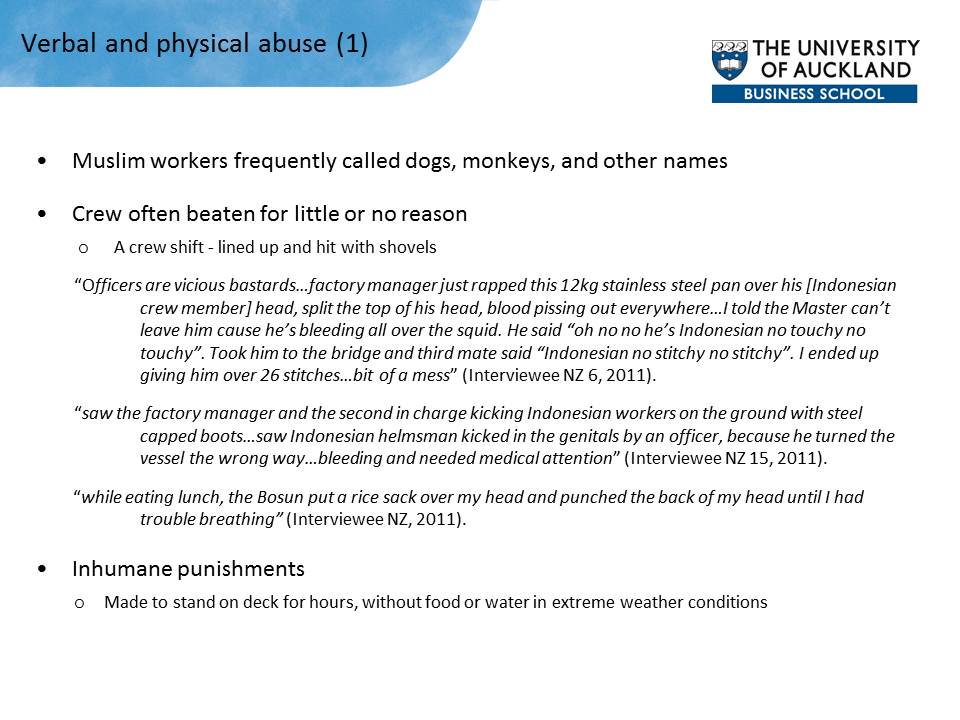
Not in New Zealand's waters, surely? Labour and human rights abuses aboard foreign fishing vessels
http://www.stuff.co.nz/sunday-
http://www.theaucklander.co.
http://www.stuff.co.nz/
trafficking-monitor.blogspot.com/2011/08/fishing-report-released-on-foreign.html
Saturday, April 23, 2011
Human Rights USA: Human Trafficking Lawsuit to Move Forward; Judge Denies Motion to Dismiss
Thursday, April 21, 2011
A federal judge has denied a motion to dismiss claims in a lawsuit by 18 survivors of human trafficking against Star One Staffing, Inc. and some of its officers and employees. Yesterday’s decision clears the way for the survivors’ claims of human trafficking, forced labor, and racketeering to move forward in the court.
As set out in the complaint filed last year in the U.S. District Court for the Southern District of Florida, the defendants recruited the plaintiffs from the Philippines and the United States using fraudulent visa applications, false promises, and misrepresentations to induce the plaintiffs to work for the defendants in the United States. Once employed by defendants, plaintiffs were compelled to live in severely crowded housing and to work long hours in country clubs and hotels in Florida and New York. To ensure that the plaintiffs complied with their demanding work schedules, plaintiffs were threatened with arrest, imprisonment, deportation, cancellation of their visas, loss of work, lawsuits, and blacklisting. The defendants also failed to pay the plaintiffs their legally-required wages, deducting exorbitant fees from the plaintiffs’ pay for insufficient food, overcrowded housing and transportation. As a result of this campaign of fraud and coercion, the plaintiffs remained in fear and believed they had no choice but to obey their orders and continue working.
The plaintiffs are represented by Human Rights USA, the International Human Rights Clinic of The George Washington University Law School, and Gregory Schell of Florida Legal Services.
Allison Lefrak, Human Rights USA’s Litigation Director and one of the attorneys for the 18 plaintiffs, said "Judge Ryskamp has agreed that our clients have raised serious allegations of forced labor and human trafficking, and has vindicated their right to pursue those claims under the Alien Tort Statute and RICO. In a significant victory for our clients, the court will now carefully examine the defendants' actions."
The defendants argued that one of the main tools for human rights litigation in U.S. courts, the Alien Tort Statute (ATS), only applies to human rights violations that occur outside the United States. The court rejected this argument, upholding the rights of survivors of human rights abuses to bring forward claims regardless of whether the harm took place inside or outside U.S. borders. Recognizing the gravity of abuses that can be inflicted on workers by their employers, Judge Ryskamp stated in his decision that there is "no doubt that human trafficking and forced labor violate specific norms accepted by the civilized world."
The lawsuit - Magnifico, et al. v. Villanueva et al., 10-cv-80771 - is pending before the U.S. District Court for the Southern District of Florida.
Trafficking Lawsuit to Move Forward; Judge Denies Motion to Dismiss
Related articles
- Human trafficking from Armenia to Dubai, UAE (fourbluehills.com)
- New Facebook Game Highlights Human Rights (newser.com)
- Federal agency files large human-trafficking suit (cnn.com)
Wednesday, February 23, 2011
The Story of Human Rights by Taron Lexton
Genre: Documentary | Produced In: 2009 | Country: United States
Tags: Human Rights, World
You have rated this movie.
Thanks for rating :-)
Your request has been submitted.
Please Share with Your Known Contacts only. By Sharing you are promoting this film which can influence its chances for success here and beyond. Please Share freely but consciously.