Showing posts with label United Nation. Show all posts

Tuesday, December 18, 2012

Top Ten Business and Human Rights Issues 2013 - Business and Human Rights Issues

Check this out!

Source: Institute for Human Rights and Business


The 2013 Top Ten List of Business and Human Rights Issues was published by the Institute for Human Rights and Business (IHRB) on International Human Rights Day, 10 December 2012.


For an elaboration of each of the ten issues listed below, go to:

http://www.ihrb.org/top10/business_human_rights_issues/2013.html


Note: These ten issues are not ranked in order of importance.

1. Embedding respect for human rights across all business relationships
2. Expanding action to combat forced labour and human trafficking
3. Tackling challenges of dual-use internet-based technologies that may undermine privacy rights and freedom of expression
4. Advancing uptake of the UN Guiding Principles in key enabling sectors including finance, ICT and infrastructure
5. Leveraging government as an economic actor through public procurement policies that ensure respect for human rights
6. Renewing efforts to protect lives in the work-place
7. Mitigating the ‘resource curse’ by preventing negative human rights impacts of oil and gas exploration
8. Linking respect for human rights to calls for greater transparency in lobbying by businesses
9. Ensuring responsible investment in conflict-affected and 'high risk' areas
10. Addressing the impacts of land and water grabs linked to transport, fishing, security, mineral extraction and other sectors


Enhanced by Zemanta

Friday, July 20, 2012

TODAYonline | Singapore | HOME comments on Govt response to US human trafficking report

http://www.todayonline.com/Singapore/EDC120717-0000001/HOME-comments-on-Govt-response-to-US-human-trafficking-report

Source: TODAYonline

Saturday, July 21, 2012


SINGAPORE - The Humanitarian Organization for Migration Economics (HOME) has issued a statement on the United States' latest Trafficking in Persons (TIP) report, as well as the Singapore Government's response to the report. 

It said it considered Singapore's Tier 2 ranking - given to countries that do not comply with minimum standards for the elimination of trafficking, but is making significant efforts to do so - to be an "appropriate assessment". 

The ranking recognised the efforts of the Government and the Inter-agency Taskforce on Trafficking in Persons (the Taskforce) in the past year - such as the launch of the National Plan of Action against Trafficking in Persons - but also reflected the lack of adequate legislation in Singapore to address trafficking, HOME said. 

HOME also addressed the rebuttals by the Singapore Government to the TIP report. Responding to the TIP report stating that employers' ability to repatriate workers any time during during their contracts has fuelled workers' fears of being deported, the Taskforce had said that employers are required to give notice of termination in line with the provisions in the employment contract, or in line with the notice requirements under the Employment Act

HOME pointed out that the notice periods in the Employment Act are "grossly insufficient" - one day's notice or one day's salary in lieu of notice for workers employed for less than 26 weeks - and employers can also cancel work permits without informing the worker in advance.

On the Government saying that only the Manpower Ministry can impose employment bars - the TIP report had stated that employers can submit complaints to have such bars imposed - HOME noted that employers may have considerable influence on MOM. 

"Employers may lodge police reports and submit negative feedback about workers and MOM may blacklist them based on such feedback," HOME said. "Many employers also use the threat of 'blacklisting' to discourage workers from lodging complaints."

While the Taskforce has said that there are stringent penalties imposed on convicted traffickers, HOME noted that there are key aspects of the international definition trafficking set out in the United Nations' Palermo Protocol not found in Singapore's laws, and this means that many cases - especially labour trafficking cases - remain undetected and unprosecuted.

"Worse still, there are cases in which trafficked persons themselves have been criminalised, especially when they are undocumented and are treated as immigration offenders whilst their traffickers remain at large," HOME said. 

The Taskforce should identify gaps in current laws and put in place a comprehensive legislative response to combat trafficking in Singapore, it added.

HOME noted that repatriation companies have still not been outlawed in Singapore, even though their activities, which involve the confinement of migrant workers, are illegal. 

"Conducting just one operation to inspect what is an undesirable and illegal operation is insufficient as a response. Further, almost all of the 2,000 workers that HOME sees every year have had their work permit cards and passports held by their employers," HOME said. "This common practice of employers confiscating passports and work permit cards must be urgently addressed by MOM." 

Elsewhere, the organisation suggested that a comprehensive victim assistance programme be made available to suspected trafficking victims to pursue cases against their traffickers, and the availability of such programmes should not be conditional upon the participation of a trafficked individual in a prosecution case.

As for assistance for victims, HOME said it is concerned that the Government has insufficient space to house female migrant workers who have been subjected to exploitation and trafficking.

"HOME strongly believes that a far more comprehensive response is required of the Taskforce. Specialised victim assistance services are required, including shelters specifically intended for victims of trafficking," the organisation said.
Enhanced by Zemanta

Monday, April 30, 2012

Stanford researchers fight human trafficking - CDDRL

http://cddrl.stanford.edu/news/stanford_researchers_fight_human_trafficking_2011112
SOURCE: STANFORD UNIVERSITY CENTER FOR DEMOCRACY, DEVELOPMENT, AND THE RULE OF LAW
November 22, 2011 - CDDRL, FSI Stanford, PHR News

Photo Credit: trendsupdates.com
By Sarina A. Beges
Human trafficking is a global phenomenon that each year forces millions into lives as prostitutes, laborers, child soldiers, and domestic servants. Traffickers prey on the weak and vulnerable, targeting young victims with promises of a better life. This modern form of slavery impacts every continent and type of economy, while the industry continues to grow with global profits reaching nearly $32 billion annually. In spite of these mounting figures, prosecution and conviction rates are not increasing relative to the surge in these crimes. According to the U.S. State Department, for every 800 people trafficked in 2006, only one person was convicted.
As the size and scope of human trafficking increase, less is known about the root causes of human trafficking on this new scale. A better understanding of the conditions that give rise to human trafficking – income inequality, rural poor populations, cultural norms, and gender disparities – will bring the international community closer to curbing the growth of this criminal industry. Understanding how multi-lateral institutions – from the World Bank to the United Nations – may unwittingly encourage the industry will lead to more informed policies for its eradication.
The Program on Human Rights (PHR) at the Center on Democracy, Development, and the Rule of Law is launching a new research initiative on human trafficking to address these challenges and generate new knowledge on this issue of international concern. Working in collaboration with Stanford faculty and students, this project will draw on research underway across the university to create a forum on human trafficking. The goal is to produce collaborative research and policy recommendations to better address the multiple dimensions of human trafficking.
"This research collaborative will shift the agenda on human trafficking from one that has adopted a criminal-legal paradigm to one that focuses on all the pre-conditions for trafficking," said Helen Stacy, director of the Program on Human Rights. "Interdisciplinary tools drawing on law, health, gender, and psychology will introduce an integrated approach to this critical area of study."
The speaker series will begin Dec. 12 at a private research workshop featuring Madeleine Rees, the United Nation's representative in post-genocide Bosnia, and Laryssa Kondracki, director of The Whistleblower. Rees is known for her efforts to expose the U.N. for its failure to shut down brothels in Bosnia where they were actively used for human trafficking. The Whistleblower documents this story and helped ignite a debate at the U.N. over this problem.
The Dec. 12 workshop will bring together a multidisciplinary group of Stanford faculty, researchers, and students working on aspects of human trafficking in preparation for the launch of the 2012 speakers series offered in the winter quarter. The 2012 roster of speakers represent a diverse group of those advancing research, policy and activism on human trafficking.
Participants include: Rosi Orozco, Mexican congressional representative and anti-trafficking leader; Bradley Myles, executive director and CEO of Polaris-USA; and Dr. Mohammed Mattar, executive director of the Protection project at Johns Hopkins Univeristy. Stanford researchers will be paired with speakers to pursue original research on the causal factors impacting this field of study.
The 2012 Human Trafficking is Global Slavery speakers series is funded by Diana Jenkins, founder of the Sanela Diana Jenkins Foundation for Bosnia and Herzegovina.
The series is free and open to the public. It will meet on Tuesdays from Jan. 10 to Mar. 13 at the Bechtel Conference Center at Encina Hall, Stanford. It is available to Stanford students as a 1-unit course cross-listed under INTNLREL 110, IPS 271, and POLISCI204.


Enhanced by Zemanta

Tuesday, January 3, 2012

Vulnerabilities to trafficking in persons in the Pacific Islands | Australian Policy Online

http://apo.org.au/research/vulnerabilities-trafficking-persons-pacific-islands

22 November 2011This paper provides a foundation for ongoing research on trafficking in persons in the Pacific Islands region and the identification of effective prevention strategies.

There is emerging evidence that the Pacific Island region is vulnerable to the crime of trafficking in persons. Using information from a range of Pacific Island stakeholder forums and consultations conducted by the Australian Institute of Criminology (AIC), together with a review of the literature, key issues relevant to trafficking in persons in the Pacific Islands region are identified in this paper.

Existing patterns of people movement, weak border and immigration controls, states affected by poor governance, failing rule of law and corruption, the impact of cultural practices entwined with poverty and a limited capacity to respond to natural disasters are identified as key vulnerabilities to trafficking in persons.

It is noted that the factors that facilitate susceptibility to trafficking also provide focal areas for strategies to prevent and suppress trafficking in persons and to address transnational crime in the Pacific Islands region more generally. This paper provides a foundation for ongoing research on trafficking in persons in the Pacific Islands region and the identification of effective prevention strategies, which will be undertaken by the AIC in the future.

Enhanced by Zemanta

Saturday, September 3, 2011

Radio Australia:Connect Asia:Story:Thailand still a hotspot for human trafficking: report

Updated August 15, 2011 14:17:48

Tens of thousands of illegal migrants are trafficked across borders in and through Thailand, especially from Burma, Laos and Cambodia.

In a report about trafficked people released this year, the US State Department placed Thailand in the same category as Afghanistan, Cambodia, Russia and Zambia.

Over one million migrants come from Burma to work in Thailand - many illegally and many under a recent policy to provide official employment documentation.

Presenter: Ron Corben
Speaker: Joy Ngozi Ezeilo, UN Special Rapporteur on human trafficking; Nai, Burmese man; Andy Hall, a researcher with the Institute of Population and Social Research at Bangkok's Mahidol University

CORBEN: Nai a 25-year-old Burmese man came to Thailand six years ago in a bid to pay off debts after his shrimp business failed in southern Burma.

To make the journey requires a broker or front man. He is paid. In turn he lends the trafficked person monies for transport in Thailand. Nai says this loan is repaid at exorbitant rates.

NAI (voiceover translation): The front man says he is going to give you for example 10,000 baht and when you get into Thailand that's your fees for transportation then after a few months the person has to give them back 20,000 baht or 30,000 baht. That's a good front man. Because there's also bad people who just like then these people come in as soon as these people come in they just sell them as soon as they come in because they are illegal immigrants.

CORBEN: Nai tells how in one factory the manager carried guns and threatened the workers. Nai escaped. Nai is now among over 300,000 Burmese working in the seafood industry in Samut Sakon province near Bangkok. Burmese language signs at the market are a testament to the Burmese in the community.

Andy Hall, a researcher with the Institute of Population and Social Research (IPSR) at Bangkok's Mahidol University says while Thailand has in place laws and rehabilitation programs for migrant workers, the illegal migrant business is riddled with corruption.

HALL: Migrant workers when they are trafficked or smuggled into Thailand they just don't walk across borders, they don't just walk across rivers, they are put into a very complex process whereby they arrive in Bangkok and other cities in Thailand. This involves a very complex network of criminals, traffickers, smugglers including officials, law enforcement agencies and a number of different actors. So essentially what we have today is a situation where trafficking networks continue to flourish in Thailand.

CORBEN: The United Nations estimates around 2.5 million people from 127 countries are trafficked into more than 130 countries each year. The International Labor Organisation says human trafficking is worth around $30 billion a year to criminal gangs.

Nigerian activist, Joy Ngozi Ezeilo, the UN's special rapporteur on human trafficking says on a global scale the illegal trade is growing.

EZEILO: There are certain push and pull factors that make people vulnerable to human trafficking. Sometime it's to show exclusion, sometimes you find that it's ethnicity have something to do with it, a particular race, a minority and then against the divide which will also bring a lot of disparity in terms of infrastructure - all of these contributing factors, the push and pull factors why people become vulnerable to human trafficking.

CORBEN: How do you convey, how do governments convey messages to traffickers that they're unwelcome in terms of the business they are in and preventing genuine migrants from making their way.

EZEILO: That's why I recommend seriously that restricting migration policy is not the answer. We have to create the opportunities for safe migration so that can get people like if we need certain skills that you provide that and then the system is open; its transparent. So some of these things are becoming very unfortunately highly politicised in many counties of the world and that is also creating the tension and all kinds of xenophobic approach to issues of migrants.

CORBEN: Ms Ezeilo is in Thailand on an official visit to assess Thailand's efforts to deal with human trafficking. She is scheduled to travel to Australia in November for talks on Canberra's migration and refugee policies.

Source: Radio Australia


Enhanced by Zemanta

Wednesday, August 24, 2011

114,886 sign petition to UN against human trafficking

By Sophie Hong

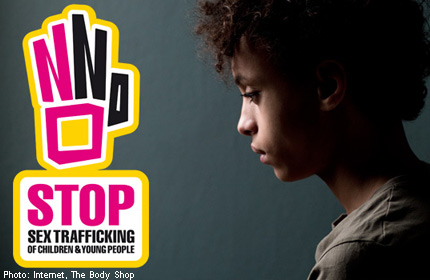
A TOTAL of 114,886 signatures have been collected here for a petition by The Body Shop's international Stop Sex Trafficking Of Children And Young People movement.

The signatures will be presented to the United Nations (UN) Human Rights Council in Geneva on Sept 29, together with other signatures collected from over 65 countries, said Ms Josephine Chow, general manager of The Body Shop Singapore, during an event at The Arts House yesterday.

Held to celebrate the successful collection of signatures here, the event was attended by Body Shop staff members, campaign partners and other guests.

The movement is organised in partnership with the End Child Prostitution, Child Pornography and the Trafficking of Children for Sexual Purposes International, the National Committee for UN Women and the Humanitarian Organisation for Migration Economics (Home).

While only five sex-trafficking cases were reported in Singapore last year, Home president Bridget Tan pointed out that the actual figure could be much higher.

"Women who are exploited do not want to report their cases. They see no benefit in doing so and they just want to forget about the nightmare," she said.

Ms Pia Bruce, executive director of UN Women here, added there should be more comprehensive laws against trafficking.

Globally, The Body Shop has amassed close to seven million signatures for the movement.


Source: ASIAONE
Enhanced by Zemanta

Friday, August 19, 2011

UN Urges Asia to Enforce Human Trafficking Laws | News | Khmer-English

Friday, 19 August 2011

UN Urges Asia to Enforce Human Trafficking Laws


Photo: AP

Cambodia remains a Tier 2 country, putting it in a category above China, which is on a “watch list,” and Burma, which is a major source of trafficking. Other Tier 2 countries in Asia include Indonesia, Laos and Singapore.

"If one looks at Laos and Cambodia, the question is also about the capacity of the government to develop and implement their legislation."

Senior United Nations officials say countries of the Greater Mekong Sub-region including Thailand, Cambodia and Laos are failing to apply existing laws aimed at combating human trafficking. The conclusions come as a U.N. envoy on human trafficking concluded a 10-day assessment of Thailand's efforts to curb labor migration abuses.

The U.N.'s Special Rapporteur on Human Trafficking, Joy Ezeilo, says countries need to adopt a comprehensive approach to combat trafficking and implement laws that are already on the books.

Some progress made

Ezeilo said in Thailand, authorities have made 'significant progress' but officials are still not doing enough to protect irregular migrants and overcome corruption.

"We need a comprehensive approach to combating human trafficking. I think implementation is actually where the challenge is, because you may have very good laws, very good national plans - and actually done a lot in the sense of rehabilitative measures to assist trafficked persons, but then with the gap to the application of the law - it should [be] comprehensive in prosecution, punishment of traffickers," she said.

After assessing Thailand's efforts to curb abuses, Ezeilo said the country remains a source, transit and destination country for trafficking.

The report said Thais are trafficked to China, Taiwan, Hong Kong, Germany, Israel, Japan, South Africa and the United States. Thailand also is a receiver nation from Cambodia, Burma, Laos and Vietnam.

Children targeted

Ezeilo said within Thailand, internal trafficking of children is also rampant, including children of hill tribe communities.

The trafficking fuels child prostitution, pornography and sex tourism. Other traffickers target workers for domestic help, begging, forced marriage and surrogacy. The report said the practice is growing in the agricultural, construction and fisheries industries.

Human trafficking is estimated to be worth millions of dollars to criminal gangs across the region.

The U.N.'s International Labor Organization (ILO) has backed efforts to implement programs to protect migrant workers from Cambodia, China, Laos, Malaysia, Thailand and Vietnam.

But Nilim Baruah, a chief technical advisor with the ILO office in Bangkok, says despite the effort countries in the region, including Cambodia and Laos, have failed to apply their own laws to better regulate labor migration.

"Management and governance of migration continues to be a major area of concern for government in the Mekong Sub Region," said Baruah. "If one looks at Laos and Cambodia, the question is also about the capacity of the government to develop and implement their legislation. In terms of Laos and Cambodia there is a need for capacity building and training from the part of the government themselves."

Comprehensive approach

Martin Reeve, a regional advisor to the U.N.'s Office on Drugs and Crime (UNODC) agrees a comprehensive approach is needed to curb human trafficking beyond law enforcement and include other sectors of the community, including business.

"Certainly law enforcement can't do it on its own, neither can government policy, neither can civil society," said Reeve. "So really you do need a multilateral approach to this - the business community. The business community can look at its own practices and to make sure that it's not involving exploitative labor at any point during the supply process - and that's a key thing."

Thailand implemented a process of documentation and registration of over one million migrant workers over the past years, mostly from Burma as well as Cambodia and Laos. The latest campaign to register the workers, largely from the fishing industry, ended this month. A full report by the U.N. Special Rapporteur, Ezeilo, is expected to be presented to the U.N. in mid-2012.

Source: VOANEWS

Enhanced by Zemanta

Tuesday, August 9, 2011

UN Rapporteur's mission will uncover uncomfortable truths of modern-day slave trade too long ignored

by The Nation
Published on August 9, 2011

The UN Rapporteur on trafficking in persons, especially women and children, Joy Ngozi Ezeilo, arrived this weekend for a two-week visit to Thailand. One can be certain that she will be looking into some very serious allegations in a wide range of industries and places, from fisheries to the brothels in towns along the border.

For as long as the fisheries industry has existed, stories of murders and outrageous abuse on the fishing boats have been commonplace.

But the problem is not just limited to crew members living in a nightmarish world out on the high seas; it has a lot to do with the folks on land as well - from the trawler owners who permit the violations to go on, to the human traffickers who provide cheap labour from neighbouring countries, namely Cambodia and Burma, in what has essentially become a modern-day slave trade.

Reports about the treatment, disappearances and murder of these fishermen never cease. Judging from various accounts, one can safely assume that a wide range of people in this trade have blood on their hands.

It is amazing that no Thai government has properly acknowledged the problems in this sector, or attempted to investigate these alleged abuses.

Does this reflect the extent of a criminal activity that operates like a powerful mafia, or it is just because our governments and society are indifferent to the plight of the foreign (Burmese and Cambodian) workers? What kind of society are we becoming (or have we already become) that we are able to turn a blind eye to such activities?

If not for humanitarian reasons, at the very least, we should acknowledge that it is the cheap labour of these foreign workers on the high seas and on factory assembly lines that helps sustain our robust economy.

The fishing industry is not alone when it comes to human trafficking, however. Border towns like Dan Nok in Songkhla, or Mae Sot in Tak, for example, are dotted with "love motels" and brothels full of sex workers from abroad. Many are said to have arrived either against their will or having been lured into the trade.

In addition to illegal workers, there are also a significant number of documented workers in Thailand whose living conditions should not overlooked.

These workers are not asking for our sympathy. All they ask is a little fairness. Considering the benefits that we received from their contributions, that is the least we should give them.

The quality of our society reflects the extent of our justice - our sense of fair play and our notion of compassion. If we can't understand that we must extend these principles and virtues to our foreign workers, regardless of their race and nationality, then we are doomed as a society.

There is a real chance that the spotlight shone by the UN Rapporteur will reveal a number of uncomfortable truths.

Don't be surprised if she concludes during her visit that Thailand has made very little real progress in countering human trafficking.

What has been going on within our borders can be easily equated to modern-day slavery. Some may complain of foreign meddling in our sovereign affairs, but let's not forget that Thailand is a signatory to a number of international conventions that may not be legally binding but do ask that we investigate these allegations.

There are also diplomatic implications. The US, for example, is required by its laws to reduce the level of cooperation with countries deemed to be dragging their feet in the fight against human trafficking. If Thailand's trafficking rating falls to Tier 3, one can be certain of serious economic repercussions.

In the final analysis, there is a role for everybody to play in the push to end trafficking. The media and civil society can employ blame-and-shame tactics, but unless the private sector, foreign consumers and the international community take up the cause and cease dealing with factories known for abusing workers, the fight against human trafficking and slavery will continue to be an uphill battle.

Source: nationmultimedia.com
Enhanced by Zemanta

Thursday, August 4, 2011

Stephenie Foster: The Whistleblower: A Compelling Film About Standing Up for What's Right

Stephenie Foster

8/2/11 10:30 PM ET

Human trafficking is horrifying and complex: it includes forced labor, sex trafficking, bonded labor, involuntary domestic servitude, forced child labor, child soldiers, and child sex trafficking. It is a crime and a violation of human rights.

In most of the movies and television shows about human trafficking, the villains are disturbed, shady people out to make a quick buck buying and selling women and girls and/or belong to organized criminal enterprises. They don't seem like people we'd know. Of course, movies and television are often informed by a true story but simplify reality and often sensationalize it.

But the movie, The Whistleblower, which will be opening on Friday, August 5 does neither. It is based on a true story about sex trafficking but doesn't over-simplify or sensationalize what happened. In this story, while the traffickers are sinister people out to make money, they could be someone we know. Frighteningly, in this story, many of them work for international and national governmental entities and private contractors working for governments.

In the movie, Rachel Weisz plays Kathy, a Nebraska police officer who goes to Bosnia as a peacekeeper after the war has ended. Well, at least after combat has ended. The impact of the war still goes on for the young women who are trafficked into Bosnia because of the international presence, and sometimes by international soldiers, contractors and peacekeepers.

The movie, and the situation that inspired it, is tough and has no real happy ending. While Kathy gets the information to the media about various cases, she is fired by the contractor she worked for, one of the young women dies a brutal death and the trafficking continues. It's a compelling and maddening story, and reflects the complexity of how international institutions function and interact and the difficulty of accountability in a situation where people have immunity for their actions. But, it's also a story of gutsy people in tough and compromising situations making decisions that aren't in their personal best interest.

I applaud the movie, Kathy and others like her, but relying on individuals to do the right thing won't stem this problem very quickly or in the long-term. We need to continue to strengthen the international and national institutions that can fight trafficking and demand that they do everything possible to protect women and prosecute traffickers.

There are two tracks to follow in this regard. First, the UN Security Council has passed a set of four resolutions that commit every country to address multiple issues about women and war. These range from addressing peacekeeper actions such as set forth in the movie, and also including women as peace negotiators and developing mechanisms to punish those who use rape as a weapon of war. The UN has also adopted a zero tolerance policy toward sexual abuse by peacekeepers. These are needed steps forward, and as global citizens we all need to watch what our governments are doing to hold international institutions and themselves accountable.

Second, last month, the U.S. State Department released its annual Trafficking in Persons (TIP) report. It's a weighty document (literally), which sets out the progress, and lack thereof, that countries across the globe have made in combatting human trafficking. The 412 pages are sobering, and give you a sense of how pervasive these problems are across the globe. This is a place where we can track what countries are doing and not doing, including our own, and see how we can push them forward to make a difference.

Trafficking can happen anywhere, including the U.S. The TIP Report reviewed 184 countries, including the U.S., and contains detailed narratives about each country situation and responses to trafficking. The report evaluates how well governments are doing on the "three Ps": prevention, prosecution and protection of the maximum number of victims. Based on these three criteria, countries are placed in one of the following tiers: Tier 1, Tier 2, Tier 2 Watch List, and Tier 3. We're a tier 1 country, which doesn't mean there is not trafficking here, but that our government "has acknowledged the existence of human trafficking, has made efforts to address the problem, and meets the [law's] minimum standards."

There is a lot of work to do -- and it will take time -- but as we learned in The Whistleblower, the victims and survivors deserve our help and the help of institutions that were designed to protect them.

Follow Stephenie Foster on Twitter: www.twitter.com/StephenieFoster

Source: huffingtonpost.com
Enhanced by Zemanta