"But a key finding was the role of fathers with researchers discovering traffickers were convincing fathers to give away their daughters by promising to arrange a marriage without the need to pay a dowry to the boy's family or a job in a city."
Read MORE
Fathers in rural India to be targeted to help stop sex trade...:
(Reporting by Roli Srivastava; Editing by Belinda Goldsmith; Please credit Thomson Reuters Foundation, the charitable arm of Thomson Reuters, that covers humanitarian news, women's rights, trafficking and climate change. Visit news.trust.org)
Showing posts with label West Bengal. Show all posts
Showing posts with label West Bengal. Show all posts
Friday, December 23, 2016


Saturday, December 8, 2012
International Development - Fighting human trafficking: 5 lessons from the field
http://www.devex.com/en/news/fighting-human-trafficking-5-lessons-from-the/79899?source=ArticleHomepage_MostPopularNews_4&goback=%2Egde_4165508_member_193690185
Source: DEVEX,COM
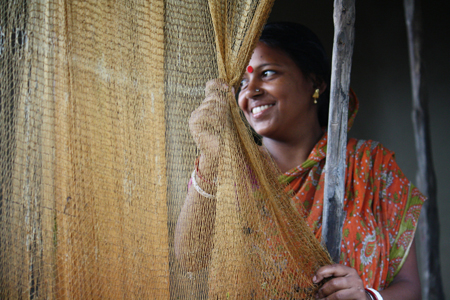
A woman from a fishing village in West Bengal in India. Her village is known for high levels
of trafficking of women and girls. Photo by: Anindit Roy-Chowdhury / UN Women / CC BY-NC-ND
By Carol Michaels O'Laughlin on 05 December 2012

Source: DEVEX,COM
A woman from a fishing village in West Bengal in India. Her village is known for high levels
of trafficking of women and girls. Photo by: Anindit Roy-Chowdhury / UN Women / CC BY-NC-ND
By Carol Michaels O'Laughlin on 05 December 2012
In the coming days, an important worldwide campaign against gender-based violence will come to an end. These “16 Days Against Gender Violence” began on Nov. 25, the International Day for the Elimination of Violence Against Women, and they will end Dec. 10 on Human Rights Day.
This campaign comes two months after U.S. President Barack Obama, in an address to Clinton Global Initiative, outlined new measures to tackle modern slavery in the United States and abroad. He called on the international community to step up efforts in assisting an estimated 20 million victims trafficked worldwide.
The attention to the issue and the new steps to eradicate human trafficking are timely and critical, as is the discussion on the lessons already learned about addressing the problem.
Trafficking in persons is a global phenomenon that is an affront to basic human rights across countries and cultures. Many forms of inequality are woven into what creates an enabling environment for trafficking, including income disparities, ethnicity, age, sexual orientation, and gender discrimination. Men, women and children are trafficked for forced labor, sexual exploitation, their organs, and petty crimes.
As a result, they suffer profound trauma that spreads to their families and communities. The situation of women and girls is often worsened by prevalent gender stereotypes and discrimination that makes them more vulnerable and prevents effective recovery.
For the past two decades, public and private organizations around the world have been fighting human trafficking. Their work has yielded important results and lessons for consideration by the international community.
1. Message mishaps
Some messages used around the world to counter human trafficking have failed to lower women’s vulnerabilities and may have worsened their situations. In Asia and Europe, past campaigns scared, rather than informed, women of the risks of trafficking. Posters that depicted traffickers kidnapping and beating women, and messages such as “Let’s protect our women” and “Do not trust anyone offering a job to a woman – he is a trafficker,” perpetuated the stereotype that women cannot migrate safely or find legitimate work, which results in higher seclusion of women looking for a way out.
Conversely, the following messages have shown to be effective in reducing stigma and engaging communities in dialogue and joint action: “Safe migration can lead you to a better future; check all the necessary papers yourself,” “What do you understand of the suffering of a survivor of human trafficking?” and “People who have survived trafficking are now fighting against it; are you with them?”
2. Focus on livelihoods
Economic instability is an important root cause of trafficking and many anti-trafficking initiatives have failed to address it, partly due to limited resources. Experience has shown that prevention or reintegration is not complete until a survivor or at-risk woman is economically self-sufficient. Skills training, educational support and business start-up assistance have empowered women to restore their self-confidence and pave the way to a better future for themselves and their families.
3. Alternatives to full-time shelters
Security and full-time care are critical for survivors’ recovery, but severe restrictions on the freedom of shelter residents can lead to increased feelings of isolation and despair. Various organizations have taken steps to offer different models of care suited to the circumstances of individual survivors, including drop-in centers offering psycho-social support, job skills training and legal aid. Transit centers, where survivors can stay for a few days, are currently being piloted in Asia to reduce dependence on home shelters and promote reintegration of survivors in communities of their choice.
4. Importance of family counseling
While reintegration standards have been improving over the past decades, one important aspect often remains unaddressed. It is common for families in certain regions to be complicit in the exploitation of their children. Despite this reality, it is not uncommon to see trafficking survivors being returned to the same vulnerable situation that led them to being trafficked in the first place – in many cases to an even more unstable situation, since family culpability and community rejection can be high for a survivor of trafficking. Initiatives to integrate family and community counseling into survivor case management are necessary to ensure that survivors return to supportive environments.
5. Qualified personnel
Another persistent challenge in assisting trafficking survivors in developing countries is the low qualification and competency of psychologists and social workers who frequently harbor biases against the women and girls in their care. In some cases, social workers have urged women to forget their experience and hide their past, leaving victims with unresolved feelings of shame and the fear that their past might be uncovered. Some organizations in South Asia have proposed marriage as a strategy for reintegration and spread the idea that to marry a victim of trafficking is an act of piety, condemning these women to live with men who do not respect them. Recognition of the problem and intensive training with all staff who work with survivors is needed to develop a decent, respectful and needs-based support system.
During these 16 Days Against Gender Violence, we thank the thousands of volunteers and professionals who are empowering communities to respect and protect the rights of every citizen and who are making a difference for generations to come.
This article is based on the paper Addressing inter-linkages between gender-based violence & trafficking in persons to prevent reinforcement of inequalities, published as part of Global Thematic Consultation on Addressing Inequalities.


Monday, July 30, 2012
India: Bringing the curtain down on human trafficking
http://www.ungift.org/knowledgehub/en/stories/july2012/india_-bringing-the-curtain-down-on-human-trafficking.html
Souce: UNGIFT


Souce: UNGIFT
(UNODC) - A young boy pretends to fall in love with a school girl. He tells her that he will marry her and asks her to run away with him. The girl, madly in love does what is asked of her. The boy takes her to a nearby village and sells her.Meenu is trafficked at the age of five. She is forced to sleep with up to 20 men a day and by the age of twelve she is pregnant. She is ill treated by her clients and after years of exploitation, she is now in a state of psychotic depression.
These are stories from villages in West Bengal where numerous girls are trafficked daily. According to a news report 1, in the last one year 14,000 adults and children have disappeared from West Bengal - most of them believed to have been swallowed up by the human trafficking trade.
UNODC met with Ms Suravi Sarkar, Project Coordinator, Banglanatak.com. Ms Sarkar uses theatre as an instrument to spread awareness on important issues relating to rights and entitlement, health, safety and environment. In an interview, she shares her experiences on human trafficking while working with vulnerable communities around the Indo-Bangladesh border.
1. How does Banglanatak.com use theatre to educate communities?
We believe that theatre is a powerful tool. We use theatre based activities to sensitize all stakeholders including community workers, anganwadi workers (child care workers), panchayati raj institutions (village council) etc. Unemployment, poverty and lack of awareness make communities vulnerable to trafficking. We begin by identifying a vulnerable community and perform a base line study on the problems, myths and misconceptions in the community. Based on this study we produce a play that highlights the problem and suggests ways out of it. We also lead the audience to helpline numbers and other resources that can help them through these problems.The play features an ignorant person who is caught in the problem and an informed hero who brings about change. We try and keep the number of characters to a minimum and within a span of 15-20 minutes the message is conveyed clearly to the audience.After the play, we organize a quiz to assess how the community has grasped the message of the play. Those who give correct answers are given prizes.We then select a small group of enthusiastic members of the village and organize a discussion. The group discusses the issue in depth and tries to build a support system in the village.
2. What makes communities vulnerable to human trafficking?
There is a common misconception that only economically backward communities are vulnerable to human trafficking, but that is not the case. Everyone is vulnerable. The need and desire for a better life makes one vulnerable to human trafficking. Numerous uneducated and unaware people become ease prey for traffickers.
Apart from ignorance and illiteracy, I feel that there are two more reasons that make certain communities vulnerable to human trafficking. Firstly, many villages are poorly connected to the outside world. They hardly have motorable roads and phone lines are few and far between. Therefore, once they realize that their daughter has been trafficked, they don't know whom to turn to for help. The local Panchayats are not equipped to offer help and the local police station can be up to 30 km away. The family is unable to find help and support and thus resigns itself to the circumstances.
Secondly, village life has very little to offer by way of entertainment and education. Young girls feel restricted by strict social norms in the village. In order to escape they get involved with men, who in many cases turn out to be traffickers.
A mapping of villages in West Bengal was conducted and a few communities have been identified as vulnerable to human trafficking. For example: We identified vulnerable blocks in four districts in West Bengal, two in Jharkhand and two in Bihar. Blocks in Malda, Nadia, Murshidabad, North and South 24 Parganas have been identified as source points and sometimes transit points for victims coming from Bangladesh.
3. What is the role of the family in putting a stop to human trafficking?
In my experience there have been very few cases where girls were taken by force or abducted by traffickers. In the first stage of trafficking, the family is always involved - they either introduce them to the traffickers or openly sell their daughters to 'agents'. Therefore, families need to be sensitized and made aware of what their child goes through once she is sold to a trafficker.
Families also play a huge role in a victim's life during rehabilitation. In many cases, families don't accept the girl back and treat her like an outcast. Even if some families accept the victim back, the larger community boycotts the family. The family then finds it difficult to live in the village.
I feel that at present rehabilitation and re-integration of the victim into society is very difficult and it is only possible if the family and community step up and offer support.
Banglanatak.com is a social enterprise that uses theatre to educate people on social issues and promotes community led action. Their campaigns have covered more than 100,000 villages across 23 states of India.
Friday, February 11, 2011
Human trafficking racket with tentacles in your house - The Times of India
NEW DELHI: An exemplary act of courage by a 20-year-old woman, a resident of Jharkhand, has helped Delhi Police to bust one of the most organized human trafficking rackets operating in the capital.
Even as four men were arrested, cops claimed in the past two years at least 45 girls from Orissa, Bihar, Jharkhand, West Bengal and Assam were brought to the capital after being sold in their home states for as little as Rs 15,000-20,000. They were promised "respectable jobs" as maid servants and customer care executives, only to be resold in the city at double the price the agent paid their relatives.
The Union ministry of home affairs has now asked all states and union territories, especially Delhi, to form an antihuman trafficking unit to curb such activities. "We have asked the ACP of each of the district investigating units (DIUs) to lead the unit in their respective district. The crime branch will act as the nodal agency to curb trafficking in the capital,'' said a senior crime branch officer.
"During investigation, it was revealed the accused used to exploit these poor and undernourished girls. Some were sexually abused by these traffickers before being placed in residences of businessmen and traders. The girls were told to hand over most of their income to the accused and even steal on their behalf,'' said H G S Dhaliwal, DCP (south).
He, however, clarified that so far no one was known to have been "sold off" to brothels or forced into sex trade. "The physical abuse of these girls was confined to these traffickers,'' added Dhaliwal.
The accused have been identified as Saleem (32), Sumeer (38) and Sanjit (28), all residents of Simdega district of Jharkhand, while the fourth accused Pinku is a resident of Ranchi. The main accused, Jai Ram, who visits several districts across the five states and speaks in the local dialect, has been identified as the brain behind the gang. He is absconding. "So far, we have been able to rescue just two girls. Once we get Jai Ram, we hope to rescue more women,'' said the DCP. Sources claim over 100 such women are expected to be present in the city.
The chain of events dates back to February 2, when a PCR call was received at Police Station Defence Colony stating that some people are trying to abduct a woman in a Maruti van. "The local police immediately rushed to the spot and found a 20-year-old woman, a resident of Kuru, Jharkhand in a distressed condition.
"On enquiry, she said that one Jai Ram, who is a resident of her neighbouring village Chandva, had come to her parents and informed them that her elder sister whom the same person had brought to Delhi to work as domestic help was not keeping well. He requested her parents to send their younger daughter to Delhi to look after her ailing sister. On reaching Delhi, Jai Ram had sold her to three persons namely, Rajkumar, Saleem and Pinku, for a paltry sum of Rs 10,000 as she is physically challenged,'' said Dhaliwal. On February 2, she escaped by jumping out of a moving Maruti van.
Source: The Times of India
Human trafficking racket with tentacles in your house - The Times of India

Monday, December 20, 2010
Catholic Church Fights Child Labor on Indian Tea Plantations | End Human Trafficking | Change.org
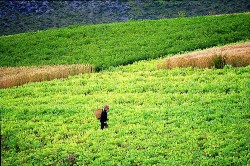 Child labor is common in the tea plantations of West Bengal, where children are kept out of school and forced to work long hours harvesting tea in often treacherous conditions.
Many of these children come from the Dalit caste, and their families may have been indentured servants in the tea industry for generations. But the Catholic Church in India has launched an effort to reduce child labor and indentured servitude in the tea industry. You can help them by supporting Fair Trade certified plantations.
In the tea plantations of West Bengal, a region of India that produces massive quantities of tea for international export, over two thousand children work alongside their families harvesting and processing the crop. These children are prevented from attending school and work long hours, often in hot conditions with little clean water and less-than-adequate sanitation. They earn pennies a day for their work, when they are paid at all.
For many families, life on the tea plantation and the poverty-wages, mistreatment, and indentured servitude that comes with it has existed for generations. But social stigma against their caste makes it difficult for adults to find higher-paying work, so whole families labor with no end in sight.
Fortunately, the Diocese of Jalpaiguri -- part of the Roman Catholic church -- has taken up the cause of child labor in the West Bengal tea industry. They've developed an economic empowerment and educational program specifically for Dalit children working in tea plantations. Social workers have been teaching Dalit families about the importance of education, paying school fees for children, and providing transportation to local schools. Since the program began in 2004, they've moved over 500 children from the tea plantation into school, almost a quarter of the total child laborers in the area.
But despite the effectiveness of the church's programs, child labor remains a significant part of the tea industry.
In part that's due to the oppression of certain groups in India, like the Dalits, who remain in indentured servitude for generations. In part it's because of a complete lack of oversight of working conditions in India, where child labor is technically illegal. And in part it's due to a desire to keep costs down (child labor is cheaper than adult labor) to maximize profit and compete in an international market. The Diocese of Jalpaiguri is only able to solve a third of the problem with education. The other two thirds can be solved by Fair Trade.
Fair Trade certified tea means that no child, forced, or slave labor was used to produce the tea, and that workers were paid a living wage. When consumer demand for Fair Trade tea goes up, more companies will buy Fair Trade certified tea and more plantations will become Fair Trade certified to meet the market demand. For example, Honest Tea recently announced they were going 100% Fair Trade, hugely expanding the demand for Fair Trade tea. Snapple, however, buys 0% of it's tea from Fair Trade certified sources. If they switched just 10% of tea purchases to Fair Trade, they'd make a big difference in the lives of Dalit children in West Bengal.
Tell Snapple it's time to live up to their motto and actually use the best stuff on earth to make their product: Fair Trade certified tea. By signing the petition, you'll help further the existing efforts to reduce child labor in the tea industry for all children.
Related Petition

 Amanda Kloer is a Change.org Editor and has been a full-time abolitionist in several capacities for seven years. Follow her on Twitter @endhumantraffic
 Catholic Church Fights Child Labor on Indian Tea Plantations | End Human Trafficking | Change.org

Wednesday, June 9, 2010
Bangladesh: school children learn and talk about human trafficking
 Image via Wikipedia
The children sit on the floor, books open on laps, and listen to the senior headmaster, who is from Kolkata, India. He dedicates all his time to helping the children to stay in school and complete their education and, most importantly, to talk to them about human trafficking, why it occurs, its cause, who are the potential victims and how to take preventive steps.
The headmaster explains that "there have been several reported cases in this village, where girls as young as 5 years old have been trafficked or sold by families. They become victims of sexual and labour exploitation in West Bengal. Approximately 7,000 girls and women are trafficked from Bangladesh to West Bengal annually. If we are to stop this crime, we have to teach them about human trafficking from the earliest age so that they do not become victims".
Anima is the head girl of the class. Standing tall in front of her classmates, she urges them to recite in chorus a short poem in the local language. The poem centres around the heinous crime of human trafficking and how children are vulnerable but not helpless to act. In addition, Anima explains to the class that "we should refuse to speak to strangers, especially men. If he offers us sweets and lures us with tales of a good life, we should report this to our elders or the police. Traffickers lure children like us. We are sold to brothels, sexually exploited and abused. We are forced to work in houses and factories with no food and no money. This is not what we want. We want to be educated and aware." The room fills up with claps.
"The children are always the best teachers," adds the headmaster. He believes they are in a good position to help spread information on these issues and raise awareness among the whole community. Such initiatives, where life-saving messages are built into the education curriculum, help children grow safely and wisely in a world fraught with danger.
UNODC and Action against Trafficking and Sexual Exploitation of Children India, a network of non-governmental organizations working to prevent human trafficking, support this initiative under the UNODC project on prevention of human trafficking, with contribution from the United States Agency for International Development.
Human trafficking in South Asia is often referred to as one of the fastest growing transnational organized crimes. Over 150,000 people are trafficked in the region every year for sex work, labour, forced marriages and organ trade. Countries in South Asia, including Bangladesh, serve as prominent origin, transit and destination countries for women, children and men being trafficked. In South Asia, the largest numbers of women trafficked are within or from the region, and child trafficking is a major concern. With a rise in demand for domestic help in the cities, families from rural villagers often willingly turn their children over to middlemen who promise a better life in the cities.
In addition to supporting local initiatives by non-governmental organizations, UNODC also provides technical assistance and financial assistance to projects aimed at preventing and prosecuting human trafficking in the region.
Bangladesh: school children learn and talk about human trafficking
![Reblog this post [with Zemanta]](http://img.zemanta.com/reblog_e.png?x-id=554da6c5-f32f-4319-bd85-d86f50ff0b90)
Subscribe to:
Posts (Atom)
